
Ráhel Anna Molnár
The monster commands, ‘Remember me’: restore my fragmented body, piece me back together, allow the past its eternal return. The monster haunts; it does not simply bring past and present together but destroys the boundary that demanded their twinned foreclosure.[1]
The Benaki Museum is an overwhelming place. The Athenian museum complex’s main collection (Benaki Museum of Greek Culture) houses over 3,300 artifacts, encompassing an incomprehensible immensity of historical time and place, spanning from the prehistoric and Hellenic periods to the Byzantine and post-Byzantine eras, all the way to the formation of modern Greece in the early 20th century. Through two floors, you will walk through a flood of stories and an unstoppable chatter of thousands of souls – from Hellenic sculptures and broken faces, torsos, wine jugs, mermaids staring from reliefs, psychedelic Christian altars, jewelry, and gold. Entire rooms of Ottoman Greece; clothes, rugs, relics, a fairy-tale-like canopy bed of a long-dead princess. Figures to fear and figures to admire, displayed in neat, chronological order.
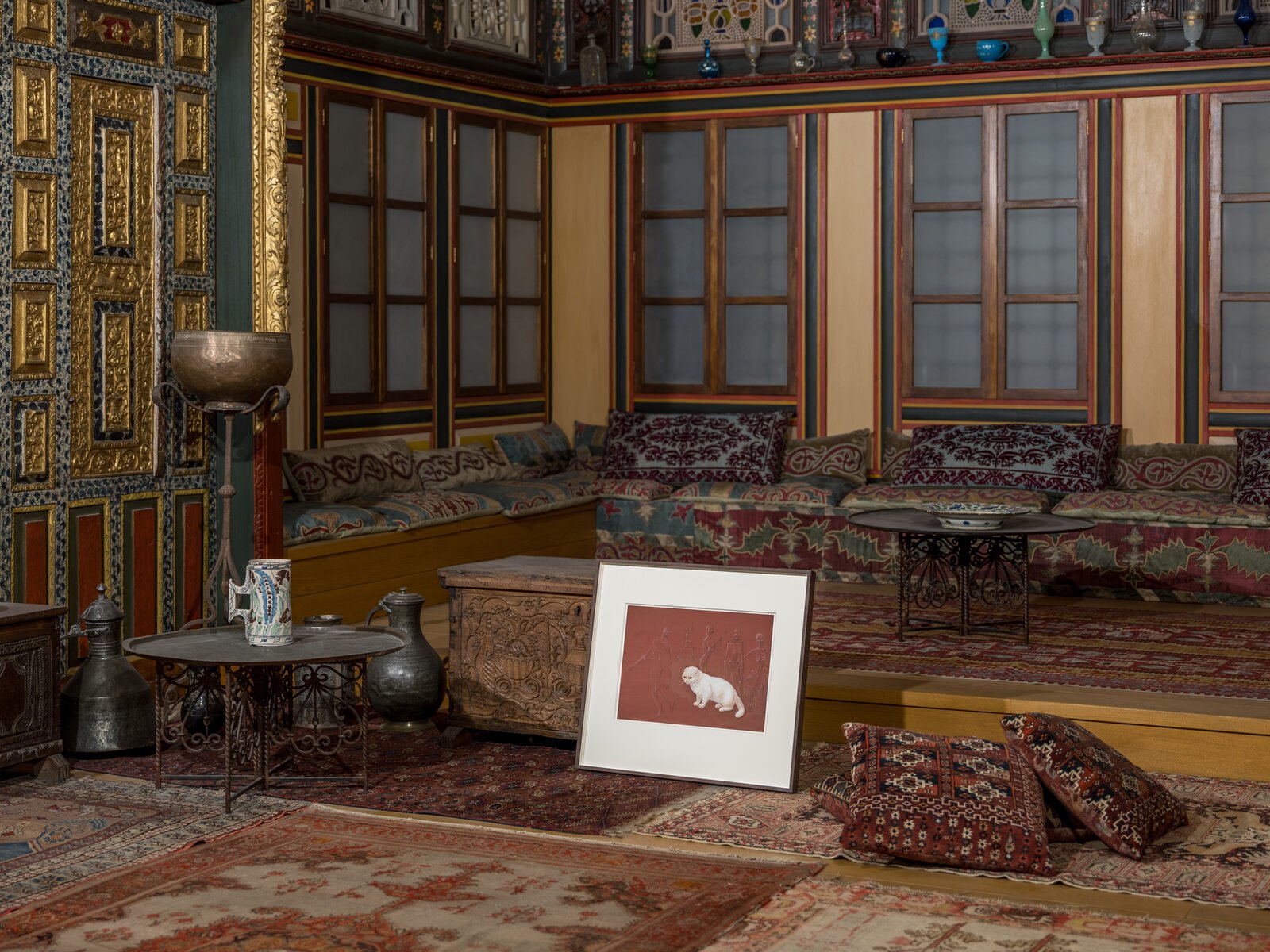
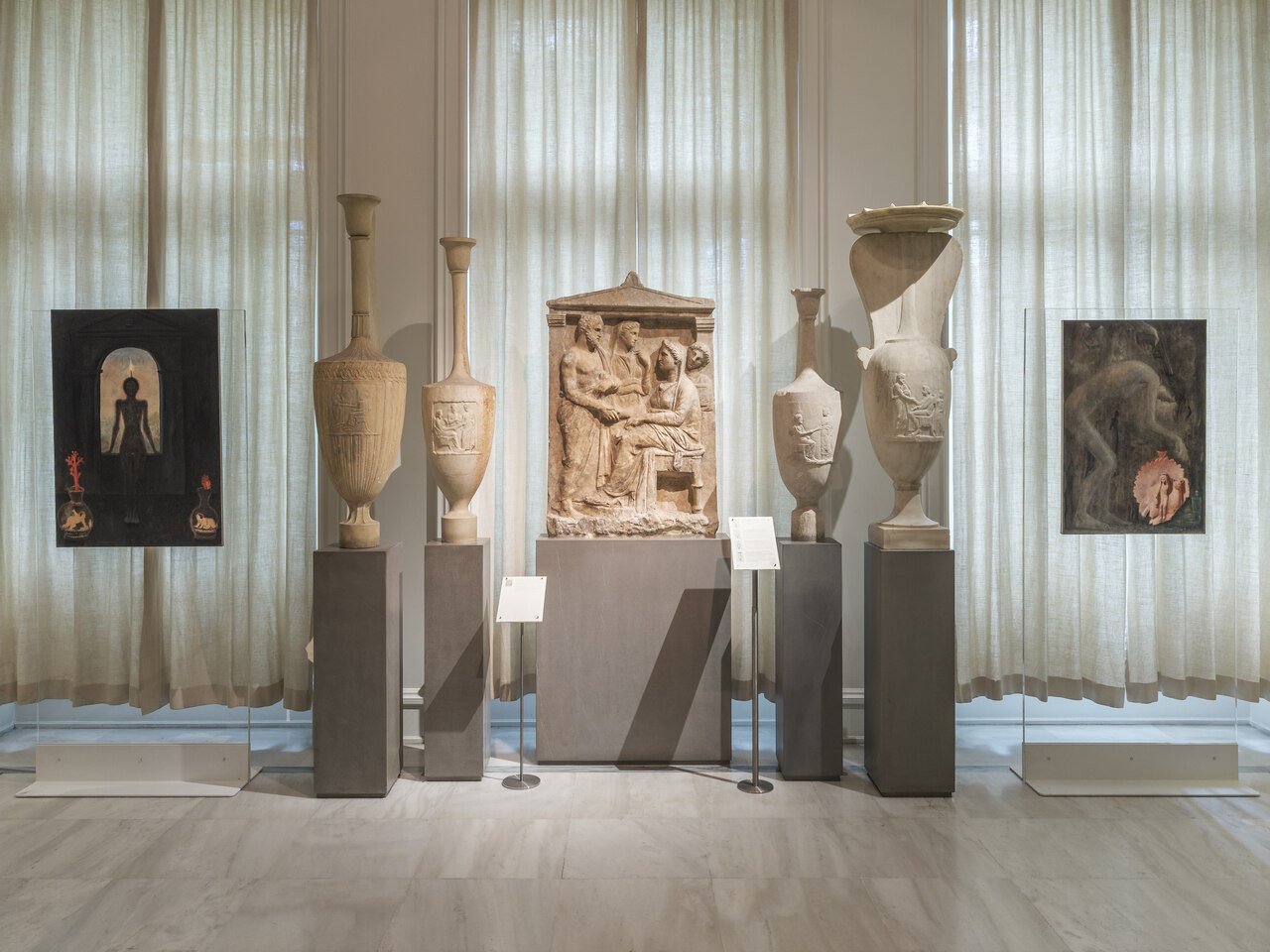
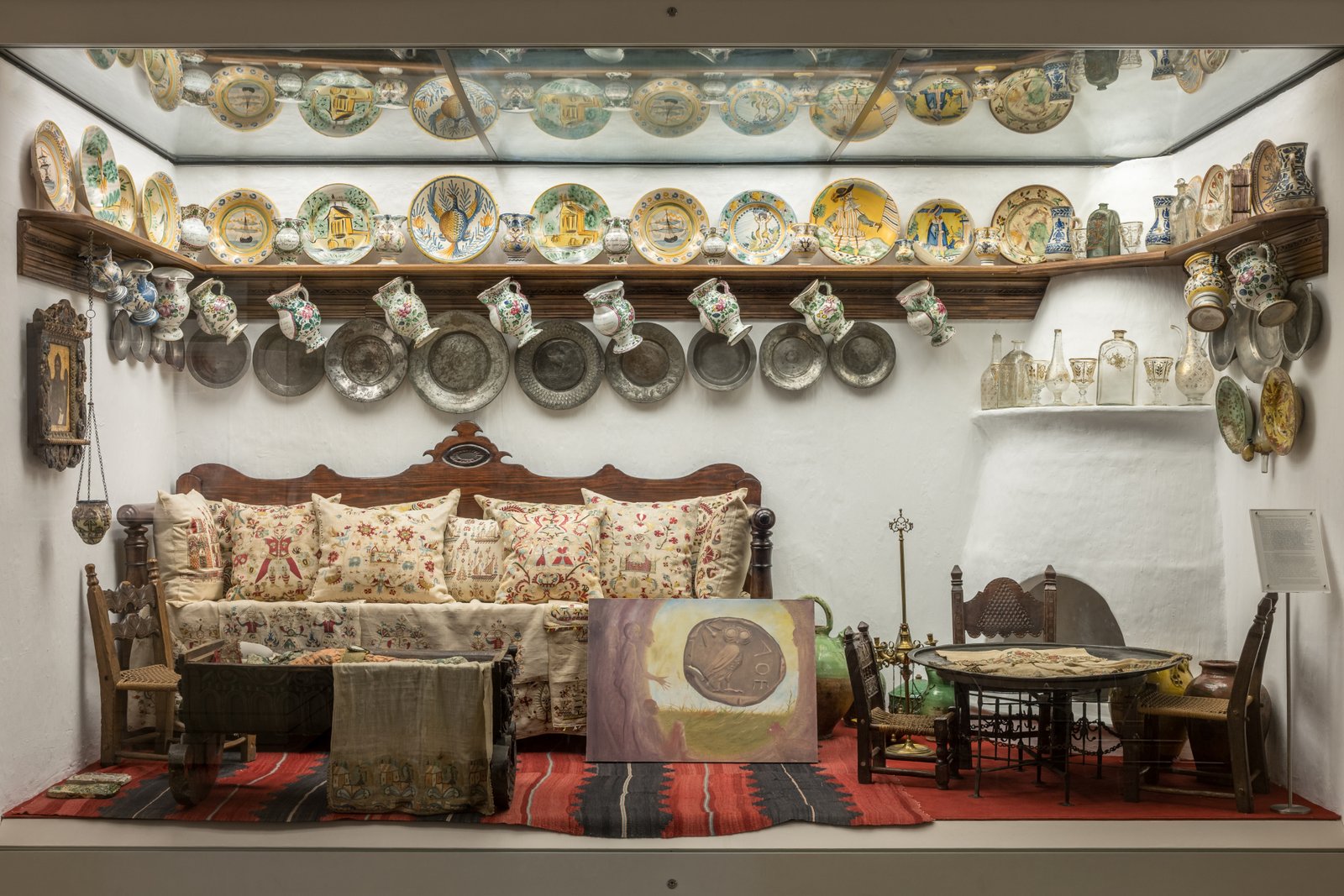
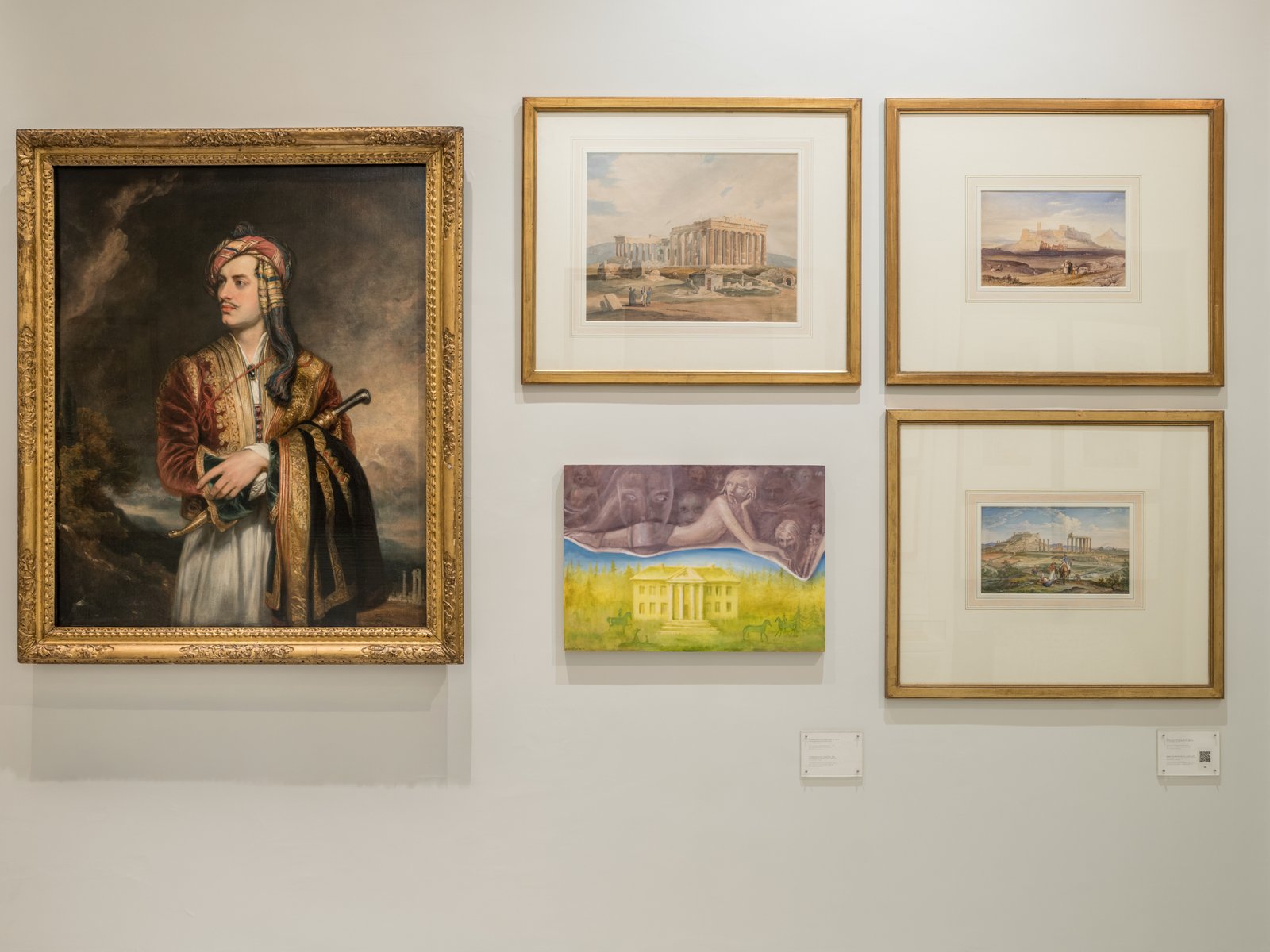
Right now, the museum’s maze is expanding even further through a collaboration with Polish contemporary artist Aleksandra Waliszewska. Irruption of Antiquity, a “transhistorical exhibition,” shows fifteen of her paintings in line with the museum’s collection. Waliszewska’s painterly style is commonly referred to as new gothic. Her world is filled with “fantastical animals” and “nasty children,” abandoned and mischievous, brutal and humiliated, beautiful and frightening, living and dead. Drawing from 19th and 20th-century symbolist tradition, early Renaissance, and charged with tentacular references to folk beliefs and myths, her work captures a myriad of unarming scenes of the same cosmos – sometimes crafted with almost cartoon-like, childish grandeur, sometimes with the precision and opalescence of Pre-Raphaelite imagery. It’s a bestiary without definite ends or predefined references.
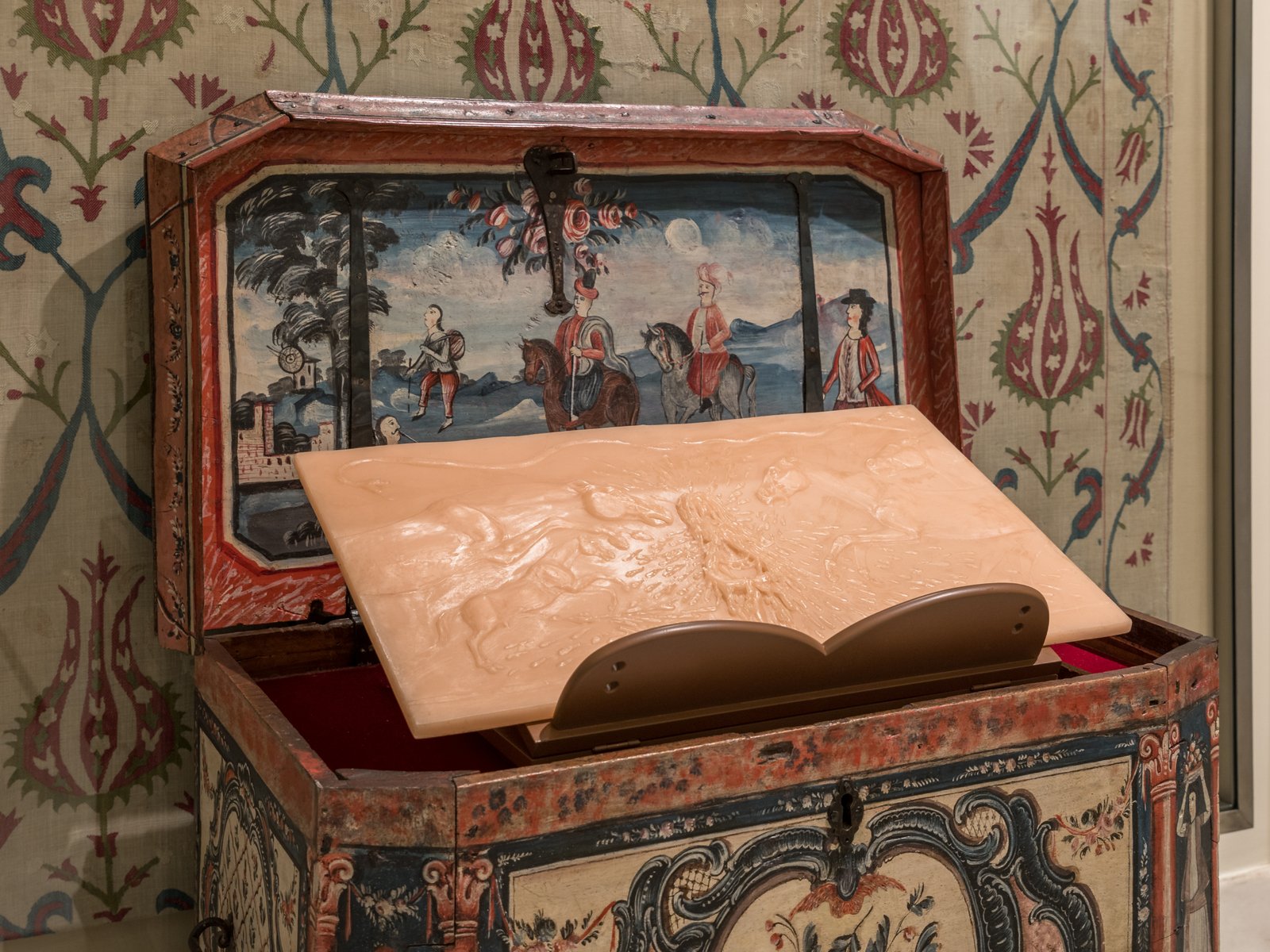
Her archetypical, repeating figures – monstrous and violated women, shapeshifters, vampires, snakes, cats, horses, otherworldly babies and mermaids – appear and dissolve like quick scenes of the same distressing vision. Their natural habitat is a traversable dimension perpetuated by a “proliferation of stories within stories.”[2] Linked within the same spiritual realm and concretely duplicated in the collection of paintings, the cultural-historical artifacts in the permanent exhibition serve not merely as stages for Waliszewska’s works but, together, they open a path toward a sphere of storytelling that is at once imaginary and also very real.
Courtesy of Consonni Radziszewski.
Benaki Museum of Greek Culture, Athens, photo: Giorgos Sfakianakis.
Courtesy of the DESTE Foundation.
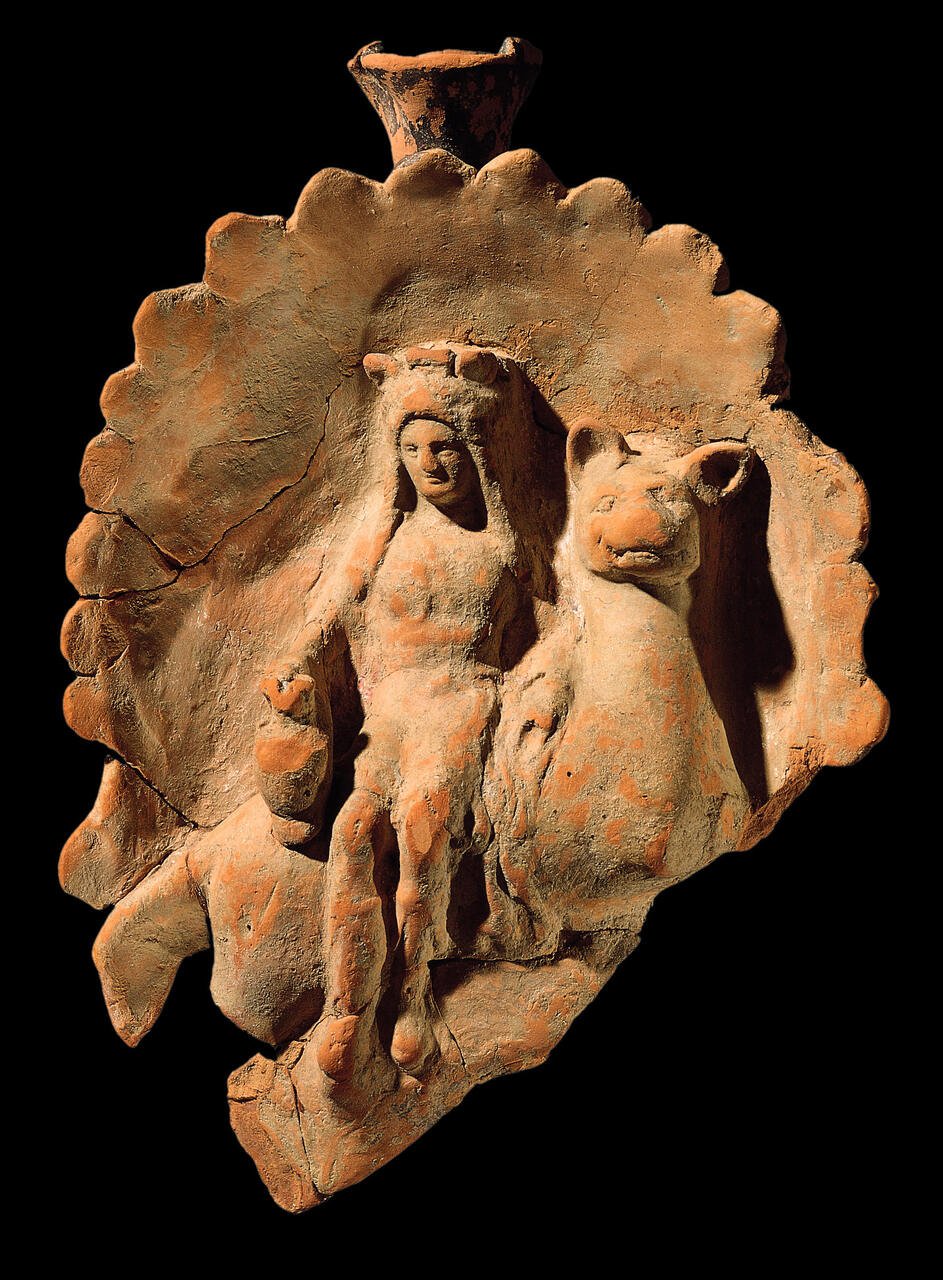
Image courtesy of the Benaki Museum.
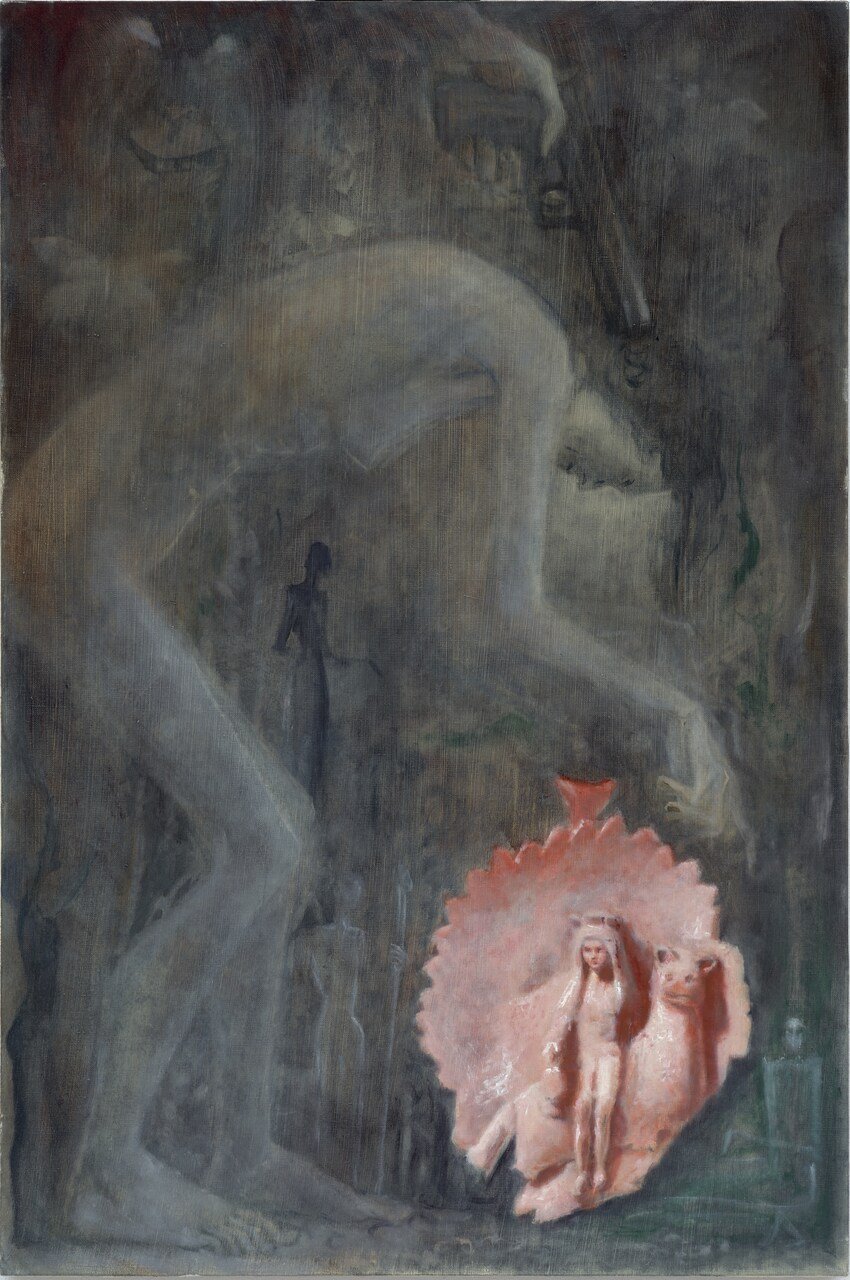
Dionysus is depicted riding a panther on a small terracotta figurine from the 4th century B.C.; its counterpart appears in Waliszewska’s painting with a massive, disembodied hand pressing a gun against the head of a naked female. In another work, a young, naked girl stares out from the canvas with a burning candle on her head. In the foreground, two antique vases depict crawling babies. The same child is crawling there in the exhibition space, on a red-figure lekythos dating from the late 5th century BC. Later, a two-tailed mermaid on a Cycladic relief from the 17th–18th century, and Waliszewska’s bright green mermaid-like creature rest within the ancient installation, stretched out with blood-red spectators behind her. These apparitions continue throughout the exhibition space: a horse from a relic holds purgatory in its mouth, a snake from a gold bracelet emerges on the canvas to suck on a woman’s breast.
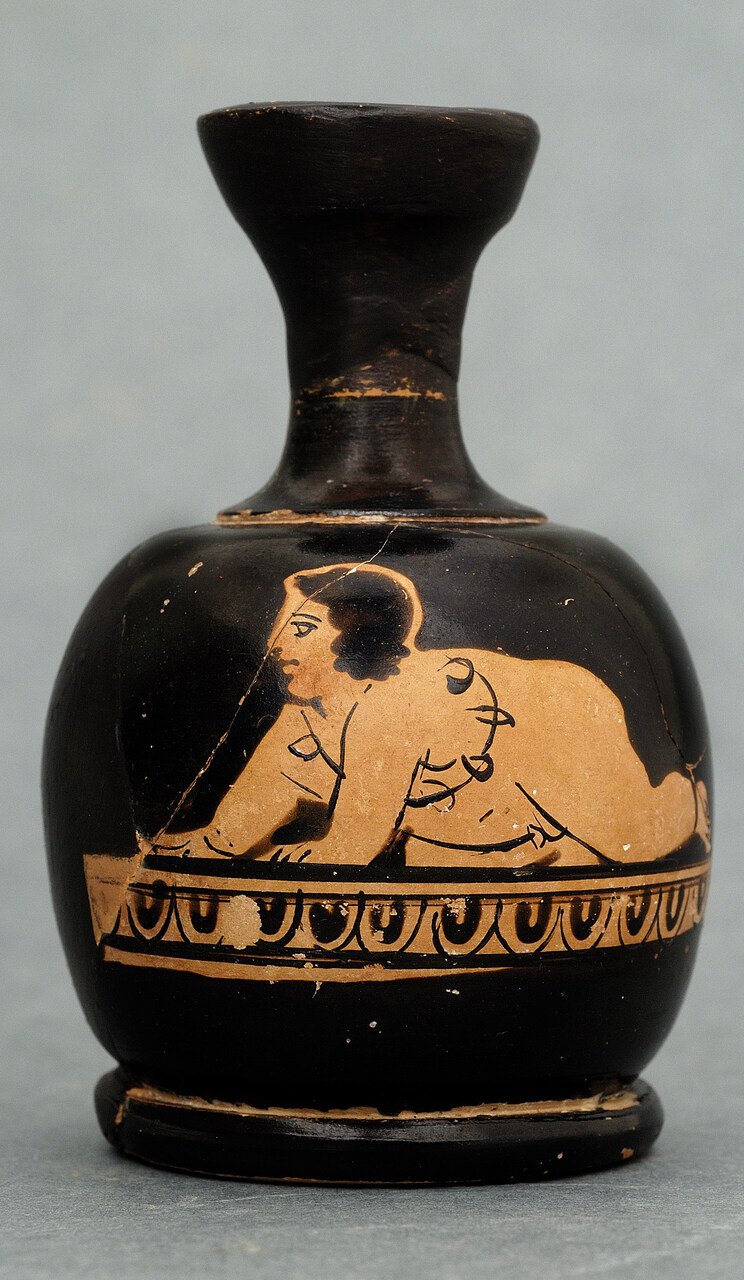
Image courtesy of the Benaki Museum.
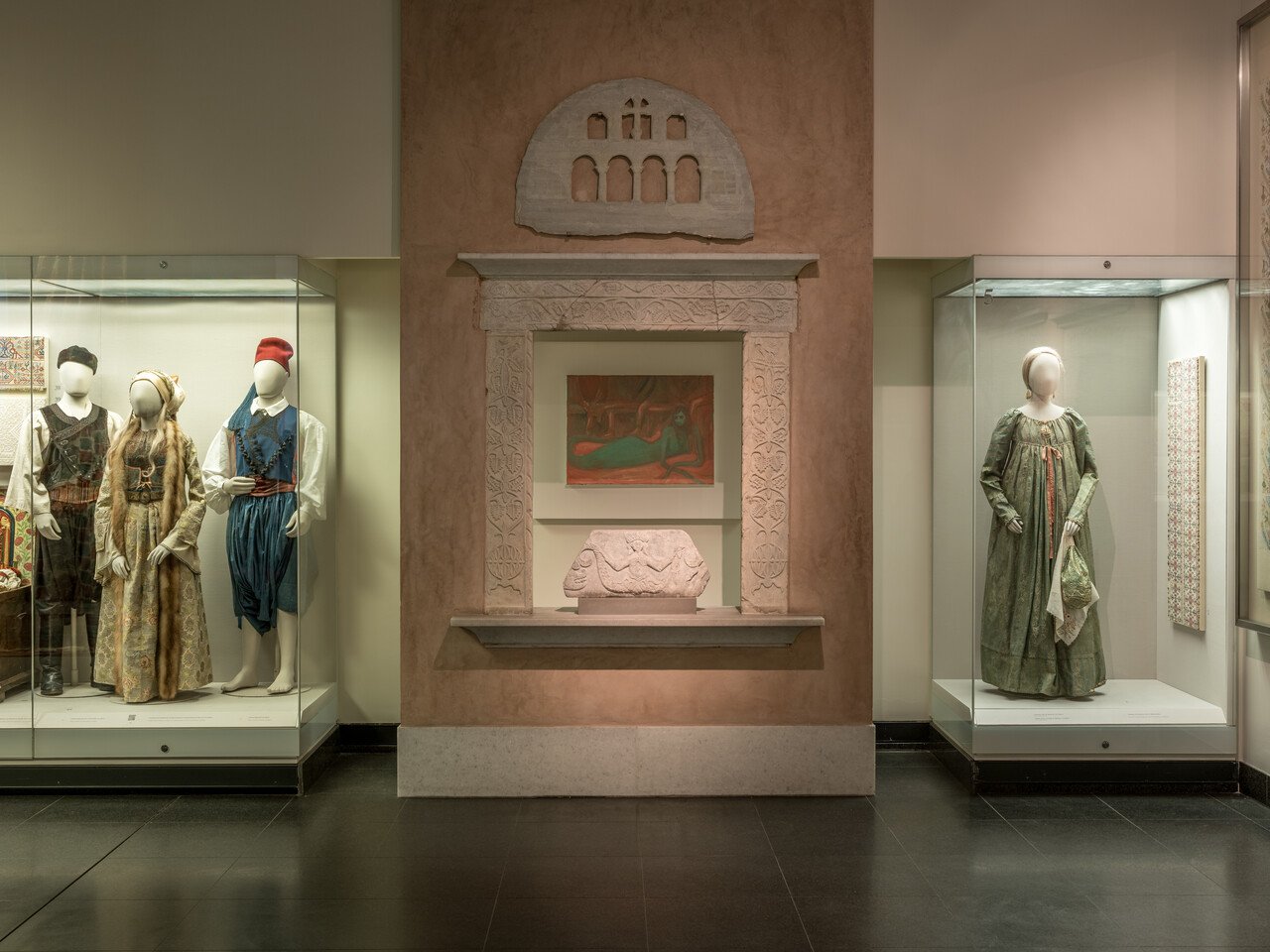
Benaki Museum of Greek Culture, Athens, photo: Giorgos Sfakianakis.
Courtesy of the DESTE Foundation.
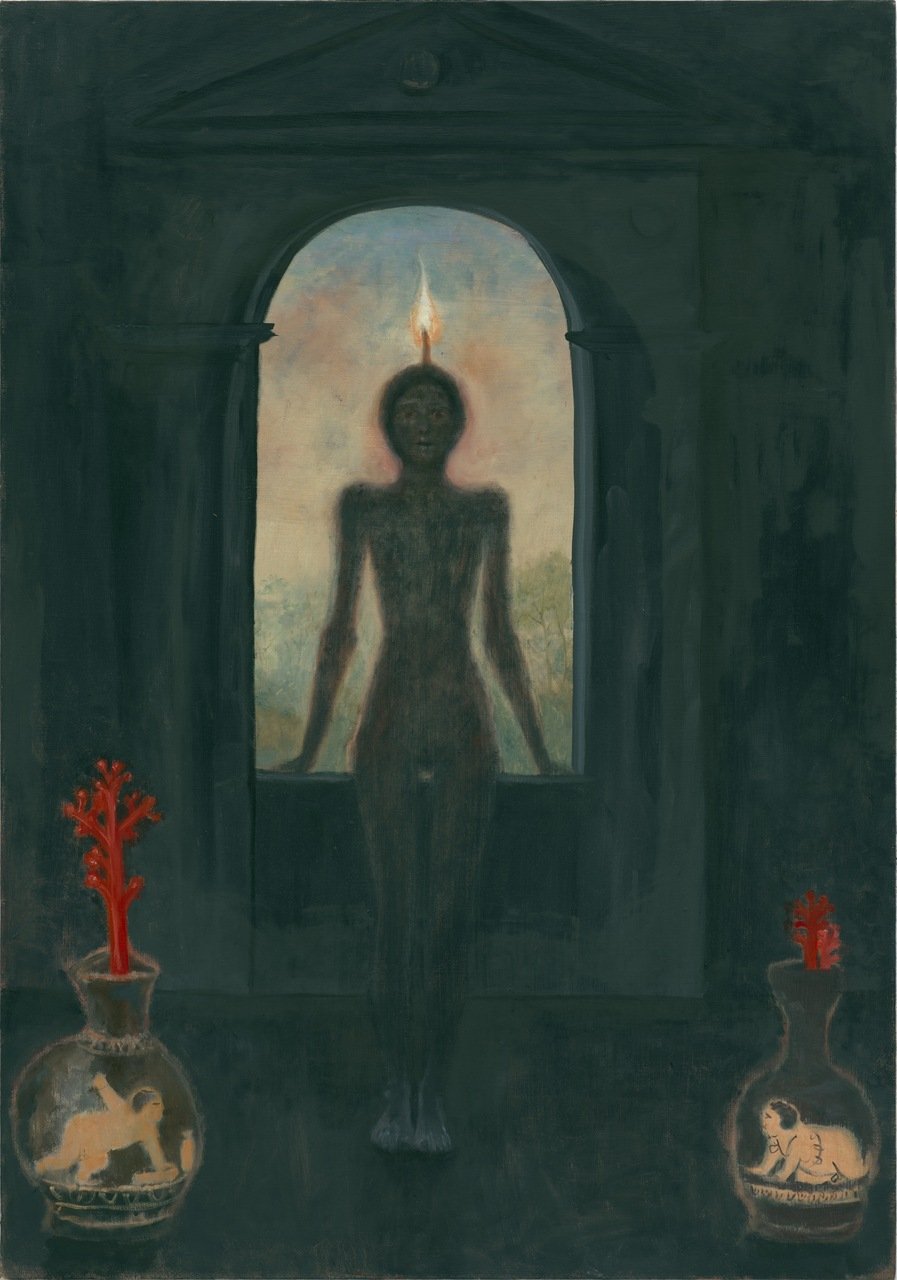
Courtesy of Consonni Radziszewski.
Doubling and repetition open a door to another realm by dismantling the solid physical body around these objects, thus exposing materiality as “only one of the dimensions through which reality reveals itself.”[3] The characters in question occupy their main realm in the imagination. The snake in the bracelet is not the representation of a snake, the animal on planet Earth, but a boundless vessel of imaginations. If we look at it through the glasses of Greek antiquity, it’s talking about primordial life, rebirth, and healing. But snakes quickly become guardians of treasures and the home; symbols of wisdom, fertility, and ancestors, if we turn towards Polish folklore, just as vividly evoked by Waliszewska’s body of work. It is exactly through the interconnection of seemingly distant otherworldly beliefs (hiedelem[4]) – both in space and time – that disrupt the static narrative that all too often dominates museum collections. In this sense, Waliszewska’s paintings do not simply liberate museum objects from their familiar environment, but allow the objects to return to their original home: the infinite, existing independently of measurable time – the very same place that gives shelter to Greek, Eastern European, and Slavic folklore.
One of Waliszewska’s recurring, shape-shifting characters is the vampire-zombie woman with flaming yellow eyes and neon-green hair. She’s staring into nothing, almost shocked by her own creation. Waliszewska’s character is taking us to ancient Poland, where the upiór, a predecessor of the vampire, was born. A demonic figure which, unlike cinematic vampires, is not so much an aristocratic figure as a bloated, reanimated corpse driven by an insatiable hunger for human flesh – very similar to the Greek vampire, the vrykolakas.[5] Through pagan imagination mixed with (Orthodox) Christianity, the fantastical quite literally bleeds into everyday life, and in many cases, results in many other terrifying persecutions.[6] In the context of all these stories, the monster depicted in the painting is not merely a figure of terror, but an icon of the imagination’s capacity to build entirely new worlds – whether it’s the world where I must shoot a dead woman in her grave so she won’t haunt me[7]; or, in fear that they might be vrykolakas and I will have to help drag a corpse out of its grave and set its heart on fire at the seaside.[8] These experiences feel absurd to visualize today, however, customs feeding off superstitions were performed in tangible reality, in some cases way longer than we realize.[9] Folk culture is brutal, and Waliszewska gives this inherent brutality back to what has been, over time, toned down to mostly aesthetic beauty in the museum context.
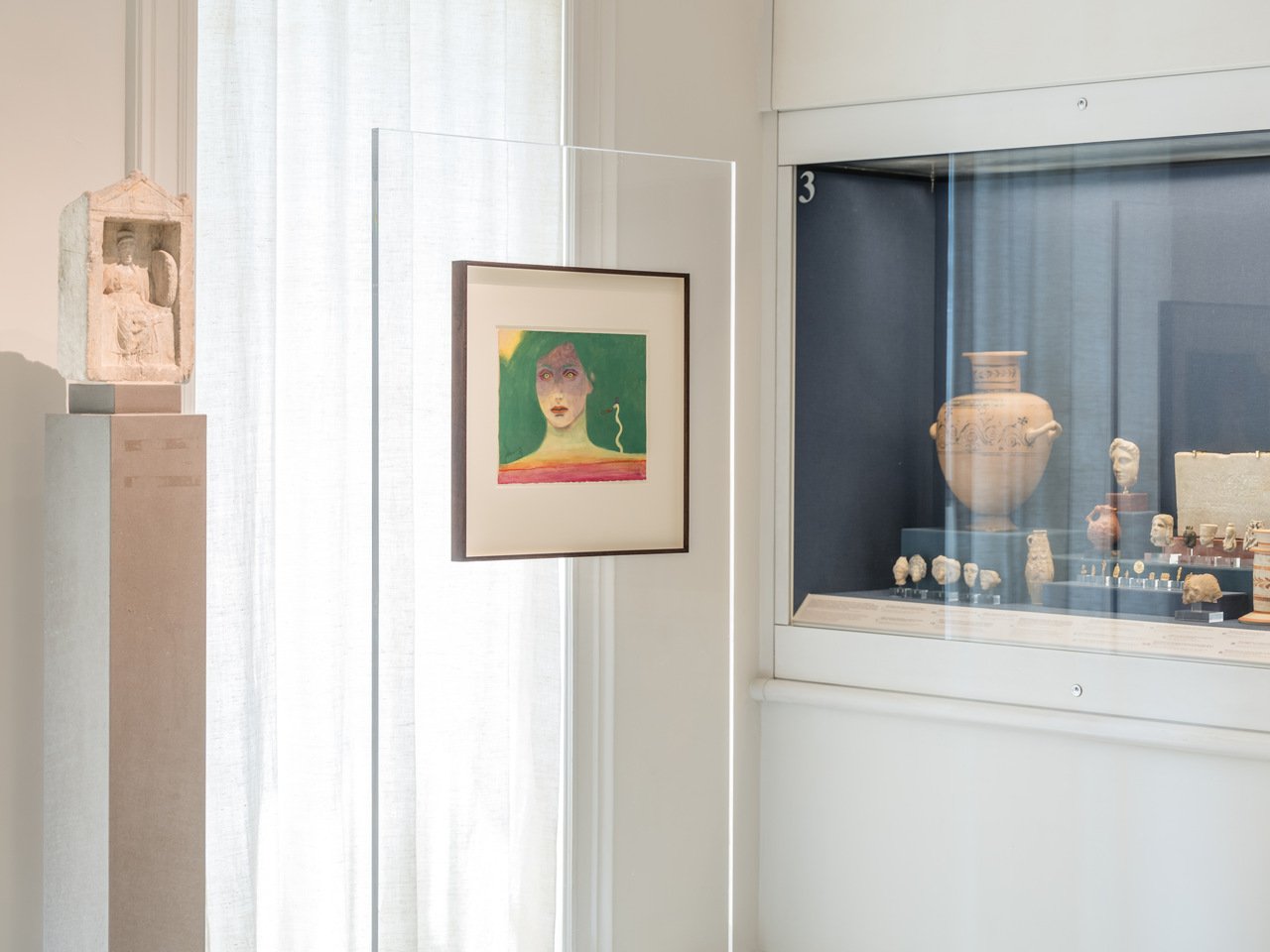
Benaki Museum of Greek Culture, Athens, photo: Giorgos Sfakianakis.
Courtesy of the DESTE Foundation.
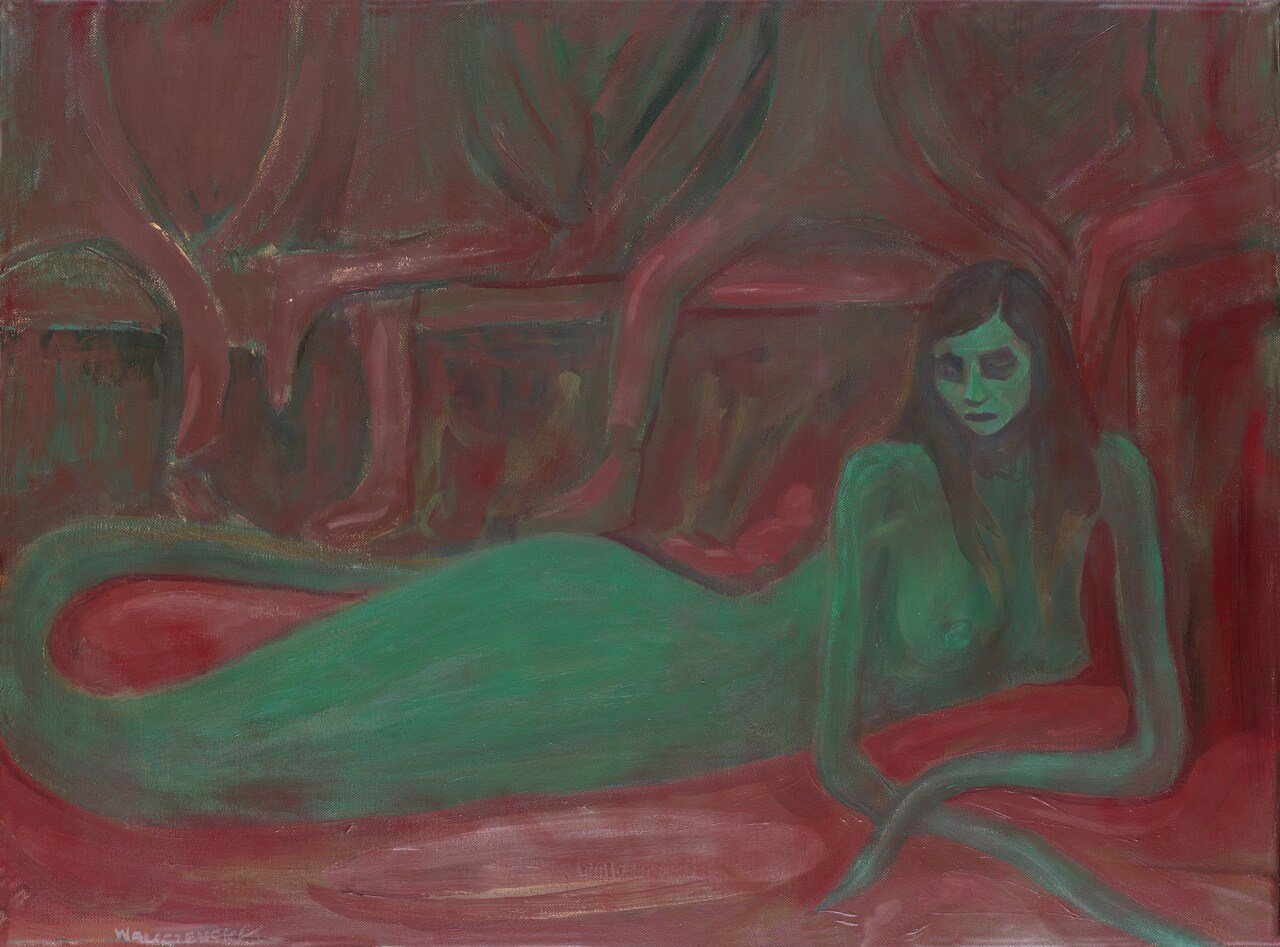
photo courtesy of Aleksandra Waliszewska. Courtesy of Consonni Radziszewski.
The images of babies in her paintings conjure eerily similar beliefs (hiedelem), surrounding the “swapped child” in Eastern European and Greek folklore. Her glowing yellow child evokes the Polish Mamuna, a demon that replaces newborns with her offspring.[10] In Hungary, witches or szépasszonyok[11], and in Greek tales, the Nereids do the same as the szépasszony: female demons of enchanting beauty but ill intent, living in caves and other natural hideouts, sneak in to make the switch. The displacement of the trauma surrounding children born with disabilities or autism leads to scenes in reality that are no less dark than the ones mentioned before, among others, babies thrown in the trash, left by the roadside, or placed in a frying pan over the stove.
Of course, traditions arising from a less bloodcurdling realm of superstition are always present, such as the small vases adorned with images of babies that accompanied them to the afterlife, placed in the graves of young children who died tragically young. The purpose of these descriptions is neither to provide entertainment through historical disaster tourism nor to startle the reader. It’s only a way to show how our cultures have translated the horrors of existence – and how these stories, more often than not, don’t end well. These are exactly the scenes that ultimately constitute Waliszewska’s painterly universe, where feral survival and gratuitous violence are baseline norms, integral parts of the fabric of human life. Where reality is held together by something other than the moral codes we live by today, and borders between here and beyond are unnervingly thin. By unveiling and arranging these “stories within stories”[12] from the depths of different cultural imaginations, the exhibition as a whole is placed within the logic of the folk tale, where “a character [is] always being in transformation, but also open to be inhabited then abandoned by the reader constantly.”[13] Waliszewska’s protagonists open up this relationship between reader/viewer and subject, so much so that the polished stories standing still in the museum space can begin to offer themselves to be inhabited and abandoned again, by their own rules, in constant metamorphosis.
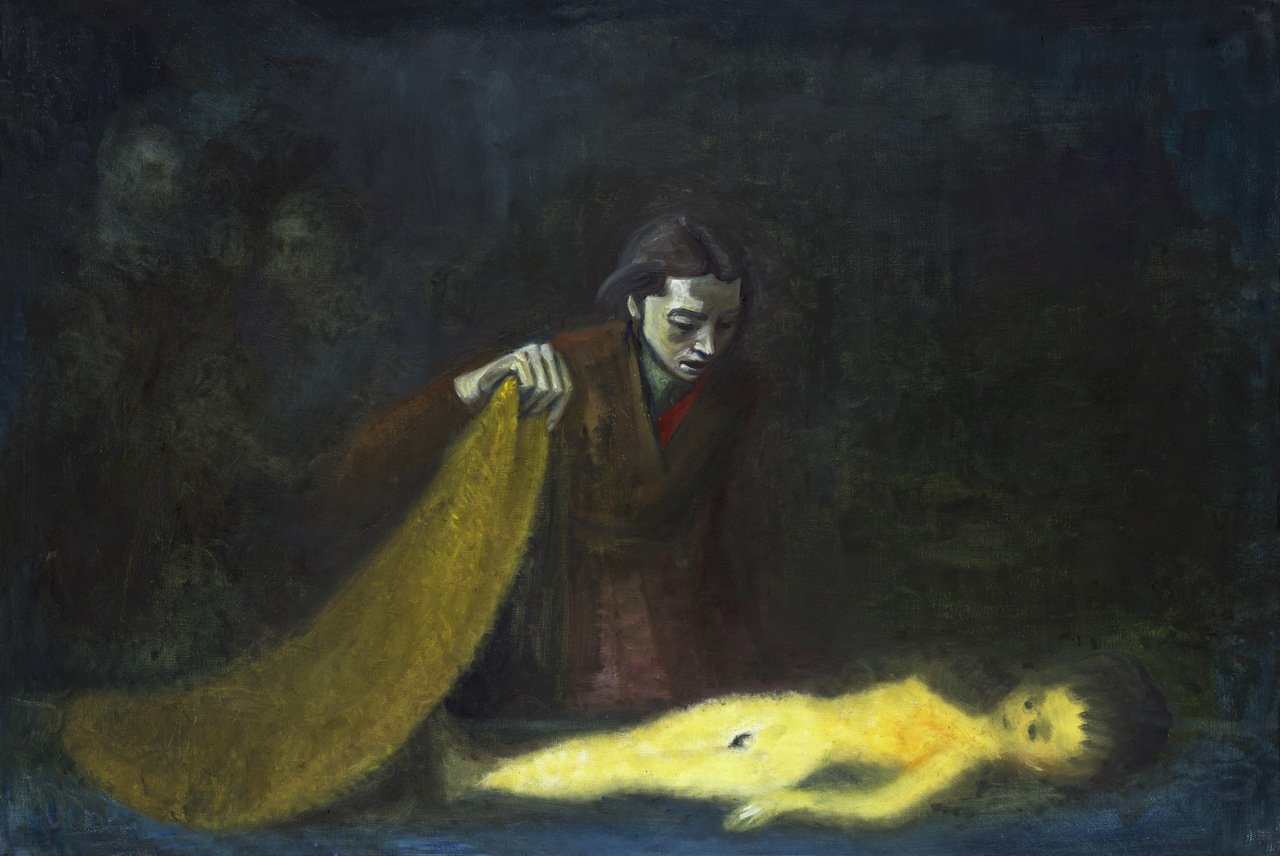
photo courtesy of Aleksandra Waliszewska. Courtesy of Consonni Radziszewski.
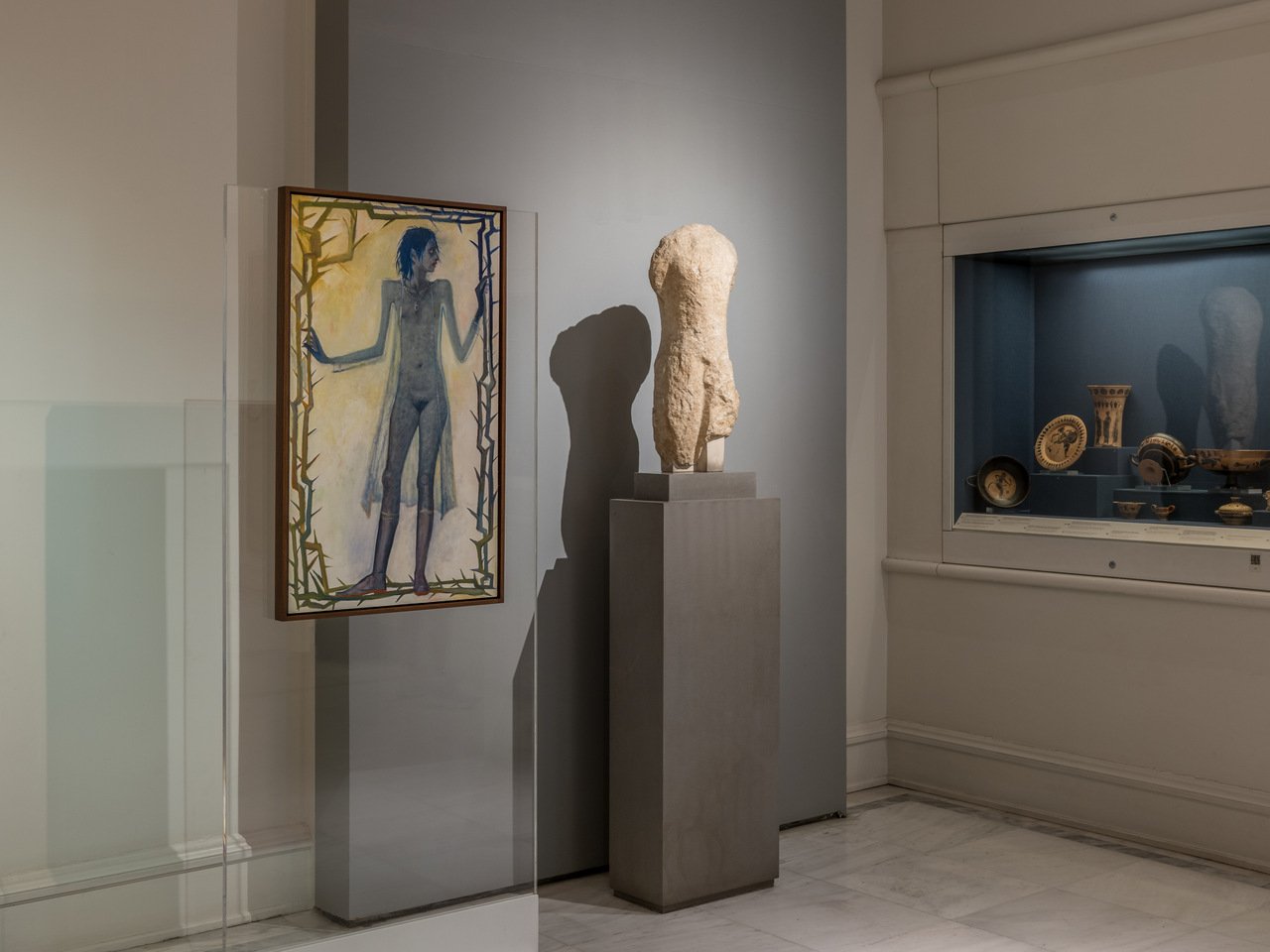
photo: Giorgos Sfakianakis. Courtesy of the DESTE Foundation.
Distance and a level of disengagement are, of course, natural occurrences in institutions of research and preservation, which is owed to the fact that objects (and their spirits) dating back thousands of years can still captivate us today. However, the extent to which symbols of Greek antiquity have been simplified and commodified by mainstream visual culture and nation branding is akin to the deboning of folk characters such as the vampire or the mermaid in the Western imagination. Repeated in mass media to the point of absolute boredom and depletion, they practically became the visual sign of a single romanticized idea of not only ancient, but also contemporary Greece.
Waliszewska’s exhibition does create a brief irruption within this narrative by summoning a multitude of forgotten or marginalized stories which, if listened to closely, can tell about the human desperation to create worlds, where there is always someone (or something) to hold responsible, and in which some kind of deliverance can be achieved through following the appropriate steps. But it would be naive to think that personifying fears and traumas as demonic forces – or virtues and blessings as otherworldly protectors – is only a practice of the past. As we have seen, through cultures and epochs, we tend to create the monsters that h(a)unt us.
The exhibition has been organized by the DESTE Foundation for Contemporary Art and Dakis Joannou.
Benaki Museum of Greek Culture, Athens, photo: Giorgos Sfakianakis.
Courtesy of the DESTE Foundation.
Benaki Museum of Greek Culture, Athens, photo: Giorgos Sfakianakis.
Courtesy of the DESTE Foundation.
[1] Monster Theory – Reading Culture. Ed. Jeffrey Jerome Cohen, University of Minnesota Press. 1996. p.9-10.
[2] Technic and Magic: Politics, Neoplatonism, and the Limits of Language with Federico Campagna – Acid Horizon podcast, 2026
[3] Federico Campagna: Otherworlds – Mediterranean Lessons on Escaping History. Bloomsbury, 2026. p.3.
[4] The Hungarian word hiedelem refers to credence, conviction, superstition, and belief at the same time. In the Hungarian mind, it’s easy to create an immediate lullaby around hiedelem, riadalom (panic), and félelem (fright). It’s a deeply fitting term, both in terms of literary and atmospheric meaning.
[5] Vrykolakas are the vampire-like creature haunting throughout the islands of Greece.
[6] Similarly to the witch hunts, political and economic agenda play a role in these cases as well, but examining these contexts in detail lies far beyond the scope of this essay. It is also important to note that the figure of the Upiór, as the Other, the shapeshifter, is related to the realities of queer and trans bodies in contemporary Poland.
[7] To prevent the ghost of a woman who died in childbirth from returning, it was customary in Hungary and other parts of Eastern Europe to fire a shot into the grave before burial. Dömötör Tekla – A Magyar Nép Hiedelemvilága. Corvina, 1981. p.221.
[8] Josef Pitton de Tournefort: The Exhumation of a Vampire in the Island of Mykonos in 1700. In. George Horton: Greek Vampires. Cycladic Press, 2023. p.22.
[9] In certain rural areas of Hungary, propping the deceased up at the dining table and stuffing food and drink into their mouth was a custom practiced even as late as the 1950s. Dömötör Tekla – A Magyar Nép Hiedelemvilága. Corvina, 1981. p.221.
[10] Dictionary of Polish Folk Tales Ed. Violetta Wróblewska. https://bajka.umk.pl/en/
[11] Lit. = beautiful women. Evil spirits that appear to be women of irresistible beauty. They typically kill men by taking them to a dance that lasts forever. Szépasszonyvölgy, The Valley of Beautiful Women is one of Hungary’s most important vine regions and touristic areas that still wears their name today.
[12] Technic and Magic: Politics, Neoplatonism, and the Limits of Language with Federico Campagna – Acid Horizon podcast, 2026.
[13] Ibid.
Artist: Aleksandra Waliszewska
Exhibition Title: Irruption of Antiquity
Curator: Alison Gingeras
Venue: Benaki Museum of Greek Culture
Place (Country/Location): Athens, Greece
Dates: 03.06.–27.09.2026