
Łucja Staszkiewicz
Ewa Partum (born 1945) is considered a pioneer of politically engaged conceptualism and feminist aesthetics in Polish art. Her works – focused on exploring methods of artistic expression through film and visual poetry, appropriation of state-organized artistic infrastructures (by organizing Galeria Adres in Łódź), and women’s everyday problems – have become important in Central-Eastern European art histories, especially for her formula of socially engaged art. The exhibition – curated by Adam Budak and Marta Smolińska – celebrates 60 years of Partum’s artistic practice, showing it in relation to her global artistic genealogy, from the international Fluxus movement to art focused on women’s emancipation during state socialism. Contemplating art, contemplating love is an exhibition which reconsiders the questions of actualization of a socially engaged formula in relation to conceptualism and artistic autonomy, and also the scale of resonance with which Partum’s work has shaped the landscape of conceptual and feminist artistic practices.
The exhibition in the Museum of Contemporary Art in Kraków (MOCAK) is a very interesting, if not exciting, presentation of Partum’s works. She is presented as a trailblazer; with her works positioned alongside those of artists like Jarosław Kozłowski, Wolf Vostell, and Yoko Ono, showing her roots in local and global iterations of conceptual art and later contact with artists engaged in the Fluxus movement, or accompanied by other feminist artists creating in socialist countries like Sanja Iveković, Vlasta Delimar, and Anna Maria Maiolino. This curatorial choice is pointing to how Partum’s proposition is not a singular intervention, but rather a distinctive one within the arsenal of emancipatory artistic practices of women within global conceptual circles. And through that her art becomes a lens through which the landscape of conceptual artistic practice is viewed in the exhibition – especially in the aspect of artistic autonomy, its definition and tactical usage i.e. appropriating the institutional infrastructure of art. By tactical usage of artistic autonomy I refer to how Partum’s working within conceptualism – mostly referred to as high-art, valorized for its tautological focus on art and its characteristics – using artistic experimentation to hijack and and remix the medium as poetry, film, and photography to create a space for feminist engagement.
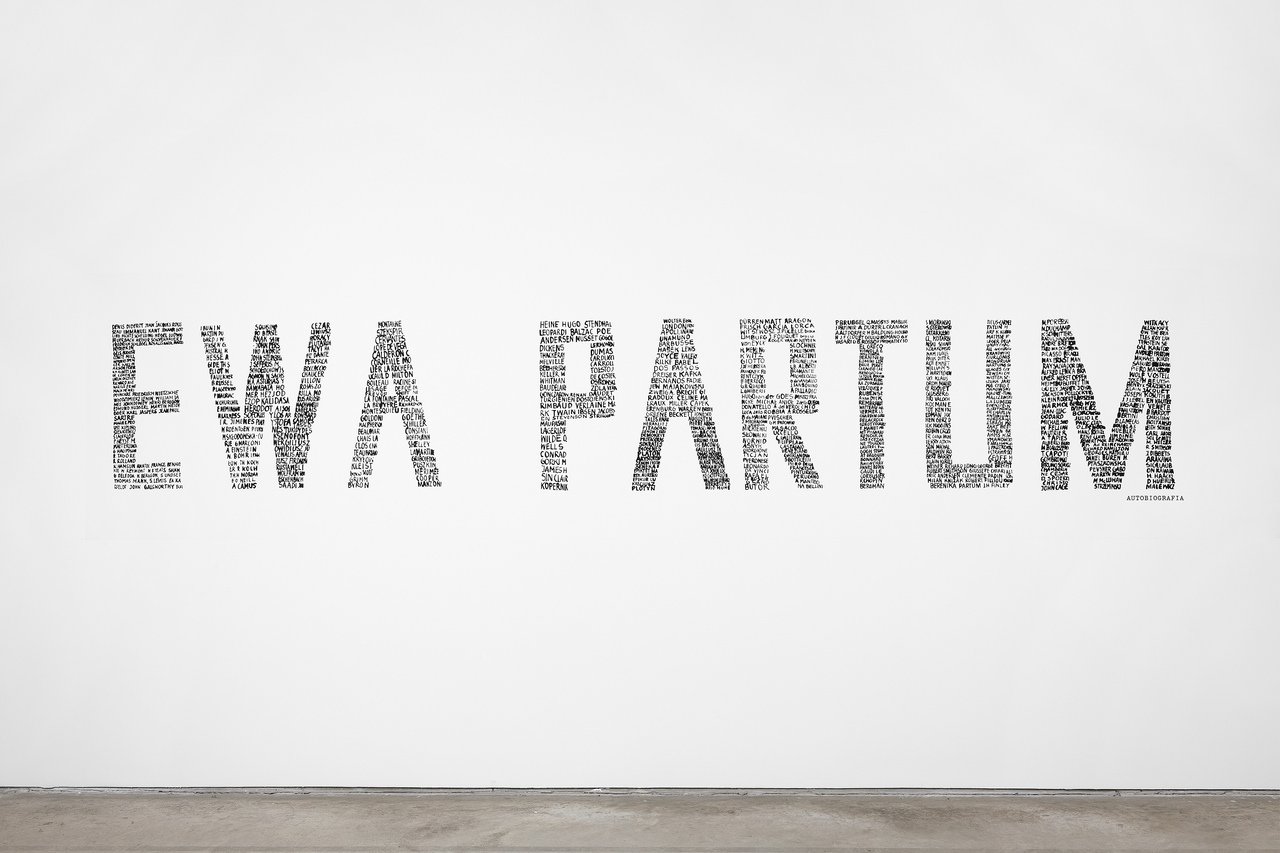
Image courtesy of MOCAK.
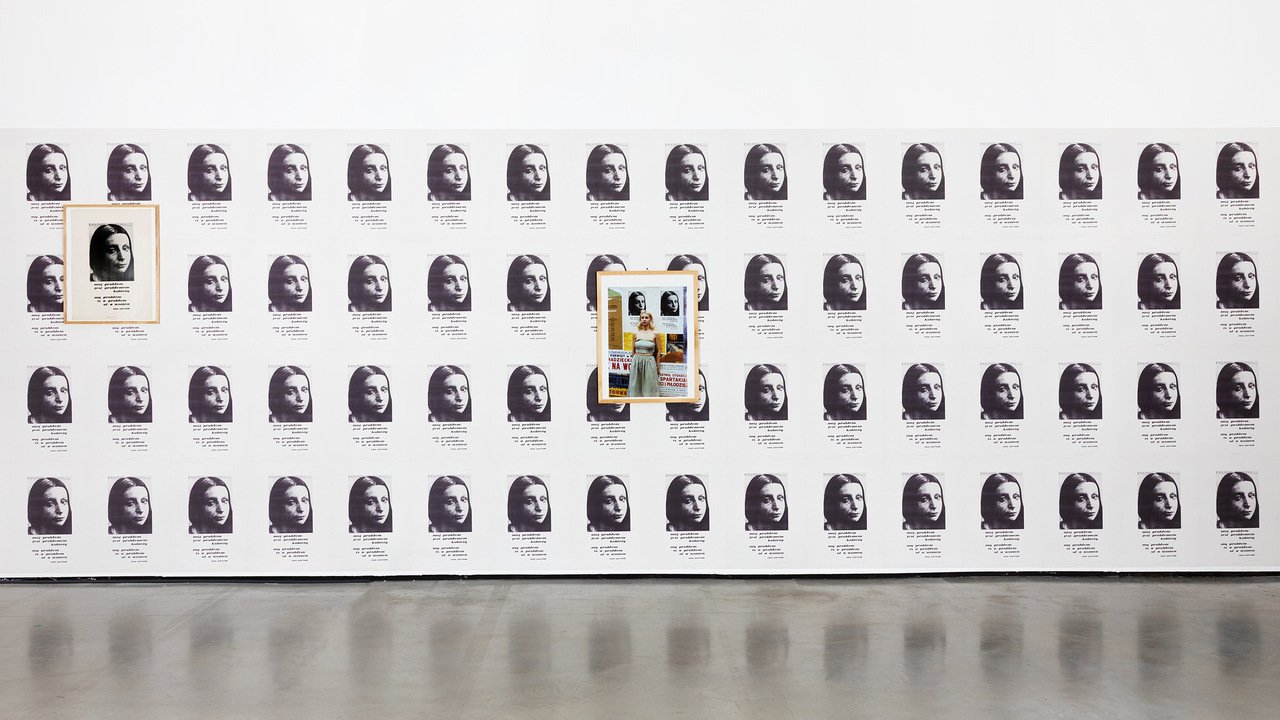
Image courtesy of MOCAK.
The first room of the exhibition can actually sum up a great portion of its premise. Just after entering the show, the first work is the name of Partum composed out of names of philosophers and artists that had an impact on her artistic genealogy. The relationality of her practice that is referenced throughout her art is acknowledged and exposed directly in a single work. The next work, Self-Identification, is a series of photomontages in which Partum places her naked body on the streets in different situations – facing a policewoman, walking down the street, standing in an RTV shop – accompanied by a video new horizon is a wave in which the title of the video is floating above the horizon of the Baltic Sea. The selection of works is witty and makes an interesting connection between the artist’s different stages of practice: conceptual, experimentation with visual poetry, tautological cinema, and feminist engagement.[1]
The most iconic of Partum’s works are presented alongside a film called Emancipationist from Poland (Emancypantka z Polski), an excerpt from the Polish Film Chronicle (Polska Kronikowa Filmowa); a state-organized propaganda tool showing life in socialist Poland. A short production made in 1981 presented Partum’s art as “devoted to handicapped women in the contemporary social life”[2] (sic!) presenting alongside works in which Partum is making gestures of silencing. Here the official language is used to diminish the artist by the sarcastic tone and the misinformation about the characteristics of her work. The official language that Partum was appropriating, especially in the action mentioned in the film called Women, Marriage is Against You! is used to discipline the artist, presenting her work as unserious (meaning not at all dangerous). The gesture of illustrating the tension between Partum’s practice and the official narrative produced by the state, represented by the Polish Film Chronicle, demonstrates the broader misunderstanding and scapegoating of Partum’s art even in neo-avant garde circles. This film is exhibited closely to the piece prepared by the artist for the 1992 exhibition Polnische Avantgarde 1930-1990 at the Neue Berliner Kunstverein, called Polish Female Avant-Garde Artists Have Their Great Chance – but as Dead Bodies Only – a simple message commenting on the position of women in avant-garde circles, referring specifically to the history of Katarzyna Kobro.
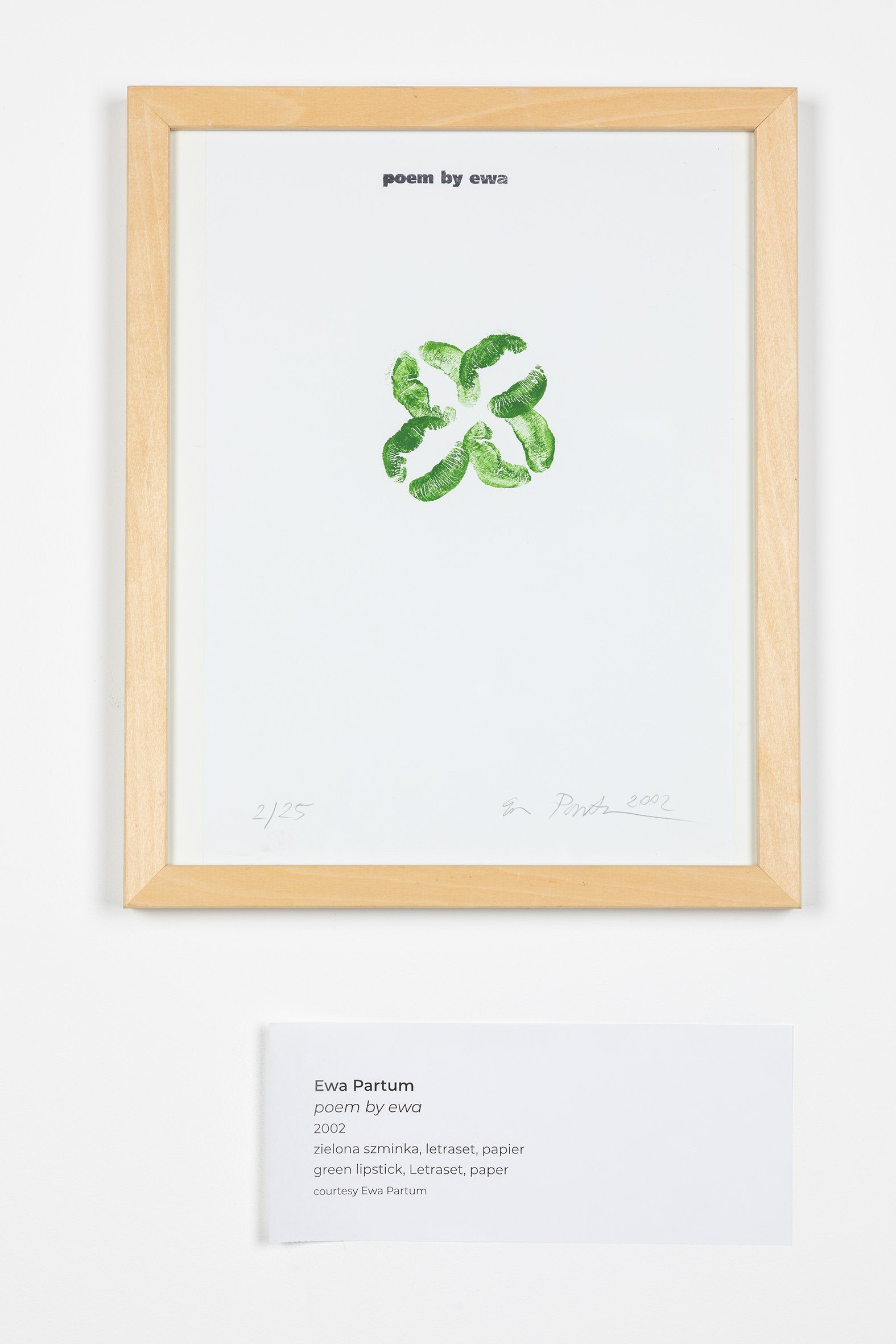
Image courtesy of MOCAK.
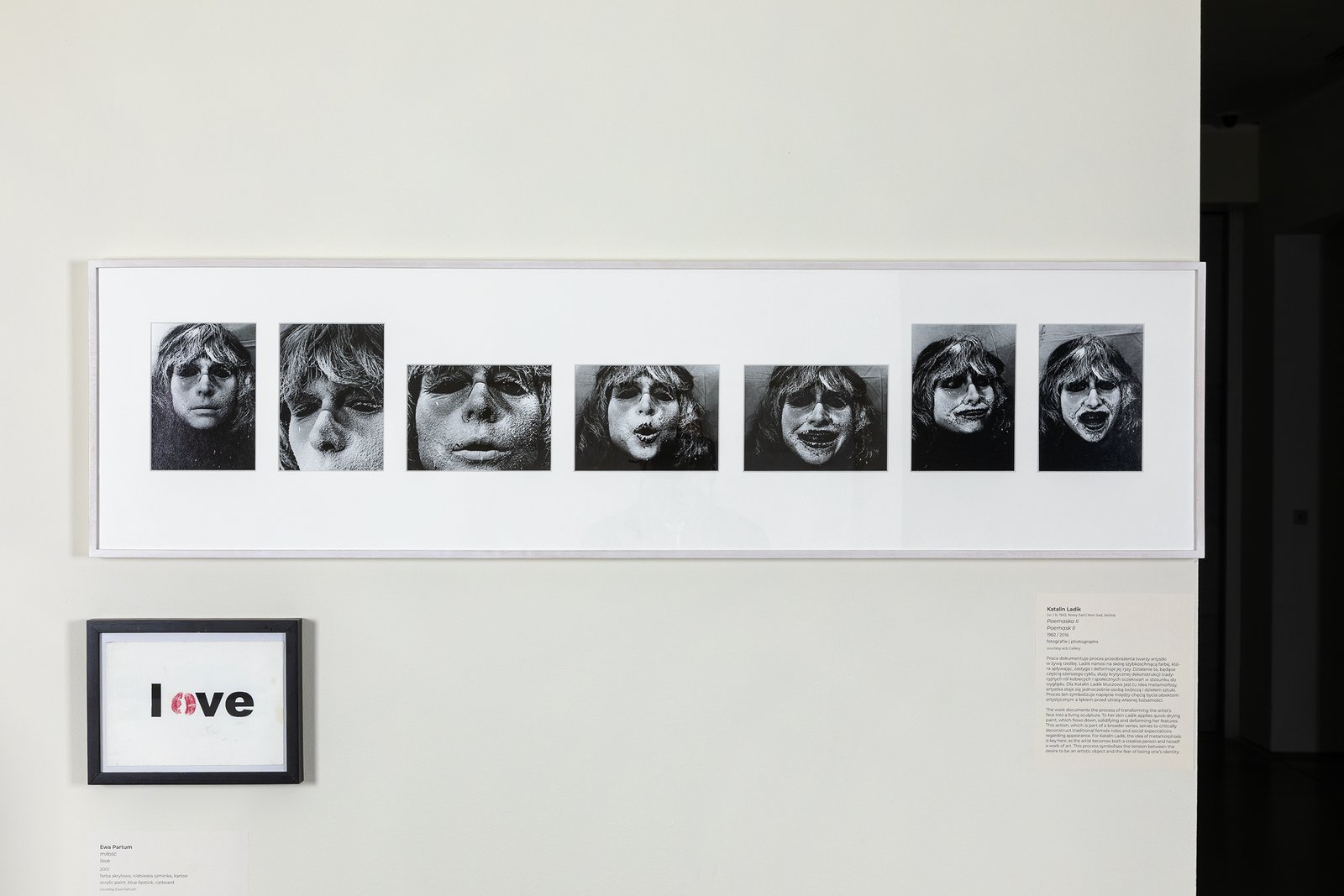
Image courtesy of MOCAK.
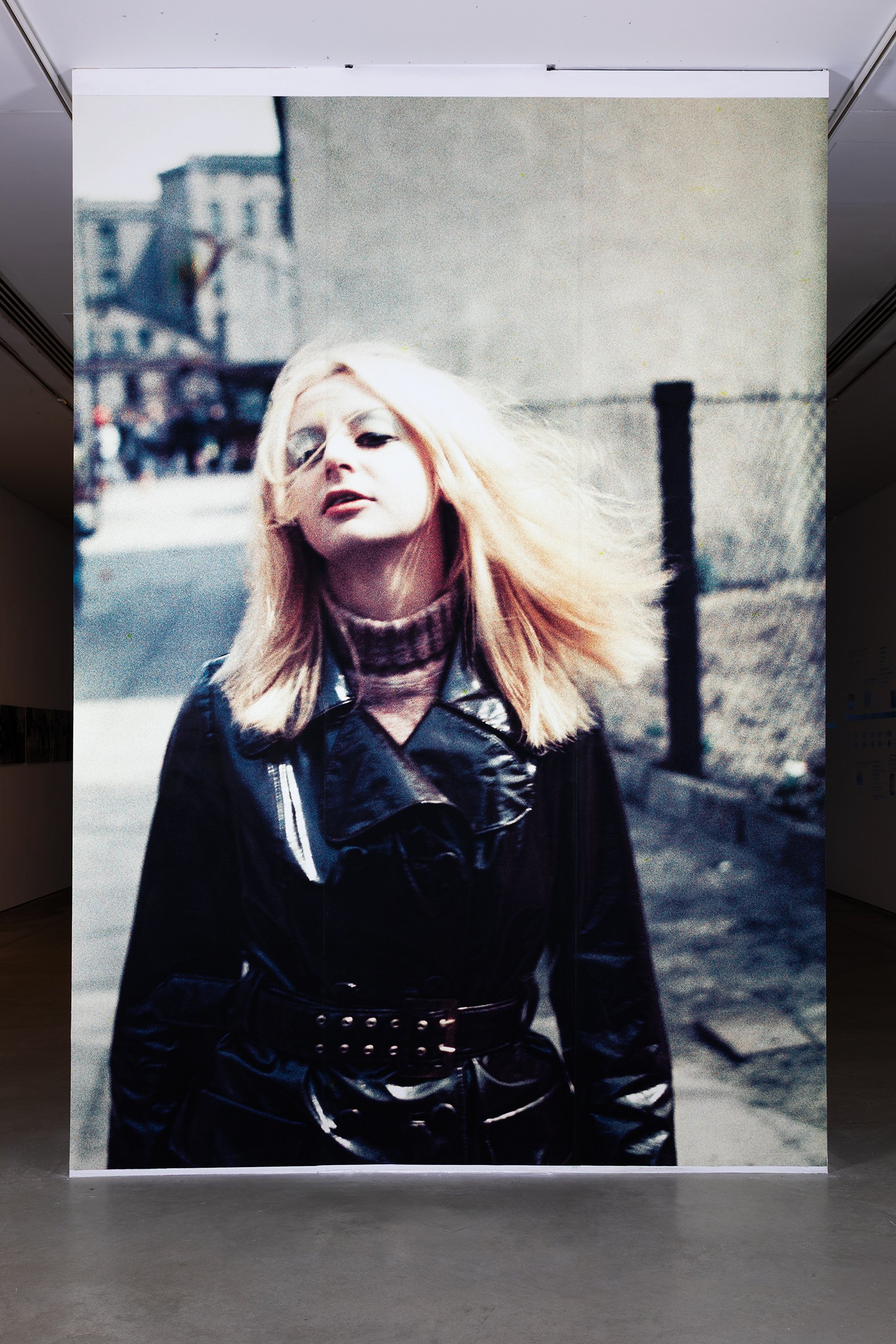
Image courtesy of MOCAK.
East-West divide interrupted
Historically speaking,[3] Partum’s work was not really present, or rather even visible, in the field of Polish art in the times of the transformation to capitalism. The first attempts to reintroduce her work in the Polish context were two exhibitions that historicized her practice in the landscape of Polish art of the time: Ewa Partum: Legality of Space (Ewa Partum: Legalność przestrzeni) prepared by Aneta Szyłak for Wyspa Art Institute in Gdańsk and Self-Identification(Samoidentyfikacja) in the National Museum in Warsaw, curated by Dorota Monkiewicz, both presented in 2006.[4]Exhibitions like Three Women (Trzy Kobiety) curated by Ewa Toniak in 2013 at the Zachęta – National Gallery of Art in Warsaw and Nothing Stops the Idea of Art (Nic nie zatrzyma idei sztuki) curated by Maria Możuch in 2014 at Muzeum Sztuki in Łódź, situated Partum’s art in the context of other artistic practices and circles in Poland. The former showed her alongside two other great feminist artist creating under state socialism – Natalia LL and Maria Pinińska-Bereś – while the exhibition curated by Maria Możuch presented her practice as part of the artistic circles in Łódź, and its history as the city of the Polish avant garde and the birthplace of the first modern art museum in Europe.
The exhibition in MOCAK points to how Partum’s work emerged from the historical changes of art production under state socialism and discourses of art related to that change – the assertion of some neo-avant garde circles on artistic autonomy over political engagement of the avant garde of 1940s and 50s executed within the decentralized institutional life of mid 1960s to the late 1970s.[5] In consequence, curators set her practice as formed by these historical conditions, through which (and against) her art was formed and which in time revolutionised artistic idioms in which Partum was participating (conceptualism, feminist aesthetic) – not only on the local level of the Polish art field, but rather in relation to global art movements.
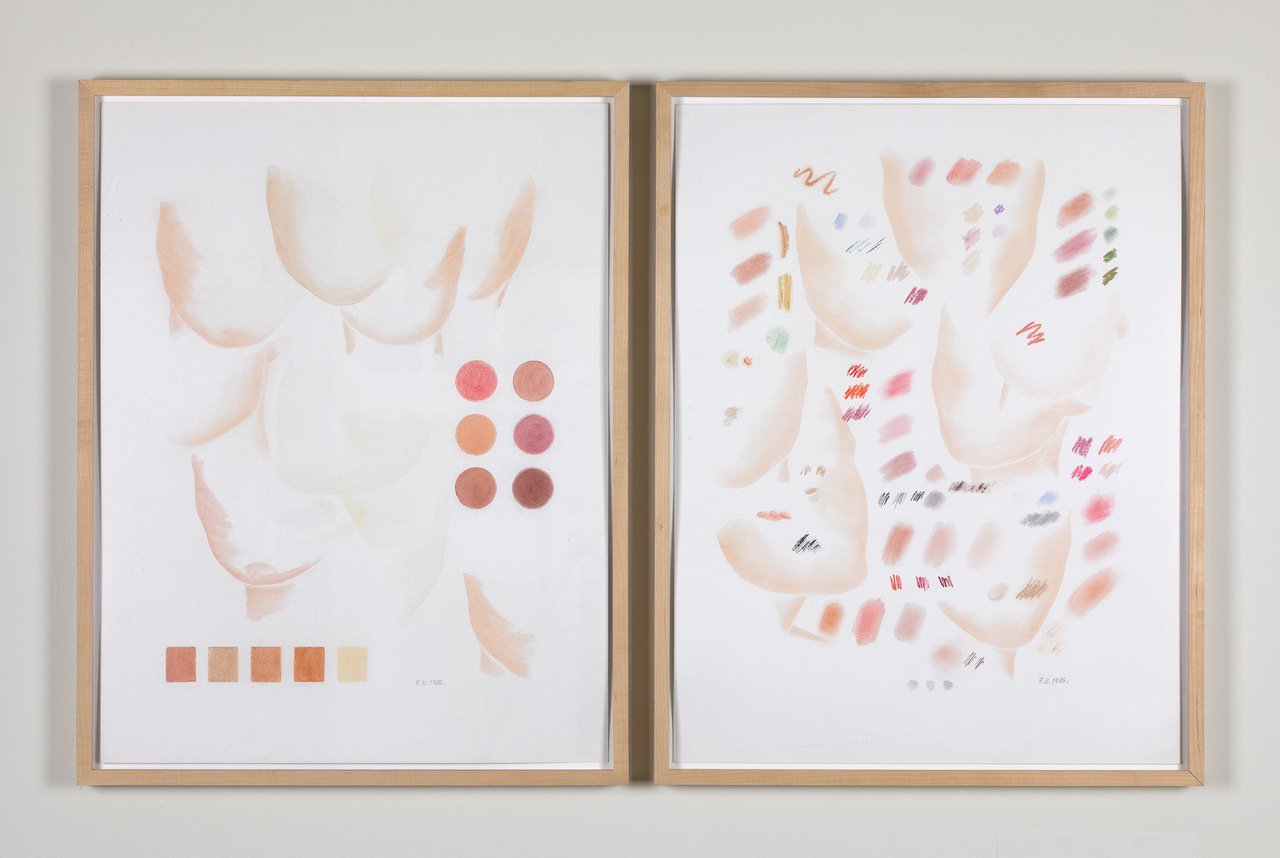
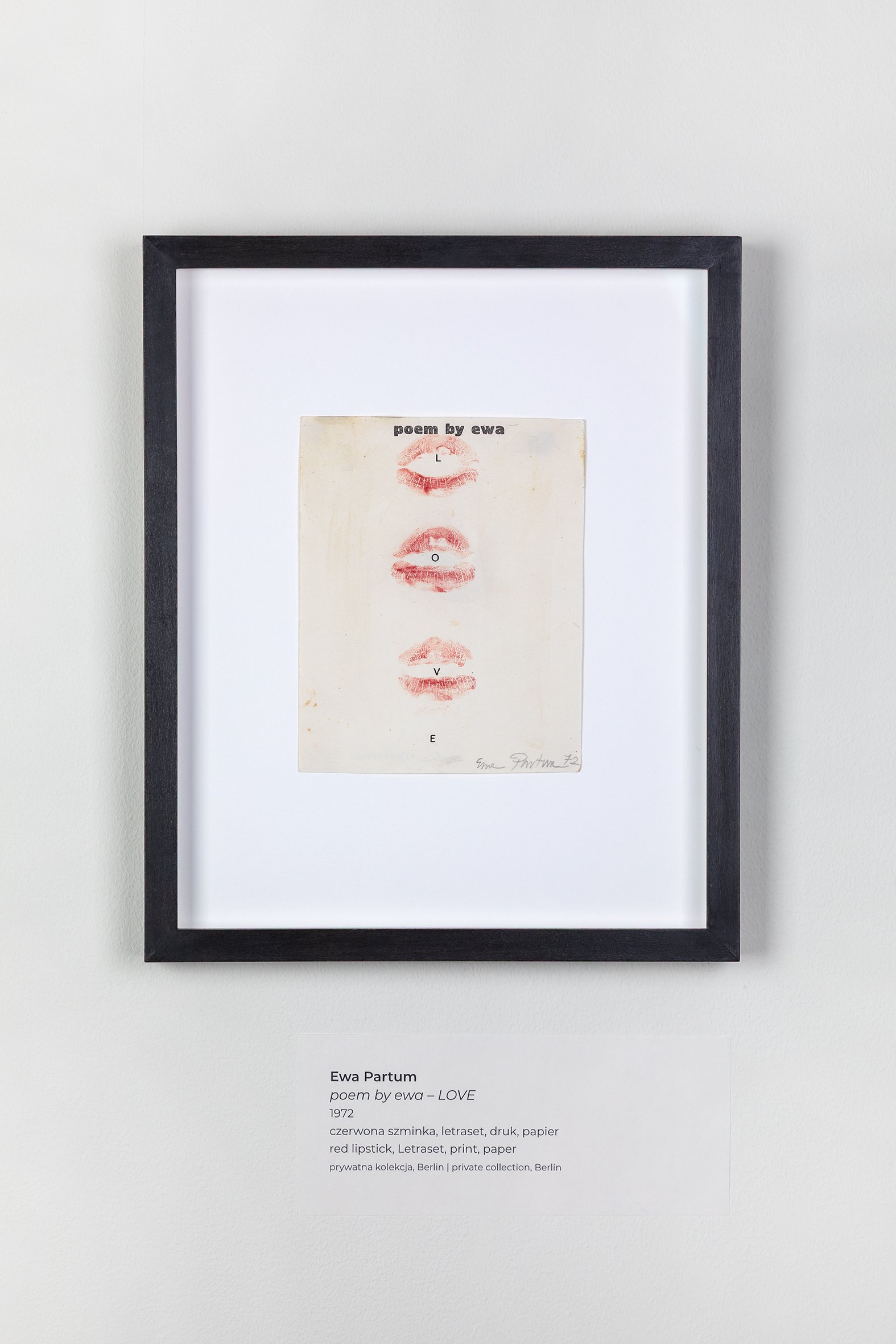
Image courtesy of MOCAK.
In this case, the global aspect of Partum’s art is not in any way reduced to some simplified notion in which the presence of artists from the Western art centers somehow legitimize her position within the local scene, but rather presents a more nuanced take on Partum’s participation in the artistic exchange of the international avant garde on the line of the East-West divide. The relationality of Partum’s work is demonstrated in a very thoughtful way in the part of the exhibition where her work Pirouette is presented next to Carolee Scheemann’s Ice Naked Skating.
In Pirouette, a performance done in 1984 in Berlin, Partum stands naked next to an installation made out of a ribbon of paper with her self-portrait attached to a mixer, under which was placed a mirror, the artist being surrounded by the viewers. After reciting a text about her relationship with the past, the artist started to walk on the mirror while wearing skates, gradually making stronger steps, leading to cracks and eventually breaking the mirror. The video presenting the whole performance was facing two other pieces of documentation: four horizontally-aligned photographs of Partum balancing on the mirror with her skates, and a pile of shards of the mirror and her skates were placed in a display case. This work relates to the passage of time, a theme that is present in many of her works, especially those about the patriarchal assertion that a woman’s value and position is conditioned by her attractiveness, as in My problem is a problem of a woman.
Ice Naked Skating, made by Scheemann from 1977 to 1988, is a series of photographs presenting the artist posing joyfully as a naked figure skater. In the singular photograph presented in the exhibition, Scheemann is standing naked while wearing figure skates, stockings, a scarf and a headpiece. The photo mimics that of a showgirl, but makes this shift from a produced image that creates an illusion of objectivity through its professionalism, in which the set is not visible, to one that reveals aspects of its artistic production. Exploring these themes in a playful way, both works relate to how women experience their changing bodies.
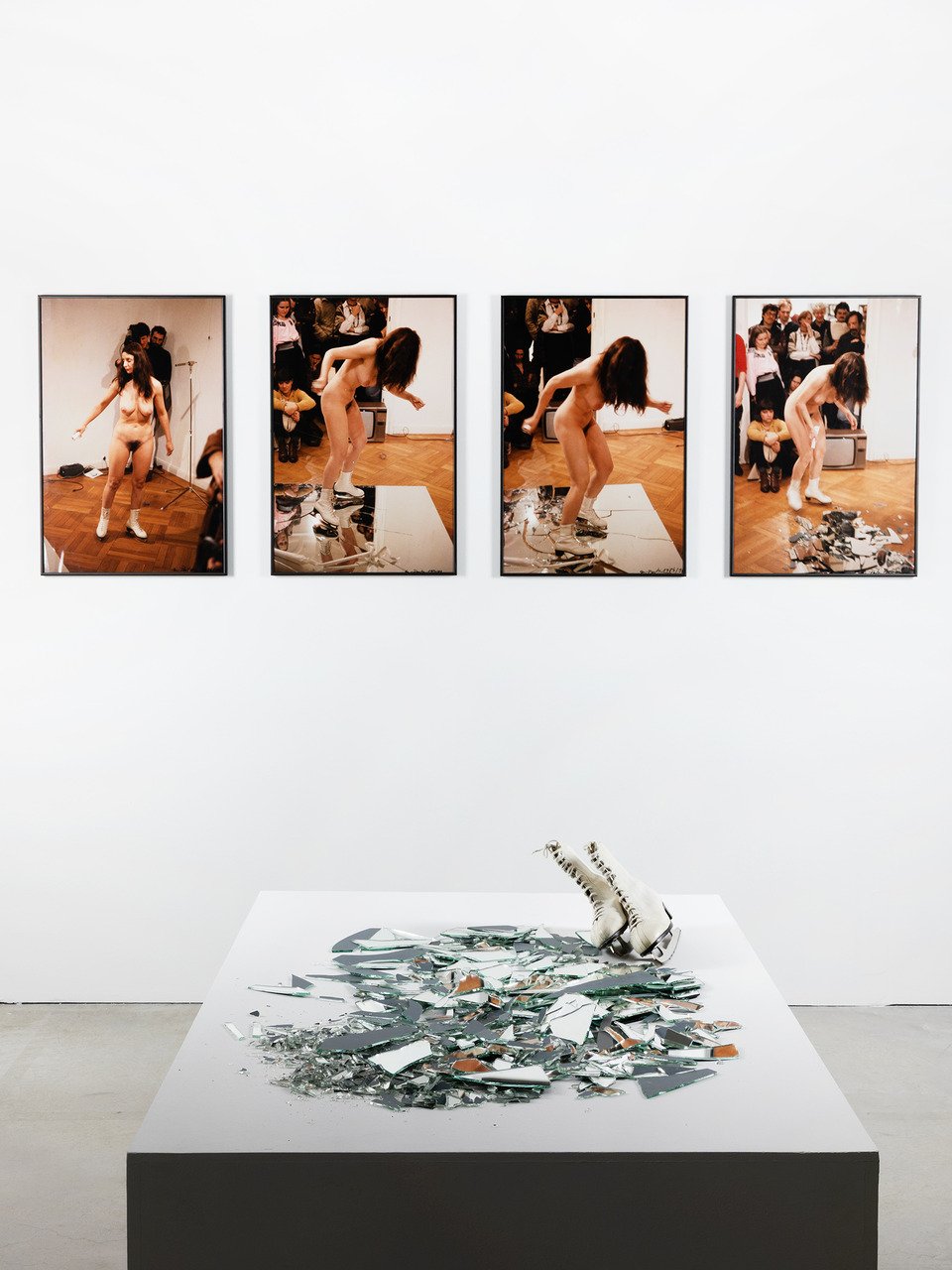
Image courtesy of MOCAK.
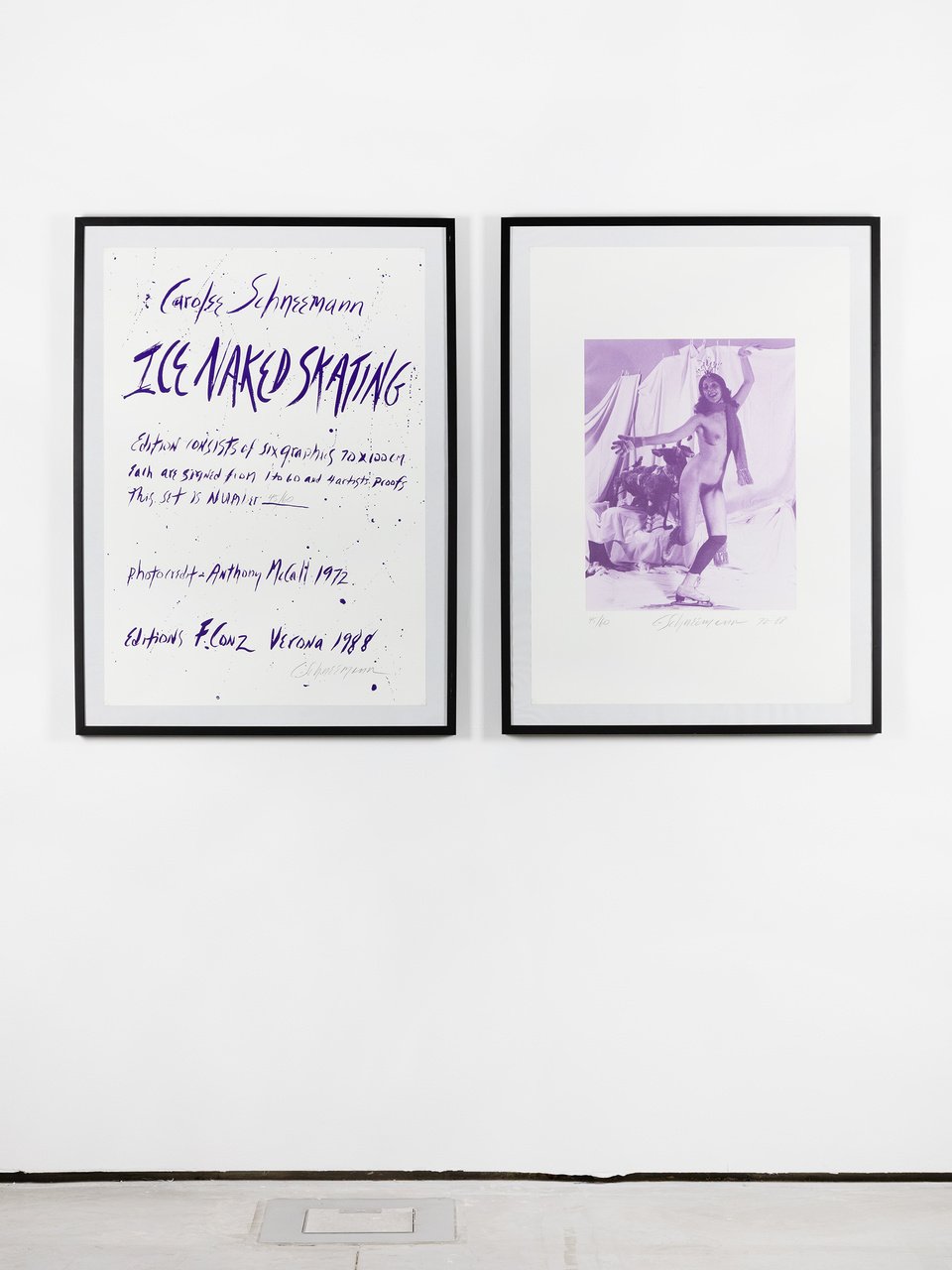
Image courtesy of MOCAK.
Although it seems that the curatorial choice to exhibit those works in proximity only comes from the formal or aesthetic comparison between these two artists, the connection really demonstrates the relationality of Partum’s art. As Karolina Majewska-Güde points out in her monograph about Partum, the artist encountered feminist art through a reproduction of Schemmann’s work Feminist Architecture (1973), printed by Something Else Press and edited by Wolf Vostell.[6] It was most likely the first work that openly referred to feminism that Partum had ever seen. This movement from aesthetic to historical connection is the method through which these relations with other artistic practices is exhibited: regarding the works of Wolf Vostell, who was a contact of Partum, and her connection to the Fluxus movement, or Dóra Maurer, whose works resembled Partum’s on the level of aesthetic choices used to critique the place of women and women’s bodies in art through working with the female body as a medium, not as an object for the male artistic genius to play with – per Yves Klein – but as a subject with her own desires and intentions.
On the level of East-West relations, the exhibition is well thought out, but not so much in the area of historical placement of Partum’s work in the local context. The problem for me is in the narrative produced in some portions of the texts (both in the wall texts and descriptions of works, especially in the first room) that are just incoherent with what the viewer can see from the works and their constellations presented at the exhibition. In one of the wall texts, the curators point out that Partum’s work was “ahead of its time,” or in a way, prophesized the socio-political changes of the 1990s (this judgment is formulated in response to Partum’s film Emancipationist form Poland). However, this view is a stark contrast to how her artistic practice and others are presented in this exhibition. This emancipatory feminist aesthetic and critical rethinking of patriarchal order can be seen across the different socialist countries, from Yugoslavia to Czechoslovakia to Brazil. And although not really in contact with each other, these practices exemplify the same kind of political engagement, opposing the conservative view on gender and women’s sexuality in socialist countries[7] that were part of global shifts in feminist organizing during the 1970s[8] (on which I will focus later in the text). Presenting Partum’s practice as not of her time but from the future may sound profound, but it is not at all true.
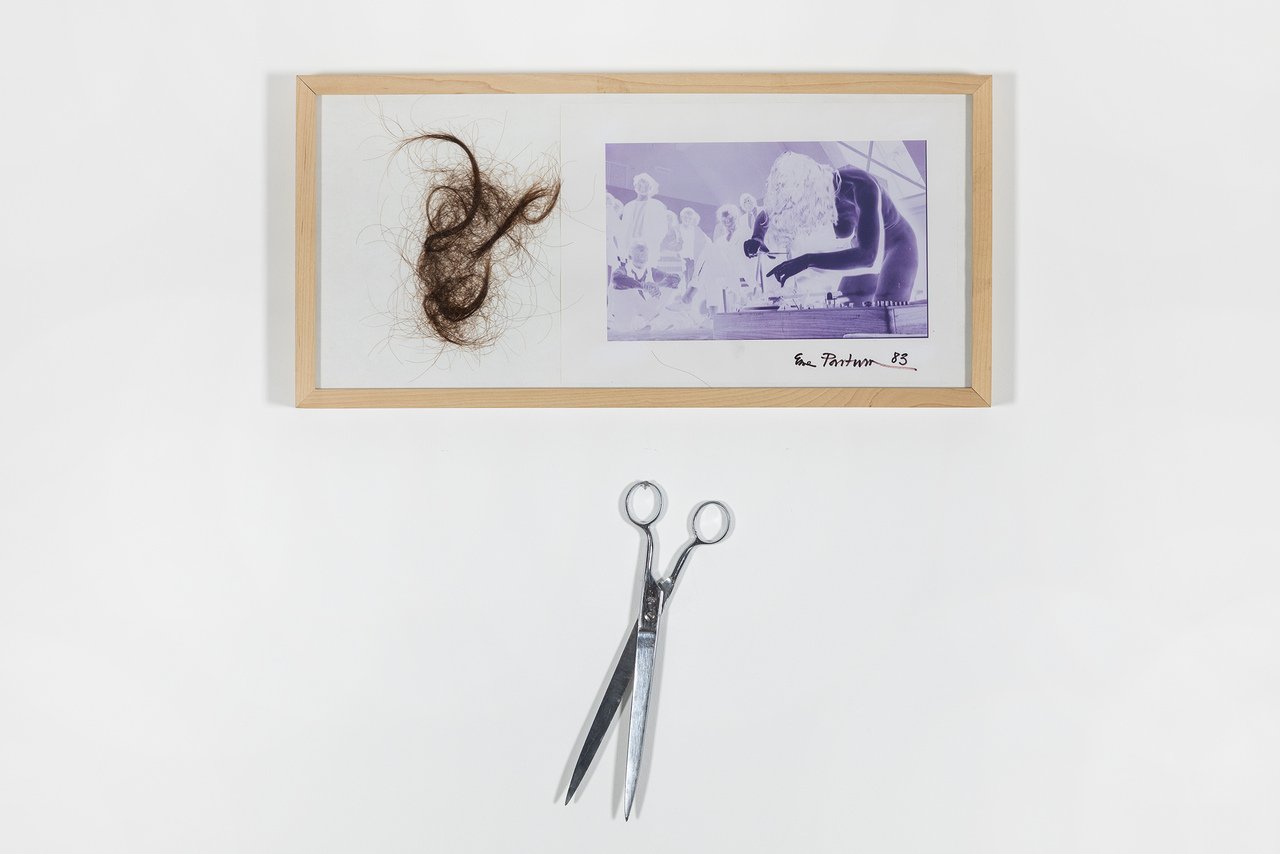
Image courtesy of MOCAK.
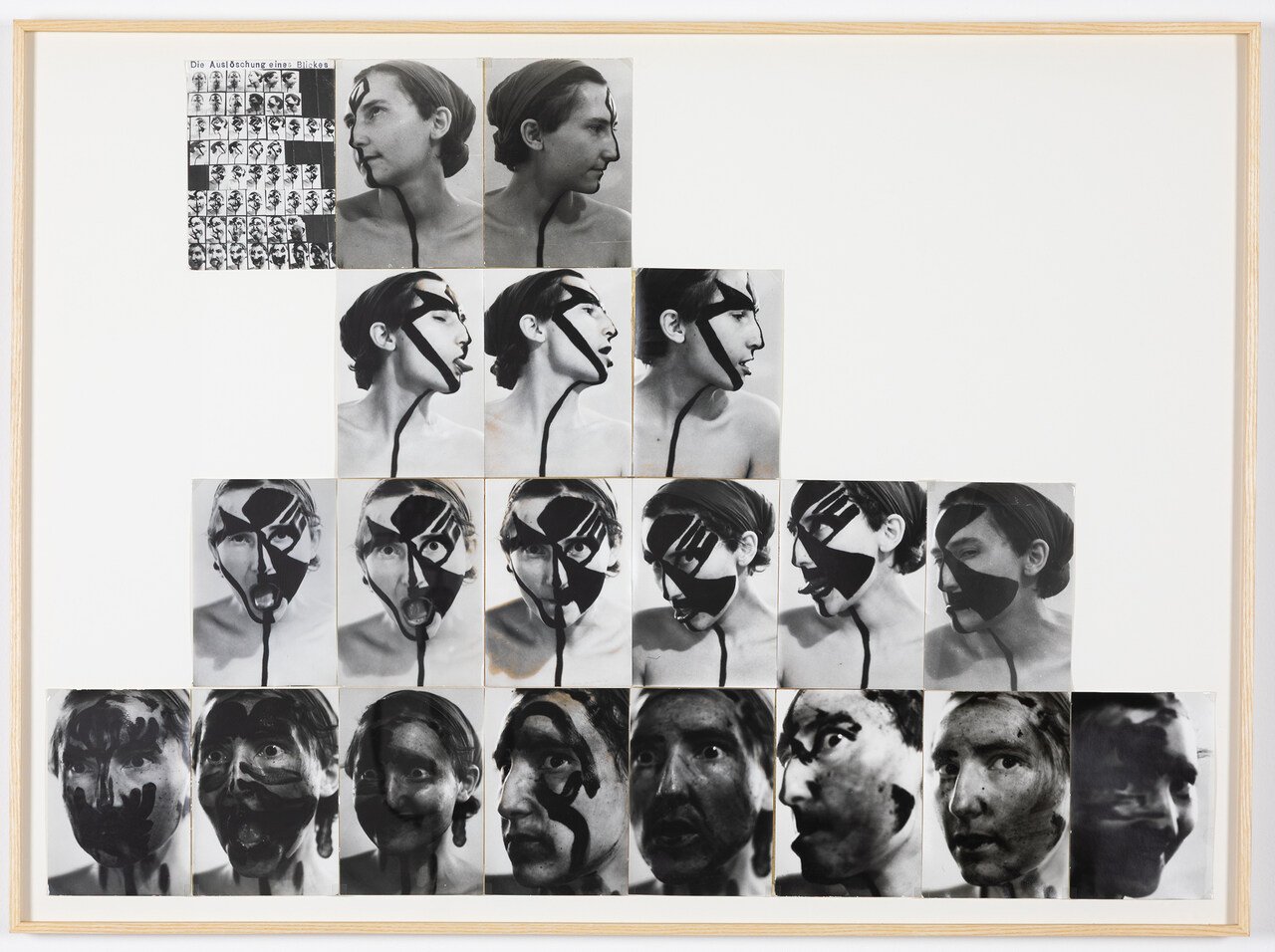
Image courtesy of MOCAK.
“…determined enemy of a marriage (and she is making it clear right now)”[9]
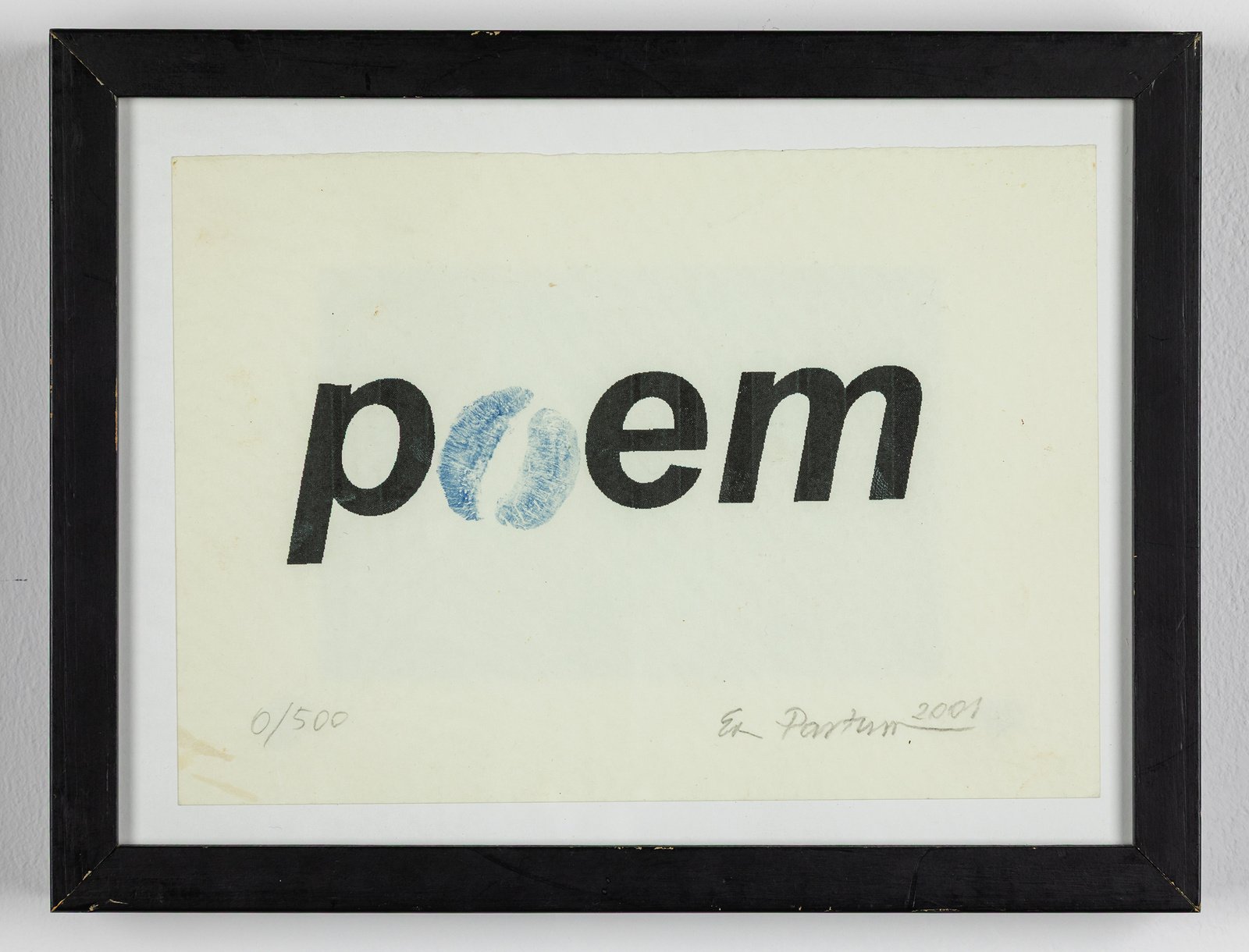
The title of Partum’s exhibition in Kraków is borrowed from the artist’s series Contemplating art, contemplating love, and in some way it is repeating the logic of that work. In this piece, the artist is continuing her method of combining a simple text with smudges of lipstick from her series Poems by Ewa. The first piece is composed of a phrase Contemplating art under which there are blue lipstick stains. The second one, Contemplating love, is made in the exact same way, but this time the lipstick is red/pink. The relation between the two fragments of work is an ambiguous one. It can form a story in which one cannot be spoken about without the other – presenting a non-antagonistic relation of complementary elements. But it can also refer to the tension within conceptualism itself – in which the sexual difference determined which themes can be articulated within this artistic formation and which kind of artists were permitted to speak competently about art (cerebral, public) and which could speak about love (embodied, private).[10] But it can also be a synthesis of both – presenting a view in which there is a categorical tension in this artistic idiom, historically coming from the territorial debates of the mid 1970s (such as those manifested in Wiesław Borowski’s text Pseudoawangarda),[11] but that can be negotiated through political engagement. This interpretation of the work is the key for viewing the exhibition.
Love is one of the central categories in Partum’s artistic practice; she uses methodologies of conceptualism to articulate problems relating to women’s work, devotion, emotional lives, and expectations in patriarchy, both in socialism and capitalism from the 1970s onward. Love in its most refined form (marriage), or the performative aspect of love as work, the continuous effort to make others feel the soothing atmosphere of love, and love that becomes a disciplinary force through violence – both mental and physical – these issues can be seen in Wedding Attire, Stupid Woman, and Marriage Disaster.
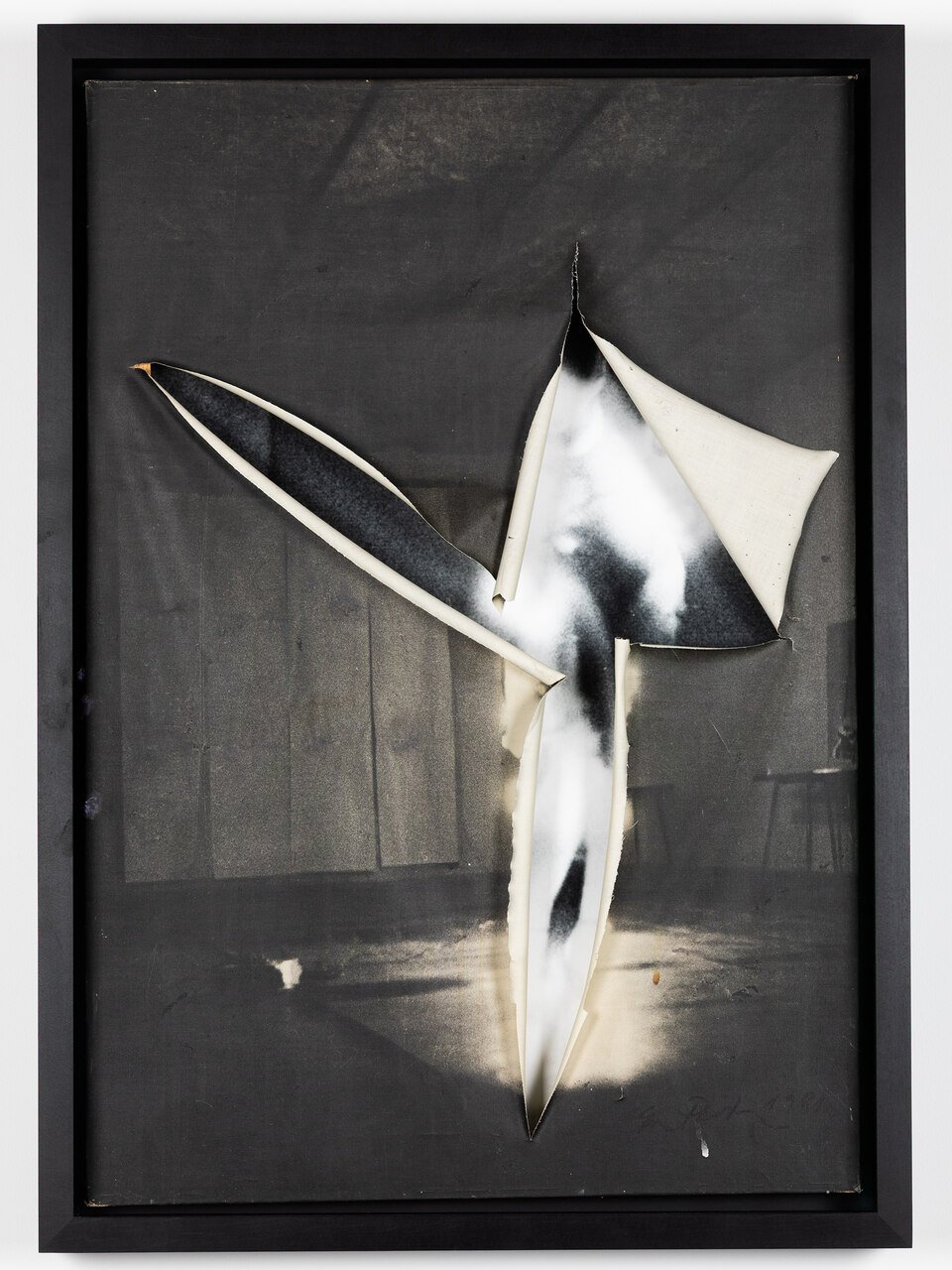
Image courtesy of MOCAK.
Wedding Attire is a performance documented in photo and video. There are four photographs presented, creating a brief sequence of events. In the upper left one, the artist is holding a banner with the titular phrase placed in uppercase letters (KOBIETY, MAŁŻEŃSTWO JEST PRZECIWKO WAM, eng. WOMEN, MARRIAGE IS AGAINST YOU) mimicking the official signs made for state-organized demonstrations, and in Majewska-Güde’s words, a feminist agit-prop[12]. Partum is standing naked behind it, before the improvised aisle in Galeria Labirynt in Lublin, on which her husband is standing still, holding his hands behind him, not looking at the artist. In the second photograph, Partum is picking up a wedding dress from an easel, and in the third one she is getting dressed near it. The last photograph is a view of Galeria Labirynt after the end of performance, exhibiting the banner and a video of the work playing on TV next to the aisle. A part of this performance in the gallery is used as visual material in Emancypantka z Polski, where Partum is cutting her veil and aggressively undressing herself, resulting in her standing naked before the banner, which we can see in the film from the Polish Film Chronicle. Her pieces, bold and controversial, criticized women’s position in marriage – in which her work is reduced to an act of love, and thus becoming a form of exploitation. Yet another critique of marriage is actualized in Marriage disaster, a photograph of Partum’s face, bruised after being attacked by her husband, placed in a lightbox. The photograph, taken in 1987 and exhibited for the first time in 2005, consists of the artist gazing into the camera and in turn, into the eyes of the viewer, while standing in what seems to be the home she shared with her husband. The viewer faces Partum while she demonstrates a moment of brutal unraveling: when love becomes only an illusion, a tool for disciplining and subjugating women into becoming proper, which is something that the artist criticizes through her works.
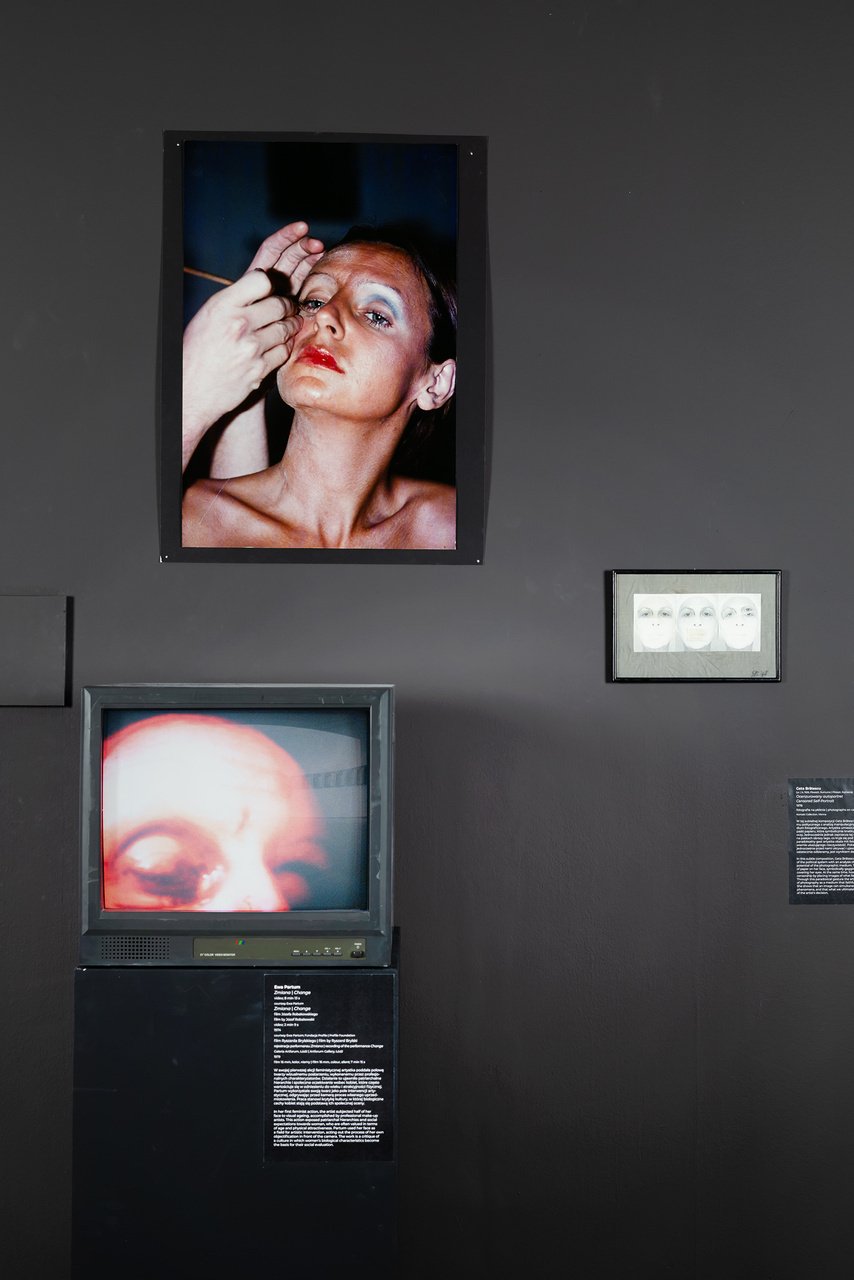
Image courtesy of MOCAK.
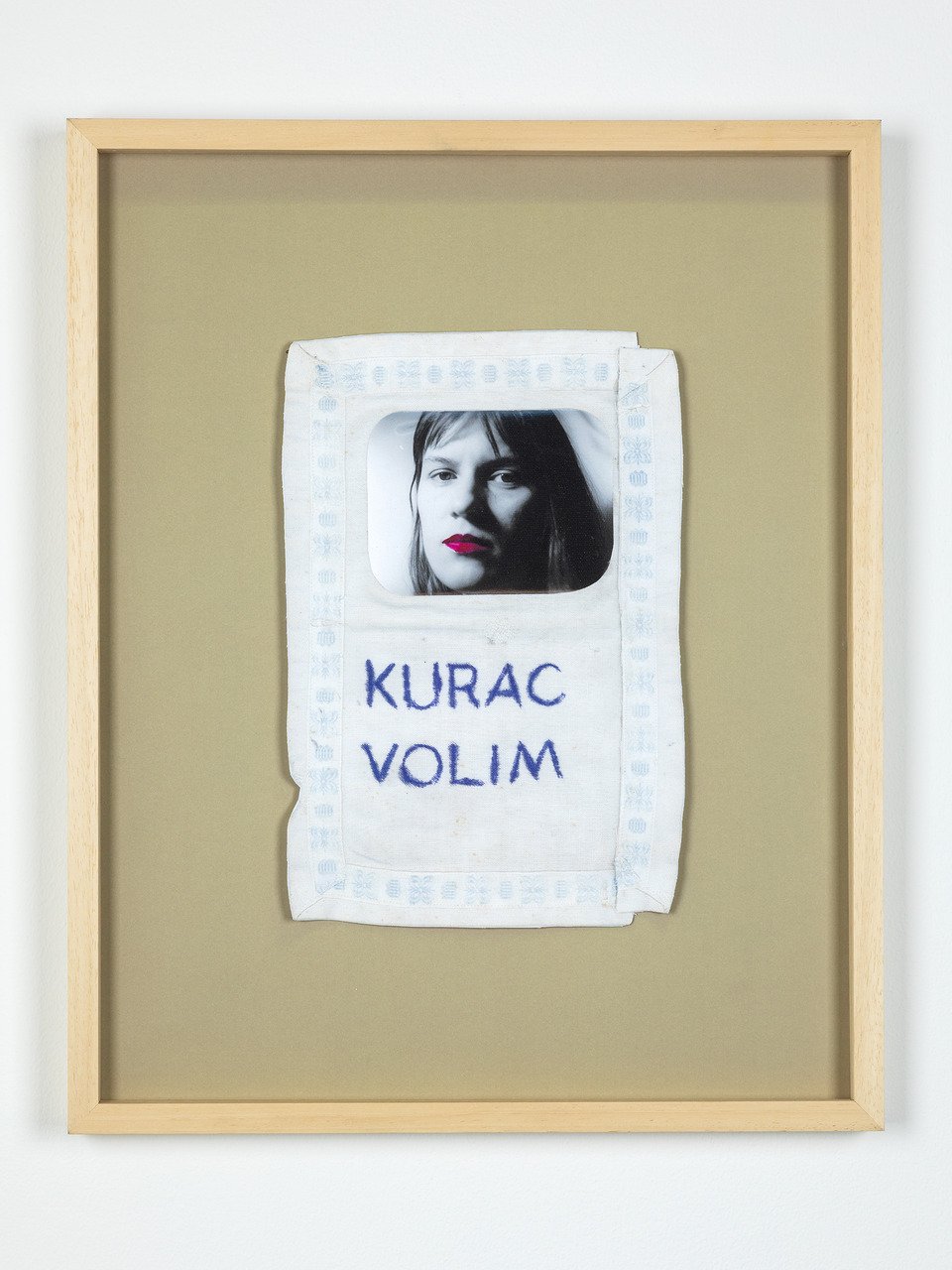
Image courtesy of MOCAK.
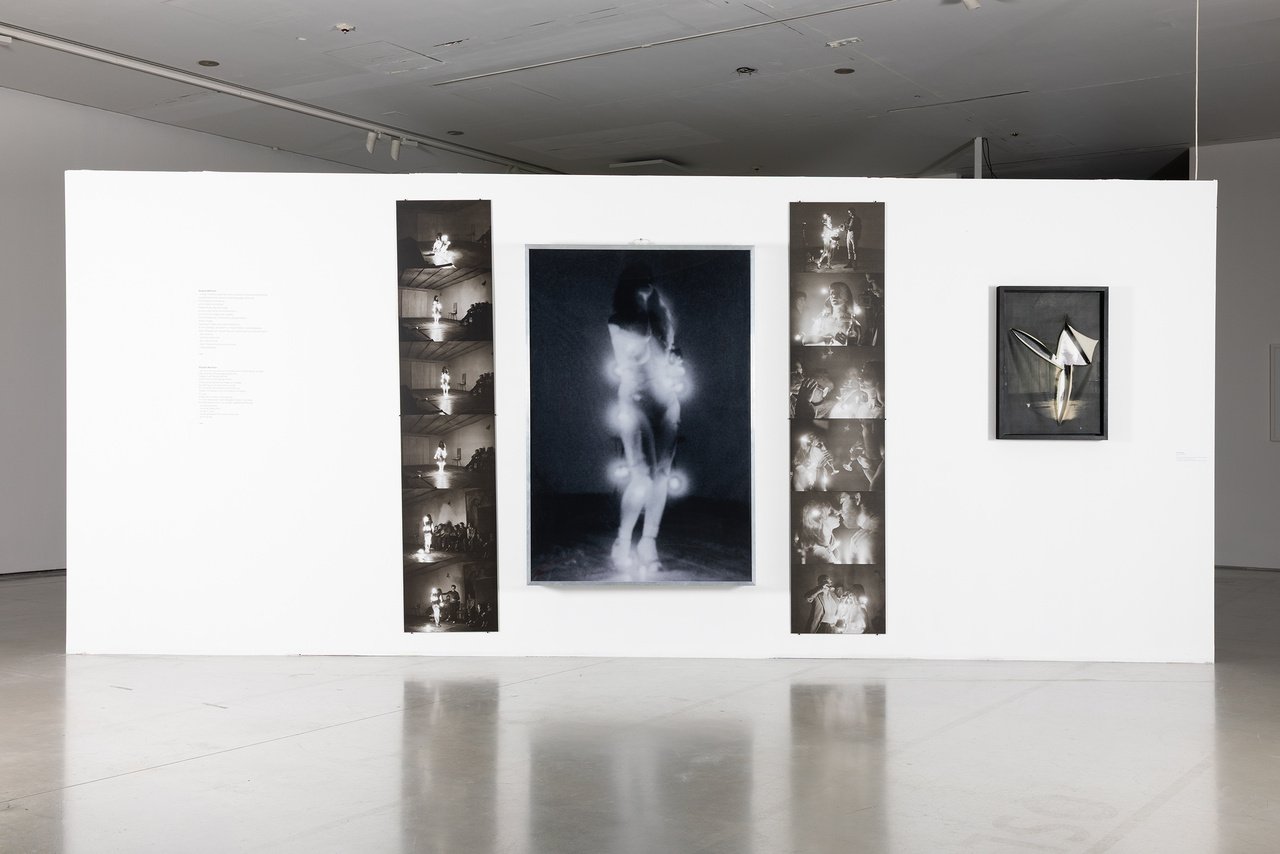
The position of women in institutions, society, and the arts has also been revisited by the artist in her performance Stupid Woman from 1981. This work is also composed of four pieces. Two image sequences of a performance show the artist wearing Christmas lights wrapped around her body. One of the layouts features a sequence in which she is standing before the audience, the second one is presenting a sequence in which she is drinking, laughing, and flirting with the audience, even kissing strangers. Between them there is a lightbox with a picture showing Partum standing in space, also wrapped in lights. The final piece is a collage constructed by placing one photo onto another. The photograph on top of an empty space, dark and cold. The photo has been cut into, allowing the bottom photograph to peek through, showing the same space illuminated by the artist. The documentation is accompanied by a text written by Partum:
…so it turns out one can choose which feelings to accept
like an actor choosing a costume
Today it will be ambition,
tomorrow a love assignment.
One would therefore make a mistake
by taking a schizophrenic world
for a stream of wealth and brilliance
meant to replace the monotony of reality.
If I can
Imagine so many love scenes,
It is not because I was disappointed in my love,
But because one is not capable of loving
…to be beautiful
…to smell beautiful
…to be in love
…to be pleasant for one’s audience
…to truly be.
Stupid Woman is a work about love, but in a more performative sense, it is a process of creating an atmosphere; one in which a person can be included, feel safe and seen, or take shelter from the outside world. But the other part of the piece is about the cost of such work – the vulnerability that is created by Partum through getting drunk while performing the piece. It can be an allegory or direct representation, but regardless, it is a warning about the ambivalence of love and women’s position in romance – and in art. As a part of conceptual neo-avant garde circles that were heavily masculinized, Partum knew exactly what kind of position women had in the field of art.
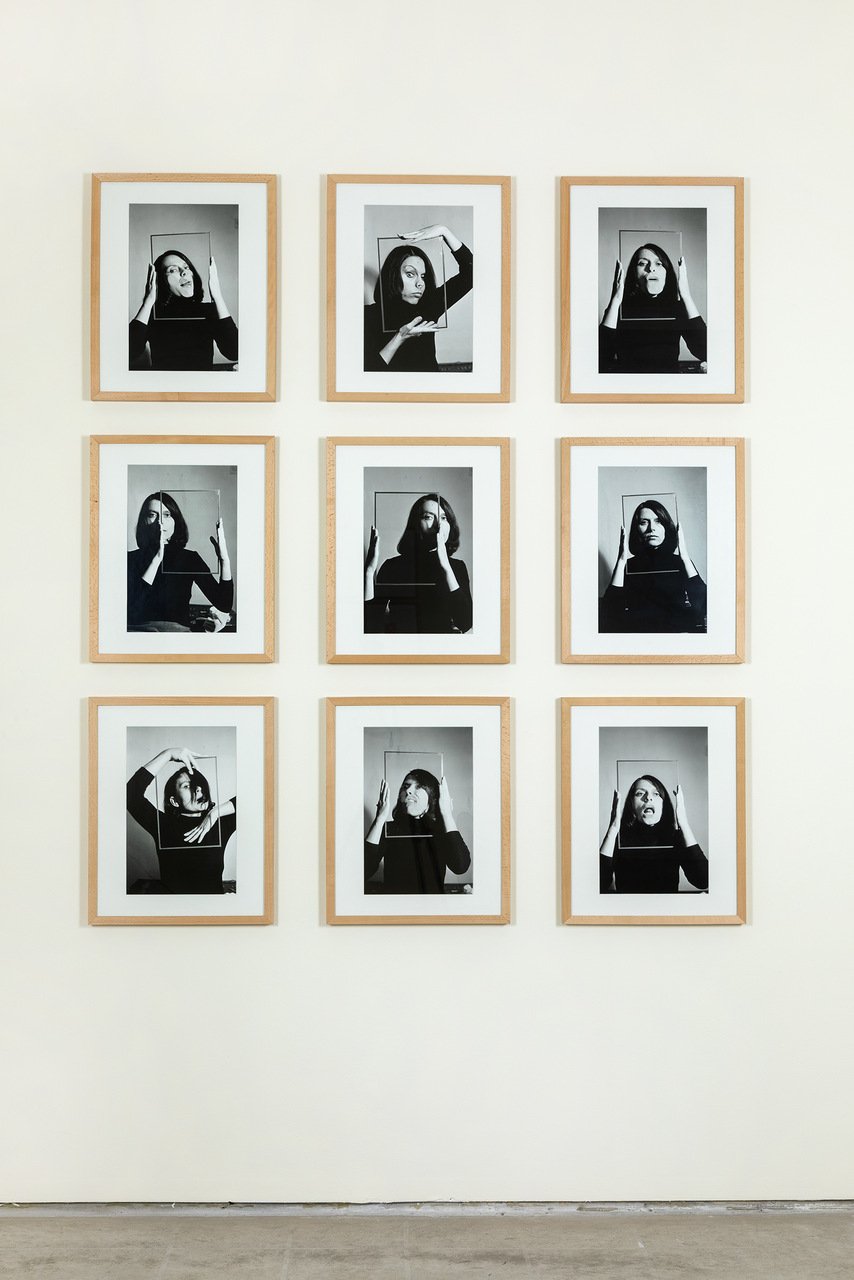
Image courtesy of MOCAK.
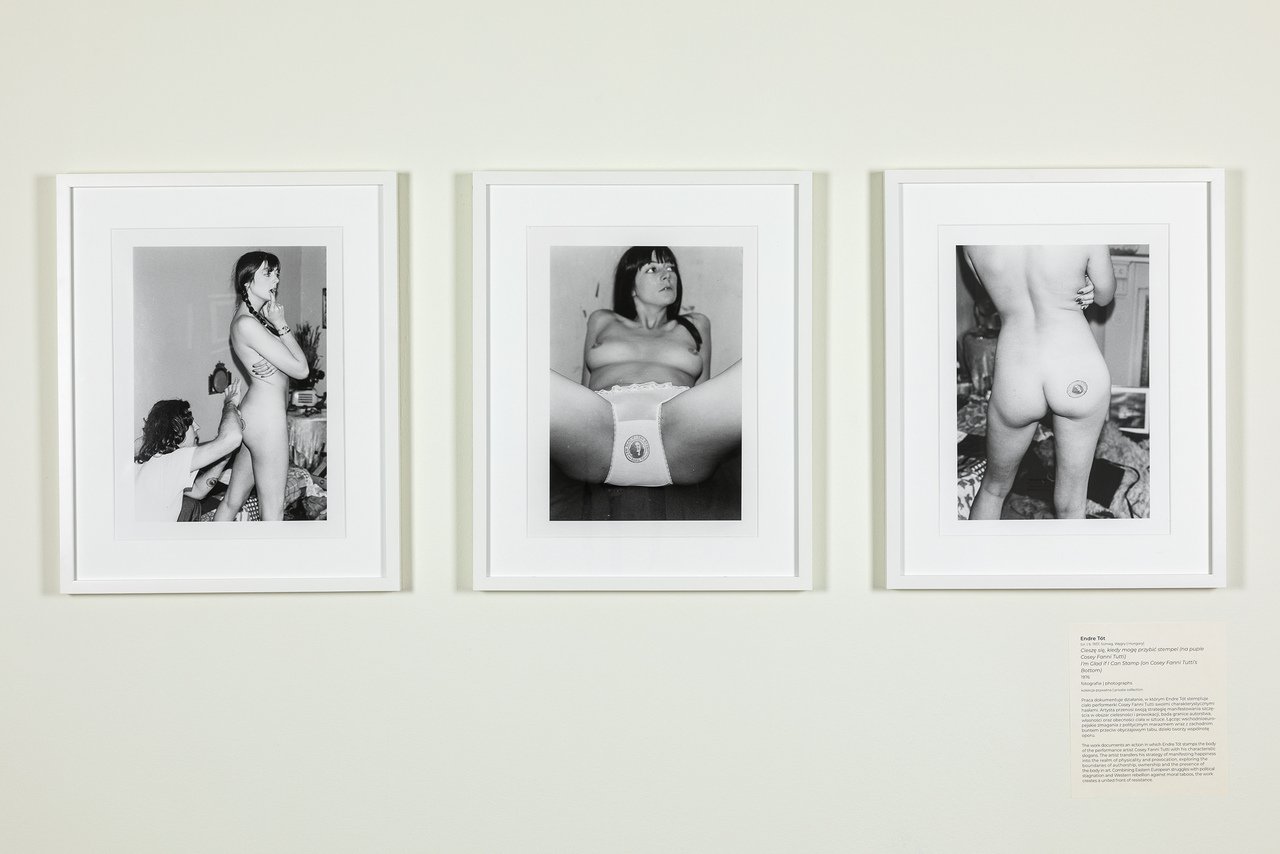
Image courtesy of MOCAK.
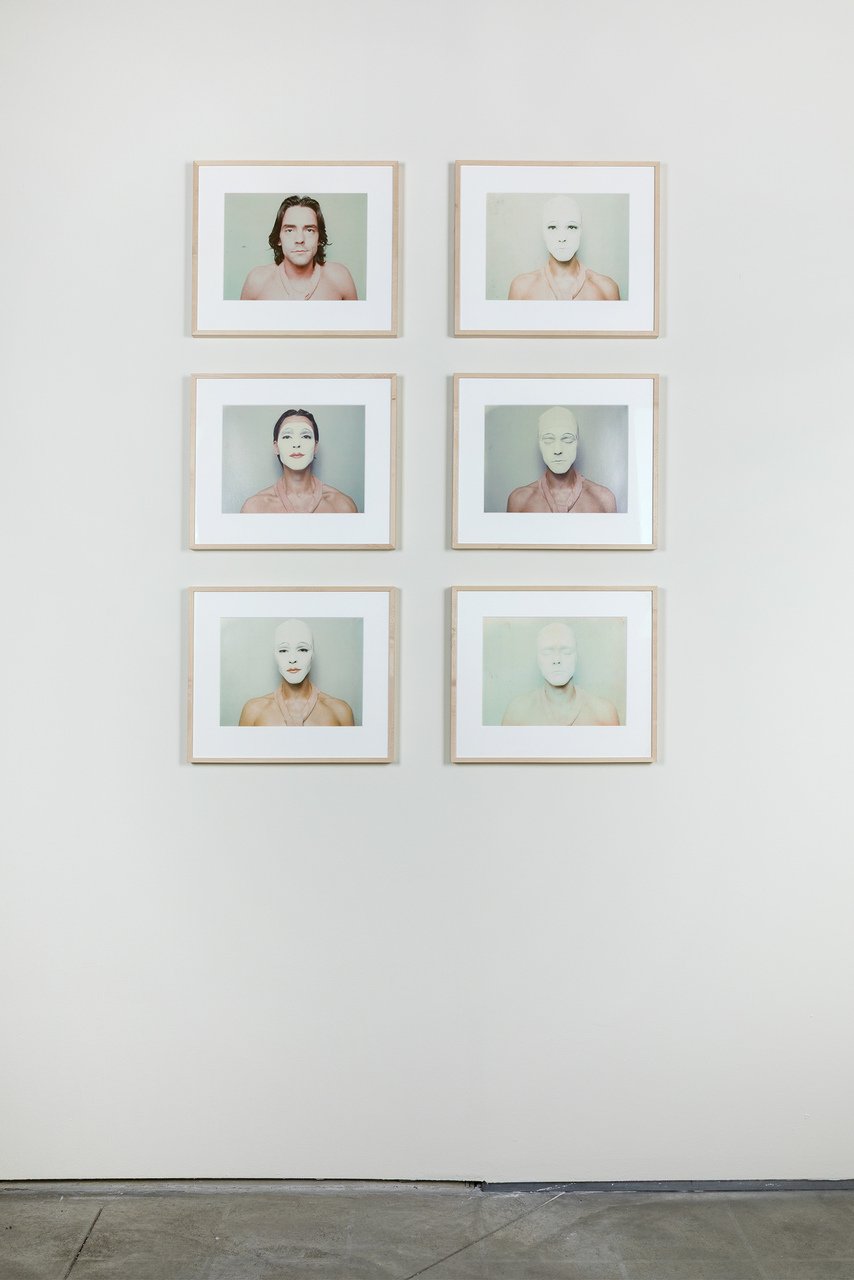
Image courtesy of MOCAK.
These interventions formulated by Partum are assembled with works by women artists from other CEE countries: artists who created during the 1970s and 80s as well as contemporary feminist artists. But when her work is being brought together with some of the contemporary works of feminist artists from Kraków, it results in some kind of flop I would say. The methods of artistic practice that were promising and powerful in the time of state socialism are not exactly something that translates well to some of the artistic tactics present today. To paraphrase Karl Marx (I think?) history happens two times – the first time as a tragedy and the second time as a comedy. And this time, seeing the photomontage of dozens of images by Iwona Demko of her work 408,223 skirt lifts, or my dream of the Black Protest, I unfortunately can only feel a slight cringe. Using the technique of photomontage, resembling Partum’s method from Self-Identification, Demko places dozens of her images onto the picture of Sukiennice, a landmark in Kraków’s Old Town. It can be described as an exercise in public art, or art as a means of protest, which is really close to the notion of Partum’s works. However, for some reason I cannot get away from the feeling that this kind of intervention really should not be reannacted today as it has lost its edge. An act that in the past worked really well in times where introducing women as a subject of art was a struggle, here it is a repetition that does not carry the same weight of political and artistic intervention. Especially in that Partum’s work gives space for meaningful speculation – did it actually happen? Did a woman encounter a policewoman while naked on the street, just like that? The work probably looked cool and was meaningful on social media in 2016/2020, but it doesn’t really feel relevant when put in the context of this exhibition.
But what does love have to do with autonomy?
There is another important theme present in much of Partum’s socially engaged works, especially those created while she was taking part in the neo avant garde circles via Galeria Adres: the autonomy of art. Her works from that period – 1971 to 1977 – are presented in the last section of the exhibition, just after the works referring to women’s autonomy. In MOCAK, the archive of Galeria Adres has been shown as typical archival material – through documentation on a monitor, in a display case, and an architectural plan of the gallery marked on the floor.
Adres was another form of her artistic practice – a project of appropriating the infrastructure of The Association of Polish Artist and Designers (ZPAP) – a highly politicised union of Polish artists instrumentalized by state officials. Through this work she was redistributing access to such spaces and creating a place for negotiating the conditions of artistic production, especially freedom for artistic experimentation and political intervention.
In Partum’s case, the experimentation and autonomy within the field is not something done just for the sake of art – a position that is making its return in the field today. Her practice shows how experimentation with formal and structural levels of art can result in the opening up of marginalized social and political life – the role and position of women under patriarchy, their position in the field of art, and other, more universal problems, and creates a space for feminist critique as a vital proposition for both.
The exhibition in MOCAK presents the work of Ewa Partum as a proposition for and intervention of the situation of women under state socialism, and the art world conditions through which this kind of art emerges. In the end, this exhibition can be a great opportunity to delve into the realities of Partum’s practice, in which the autonomy of art is dependent upon the engagement with life outside the field of art – a thing that now can be a dangerous game, which was once an invitation full of love.
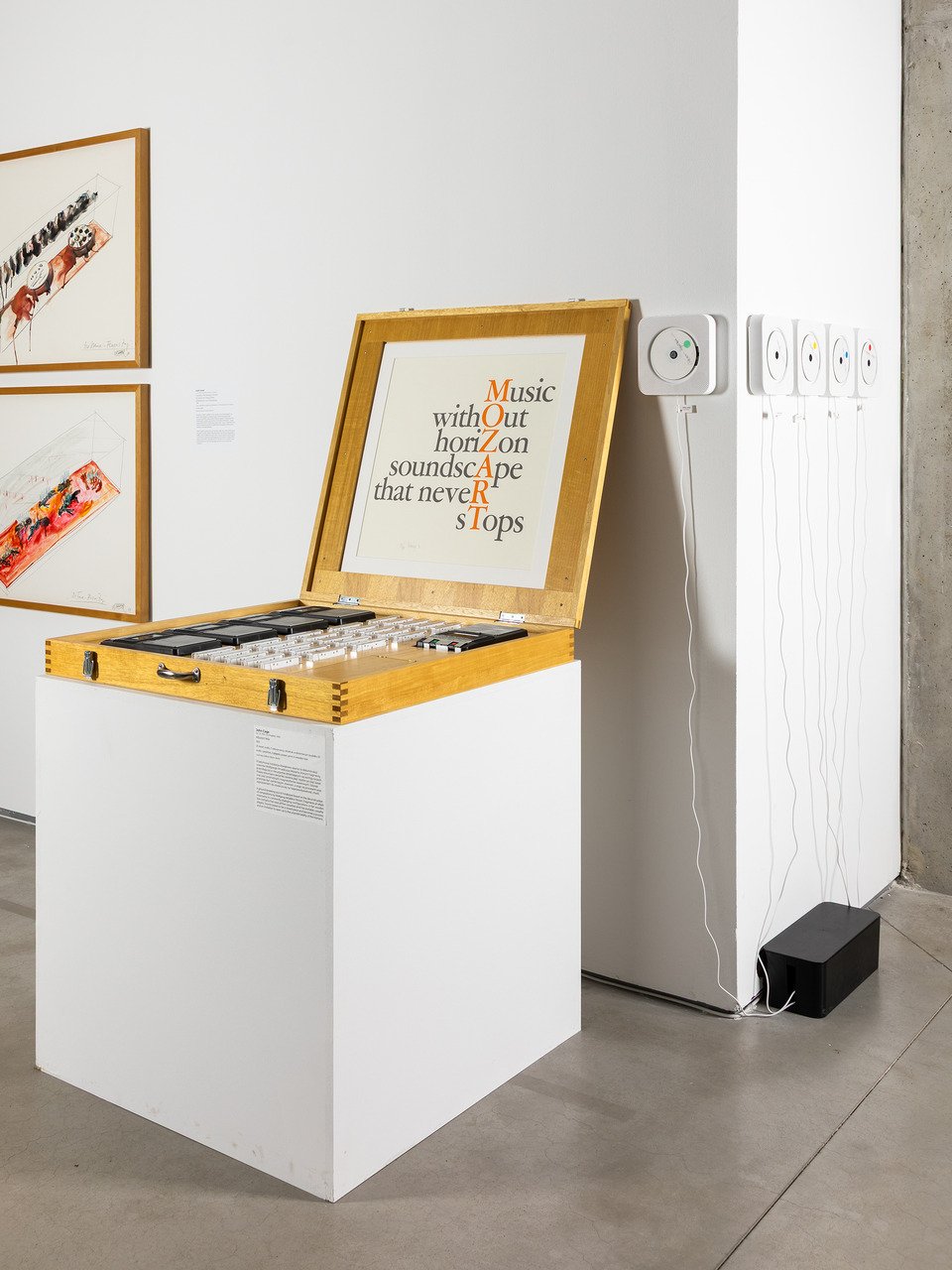
Image courtesy of MOCAK.
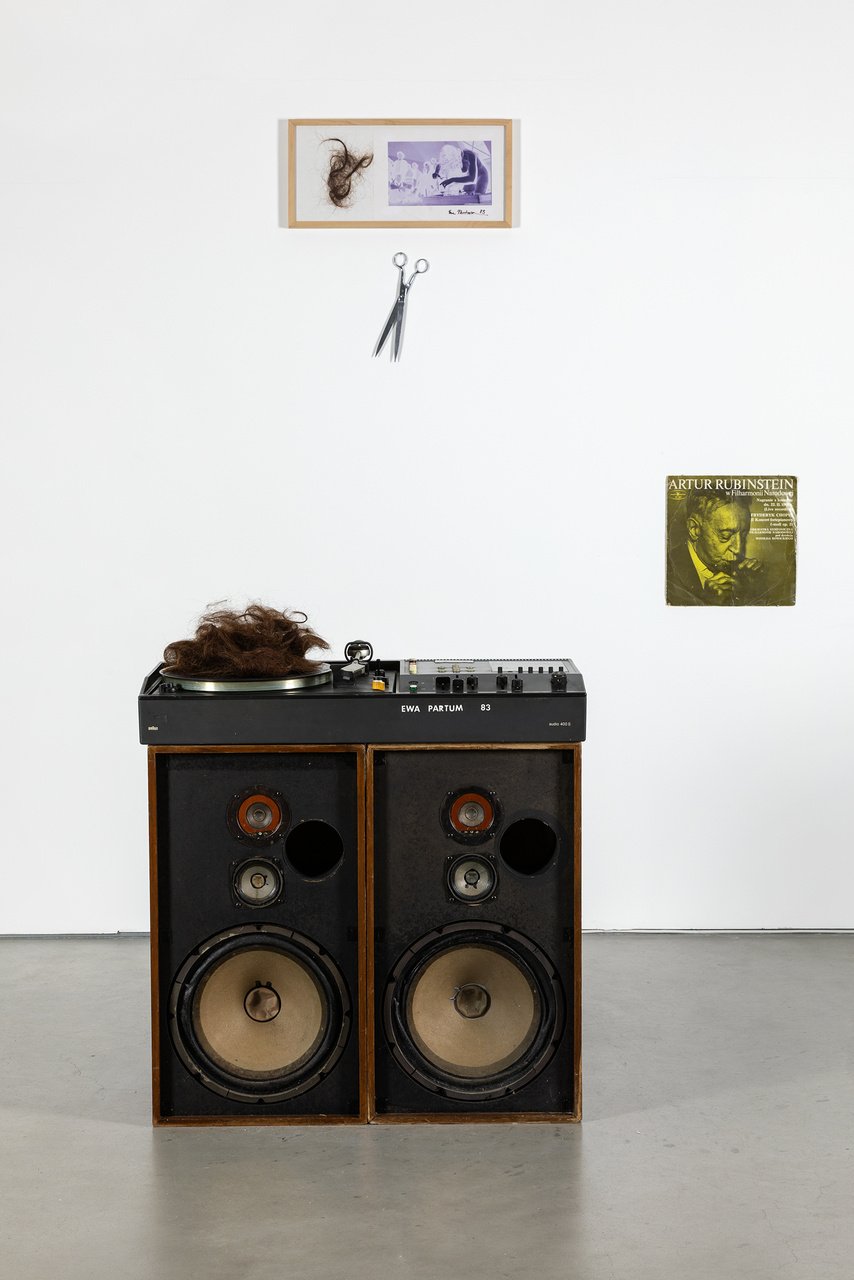
Image courtesy of MOCAK.
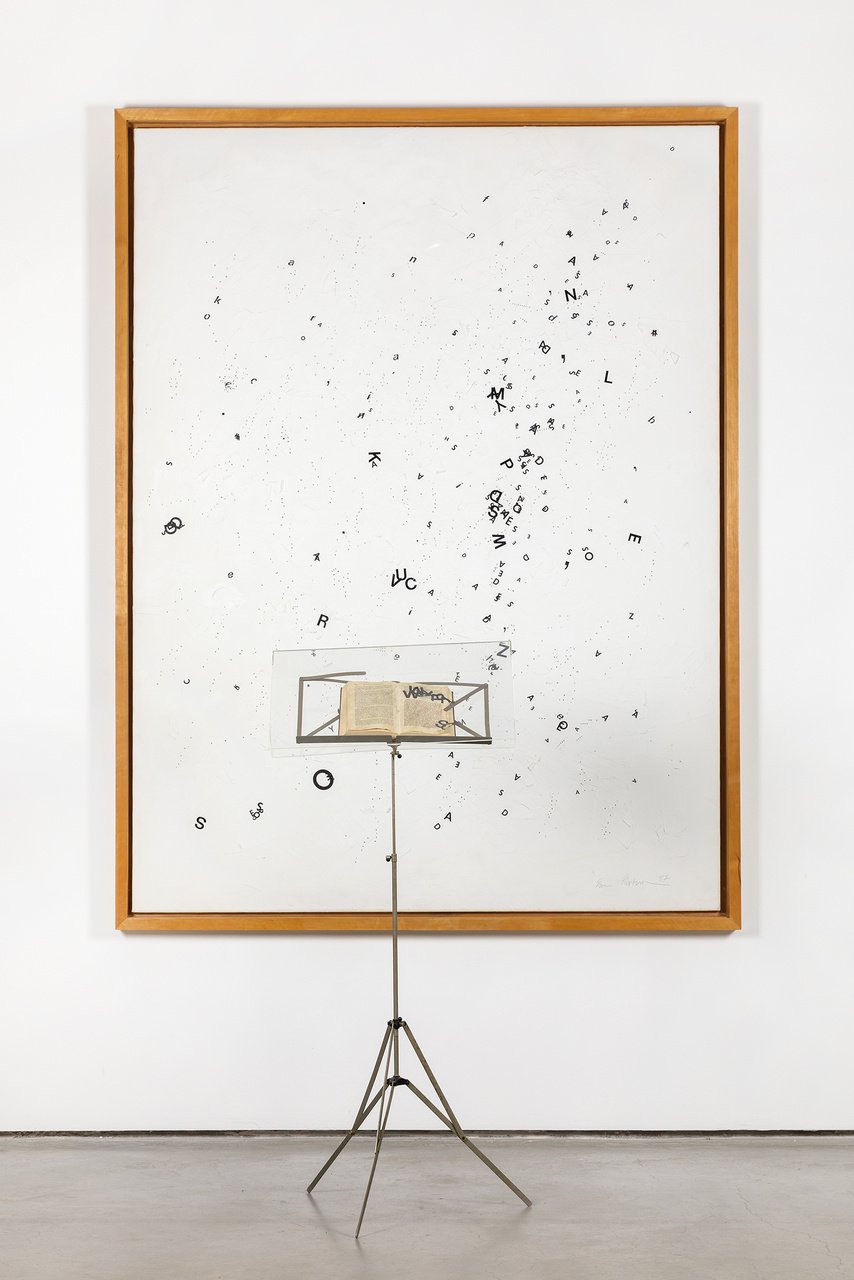
Image courtesy of MOCAK.
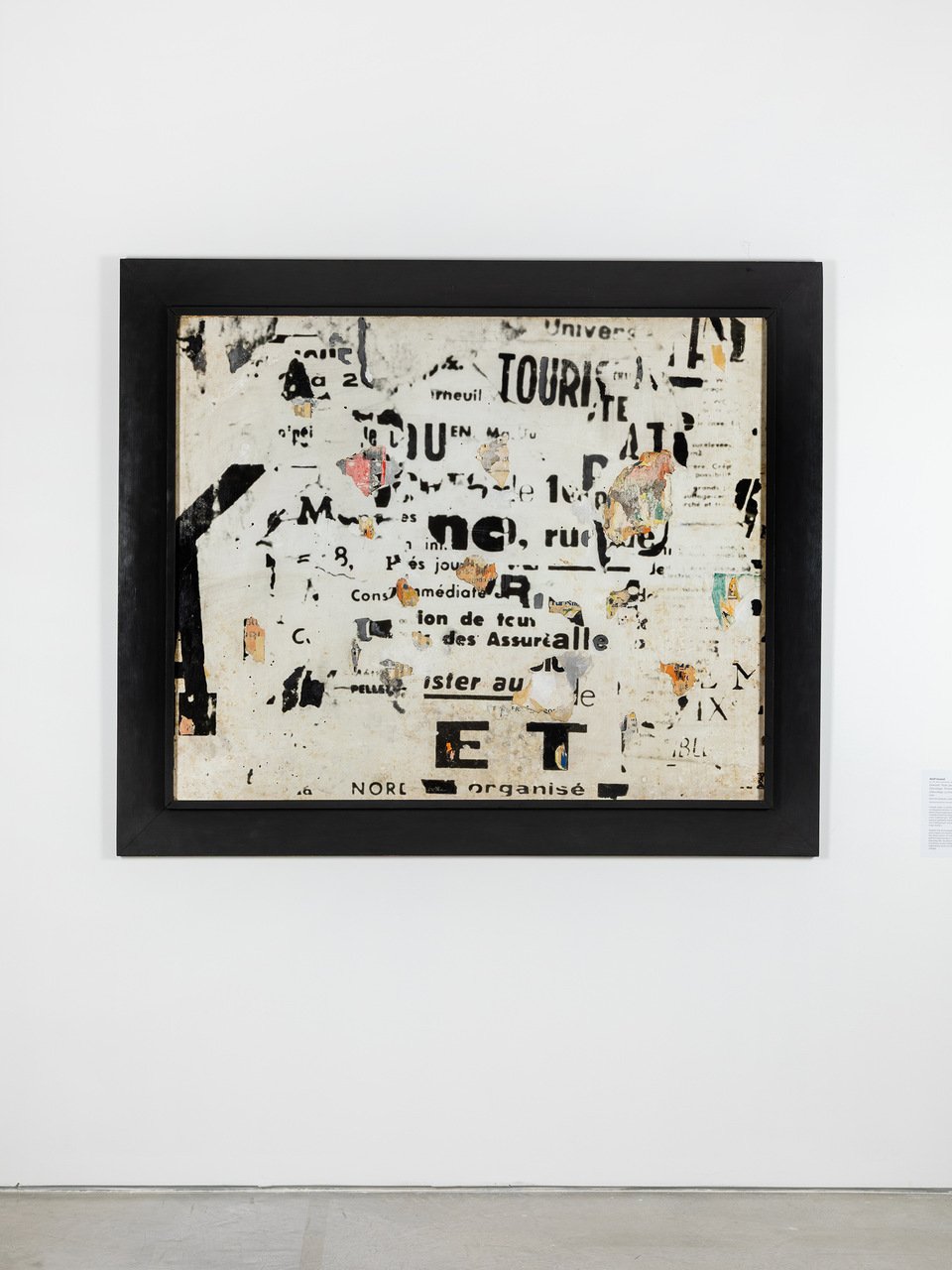
Image courtesy of MOCAK.
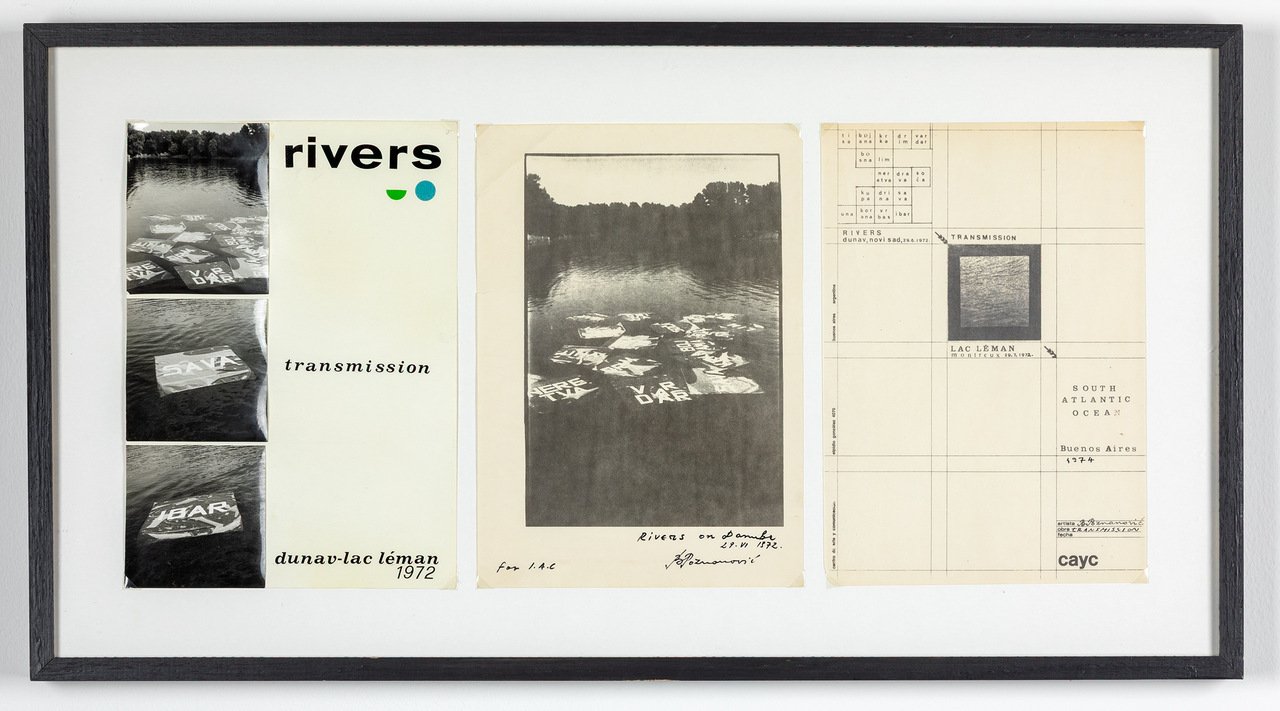
Image courtesy of MOCAK.
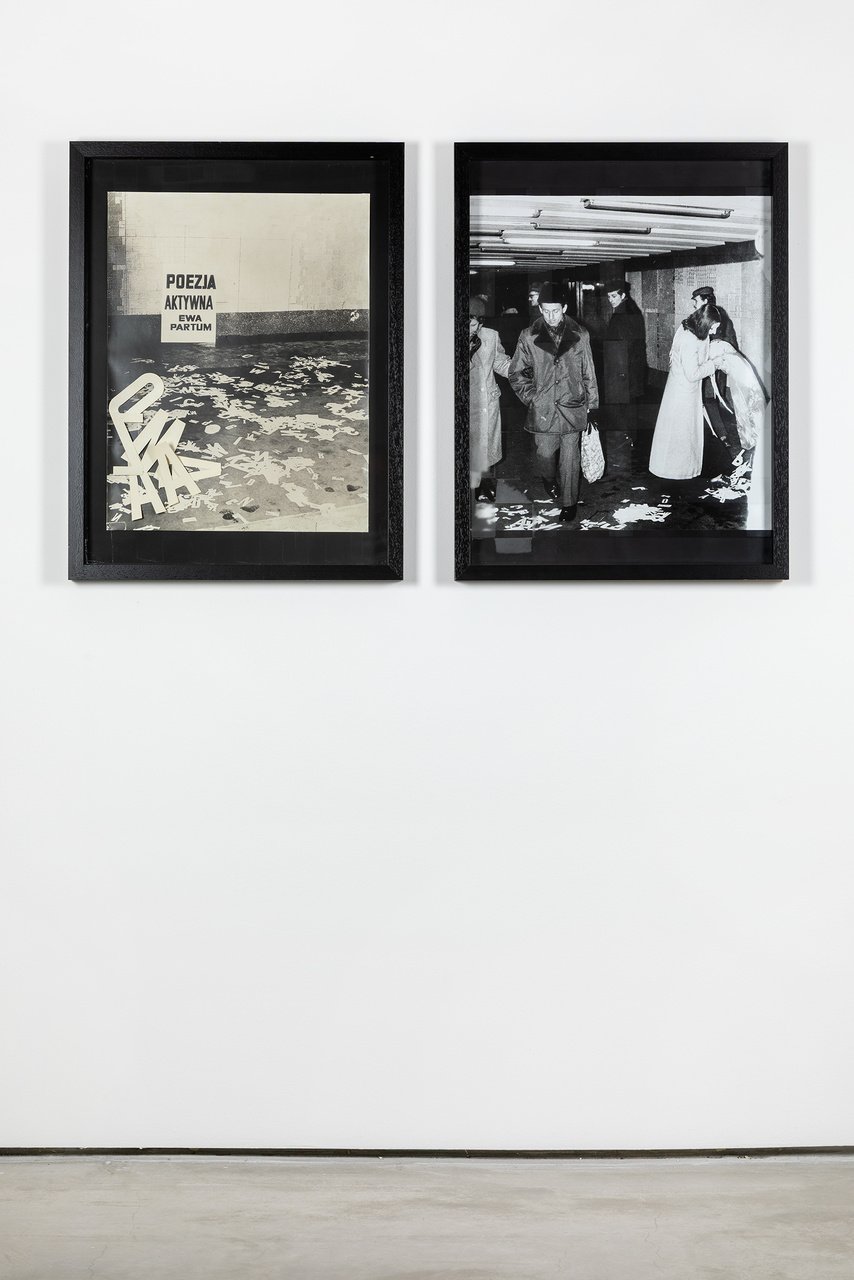
Image courtesy of MOCAK.
[1]The artist, in the self-published catalog for her exhibition at Galeria Mała (Warsaw, 1982) has divided her own practice into sequences, distinguishing periods of her conceptual practice, visual poetry, tautological cinema, feminist engagement, and her work in organizing Adres Gallery in Łódź. See K. Majewska-Güde, Ewa Partum’s artistic practice. An atlas of Continuity in Different Locations, transcript Verlag, Bielefeld 2021, p. 119-120. It is important to point out that the book by Majewska-Güde has been a great support in writing this text.
[2]This quote comes from the movie described in this paragraph. See. J. Motylińska, Emancypantka z Polski, Polska Kronika Filmowa, Wytwórnia Filmów Dokumentalnych i Fabularnych, 1981. Although the fact is that Partum has described that women are “handicapped by the existing social system.” See. Ewa Partum, handwritten notes, undated, in Ewa Partum’s archive, as cited in Majewska-Güde, p. 170.
[3]I am, indeed, a nerd.
[4]Majewska-Güde, p. 37.
[5]T. Załuski, Więzi i węzły neoawangardy. Koncepcja przestrzennego układu kultury Aleksandra Wallisa oraz możliwości jej aktualizacji, “Teksty Drugie”, 5/2024, s. 57-59.
[6]Majewska-Güde, p. 169.
[7]See. A. Jakubowska, Sztuka i emancypacja kobiet w socjalistycznej Polsce. Przypadek Marii Pinińskiej Bereś, Wydawnictwo Uniwersytetu Warszawskiego, Warszawa 2022.
[8]W. Szczupacka, 1975 – International Women’s Year and the Exhibitions Organised on this Occasion in Warsaw: A Case Study on State Feminism and Art Through a Revisionist Lens, “Ikonotheka”, 33/2023, p. 60-63.
[9]Motylińska, Emancypantka z Polski.
[10]L. Nader, Konceptualizm w PRL, Wydawnictwo Uniwersytetu Warszawskiego, Warszawa 2009.
[11]In his text Wiesław Borowski, one of the organizers of Galeria Foksal has committed a very provocative text criticizing the big part of neo avant garde newcomers, such as Partum, for their aspiration to create socially engaged art. See W. Borowski, Pseudoawangarda, “Kultura”, 12/1975.
[12] Majewska-Güde, p. 182.
Artist: Ewa Partum with John Baldessari, Josef Bauer, Mehtap Baydu, Lenora de Barros, Bettina Bereś, Renate Bertlmann, Joseph Beuys, Geta Brătescu, Marcel Broodthaers, John Cage, Vlasta Delimar, Iwona Demko, Monika Drożyńska, Jochen Gerz, Alexis Hunter, Sanja Iveković, Alfredo Jaar, Tadeusz Kantor, Běla Kolářová, Joseph Kosuth, Jiří Kovanda, Barbara Kozłowska, Jarosław Kozłowski, Katalin Ladik, Cecylia Malik, Piero Manzoni, Anna Maria Maiolino, Dóra Maurer, Gustav Metzger, Yoko Ono, Clemen Parrocchetti, Joanna Pawlik, Adam Pendleton, Maria Pinińska-Bereś, Bogdanka Poznanović, Jadwiga Sawicka, Carolee Schneemann, Penny Slinger, Gabriele Stötzer, Sturtevant, Endre Tot, Ulay, VALIE EXPORT, Wolf Vostell, Robert Watts, Zorka Wollny, Marta Ziółek, Jana Želibská
Exhibition Title: Contemplating Art, Contemplating Love
Curator: Adam Budak, Marta Smolińska
Venue: Museum of Contemporary Art Kraków (MOCAK)
Place (Country/Location): Kraków, Poland
Dates: 07.03 – 14.06.2026
Photos: Rafał Sosin. All images courtesy of MOCAK.