
Ida Dziublewska
There is a thread of thought that has been steadily taking up more and more of my mind throughout the 2020s: cautionary tales do not work. At least not anymore. Between global crises and the shady dealings of our tech overlords, it seems like it is better not to give the world any ideas, as no matter how clearly they are portrayed as warnings, they will come to life – sometimes in extremely literal ways as is the case with Palantir, a company dealing in government surveillance and military technology. In its early days, it was compared to the precogs of the dystopian world of Minority Report as if it was an unequivocally good thing and unironically named after the palantíri of Lord of the Rings, crystal balls making it possible to view distant events, a proto-surveillance technology abused by the story’s antagonist, Sauron. It is like the pink elephant paradox – good luck not thinking about a pink elephant when someone tells you “don’t think about pink elephants” – on a global scale. It is with this wariness that I approach one of this year’s offerings of the Ujazdowski Castle Centre of Contemporary Art’s Project Room: Ania Grzymała’s White skies, white worlds.
Grzymała made a name for herself as an artist that is able to strike the nerve of those hopped up on too big a dose of Polish national pride. Her second painting in a series titled Take off your Uniform, Apologize to your Mother (2021) sparked a media uproar perpetrated by right-wing pundits upon its having been featured at the 22nd edition of the SURVIVAL Art Review in Wrocław in 2024. It depicted a naked border guard, his uniform hanging behind him, his face in his hands, kneeling in front of his mother. Amidst the humanitarian crisis at the Polish-Belarussian border, it proved to be quite unfavorable for anyone that posed any shred of criticism directed at Poland’s handling of it. Overnight, Grzymała had to figure out how to deal with a hateful media campaign and copious amounts of death threats directed at her. Once the dust had settled, she commented on it with another work, Self-portrait with a Popular Youtuber (2024), a tongue-in-cheek depiction of her lasting belief in the possibility of a peaceful world where she sits down for tea with the titular Youtuber – an alt-media type that started it all and then just as carelessly directed the ire of his trigger-happy audience to another topic of the day.
While it might be what brought her the most attention, it does also illustrate the general tone of her practice up until now. Having seen her works at various group shows I came away with an impression of an artist willing to speak truth to power but not without a certain calmness or sense of humor. In Grzymała’s paintings and the stories she weaves alongside them, those that need to be taken down a peg or two are not spared while the disenfranchised get to enjoy a more peaceful and equitable existence. These narratives are sometimes conveyed across multiple works that compliment each other, delivering a straightforward moral message, using whimsical allegories and fantastical solutions to draw on the sort of worldbuilding we know from fables, and utilizing them to imagine radical societal shifts.
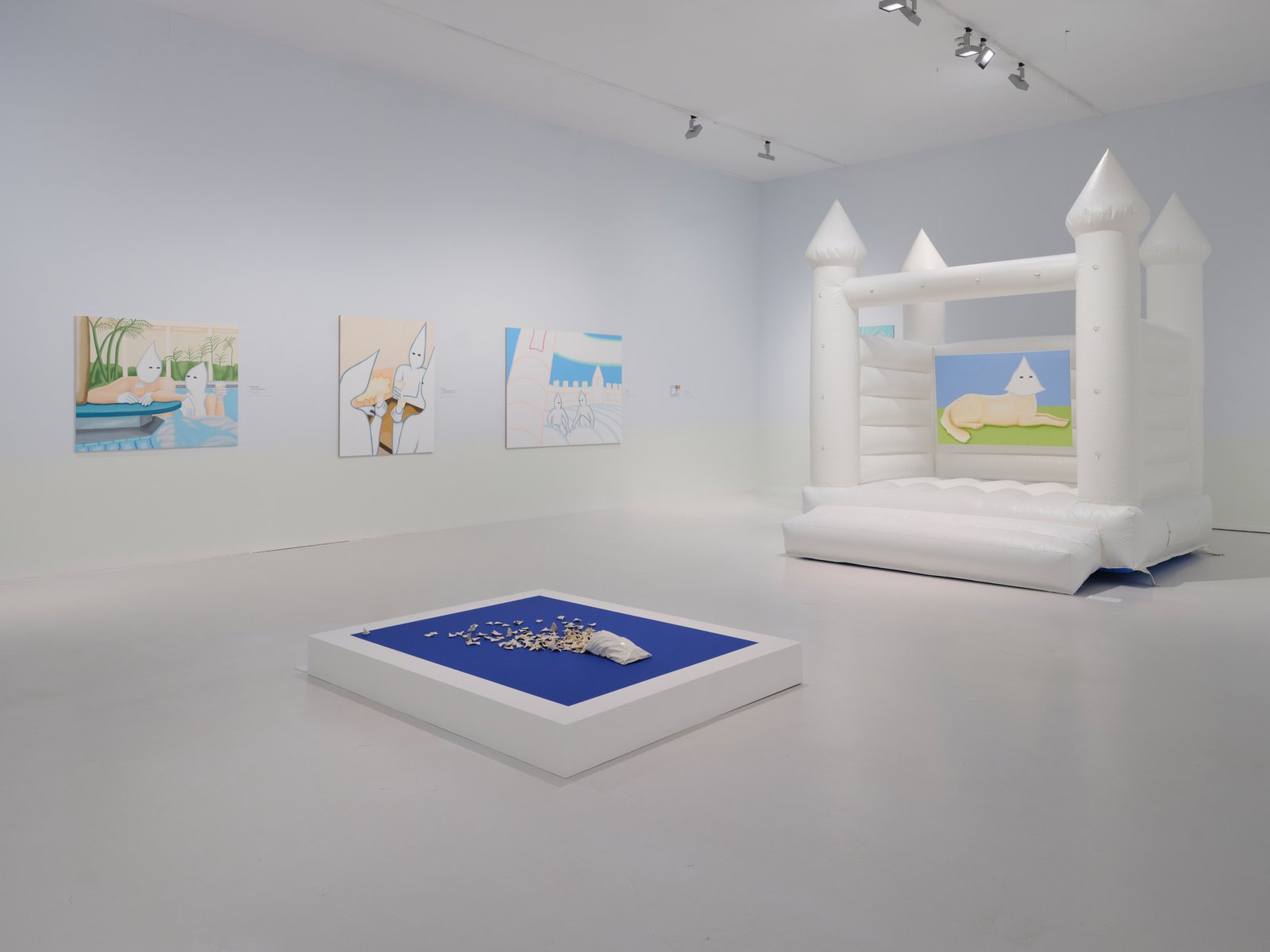
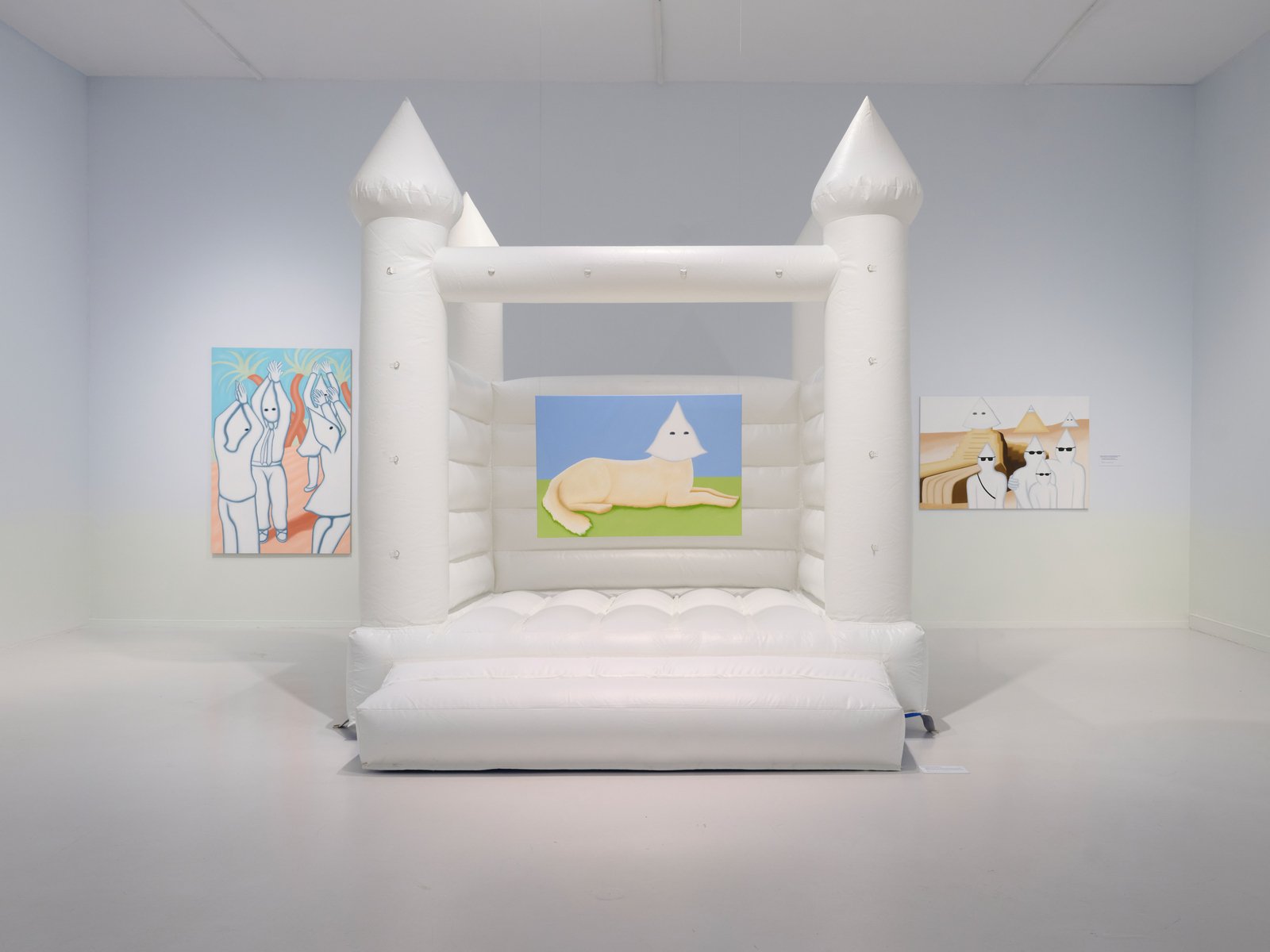
Entering the Ujazdowski project room your eyes take a minute to adjust to what is a brightly-lit, dazzlingly white space. It is pleasant, idyllic even; a family festival with a bouncy castle, except practically all of the people portrayed are members of the Ku Klux Klan. Not actual real-life klansmen, but rather a sort of transposition of them into a fantasy contemporary Poland that has been taken over by white supremacy, where the klansmen are living a rather carefree existence in their anti-utopia. It’s a strategy Grzymała uses to examine “communities founded on exclusion and the normalisation of dangerous views and beliefs,”[1] taking it to an extreme where the community achieves its goal of an all-white world.
There is a deliberate order to the exhibition’s arrangement. The project room is either square or near-square. Practically all of the works hang on the walls, roughly outlining the perimeter of the space in a straight line, the two exceptions being a painting placed in the bouncy castle and a sculpture placed in the middle, more or less splitting the room in half. The background landscape of the painting in the bouncy castle spills out on the gallery walls, covering them in a very diluted green and blue, making it feel all the more like a picnic, and accentuating the klan-white of the garments worn by Grzymała’s protagonists. While it would otherwise be a fairly by-the-book approach, here I find this arrangement strengthens the exhibition’s central themes, without remaining too strict. The sculpture in particular is a cheeky way of breaking things up. Titled White Package, it’s a white ceramic bag of klansmen head-shaped ceramic white crisps. They appear similar to the ghosts of the Polish snack Monster Munch, prompting some humorous musings – is it food for monsters or do you turn into a monster by eating them? There’s also another white package with fewer crisps in one of the room’s corners, this one with only a handful of crushed crisps, serving as a prop, trash discarded at this “fundamentalist family festival.”
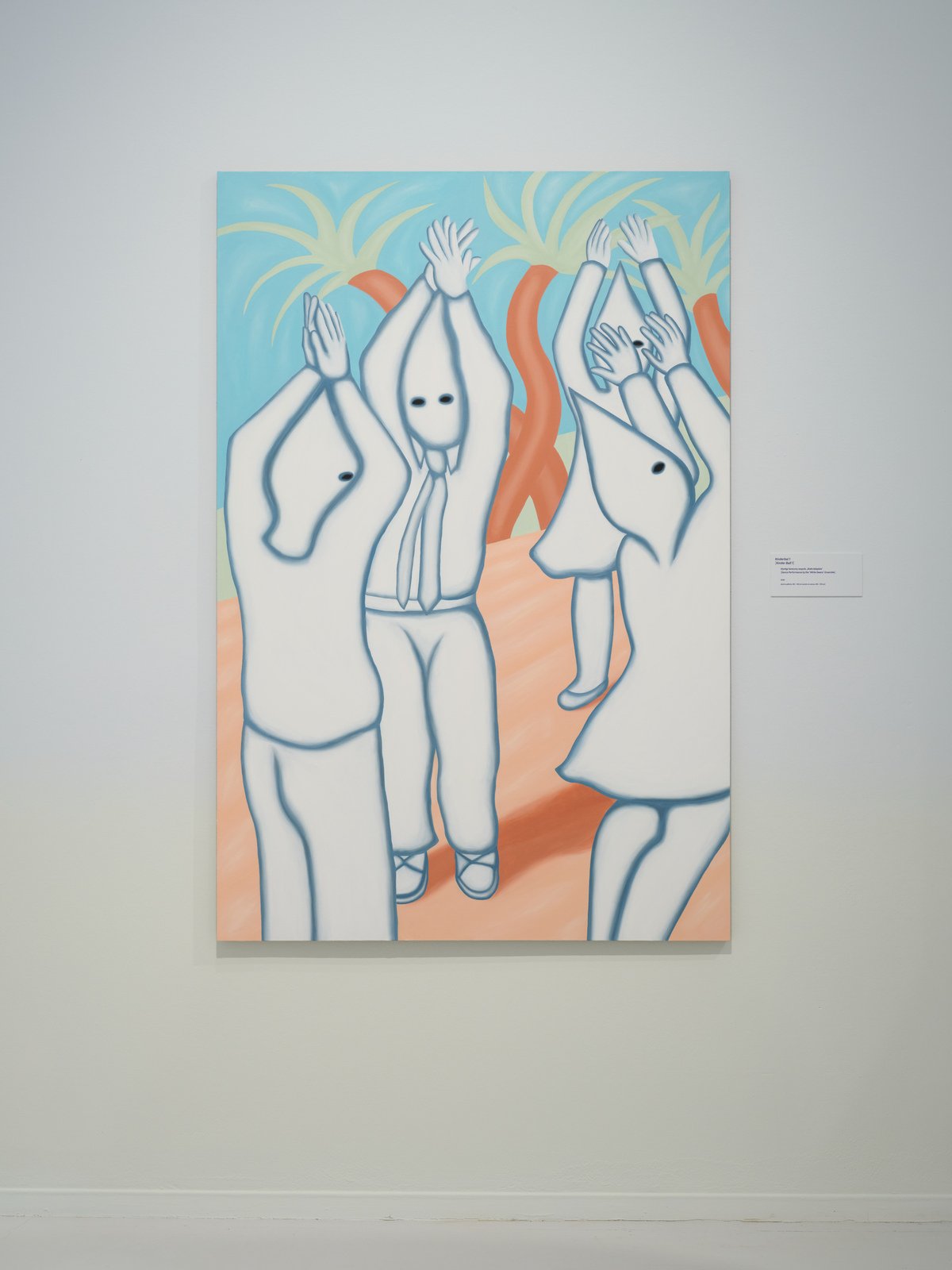
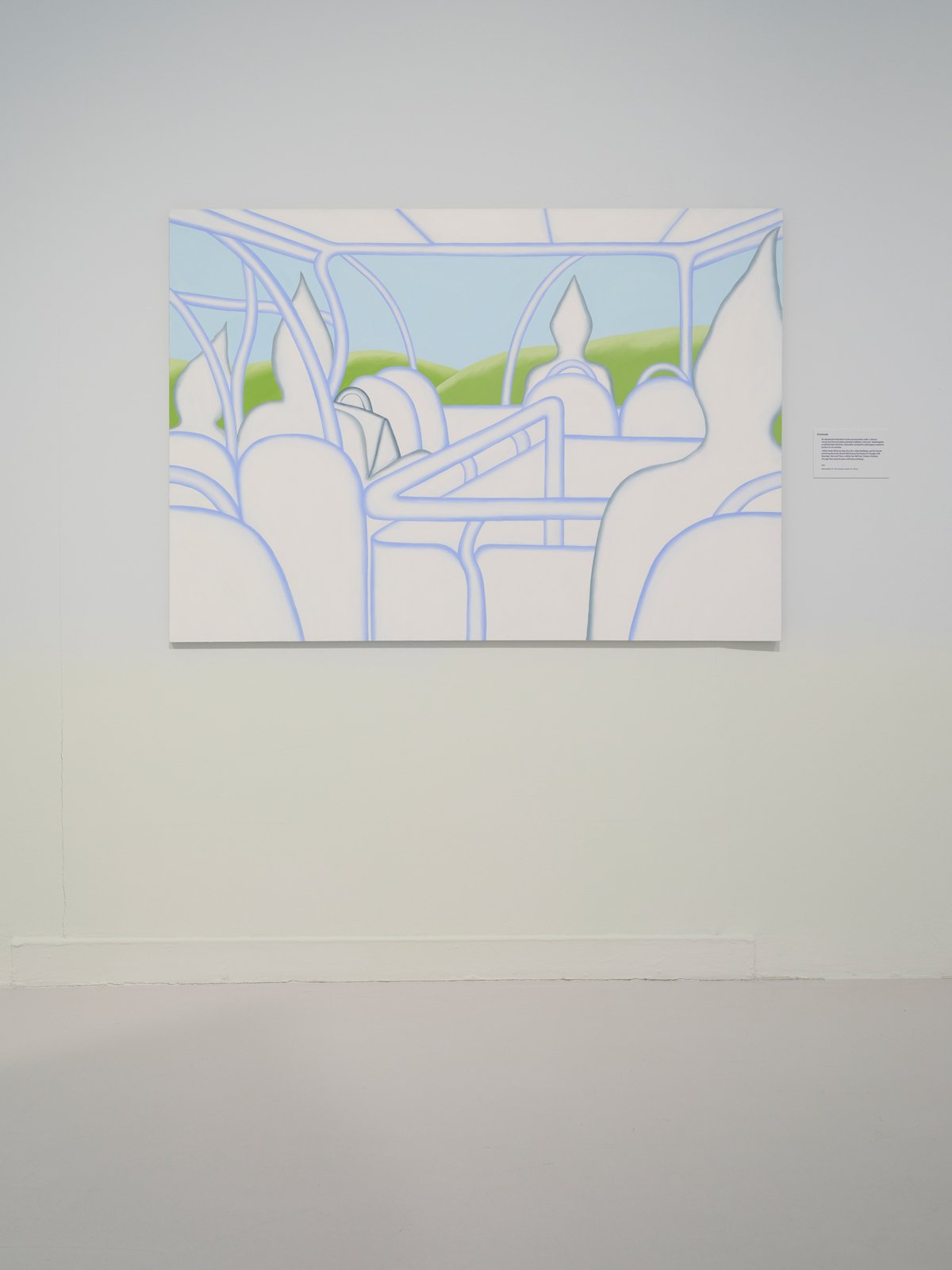
Actually, there is one more thing in the room with us, curiously missing from any of the exhibition’s paratext; a huge elephant demanding to be addressed. Throughout my entire time at White skies, white worlds, my mind kept incessantly comparing the klansmen in front of me to those of Philip Guston, his klansmen nearly 60 years senior to those of Grzymała. While there are no overt homages to be found, both artists employed a similar strategy. They depicted these white, hooded figures in benign settings, acting out carefree, daily activities; Guston imbuing them with an ease and dare I say charm that made them disarming and thus all the more unsettling, Grzymała seemingly also striving to unsettle by placing them outside of their original context. For both of these artists, this subversive strategy serves as a way of portraying the everyday, banal side of evil. But there is also plenty that sets them apart.
Guston was a son of Ukrainian Jews that escaped the pogroms in Odesa. While he was born in Canada, his parents moved to the US when he was a child, in 1919, where the KKK was very much active. He started painting his klansmen in 1968 – a year of heightened civil unrest (preceded by other turbulent years), with ongoing Vietnam War protests and the assassinations of Robert F. Kennedy and Martin Luther King, with the latter representing a tipping point not only for the civil rights movement but also for Guston, who felt the need to react. When his works with the hooded figures were first shown, they were legible in the context of both that year and the broader history of racial violence in the US, as well as in relation to his family history.
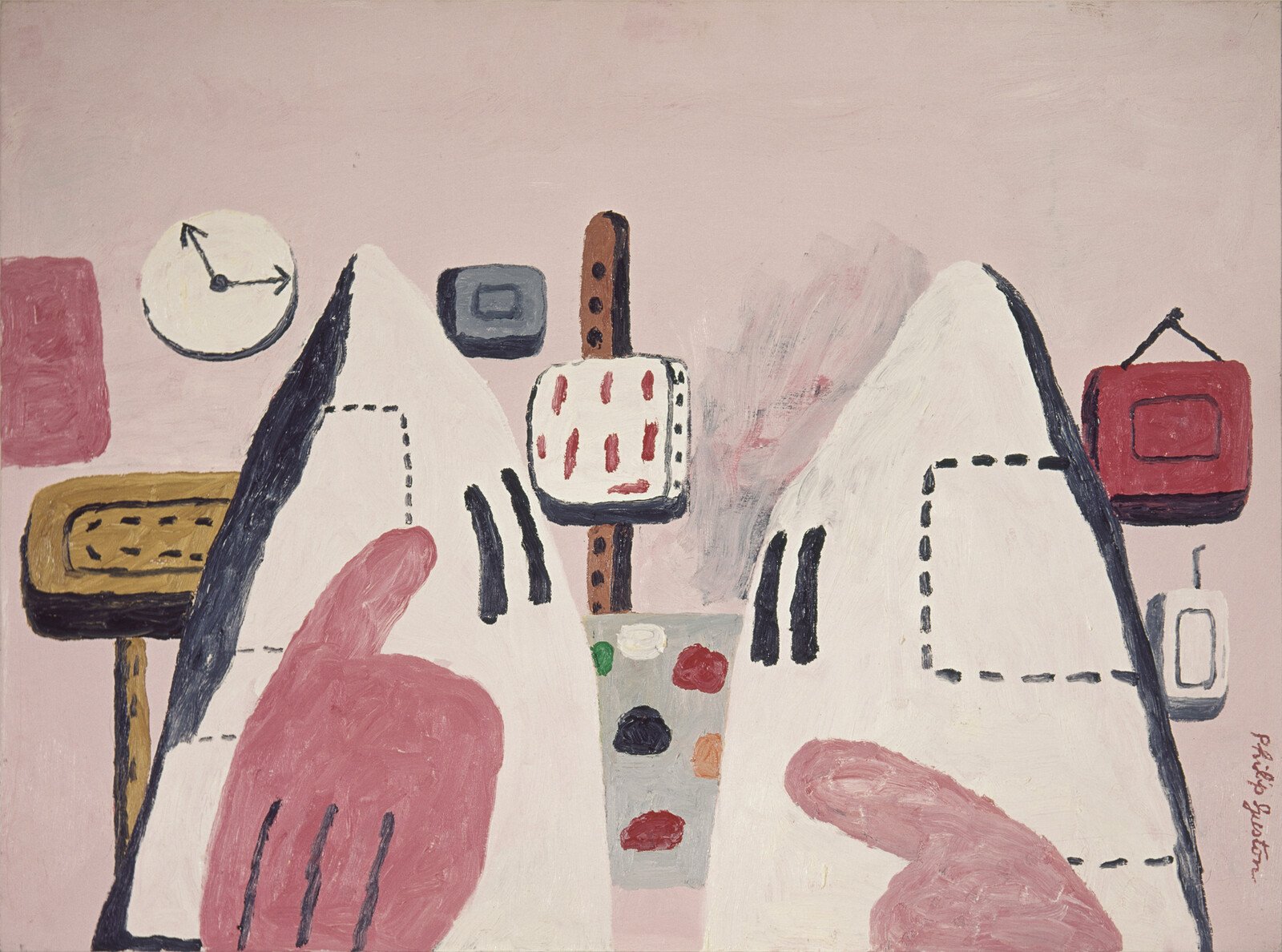
As for Grzymała, it seems a curious choice of subject matter. The aim is also legible here, perhaps partially due to the association with Guston, but transplanting the klansmen onto the Polish context seems to me to dilute Grzymała’s usually pointed critique of Poland’s bigoted tendencies. The KKK is non-existent in Poland[2] (even though it originates from Pulaski, a city named after a Polish-born general considered a national hero of both Poland and the US), so for many a Pole it might be completely unfamiliar. The klansmen appeared in the US as a reaction to the defeat of the South in the American Civil War – broadly speaking – representing a wish for the reestablishment of the most extreme form of white supremacy, wherein the White Anglo-Saxon Protestant would domineer over anyone that did not fit that description, in particular, African Americans and Jews but also, as a crucial point of comparison here, Catholics. Little of that maps cleanly onto a picture of present-day Polish bigotry. Poland was not a slave-owning nation – it engaged in serfdom – nor did its legal system ever discriminate on the basis of skin color to the extent that the US legal system once did. Furthermore, the average Polish nationalist is fiercely (if often only performatively) Catholic. Their primary concern is in maintaining Poland, a largely monoethnic country, as close to an ethnostate as possible, not letting in migrants and making the country inhospitable to those that are let in. As such, their main point does not so much lie in racial purity (which is not to say that they do not engage in race-based discrimination, they very much do) but in a more generalized xenophobia, as evidenced by the rise in anti-Ukrainian violence in Poland, targeting people that are about as culturally, ethnically, and racially close to Poles as it gets. Too much gets lost when translating between these two contexts; what little remains does not make for anything more than a vague gesture pointing towards Polish racism and discrimination.
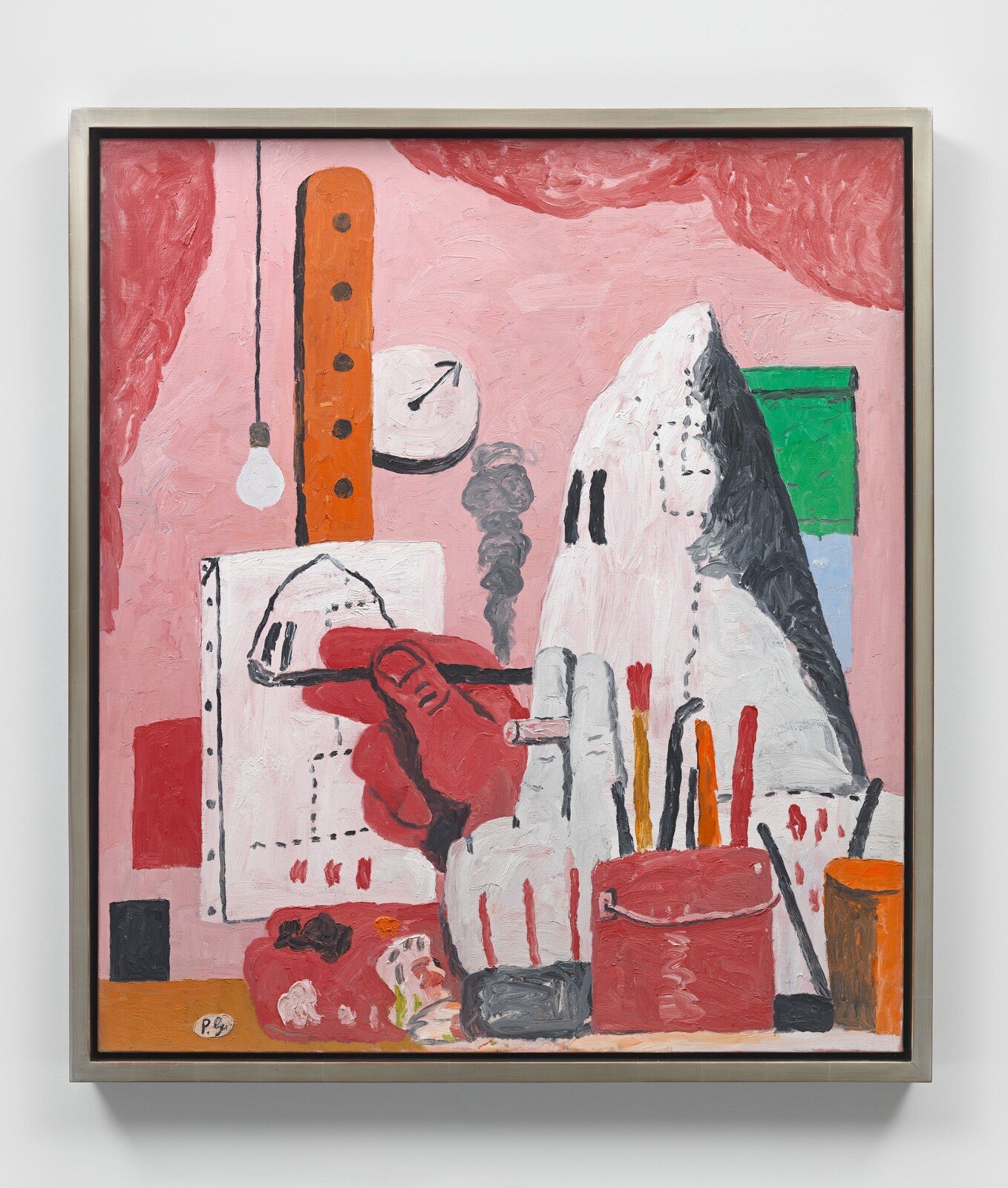
© The Estate of Philip Guston. Courtesy of the Estate and Hauser & Wirth.
For Guston, the choice of KKK as subject matter was a genuine risk, not just due to it striking at the heart of American racism, but also as a return to an old enemy of his,[3] and as the first paintings he presented after his break with abstract expressionism. When Grzymała goes for the same subject matter, the end result is low-stakes fun, playing with history and employing shocking imagery without any focused conclusion. It is also the sort of naive-historiographic approach of people claiming that ICE[4] are modern day Gestapo and more often than not it proves to be a double-edged sword. Yes, there are many genuine similarities that can be drawn between the two (Gestapo-ICE, KKK-Polish racists and nationalists), but it risks placing current events in the realm of history, as something that has already been dealt with, that will go away on its own, while undercutting the real ways in which their violence is different and how it affects people in the present moment.
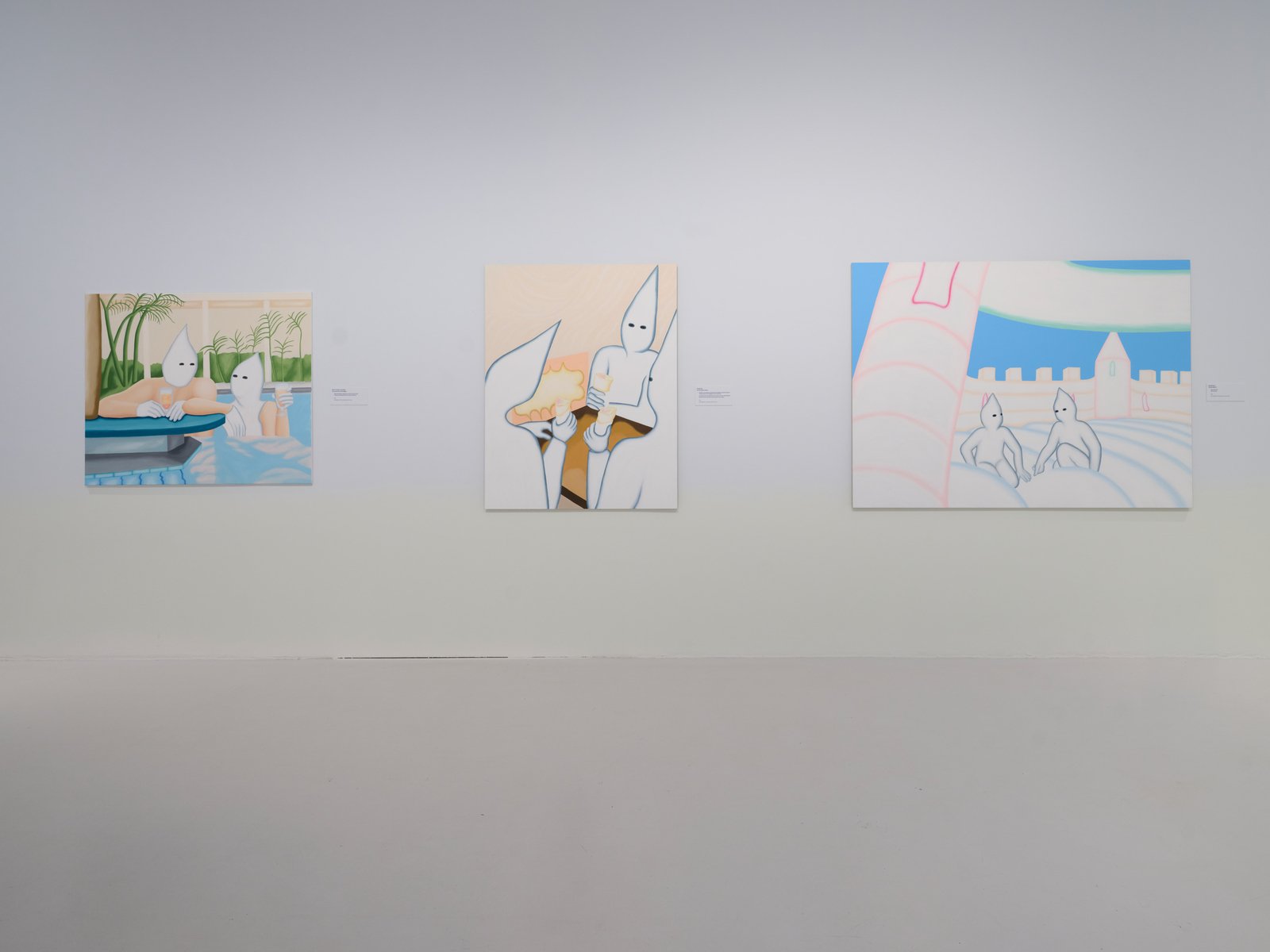
While at White skies, white worlds, viewing the paintings one by one in succession, in accordance with the design of the exhibition, I encounter a growing sense of unease, but most likely not the intended unease. People at a kebab shop, at a water park, commuting, at a corner store – the entire framing of the exhibition as a family festival; under normal conditions these all sum up to a showcase of mundane lower to middle-lower class provincial life in Poland. Warm Greetings from Sunny Egypt is maybe the one exception, depicting a family on vacation in Egypt, the sort of holiday destination that – at least in Poland – does bring up associations with your nouveau riche uncle taking his first trip by plane. Portraying these people as klansmen communicates what the artist’s intention is: to show the commonplace side of racism in Poland and to hold up a mirror (in the case of the painting The Whitest Man in the World, a literal mirror) to the average Pole.
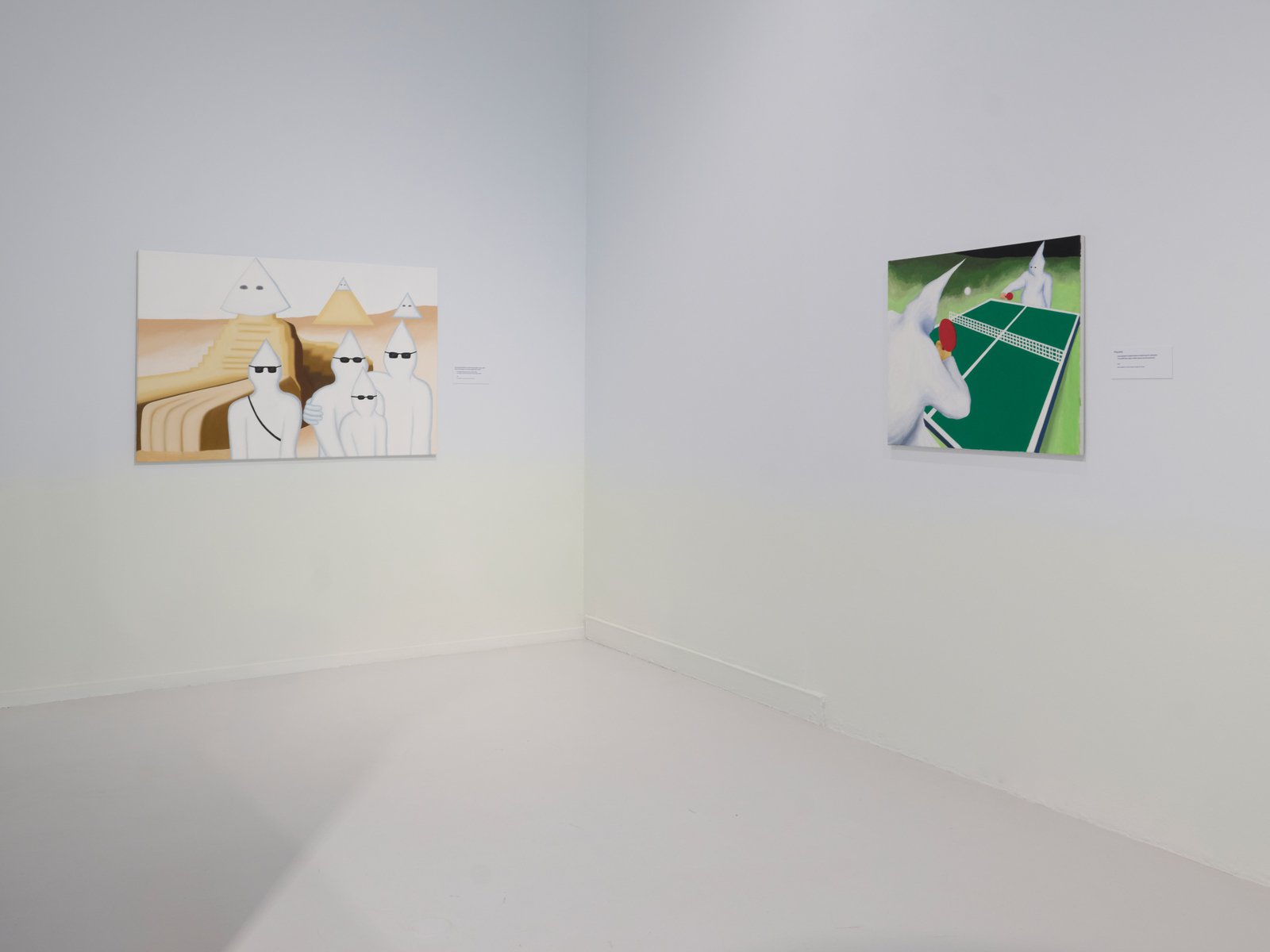
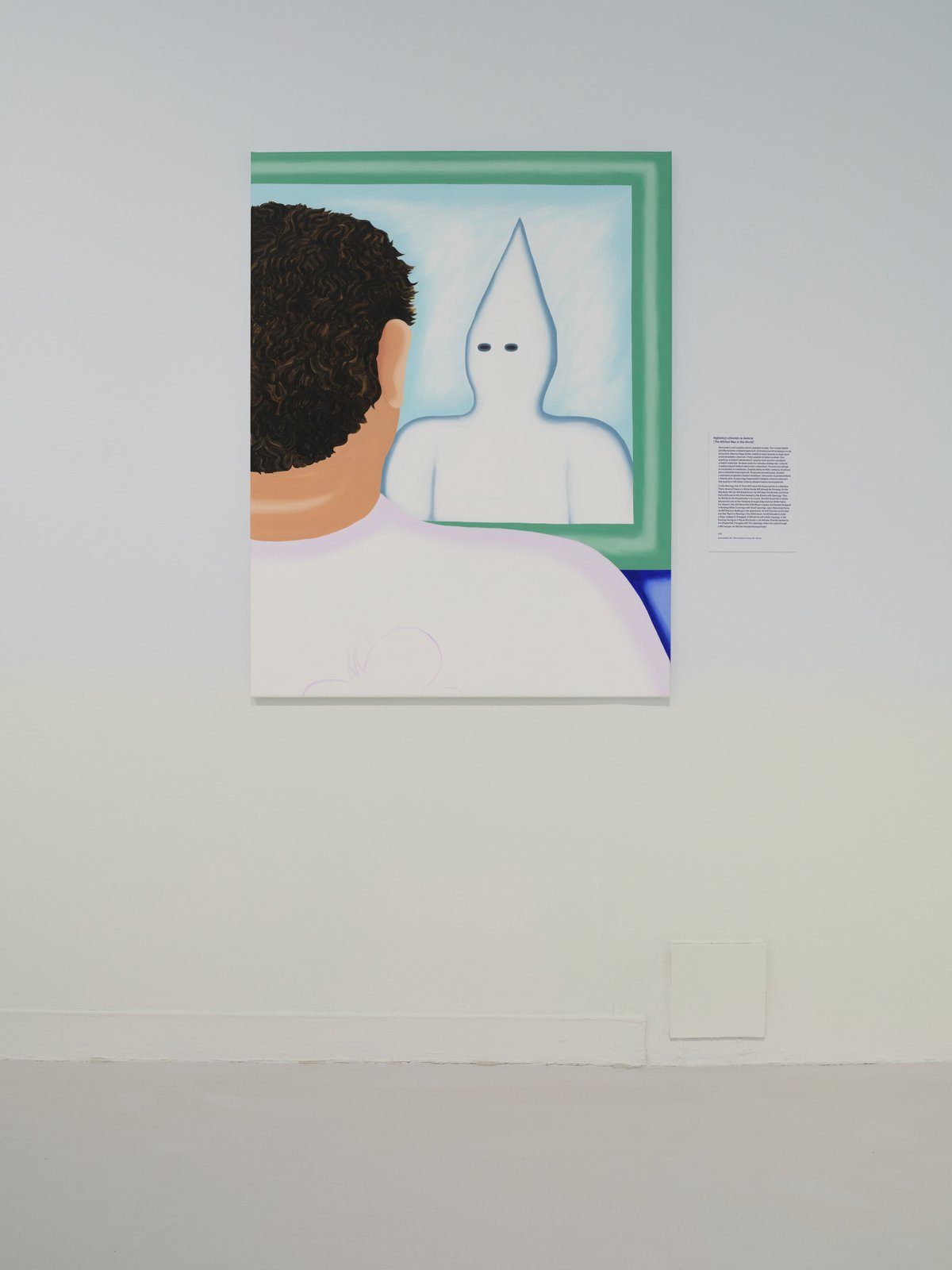
There is an unfortunate consequence to exploring the motif of the banality of evil through these depictions. While I do not believe it is intentional, and thus perhaps all the more damning, upon viewing these scenes it is hard to come away with a reading other than that racism is the domain of the “unwashed masses.” As far as White skies, white worlds goes, Grzymała’s white hoods are never placed on the heads of society’s elites, the decision makers, the movers of capital, the educated or the tastemakers. As long as we are discussing people in general terms, the elites are no less bigoted, while their racism arguably has a greater agency, making this omission rather curious. I am not ascribing any ill will to Grzymała, rather pointing out that the shortcut she took does not seem to be leading to the intended destination.
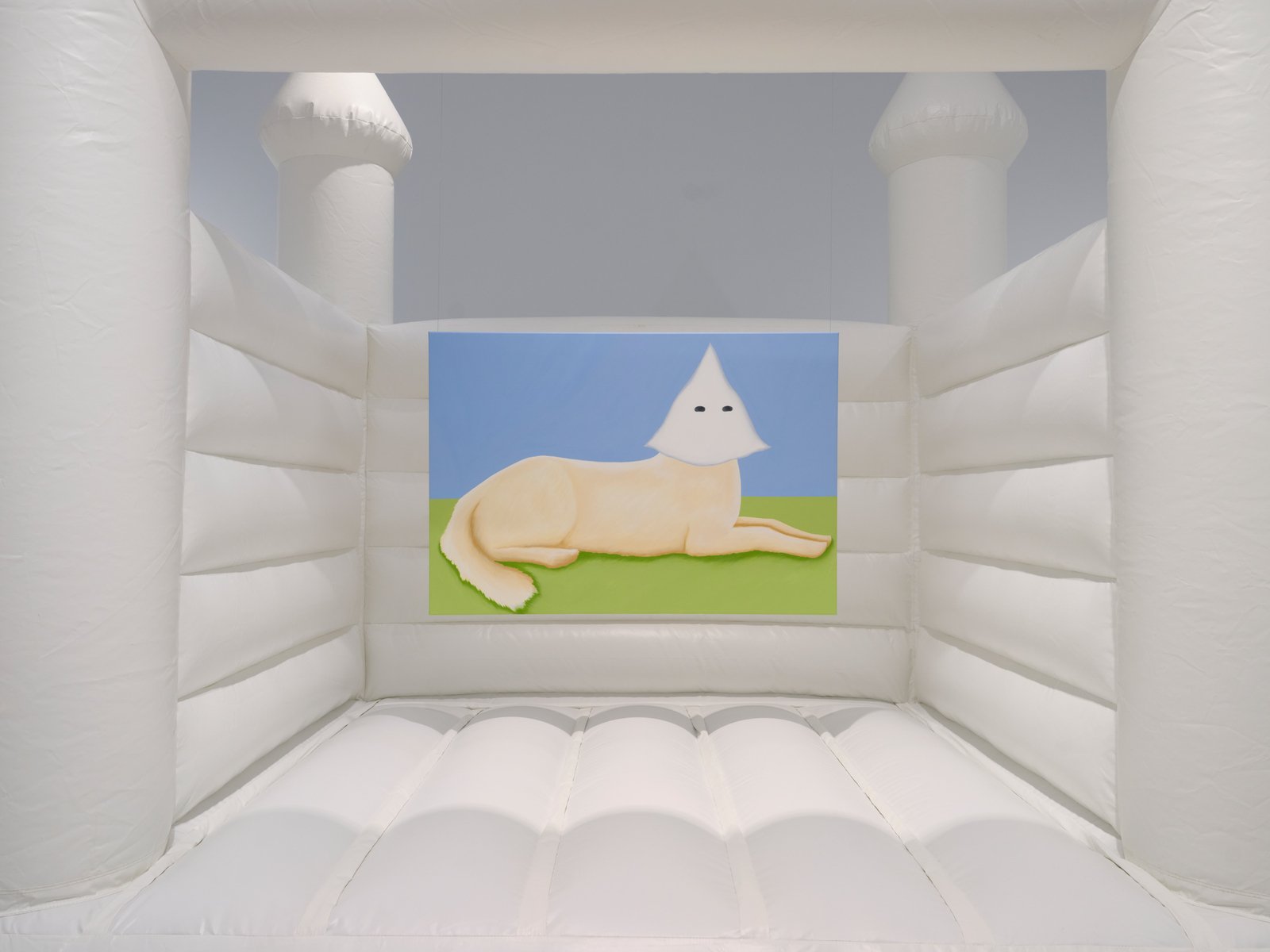
Going back to Guston, I am of the mind that he did not make exemptions for anyone. He achieved that in two ways: for one his klansmen tend to be depicted in more generalized spaces, both in city centers and on the outskirts, without focus on particular class signifiers but rather showing them as engaged in a wide range of activities (taking peaceful car journeys, smoking cigars, making conversation, day drinking, throwing bricks) and emotions (curiosity, melancholy, mellow bliss, remorse, to name a few). But more importantly he took himself, as well as fellow artists and the average gallery visitor to task; his bumbling klansmen are also there in the artist’s studio (Studio Wall, 1969), painting self-portraits (The Studio, 1969) or other klansmen (Painter and Model, 1969), discussing artworks (Discussion, 1969) or admiring a Rothko in a gallery (Red Picture, 1969). In doing so, Guston forced the audience and himself to face-up to their complacency or shared culpability in maintaining white supremacy. Grzymała’s White skies, white worlds on the other hand seems to be more likely to give the visitor a sense of absolution, to praise them for recognizing the banality of evil, congratulate for not participating in it by being cultured enough, and to place the racism in the domain of the Other, making it an issue of us vs. them. The closest she gets to a similar acknowledgement of self-culpability is in the exhibition’s bouncy castle centerpiece, The Whitest Dog in the World, loosely based on her own family’s dog, although it is a rather veiled allusion.
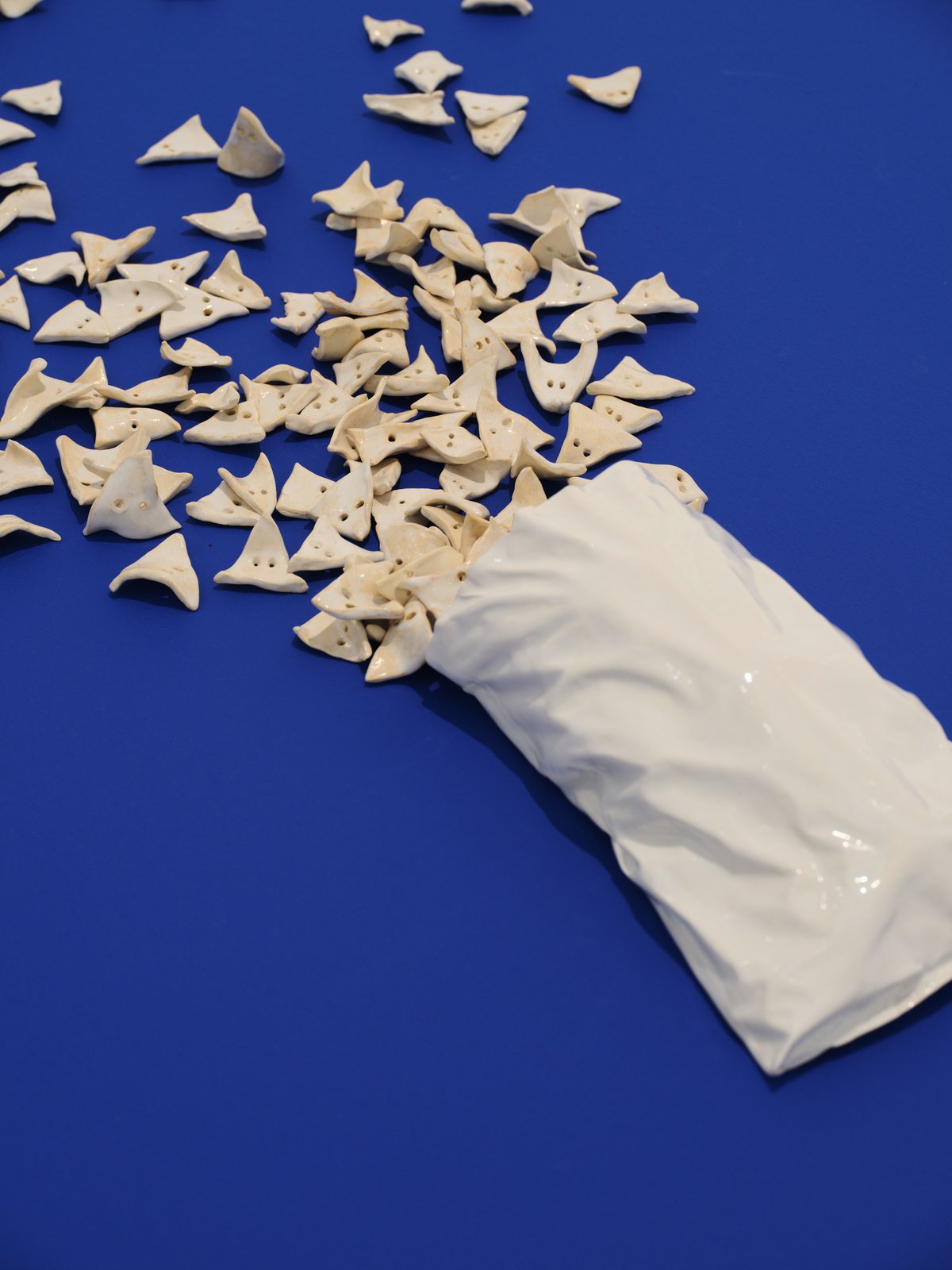
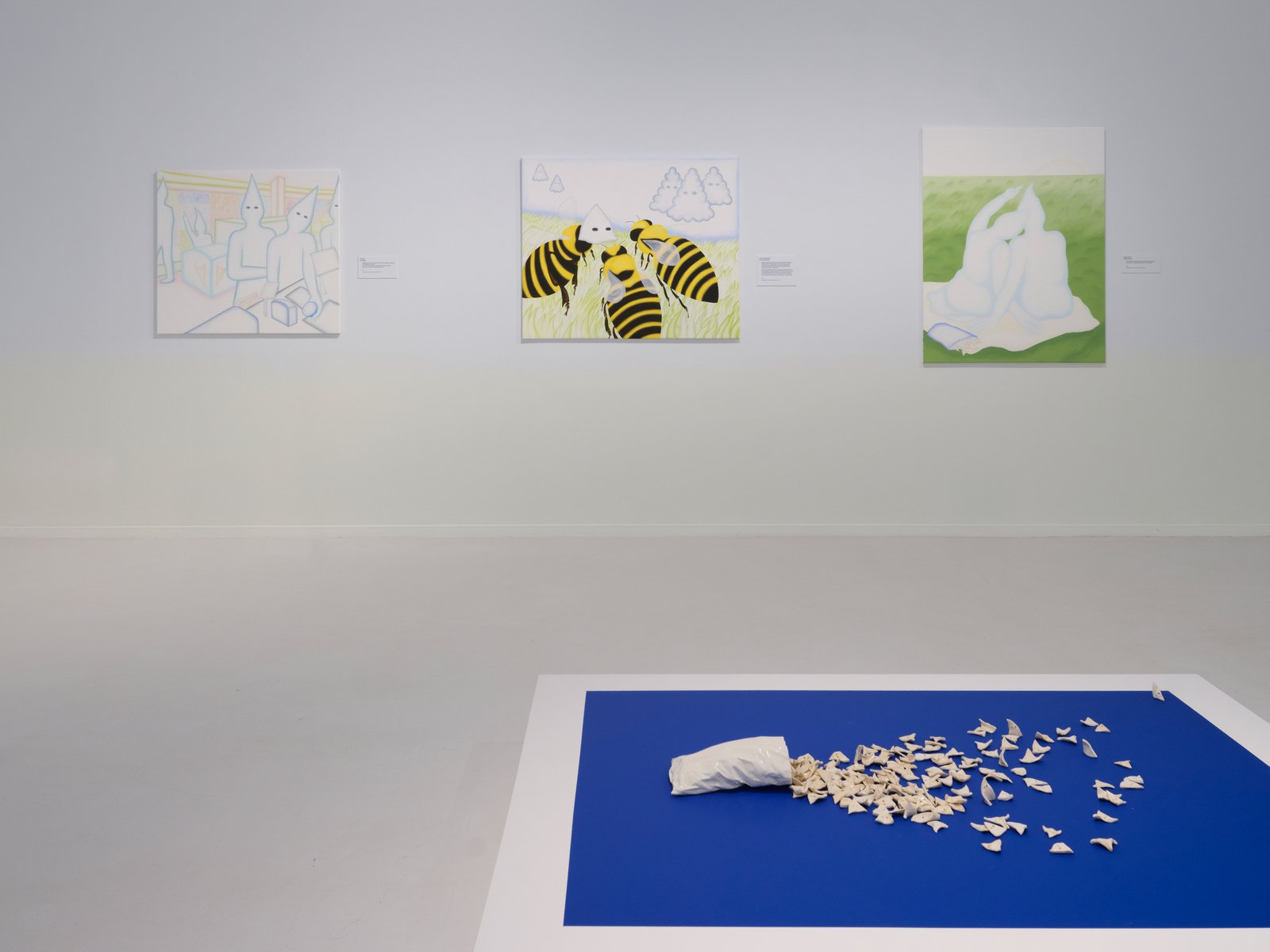
Ujazdowski Castle Centre for Contemporary Art, Warsaw. Photo: Bartosz Górka.
The comparison with Guston does not always clearly disfavor Grzymała. While I do find Guston’s works more true in unmasking how we participate in bigotry, Grzymała’s potential point of strength lies in depicting the consequences of white supremacy. Employing her usual strategies of fable-like worldbuilding, the presented works and their expansive titles and subtitles show the world increasingly growing whiter. Some of these subtitles are combined into the opening quote of the exhibition text: “Everything they look at will take on the colour of a swan. Houses, gardens and animals will turn white. On their alabaster tables covered with milky-white tablecloths, white bread and white coffee sweetened with white sugar will reign supreme. In the evenings, they will don white hoods, sip white wine, and dispute whose white is the whitest.”[5] At a guided tour with the artist I learned that the paintings are arranged chromatically – not by date but rather documenting the creeping whiteout of this klansman utopia, with the “least white” painting nearest the exhibition entrance, to the viewer’s left and progressing clockwise. The central piece of the exhibition, a white bouncy castle, is not there just to evoke the family festival motif, its air compressor also provides a steady stream of white noise, underscoring this draining of color. Coming to a nearly full circle, the last painting, White Sunset, depicts a couple at a picnic, with grass losing its chlorophyll and growing pale, the setting sun barely distinguishable from a sheet of paper, and one of the figures pointing simultaneously towards the sun and the exit door, inviting the viewer to leave.
This process of the world losing color under the gaze of the hooded figures is an intriguing one, however I remain ambivalent. It makes for a genuinely compelling approach of depicting how white supremacy affects non-white cultures, with Warm Greetings from Sunny Egypt depicting the sphynx and the pyramids donning white hoods to appeal to the White gaze, and the aforementioned The Whitest Dog in the World showing us how non-human beings can be made to serve White interests. What I struggle with is that, in spite of my appreciation for its subversive character and for the use of humor to approach the difficult subject matter, it is a rather abstract and somewhat toothless way of depicting what is a brutally violent and oftentimes deadly mechanism of power. Can the figures of the KKK alone be considered enough to encapsulate that as a visual shorthand? I am not convinced. It is further undercut by the fact that while the intention is to show this progressing oppressive whiteness, the order in which the works are placed betrays that. Ping pong, placed past the exhibition’s midpoint, with its vivid greens of both the table and the grass in the scenery, introduces a wrinkle in that whiteout narrative. The same goes for The Whitest Meal in the World with its stark reds, placed even further along. Perhaps I am taking it too literally, but being there and hearing that the paintings go from least to most white, it is difficult to suppress the automatic thought “no they don’t.”
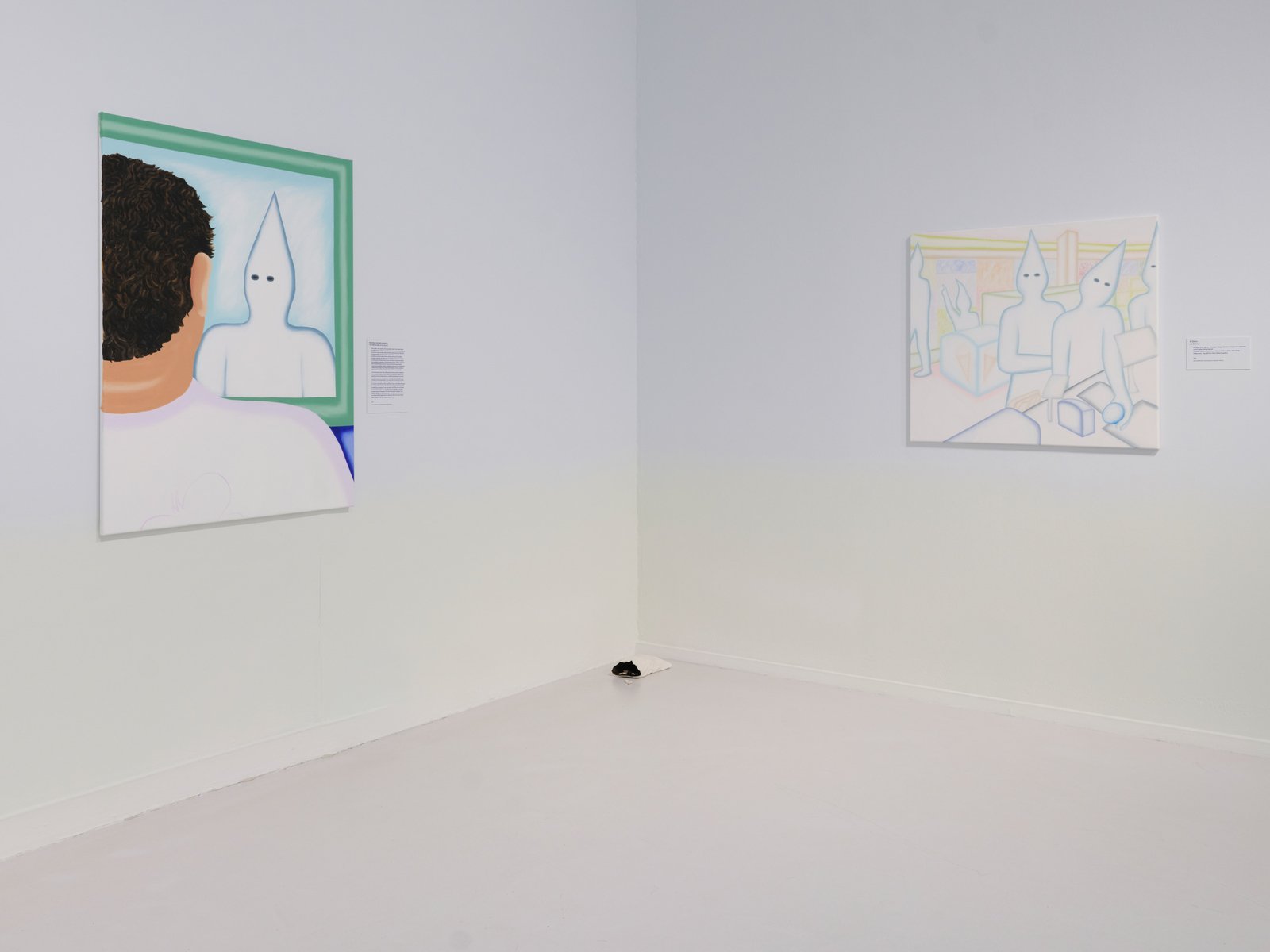
Ujazdowski Castle Centre for Contemporary Art, Warsaw. Photo: Bartosz Górka.
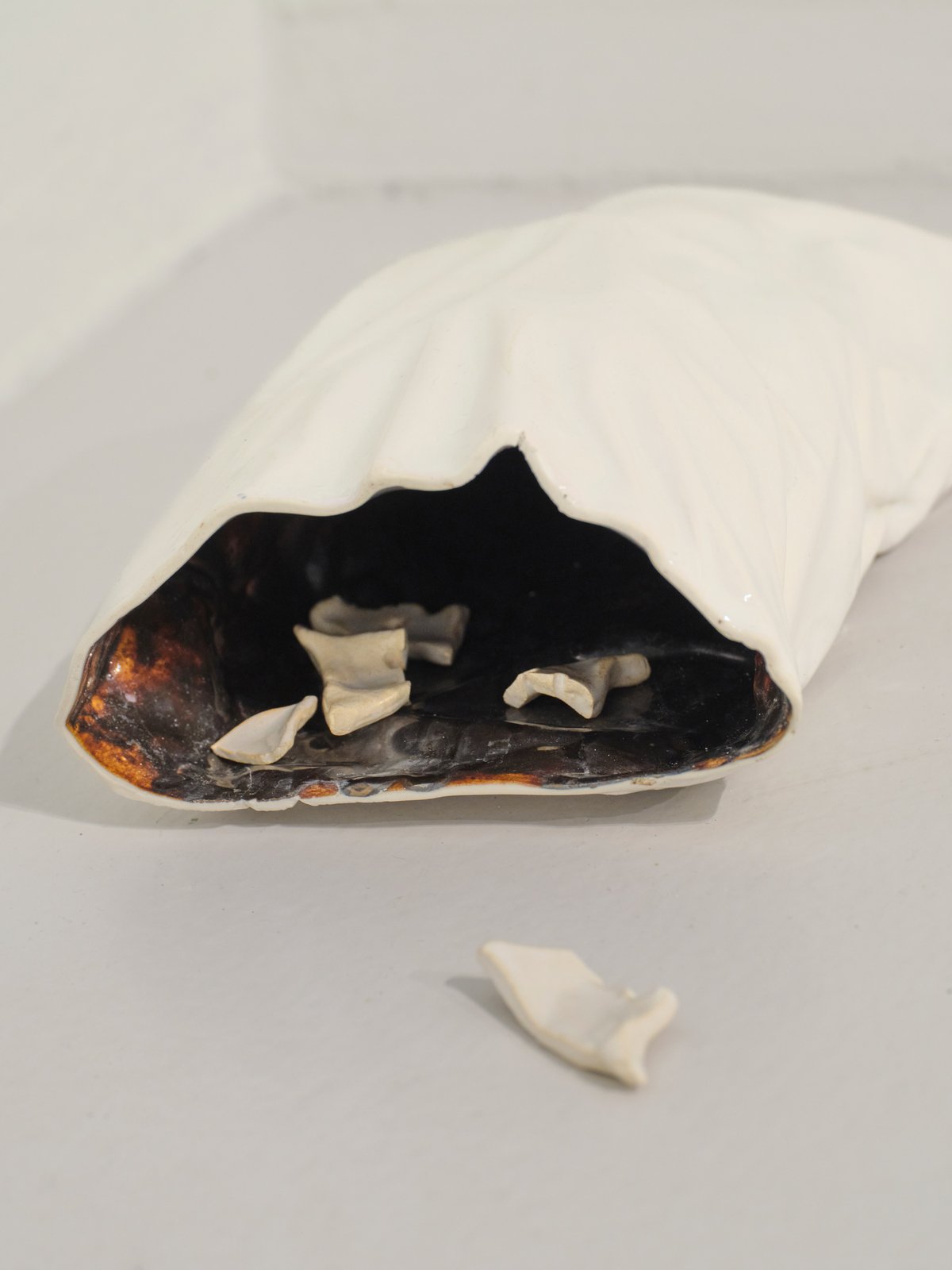
Image courtesy of Ujazdowski Castle Centre for Contemporary Art, Warsaw.
I’m leaving White skies, white worlds with the nagging feeling that in spite of some of its strengths, it totals to less than the sum of its parts. The compelling presentation, the simple yet effective arrangement, and some of the standout works end up weighed down by the aforementioned shortcuts and inconsistencies. Thinking about some of Grzymała’s past works, I’m reminded of her as a painter that tends to deliver sharper and more darkly comical critiques of Poland’s bigotry and the ways in which it fails people living there, while offering up fantasies of a different reality. One painting in particular comes to mind – Parliament (2024) – depicting a session of the Polish parliament with its benches occupied by an improbably diverse set of beings: nondescript people, insects, plants, a river, a narwhal, and, shown without any particular emphasis, equal as all the others, two figures in pointy white hoods, off to the center-left. It’s a utopian scene of all beings coming together to agree on equal treatment of everyone, but their presence imbues the image with a sense of uncertainty – are they there in good faith or are they exploiting the tolerance paradox? That painting alone contains a lot of the nuance I ultimately could not find in White skies, white worlds. A reminder of how white supremacy can infiltrate its way into institutions, how it can work in more subtle ways, would be a welcome respite from all of the depictions putting the hoods front and center. As it is, each of the works is there to hammer the same point and Grzymała’s portrayal of totalizing white supremacy is more dull than oppressive. That may well be what the subtitle for White Sunset is trying to warn us about: “Their Passion for Whiteness Will Lead to a Very Bad Ending.”
Ultimately, the concern with which I approached the exhibition is left unanswered, as to my view the exhibition clumsily tries to utilize the language of a cautionary tale for what is actually a not very distant reality. Racist, bigoted people can already be seen in reality, they are not distant or unfamiliar even if dressed in foreign garb. Hiding those who already feel comfortable being bigots out in the open behind masks only serves to confuse, rather than to uncover new meanings or new criticisms through the use of metaphor. As such, the warning is misdirected at a vague, foreboding future, while the clear reality of present-day bigotry goes unaddressed and unscathed.
This text was written as part of the mentoring program for emerging art critics developed jointly by the Hungarian, Polish, and Slovakian sections of AICA. The program, now in its second year, seeks to support art critics at the beginning of their professional paths, while strengthening the networks of solidarity and exchange that connect the contemporary art scenes of Central and Eastern Europe. Committed to creating sustainable conditions for art criticism at a time when independent platforms for critical writing are under increasing pressure across the region, this program maintains a collaborative approach to mentorship. For this edition, the editors of MOST Magazine mentored the participants from Poland and are responsible for publishing the resulting texts from all three sections.
Hungary
Authors: Sára Vera Bodor, Kata Martincsák, Dóra Vázsonyi
Mentors: Jan Elantkowski, Réka Majsai, Hedvig Turai
Translator: Kata Balázs
Coordination: Kata Balázs
Co-coordination: Tamás Don
Poland
Authors: Ida Dziublewska, Wojciech Grum, Łucja Staszkiewicz
Mentors: Ewa Borysiewicz Vera Zalutskaya, Kathryn Zazenski
Translator: Ewa Borysiewicz
Coordination: Arkadiusz Półtorak
Slovakia
Authors: Ema Brestovanská, Sofia Suzziová, Gregor Zimmermann
Mentors: Daniel Grúň, Adrián Kobetič, Lucia Miklošková
Translator: Kamila Talarovič
Coordination: Peter Megyeši
[1] Quote from exhibition text: https://u-jazdowski.pl/en/programme/project-room/-project-room-2025-2026/white-skies-white-worlds
[2] I found that a Polish KKK website was created in 2017, indicating a potential attempt at expansion and recruitment. An investigation was opened by Warsaw’s public prosecutors office but it does not appear to have gone anywhere, and when I found the website’s original address it appeared to be down. It is an important reminder to remain on guard but that does appear to be the extent of it.
[3] As he created murals that more directly portrayed the violence of the KKK back in the 1930s
[4] United States Immigration and Customs Enforcement – established as part of the post-9/11 Homeland Security Act, increasingly more controversial and embattled in federal courts during Donald Trump’s second term due to their numerous violations and abuses, a de facto government paramilitary organization engaging in illegal deportations, brutal quashings of protests, reaching possibly its highest point of notoriety with the January 2026 civilian killings of Renée Good and Alex Pretti.
[5] Quote from exhibition text: https://u-jazdowski.pl/en/programme/project-room/-project-room-2025-2026/white-skies-white-worlds
Artist: Ania Grzymała
Exhibition Title: White skies, white worlds
Curator: Paweł Wątroba
Venue: Ujazdowski Castle Centre for Contemporary Art
Place (Country/Location): Warsaw, Poland
Dates: 01.05. – 14.06.2026
Photos: Bartosz Górka, Genevieve Hanson. Images courtesy of Ujazdowski Castle Centre for Contemporary Art, Warsaw, Estate of Philip Guston and Hauser & Wirth.