
Ewa Borysiewicz
We find ourselves in Bergen, known as the “city between the seven mountains.” This calls to mind a text on another township, surrounded by the same number of rises.1 Where those hills came from, the source could not say. The origin of Bergen’s mountains, by contrast, is not in question, and perhaps this is why their influence on the city’s weather feels so palpable. After all, certainty takes less space and leaves more room for consequence. Being caught between the Atlantic coast and the surrounding mountains, Bergen’s climate is notoriously rainy: the dissonance between openness and fixity provokes the appearance of a phenomenon known as orographic rainfall. Its mechanics are set in motion as moist air is swept inland by westerly winds, which then surges upwards. After it encounters the barrier of the rising terrain, it cools down and condenses into clouds before returning to earth. Rain falls.
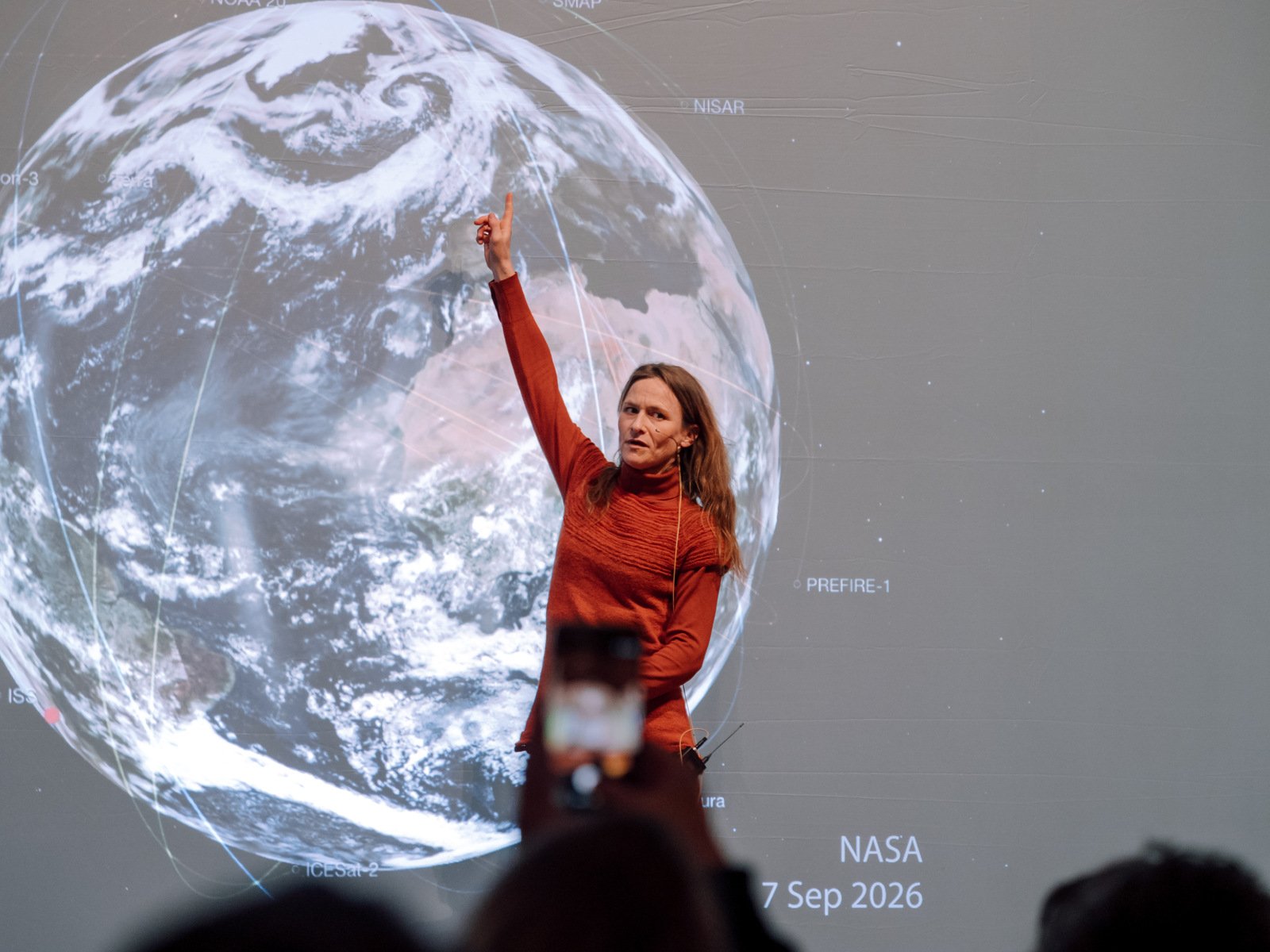
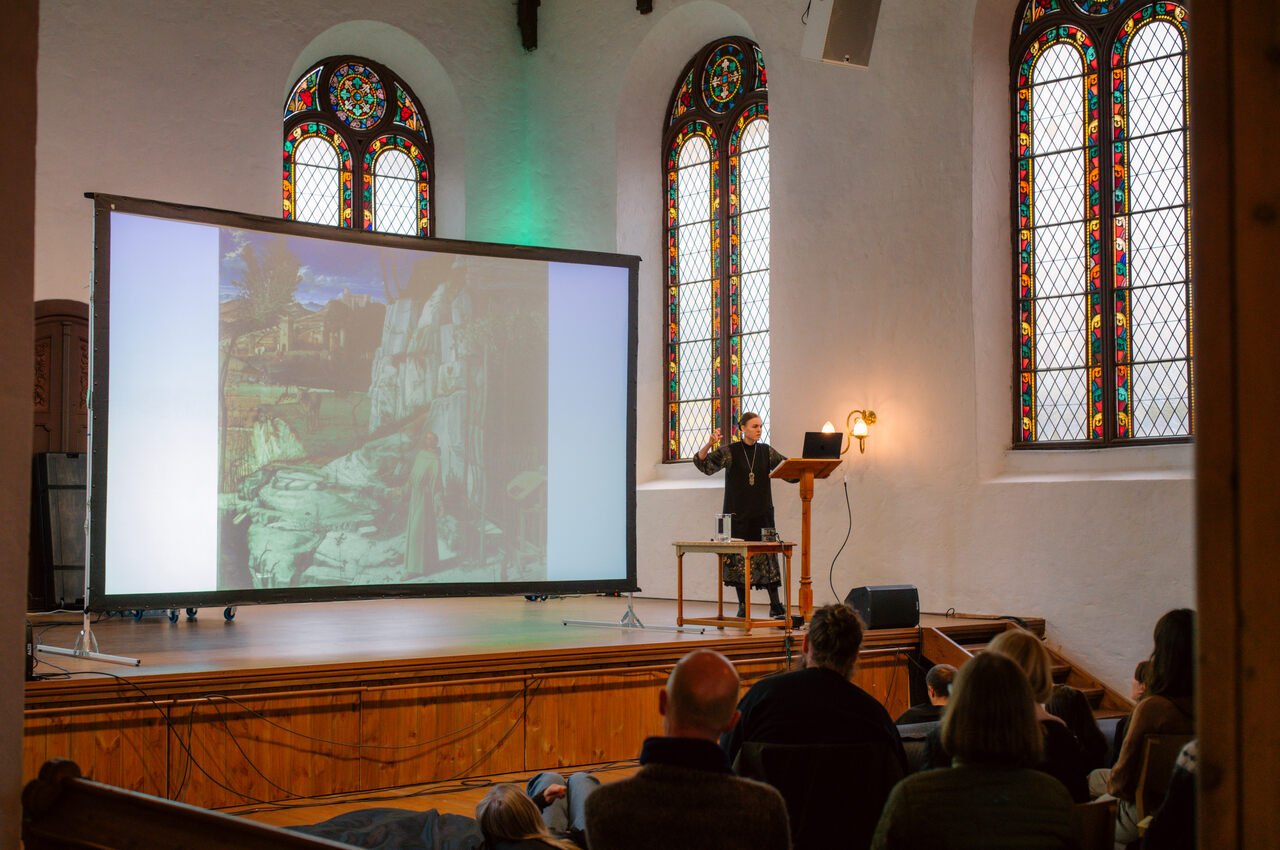
Learning this makes us less surprised to hear that Bergen is also referred to as the cradle of modern weather forecasting. The information comes from meteorologist Ellen Viste’s lecture titled “Feeling and Foreseeing.” Her mode of address is accessible and lucid, marked by the ease of a speaker with full command of her subject. Her central argument is conveyed in the same register: science may be objective, yet those who practice it are not. She points out that even well-constructed models of the same phenomenon can yield divergent predictions, and that these apply to the model rather than the “real world.” The gap between representation and its subject seems not only a philosophical problem but a human one, since those who build models bring their own assumptions to them. Although the fact that one’s perception shapes one’s expectations – in modelling and beyond – is a familiar truth, and the reciprocal nature of this relationship surprises us: expectations in turn condition what one perceives. We now see how the future may determine the present. We understand that neither representation nor the eye gives unmediated access to the world. We think “The Machine as Complex as the World Itself,” the title of the conference of which the meteorologist’s talk was part, is a fitting one.
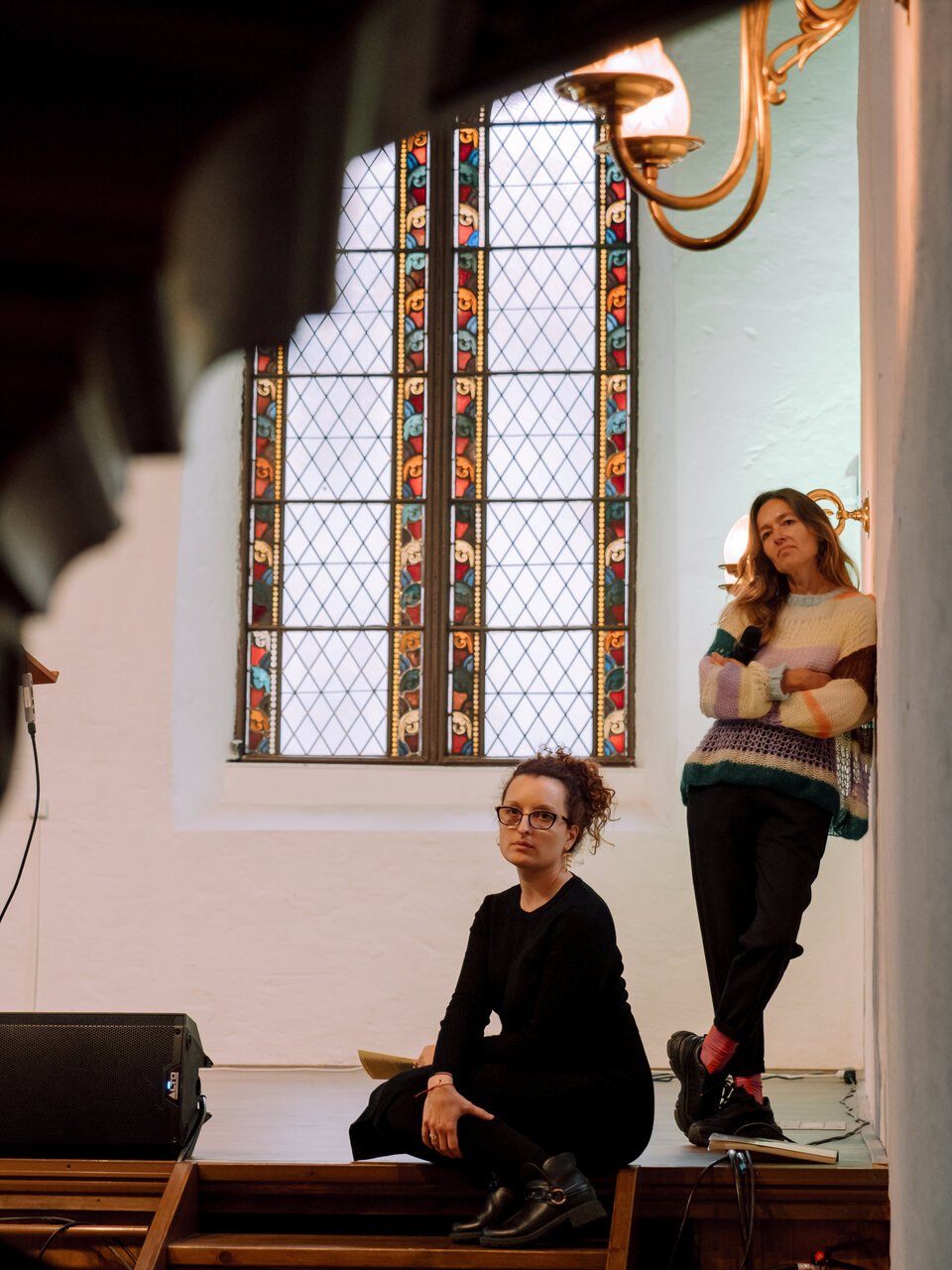
Photo: Astrid Olsson,
courtesy of Bergen Assembly.
Photo: Astrid Olsson, courtesy of Bergen Assembly.
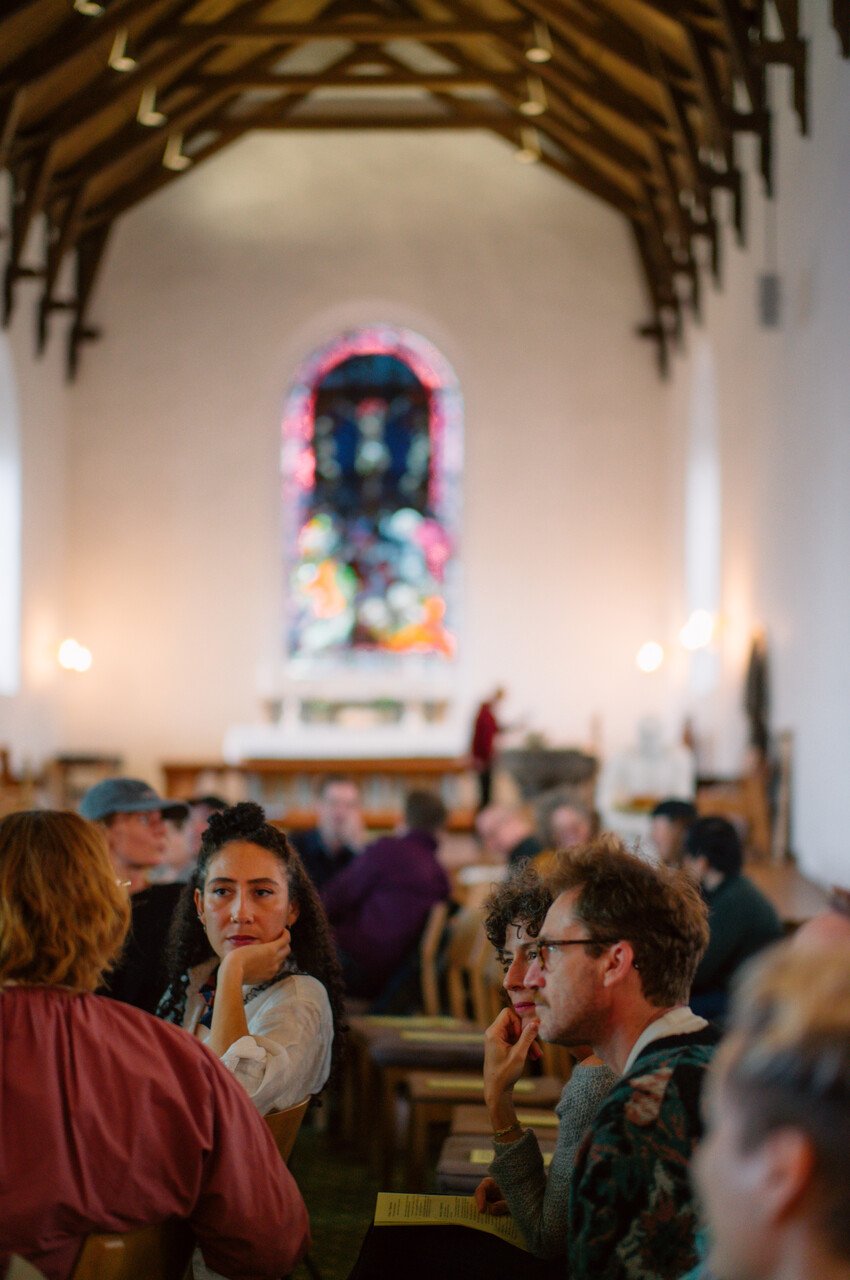
Photo: Stian Servoss,
courtesy of Bergen Assembly.
The gathering takes place in a building located in central Bergen, a church whose earliest proof of existence is a literary one: it is mentioned in the Sverris saga, detailing the life and reign of King Sverre Sigurdsson of Norway. The chronicle specifies an event in 1181, when King Sverre’s men took refuge in Korskirken, Church of the Holy Cross, the one we are currently in. The temple’s oldest parts date back to the 12th century, although we think that they must be immensely older than that.
We observe the prelude to the next Bergen Assembly. Its origins lie in a conference organised in 2009, almost twenty years ago (here again we are reminded that certain things are older than they appear; we start noticing a pattern). Initiated by the local Kunsthall in response to the municipality’s proposal for a recurring showcase of contemporary art, it was one of the earliest attempts to evaluate the role and impact of biennials: an early meta-reflection on the biennial as a subject. Perhaps drawing on this legacy, the conveners of Bergen Assembly 2028, Lucia Pietroiusti and Filipa Ramos, opted for unveiling to the public a work in progress instead of a fixed concept, inviting the audience to ask questions with them rather than offering solutions. Since certainty is easier to sustain than doubt, we tend to favor results over process. We have to conserve our energy at this stage, therefore we would not opt for the approach the conveners took. But this is not our place to judge, only to learn.
Pietroiusti and Ramos frame their inquiry between two pillars: an unorthodox understanding of what technology is, and the notion of ecstasy as an alternative to the disembodied, purely intellectual experience of the world, which has become synonymous with the digital. The first theme seems driven by a wish to free technology from the computational, which has claimed the word for itself and now passes off its own history as the only one: a linear progression from the manual through the analogue to the digital, as if technology could have developed in no other way. Pietroiusti’s and Ramos’ understanding is separate. For them, technology extends to time before and independent of the human: spider webs, bees transmitting information through their dances, birds drawing new routes across the sky. In this account, humanity arrived quite late to this long tradition. We catch ourselves considering the possibility of its early exit.
courtesy of Bergen Assembly.
The second strand, ecstasy, is understood as a state that suspends the ordinary workings of the self, exceeding the logic of usefulness and disrupting the organisation of productive life. It is this unsettling of the ordinary – or what is currently considered as such – that Simone Kotva explores in her talk, taking as her point of departure Giovanni Bellini’s Saint Francis in Ecstasy (1475-1480), in which the saint from Assisi receives the wounds from a source of light: the sun. Francis, she observes, is only one of the ecstatics in the picture: the landscape is washed with the divine light, the heron, the donkey, and the flock of sheep in the picture all turn towards the sun with the stigmatic, sharing the event. Ecstasy is depicted here as an experience available to humans and the natural world alike. Writings on holy men and women support this reading: mystics are repeatedly likened to plants drawn towards the sun.
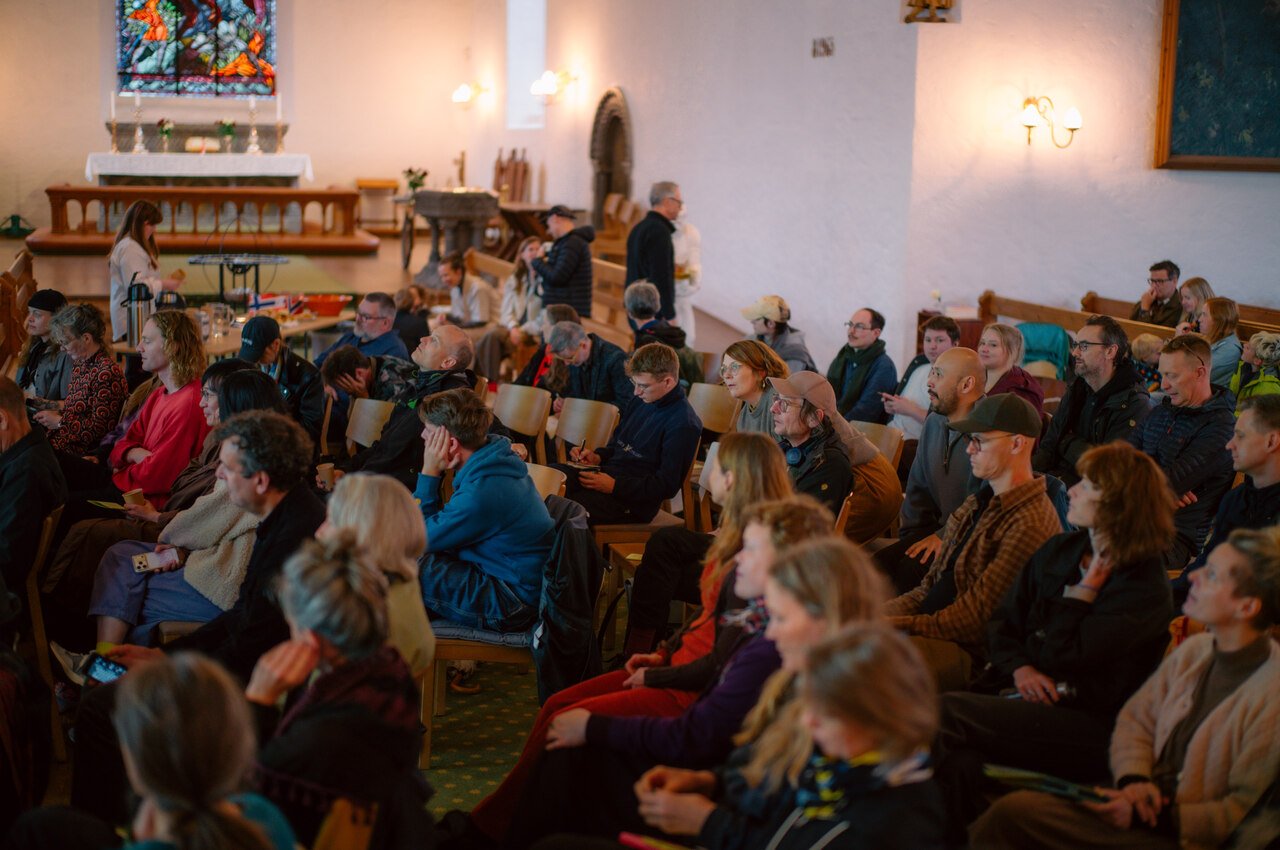
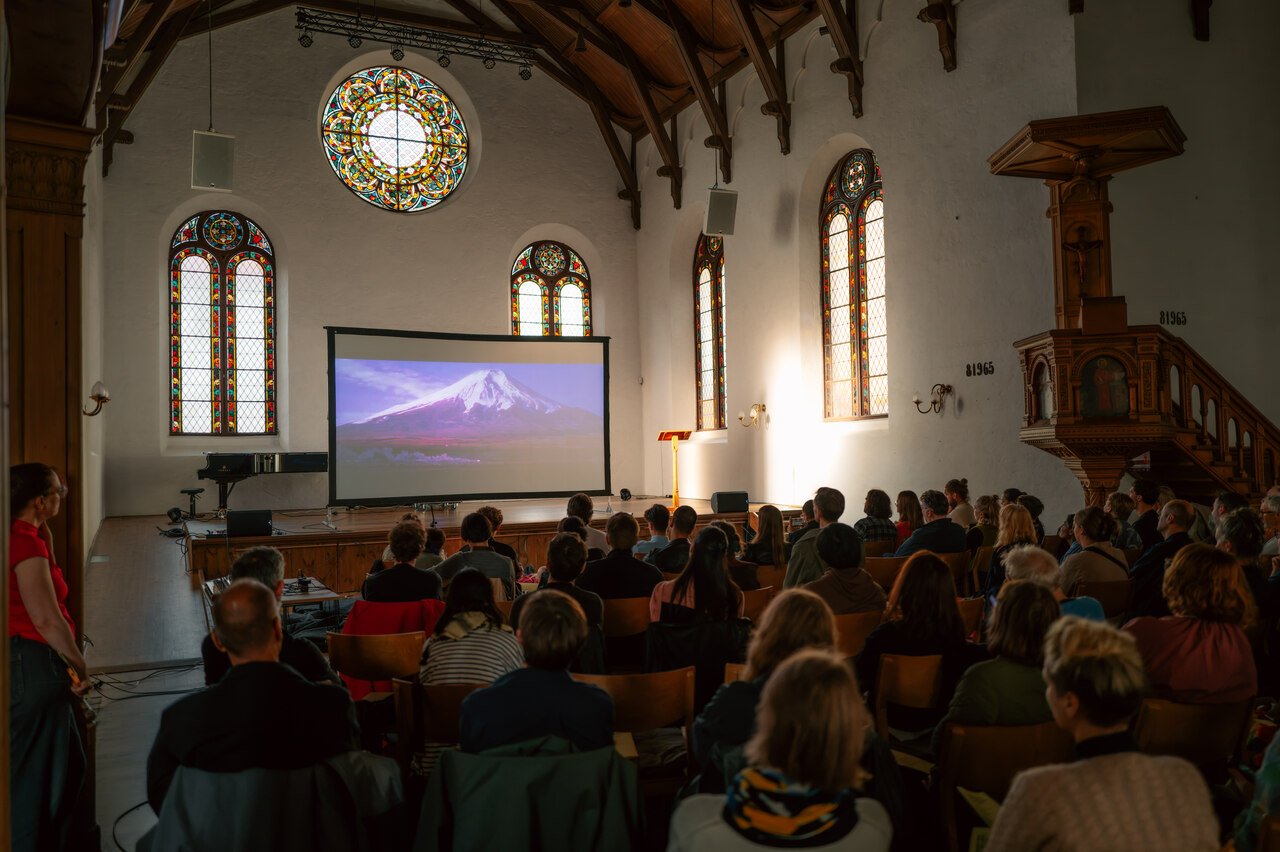
To show how far ecstasy reaches beyond the human, Kotva returns to the etymology of the term: ekstasis (ἔκστασις) in Ancient Greek, which rather than “peak experience” usually synonymous with the term, means “standing outside oneself,” a displacement from one’s ordinary state. A subject in ecstasy displays a certain sensory availability: it exists in a mode in which its senses are fully open to what surrounds it, so that the boundaries between the one who perceives and the perceived begin to blur. In Kotva’s account, this is the condition of the plant: passive, yet alive. It does not grasp the world through concepts. It receives it, directly and without interruption, through light, moisture, warmth, and air. Ecstasy grants anoetic – pre-conceptual – access to the world: an immediate experience of reality as it is. We think about plants when we inspect the church’s timber roof and a wooden door behind the screen showing the renaissance imagining of Saint Francis. The whitewashed walls of the building are thick and plain. Only near the top does a narrow band of small arched niches break the even surface. The end wall carries a grand, circular stained-glass window, whose blues and pale greys glow against the pale plaster. Everything is almost bare. This typical trait of protestant restraint allows one to focus on what cannot be seen, only felt, or as we would rather describe it, as “hallucinated.” We do possess the vocabulary of feeling, but we can’t be sure it describes what happens within. Finding the right words can be a problem. The body is the only ground where this doubt can be tested.
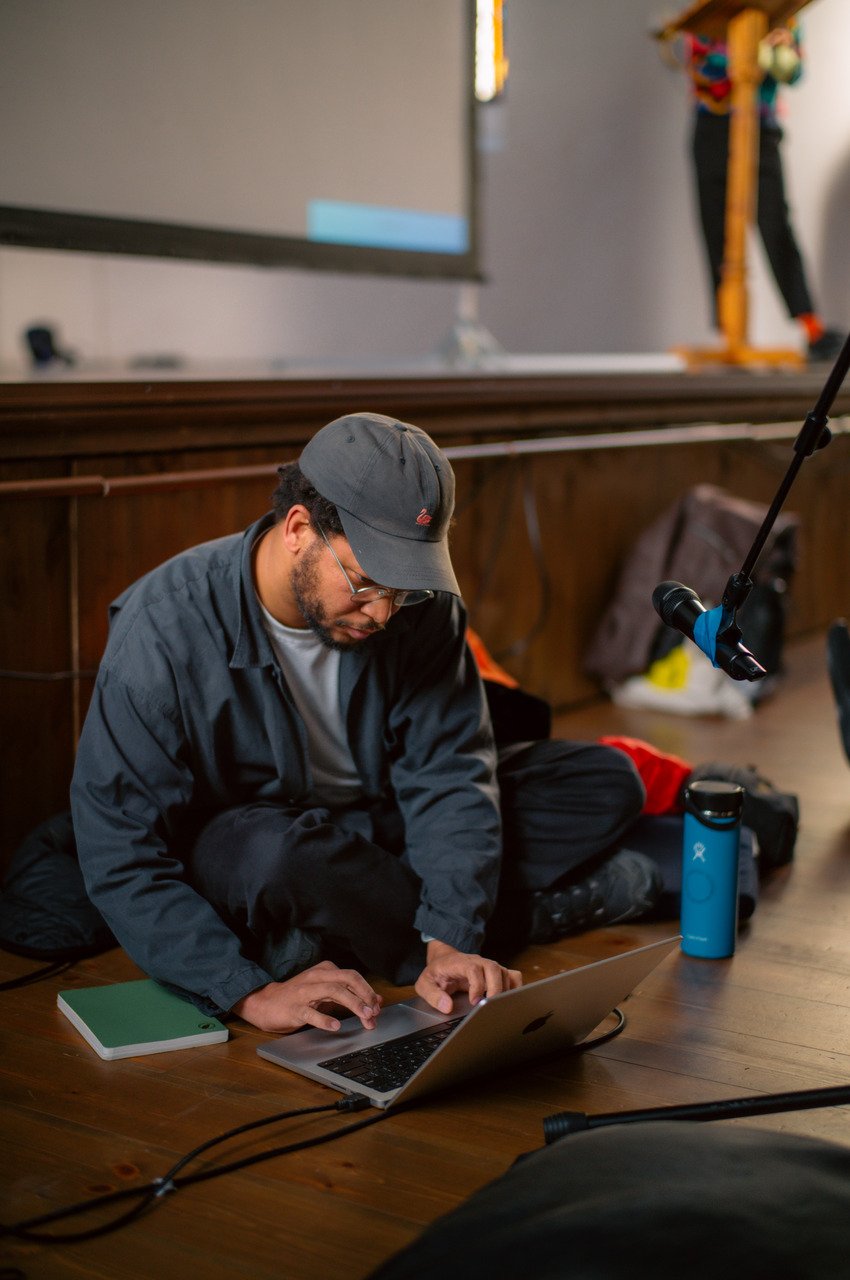
Matching the weight of the surrounding stone, Nolan Oswald Dennis moved the discussion from the verbal to the physical, inviting the audience to take part in listening exercises. The core of the exercises consisted of recordings made at monitoring stations across the planet, registering ground motion: vibrations travelling through the Earth as seismic waves, far below the threshold of human hearing. The signals would not be audible unless translated, usually through filtering, speeding up, and lifting them to a frequency that is able to enter the range of the human ear. What reached Korskirken was a sound of very low pitch: at first noise, which later swelled to a hum or growl that seemed to come from simultaneously the floor and the speakers. Before it dissolved again into static, the signal came startlingly close to a melody. Again, a pattern. We ask ourselves whether anyone else heard it. If they did, did they feel guilty at finding beauty in the traces of human violence that, according to the artist, were recorded as infrasound alongside the movements of the Earth? Was beauty, as Rilke wrote, nothing but the beginning of a terror one is still just able to bear?2 We wondered whether the melody reached the omnipresence to whom this temple is dedicated, and whether it, too, felt shame.
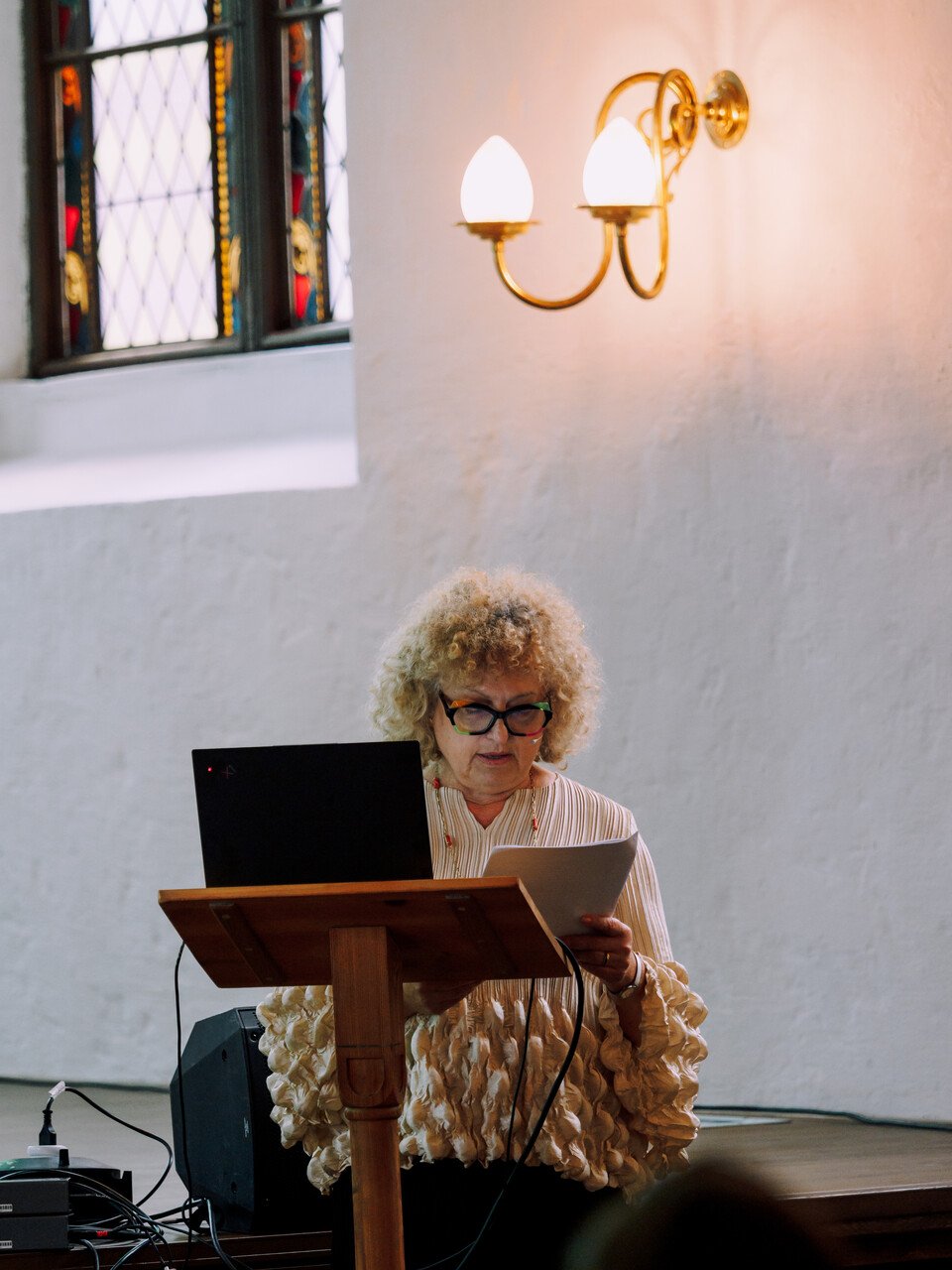
If this presence has an address, a place toward which prayers are usually directed, and the building is only its proxy, then it is in the clouds, where Western art history has long placed it. Clouds are its curtain, its seat, and its informants. Today the word has acquired a second meaning, since it is in “the cloud” that information is stored, held at a distance, retrieved, and ever-responsive. It is from this condition of stored information that Carolyn Christov-Bakargiev begins “A Fraction After Now: the Angelic-Agentic dimension. Prolegomena to a Theory of Subjectivity in the 21st Century.” Her central figure for this condition is the angel, an intangible intermediary between immanence and transcendence; a messenger carrying a dispatch on behalf of its author. It is also an agent, defined by the tasks it carries out. Seen in this light, one can think it prefigures the digital algorithm. But this foreshadowing quickly shows its limit, since the angel is an agent of prophecy, not of prediction, which is what defines the essence of computational procedure. When Gabriel appears to Mary in the representations of the Annunciation, he does not optimise her future or calculate what might statistically befall her. He addresses her, assuming the role of a witness rather than a rule-based enforcer, since the prophecy he carries is a mystery that rests on interpretation. Prediction removes that openness. We remember the ocean, the horizon, and the mountains, its antithesis, which encircle the city we are in.
Gabriel’s address to Mary is the opposite of prediction: it presupposes a space in which something can still arrive. Christov-Bakargiev finds a parallel to the writings of Simone Weil for whom grace fills empty spaces but can enter only where a void exists to receive it. Humans still possess this emptiness, allowing them to be changed by what occurs, while a machine lacks the room in which such transformation happens. That room is what the cloud – the signal of a coming of the orographic rainfall, a manifestation of the tension between the ocean and the mountain – offers: a form without fixed shape, always on the way to becoming something else. This principle shapes Chiemi Shimada’s mmm (2023), the first contribution to the Bergen Assembly prelude, constructed as a survey following the cloud as a recurring motif across Japanese cinema, from the 1920s to the present. The cloud is both protagonist and metaphor: its nature determines how the video unfolds; its subsequent scenes are linked like a chain, each borrowing a motif, a shape, or a splash of color from the previous ring; a figure emerging from the sea, another emerging from the night, a yellow patch of color transforming into a shooting star that cuts through the overcast sky. We sensed a melancholy in Christov-Bakargiev’s lecture. She remarks that interpretation loses to prediction, which has become omnipresent and immediate. The next image is formulated before it is sought, and the question is answered before it is asked. Nothing is left in between, no interval of waiting or doubt. This speed shapes, alters, marks the users of the technology it drives just as a GPS changes a sense of orientation, and the calculator a sense of quantity. Although the loss and gain of faculties is a constant in human history, not a new event, Christov-Bakargiev notes that artificial intelligence atrophies not one, but many faculties at once: memory, association, analysis, writing, synthesis, pattern recognition, decision-making. The result is a kind of decomposition, a dementia; an emergence of a body without a mind to use the effectively infinite amount of available information.
Humans are invented by tools as much as they invent them, in a kind of feedback loop: humans train systems, systems change how humans behave, and subjects form themselves through machines of their own making. The same goes for metaphors: they continuously understand themselves through the dominant technology of their era – shifting from clocks and steam engines to computers and neural networks – eventually taking those metaphors literally. To redefine technology, as the sessions in Bergen set out to do, is therefore also to redefine the human.
Another, no less crucial reason for this revision emerges from the Fermi paradox: the question of why no extraterrestrial civilization has yet contacted Earth. Several convincing explanations have been offered so far. One suggests that civilisations perish before they are able to interact: technology outpaces the capacity to control it, and life undoes itself before it can make contact. Perhaps, then, the meetings that matter most are the ones closer to home; they might be the only ones available.
We are left to ask what a machine can be. Pietroiusti and Ramos claim it might be an apparatus assembled from meetings, relationships, and exchanges rather than circuits and code. Turns out that – within the bounds of their understanding – the gathering we behold is, too, a form of technology; an apparatus for making the unexpected more likely, a repeatable method for producing a result that wouldn’t happen otherwise. A vehicle composed of relationships, “as complex as the world itself.” We’ll keep that in mind when we get to meet something like us.
We hear that most accounts of events in Bergen begin by noting how often it rains here. We’re glad to be blending in.
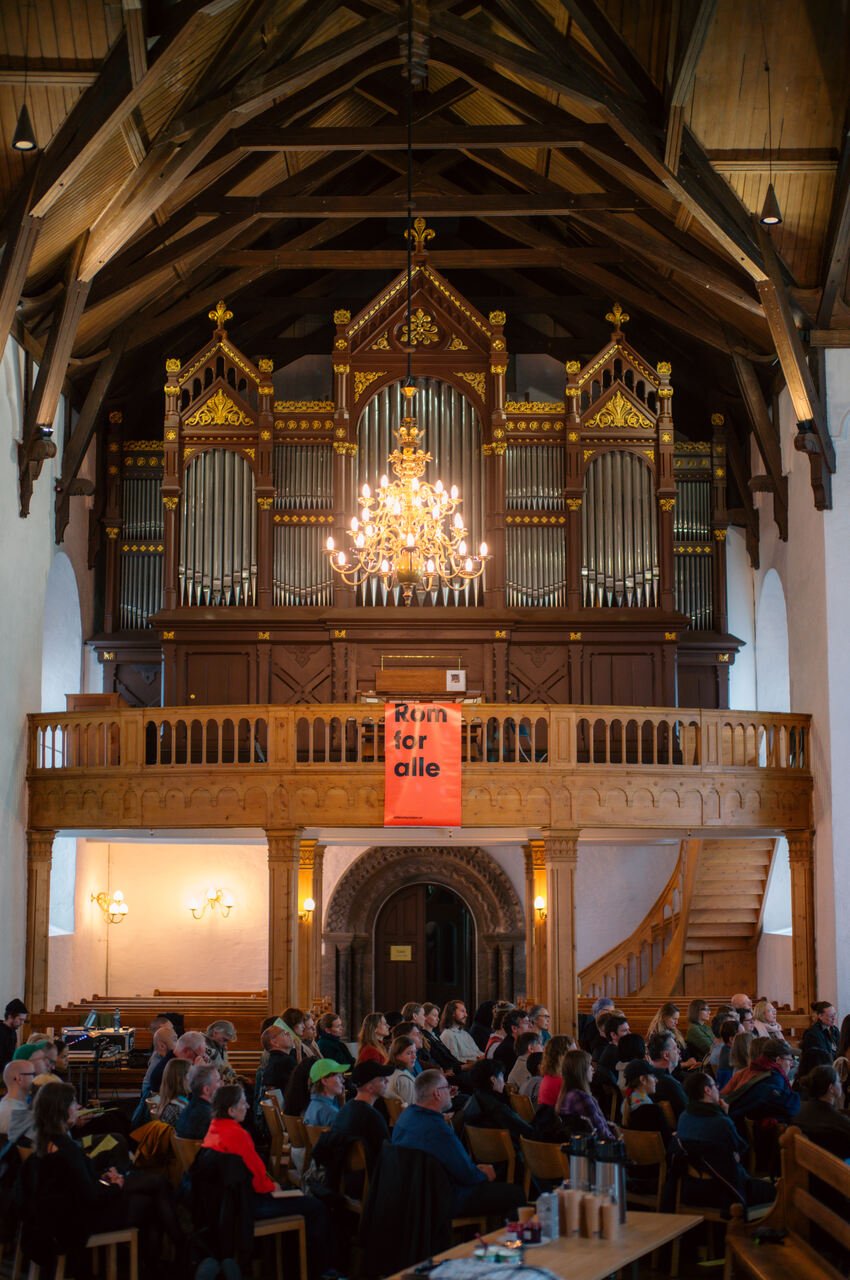
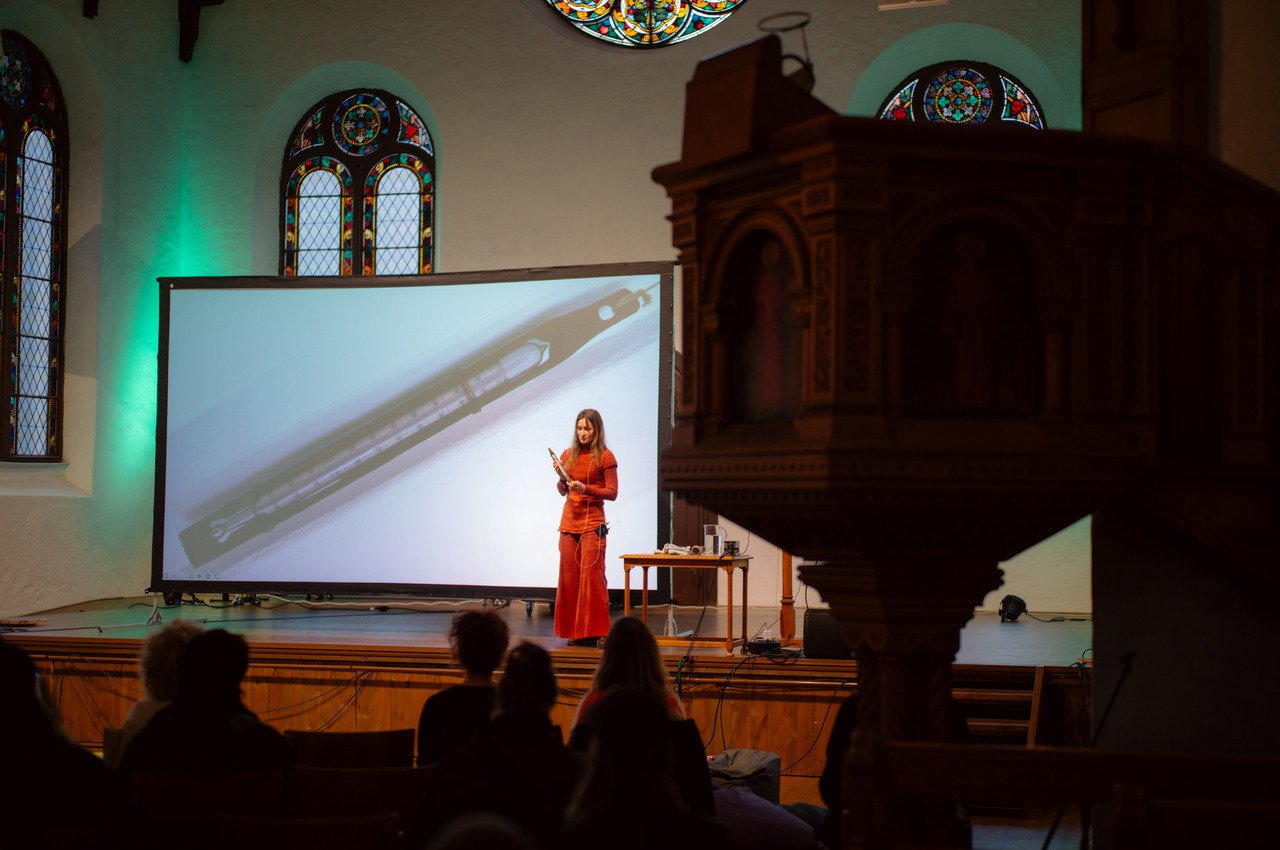
Photo: Stian Servoss, courtesy of Bergen Assembly.
- The hills in question are located near the Romanian village of Șona, where seven mounds rise from the surrounding landscape. Their origin remains uncertain (explanations range from the mythical to the man-made). see: Ewa Borysiewicz, Vera Zalutskaya, “When Drinking the Water, Think of the Source”, https://mostmagazine.org/2026/10/14/when-drinking-the-water-think-of-the-source/ .
↩︎ - Rainer Maria Rilke, “The Duino Elegies. First Elegy”, see: https://www.poetryintranslation.com/PITBR/German/Rilke.php#anchor_Toc509812215. ↩︎
Contributors: James Bridle, Alice Bucknell, Carolyn Christov-Bakargiev, Marcus Coates, Nolan Oswald Dennis, Simone Ghetti, Simone Kotva, Kei Kreutler, Lars Bang Larsen, Chiemi Shimada, Ellen Viste, Lua Vollaard, Mark Thomas Young
Conference Title: A Machine as Complex as the World Itself. A first gathering towards Bergen Assembly 2028
Conveners: Lucia Pietroiusti, Filipa Ramos
Venue: Korskirken (Holy Cross Church), Bergen
Place (Country/Location): Bergen, Norway
Dates: 11.09 – 12.09.2026