Katie Zazenski
Gen Z. All At Once takes as its subject artists born around and after the collapse of state socialism, the so-called “generation of freedom”: a generation for whom the transition into liberal democracy and capitalism in much of the region is not something experienced firsthand but a condition inherited. At the same time, these artists largely belong to a generation whose engagement with images, image- and meaning-making, relationality, and knowledge-building has been shaped by another transition: from the physical, external environment into a far more interior “phygital”[1] realm of the Internet. A space that is now nearly as impossible to be free from as it is our own bodies. What I found in the exhibition of 22 artists was an unexpected re-emergence of materiality and sculptural form, a sharp, snarky sense of humor despite the hellscape dystopia we’re living through, and an extreme level of performativity of the self; something between self-consciousness and self awareness that I couldn’t name until reading the interview with curator Michal Novotný in the exhibition catalogue. When asked about what first piqued his interest in Gen Z, he said that he began noticing a distinct shift in his first-year students at the academy[2] beginning around 2016:
“…it became clear to me that this was the first generation to spend most of their adolescence on social media…What stood out most was an emphasis on creating a ‘persona’ within their art. Interestingly, this went hand in hand with a strong insistence on authenticity. Yet from my perspective, it didn’t feel authentic at all – or at least not in the way I understand the term. That tension between claimed authenticity and constructed self-image is something that has stayed with me.”[3]
Perhaps this is why I found myself thinking, quite unexpectedly and quite constantly, about John Berger. I first encountered Ways of Seeing as an 18-year old university student studying sculpture and art history. Returning to it now, more than fifty years after its publication and untold almost unfathomable changes to the functioning of our world, parts of the book inevitably show their age – particularly the rigidity of some of Berger’s divisions around gender. Yet the basic mechanics of looking that he describes still feel relevant, if not even more so than at the time of their writing. “Soon after we can see,” Berger writes, “we are aware that we can also be seen.” Seeing establishes our position in relation to the world, but it also produces an awareness of ourselves as an object for consumption which according to Berger, was deeply structured by power.
MO Museum, Vilnius, photo: Rytis Šeškaitis.
Image courtesy of MO Museum.
MO Museum, Vilnius, photo: Rytis Šeškaitis. Image courtesy of MO Museum.
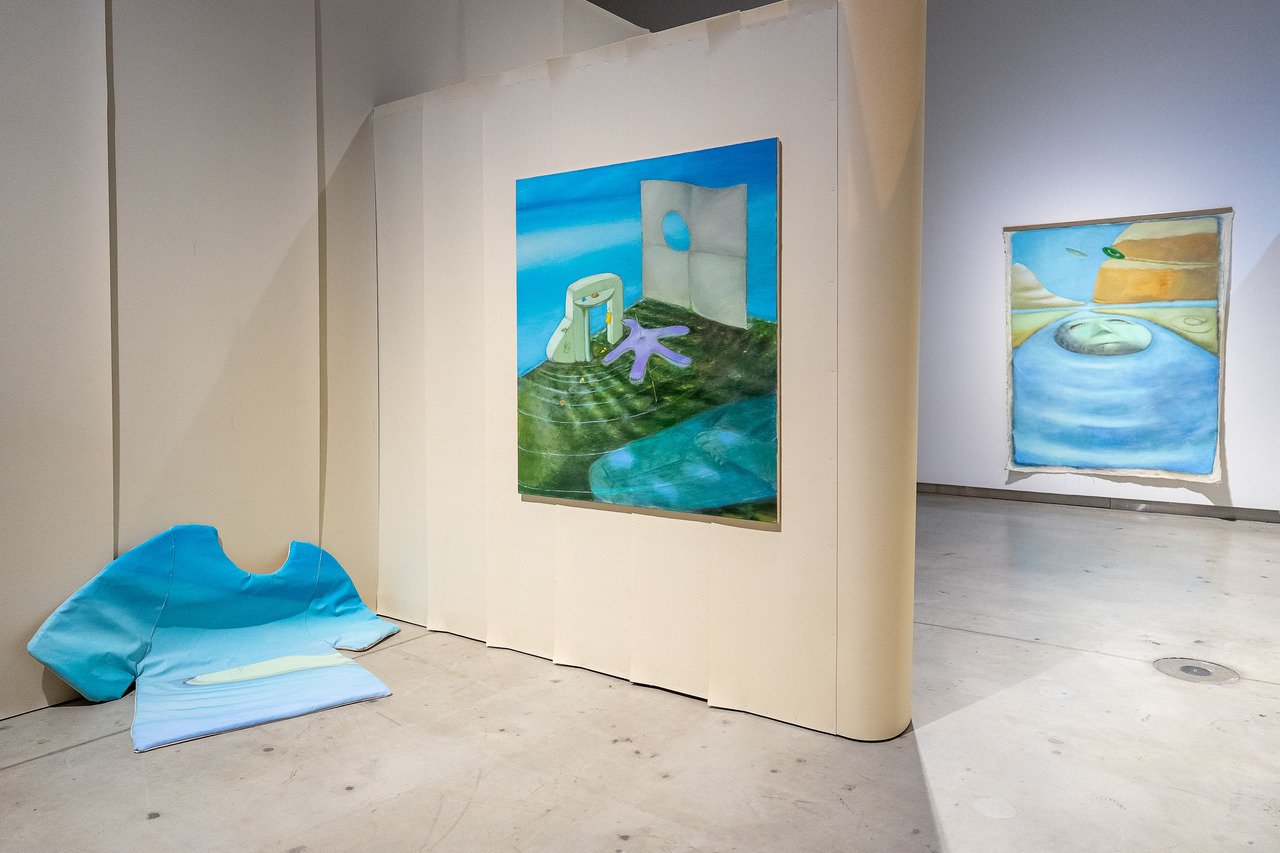
MO Museum, Vilnius, photo: Rytis Šeškaitis. Image courtesy of MO Museum.
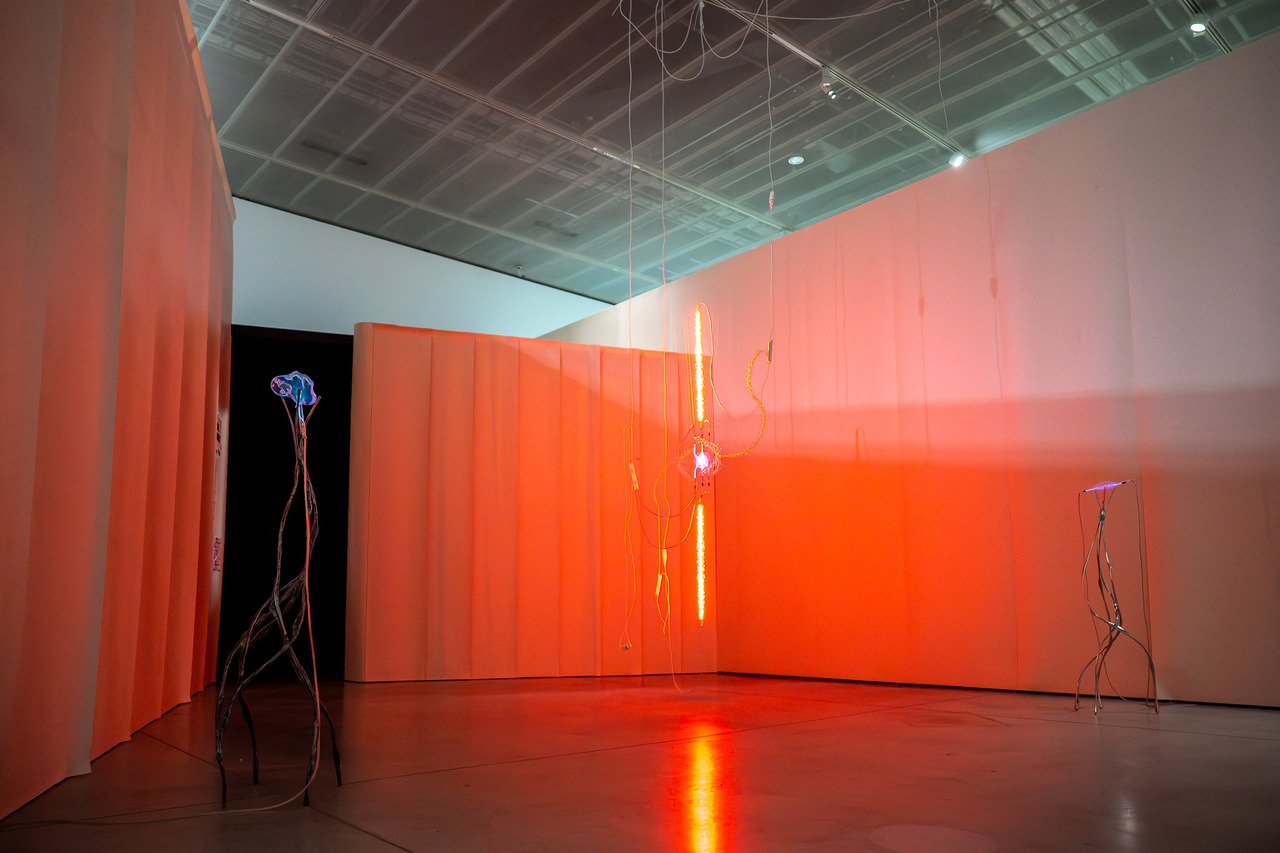
MO Museum, Vilnius, photo: Rytis Šeškaitis. Image courtesy of MO Museum.
Addressing professional visibility (focusing on practices that “in many cases have not yet entered museum collections”[4]) and avoiding confirmation bias,[5] Novotný and co-curator Marius Armonas aimed to refine their generational and regional hypotheses through the research and curatorial process itself which largely included Instagram as a source. The youngest artists featured were born at the beginning of this century, while several of the elders were born in the mid-1990s. This time period, which encompasses the past 30-odd years, has seen so much change so quickly that I stand to believe that the commonalities from one end to the other are less than other more seemingly unifying containers, such as geography in this case. And I actually find it less interesting to think on what might bring them together than perhaps the opportunity that it presents to scrutinize the platforms and mechanisms that became the curatorial framework for this exhibition, where Gen Z is understood less as a stable identity than as a proposition about the conditions under which art today is made, viewed, circulated, and scrolled past. I think it also bears noting that this whole concept and naming of generations as “Boomers,” “Millennials,” and “Gen Z,” etc. has come from a mix of American government statistical surveys and branding strategies. As an elder Millennial myself, someone whose life was wholly untouched by social media well into my adulthood, the generational distance is small enough and the gradual homogenization of cultures via globalization and capitalism has been quick enough to produce requisite familiarity and relatability (as well as antagonisms) between us. But of course, not without expected generational frictions and a much less complex human predisposition to exoticize the Other.
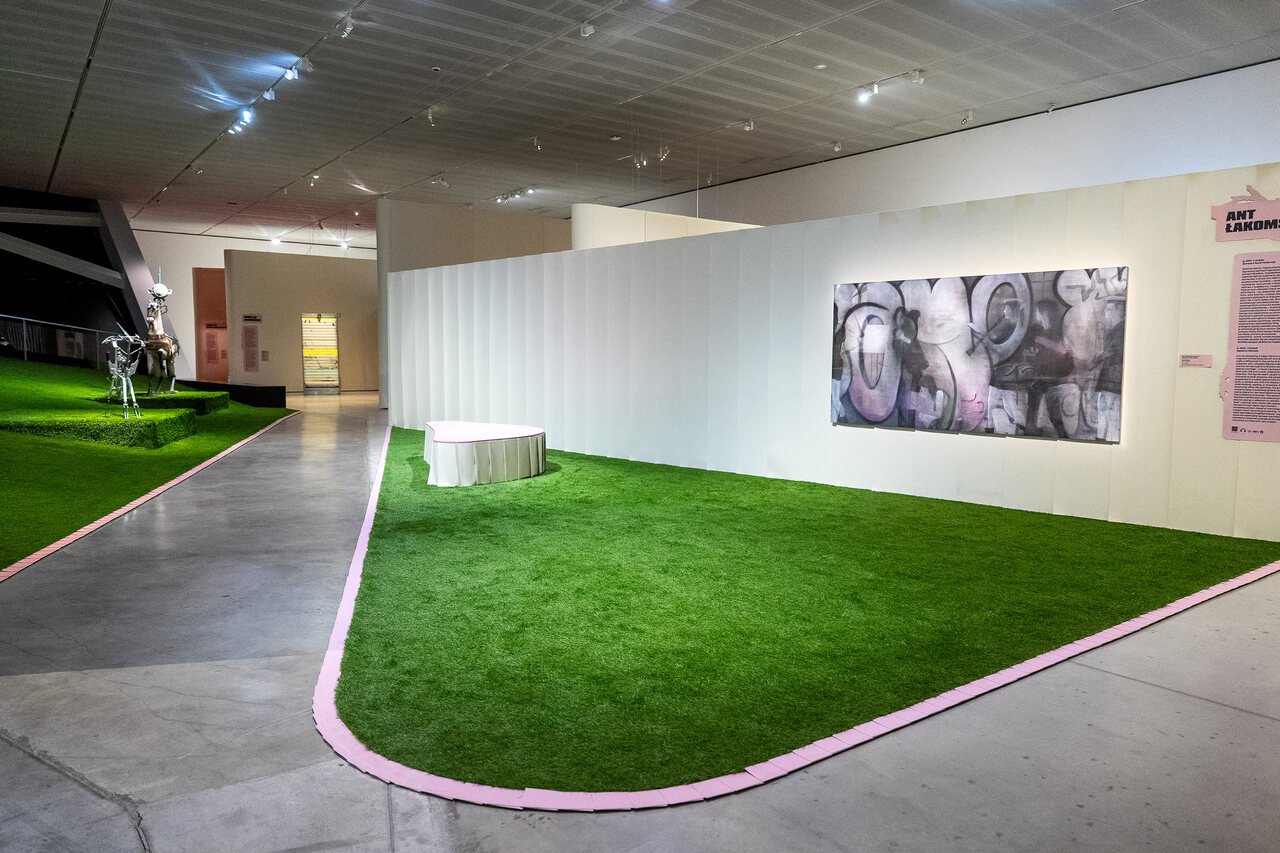
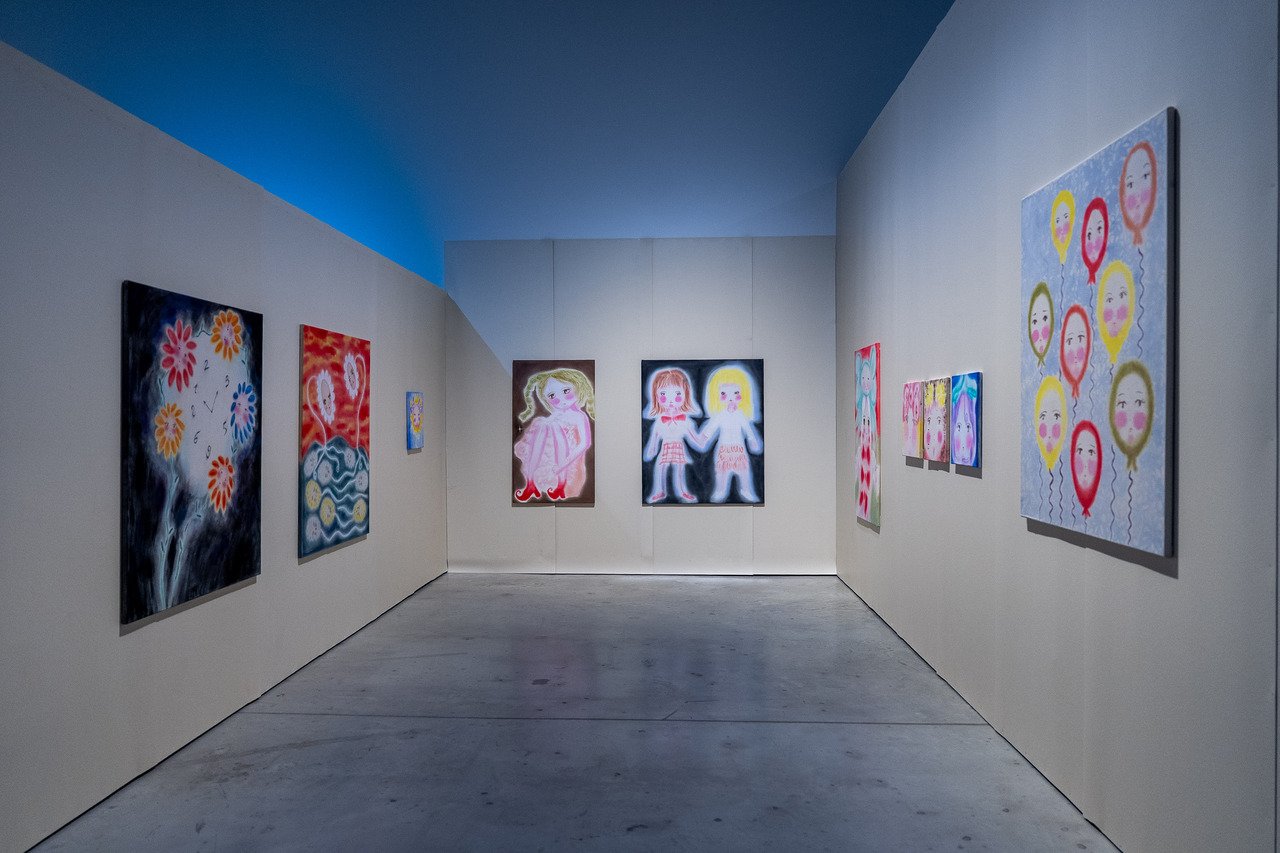
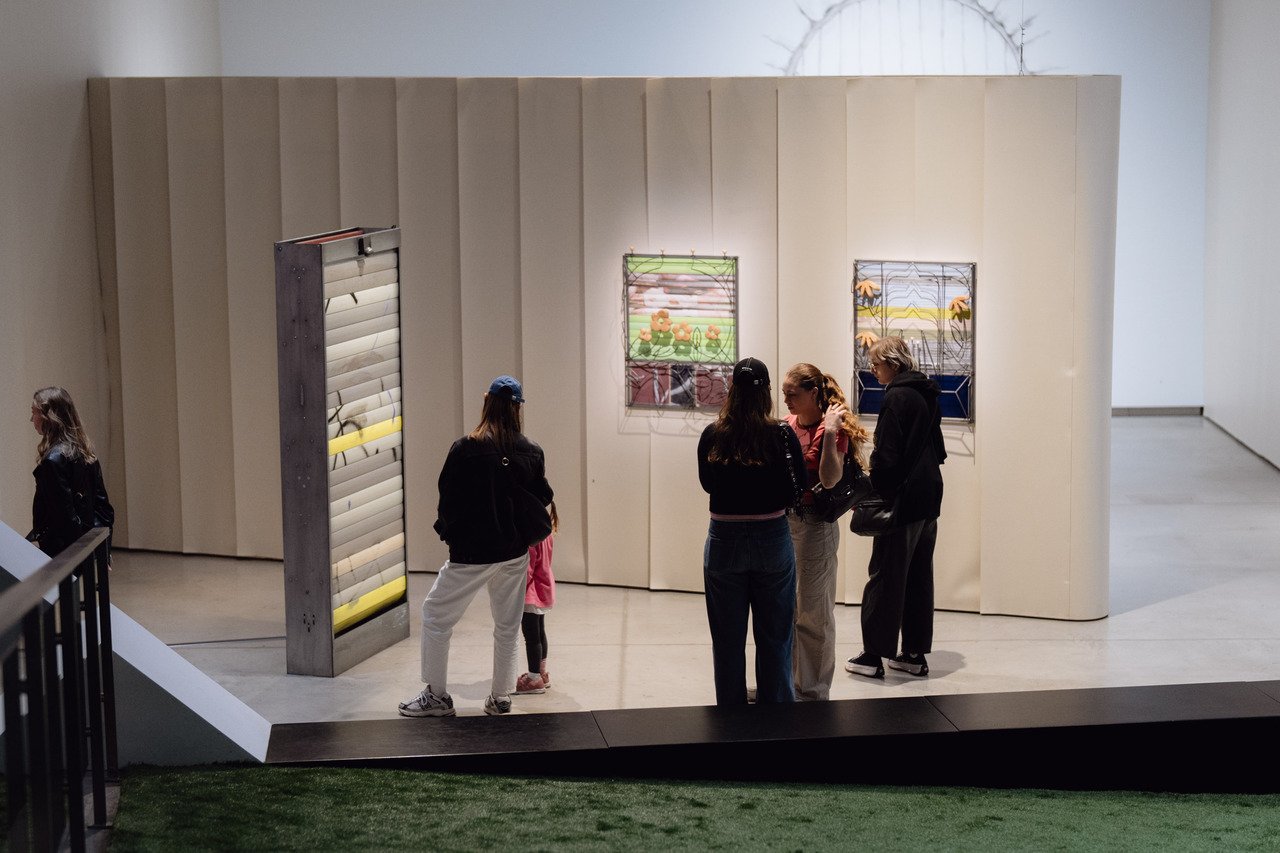
The exhibition was installed in a cavernous space, somewhat dimly lit with cool tones and subdivided into a sequence of something akin to a showcase for each artist. The walls were covered in runs of ordinary linoleum (or some contemporary plastic version of it), flipped so the yellowy, creme-colored backing was facing out. There were also islands of Kelly-green Astro turf edged with small squares of baby-pink linoleum, and I couldn’t decide whether I was supposed to feel all of this as intentional uneasiness or whether I was simply encountering an installation whose material language I could not appreciate – something like how each generation has a level of remixing and rejecting the aesthetic decisions of the generation that raised them.
While the atmosphere was an intentionality for Novotný and Armonas, according to Armonas, the conscious decision to use a slightly cooler tone to the lighting to create a subtle dissonance with that of the material covering the walls was one that he wasn’t terribly sure to be successful. For me it was an excellent strategy for creating a feeling of overwhelming inescapability – like some strange progeny of Backrooms and Miami Basel.
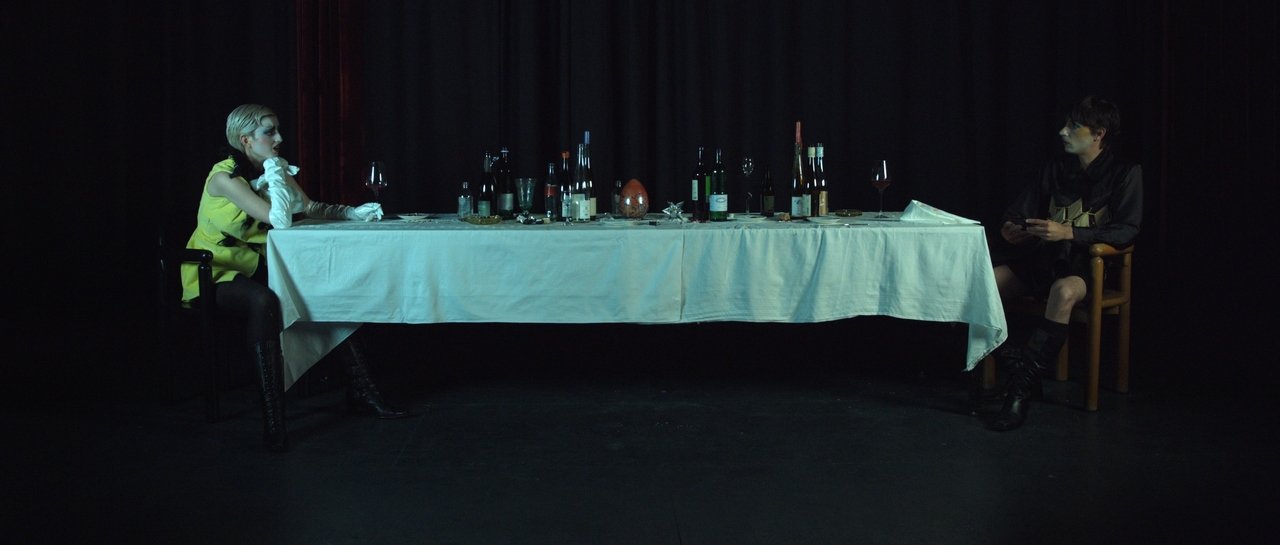
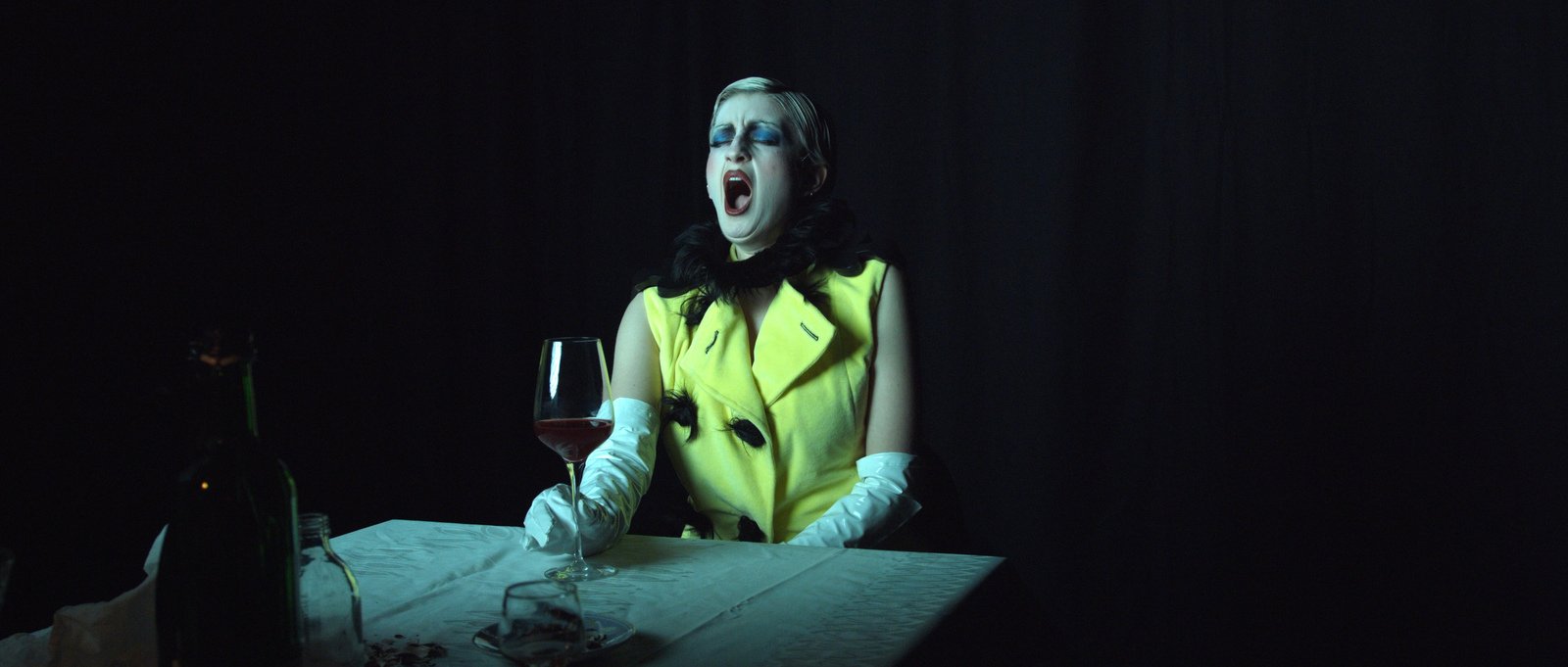
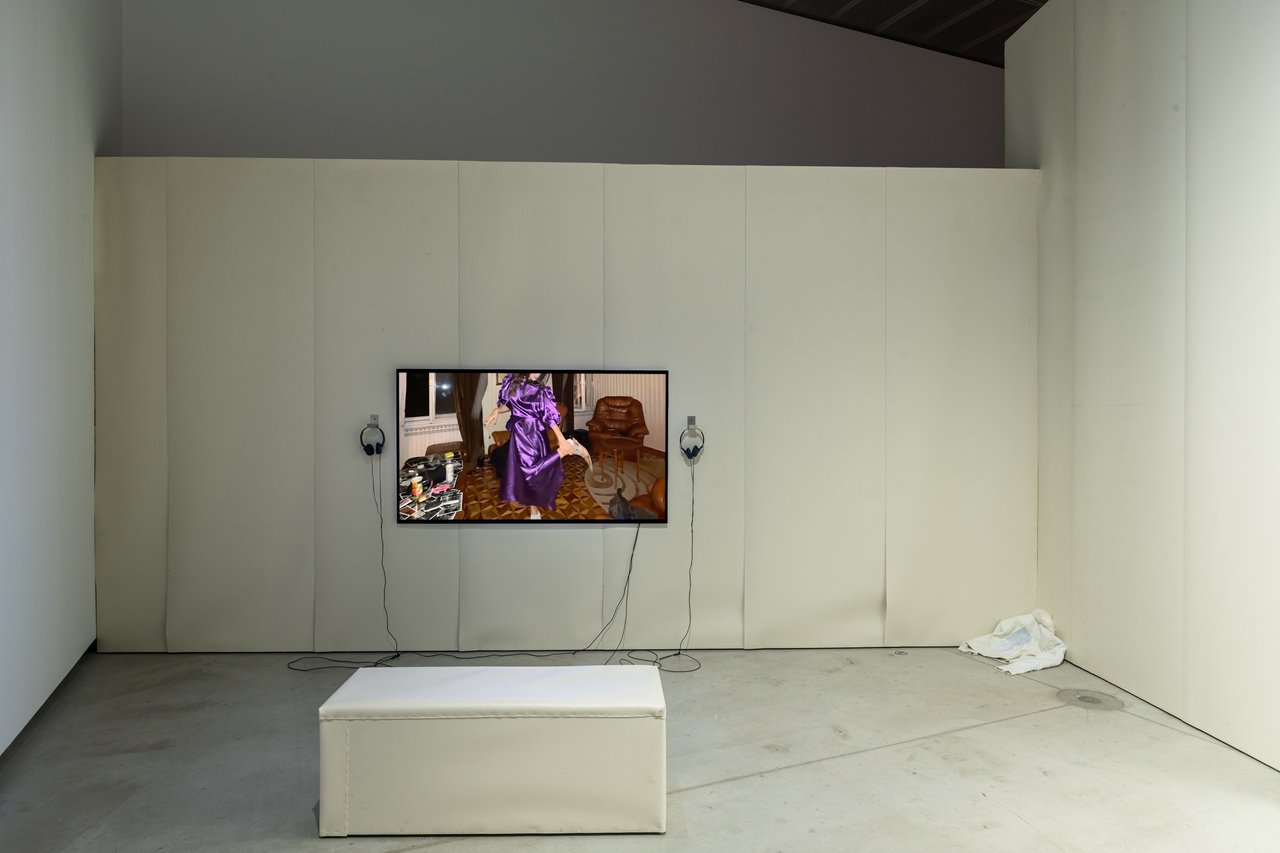
Walking into the darkened area of Tornike Gognadze to spend some time with Boom Ball (2025) I was relieved of the strangely oppressive atmosphere of the main space. As the video began, two figures sat at opposite ends of a long, elegantly curated dining table with a white tablecloth and alcohol bottles and empty glasses strewn across its surface. A cool blue-green tinge to the film; the character on the left in a canary-yellow mini dress with opera-length gloves, sapphire-blue eyeshadow, and a blonde pixie cut giving 1960s Twiggy vibes while the figure on the right sits back, wearing eyeshadow in the same tone and a brown shaggy pixie cut. The figure on the right shares a rambling (mis)memory and the figure on the left becomes increasingly more bored. As the nearly eleven minute video comes to a close, an archival clip of a protest on the steps of the Georgian parliament plays, with flash bombs going off like fireworks, green laser beams blitzing across the facade, and water canons soaking protestors. Characters of a different story. The exhibition publication suggests that in Gognadze’s imagery, intimacy is inseparable from exposure and vulnerability, that “even the most private images are already stages in relation to an imagined gaze.”[6] On Gognadze’s website, his artist statement explains that he explores themes such as “the blurred relationship between frontstage and backstage, the act of performance, and the ways in which power structures and ideologies hide behind curtains.”
The passage from Ways of Seeing that has stayed with me for all of these decades appears shortly after the opening of Chapter three:
“A woman must continually watch herself. She is almost continually accompanied by her own image of herself. Whilst she is walking across a room or whilst she is weeping at the death of her father, she can scarcely avoid envisaging herself walking or weeping. From earliest childhood she has been taught and persuaded to survey herself continually.”[7]
Until reading that passage as a quite naive university student, I assumed this to be the way that everyone moved through the world. Now, many years later, while standing in this exhibition, specifically in front of the work of Tornike Gognadze, I could feel how this gaze has shifted, and also how, despite the fact that I/we have for a very long time been engaged in a certain level of hypervigilance, there was something even more overwhelming about the presence of the self now, emerging from the way the self is performed and embodied on and for the Internet.
Berger’s gendered account of the woman who continually watches herself wasn’t about vanity, but rather the consequences of power and hierarchy for those who are not at the top. And what I felt so strongly from Gognadze’s piece was the work that it requires to seek out the truth – if that’s even possible – and how it’s just so much easier to consume a beautiful image, to be taken by the fantasy of it all.
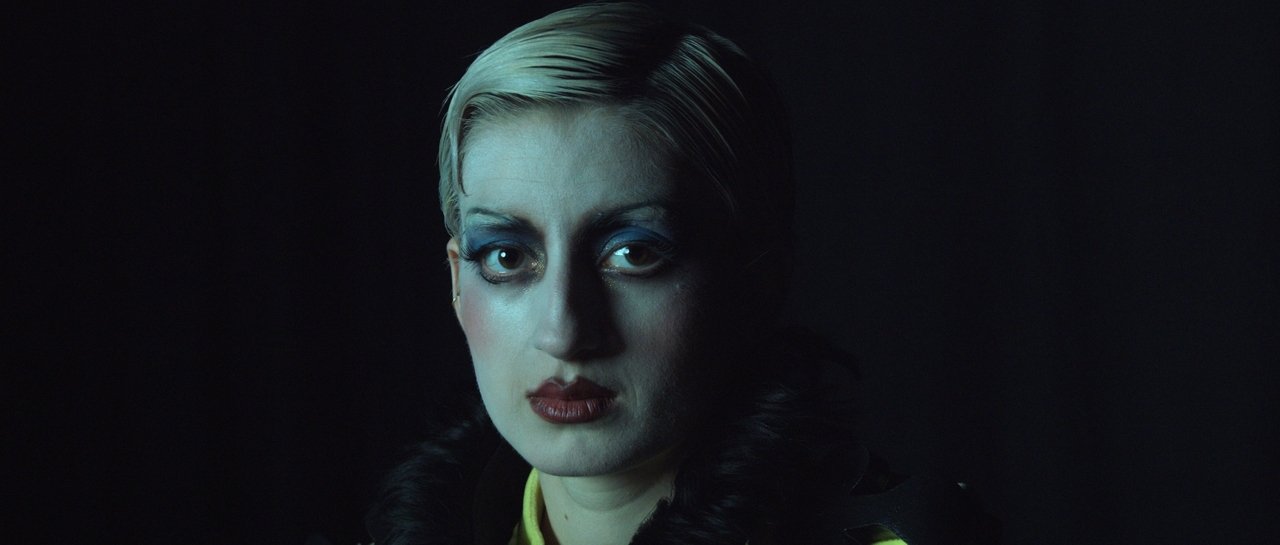
While the screen can place these experiences beside one another and platforms like Instagram turn it all into an endless cascade of images, no matter what, it cannot make their material realities equivalent. This distinction is important because the apparent collapse of distance is also a collapse of many of the coordinates we once used to orient ourselves toward what we saw, knew, believed, and trusted. Near and far, public and private, consequential and trivial no longer necessarily arrive looking any different from one another. And it takes real cognitive work to remember that these realities and contexts are so very different and so very nuanced. Selfies and memes not only soften the blow of genocide and war but are architected and incentivised so that we remain floating in that space for as long as possible, losing sight of anything that exists outside of it. I don’t know if anyone is immune to a doomscroll. This engineered mindlessness is a tactic of an infrastructure that continually produces distinctions between what – and who – becomes visible and what – or whom – is not. There is no question that a post or story by someone with a strong in-app network of literal followers is prioritized and those that are deemed “political” are buried. And by the time an image has made its way to you, it has already passed through multiple gates of potential censorship – shadow banning and flagging of “spam behavior” or the perception of breaking a “community guideline.” But what do we do, especially when we no longer simply want to be seen but in fact need it?
In Fly Trap (2023) by Helena Parys, a woman reclines on an amethyst and black ground, something like a mix between a cave and what it feels like to be awake at 4 AM. The female figure stares back at us as we stare at her – breaking her engagement with whatever is happening within the laptop propped in front of her, which reflects back to us her naked body. One could easily assume the repetition of the gaze continues endlessly like an infinity room through the webcam. Slashes across her body reminded me of Fontana’s Tagli (Cuts), another gesture signaling a lifting of the curtain, an effort to blur the boundary between frontstage and backstage.
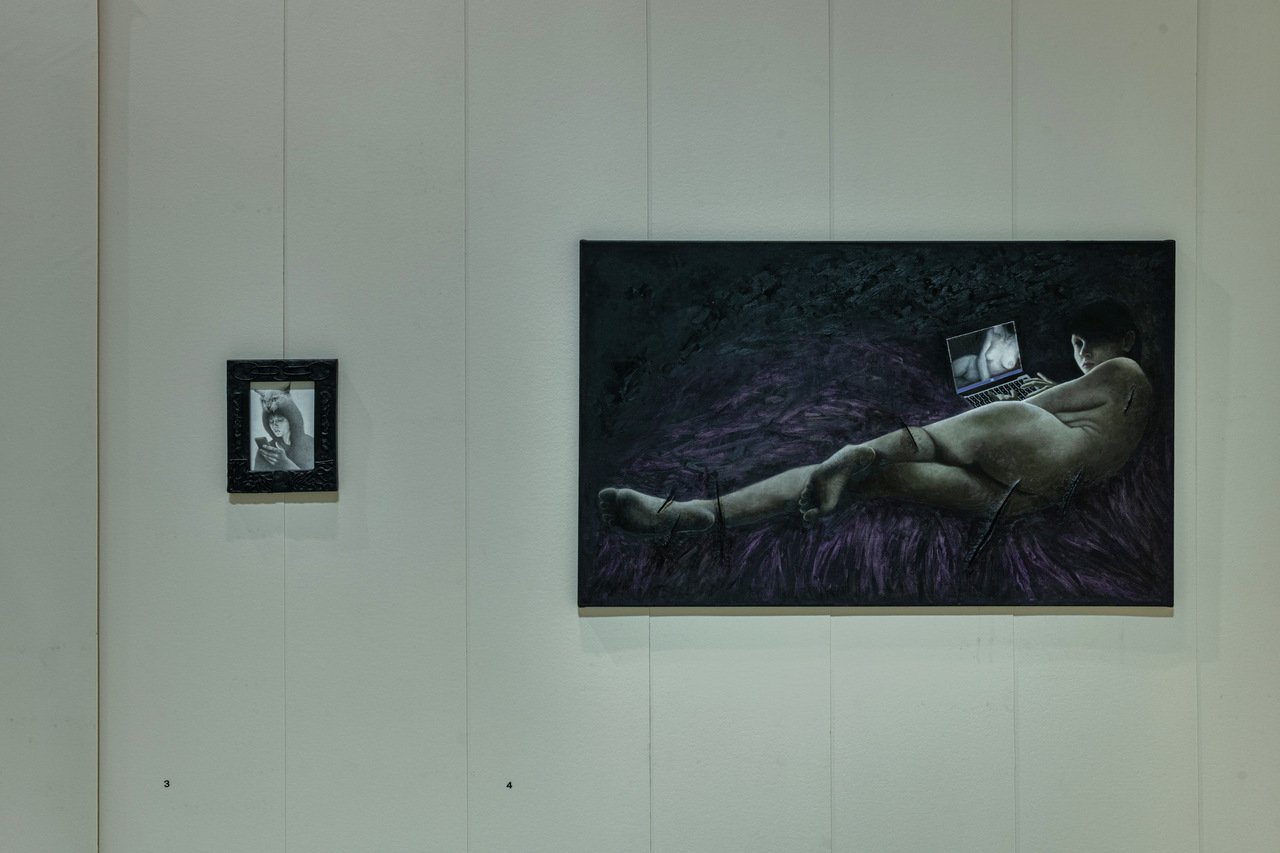
29.5 × 24.5 cm, “Fly trap”(right), 2023, oil, modelling paste on canvas, 80 × 130 cm,
photo: Jonas Balsevičiu. Image courtesy of MO Museum.
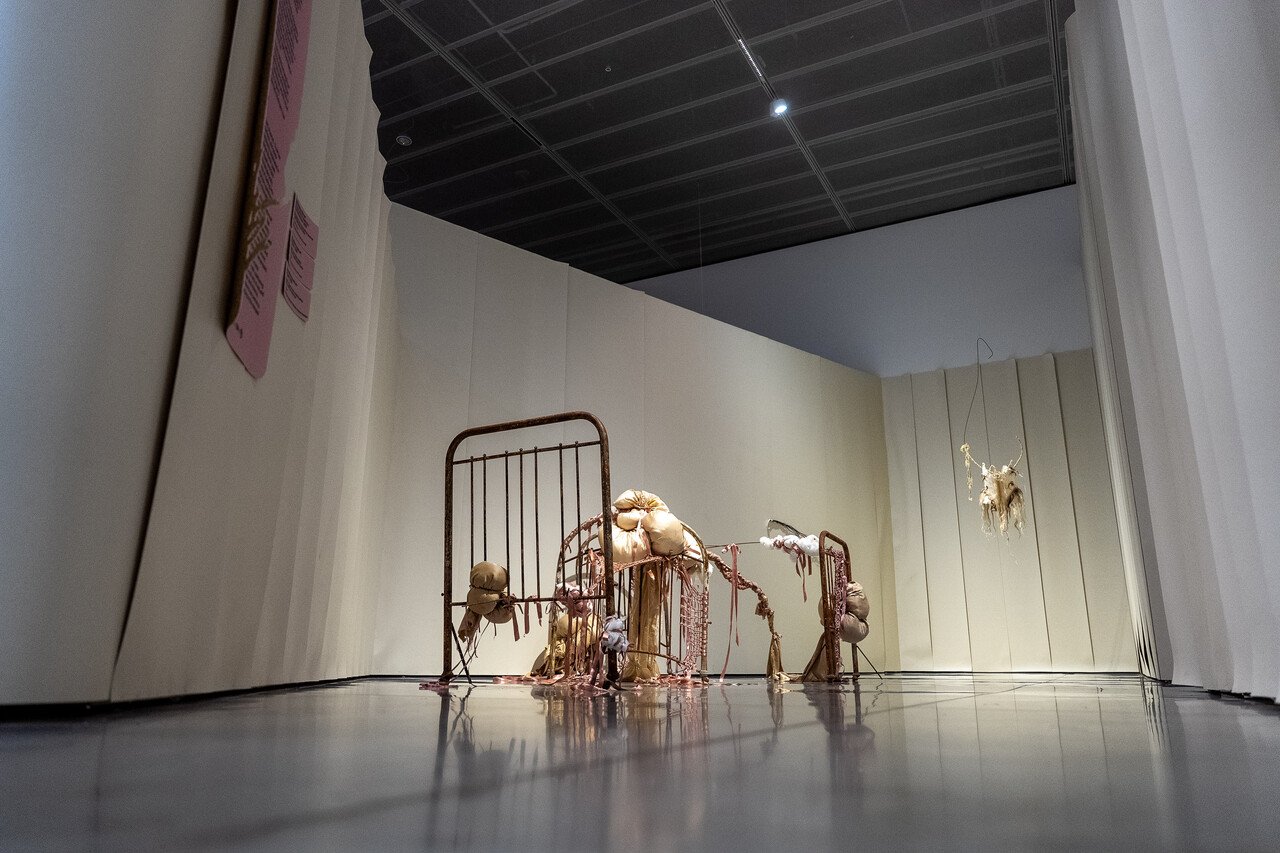
MO Museum, Vilnius, photo: Rytis Šeškaitis. Image courtesy of MO Museum.
Gen Z did not invent this condition of watching, seeing, surveilling, documenting; but they are the first to be collectively burdened by the expectation that one’s image is continually seen, recorded, surveilled, quantified/datafied, sold, and weaponized within and by and for this medium, which reproduces a ruthless hierarchy of visibility. Art history is full of reminders that visibility precedes judgment, but I think the trickier part now is the relative invisibility of the mechanisms by which these platforms, the Internet, is governed.
This hypernormalized dystopia is served to us like a viral treat in the work of Latvian artist Dzelde Mierkalne. In several of her works (Danse Shmakabre and That’s All Folks, 2024), uncanny Mickey Mouse-adjacent characters are depicted with perversely menacing melting smiles and empty eyes. A child-sized white candle with a twist-pattern, just like the little candles we blow out on a birthday cake, has collapsed under the weight of itself. Sprouting from its marbled holder, it limply rests itself on a section of the Astro-turfed floor like a caterpillar frozen mid-inch. A medieval wooden door is drawn onto the surface of the wall in crayon and a cartoonishly large, pudgy key hole is set dead-center, reinforcing that funhouse warp. Across many of her works, Mierkalne employs scagliola, a technique popularized in the 17th century to imitate marble and granite inlay, which brings into the work a long history of mimicry, faux luxury and stand-in’s. In the exhibition publication, her practice is situated around the question of how to “live, feel, and even play in a world that already appears profoundly cursed.” But what I love about her work is the coexistence rather than the contradiction. Fantasy does not mask catastrophe and humor does not alleviate anxiety, but instead intensifies it. The artificiality does not aim to conceal or even aim to achieve some more authentic reality, but becomes a new construct in and of itself; a byproduct of this real-life nightmare theater. They are less an escape from an unstable world than a strategy for surviving the carnival that is this new one.
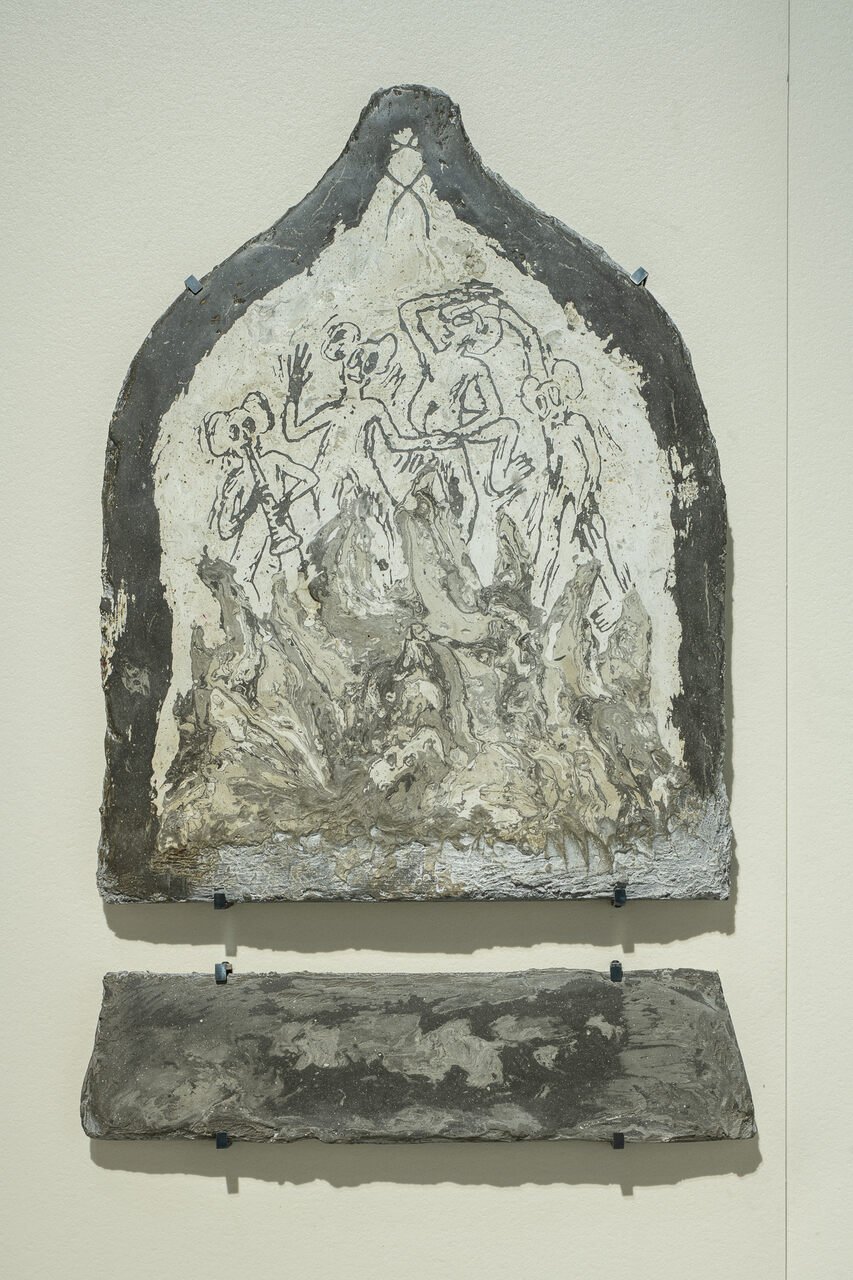
Image courtesy of MO Museum.
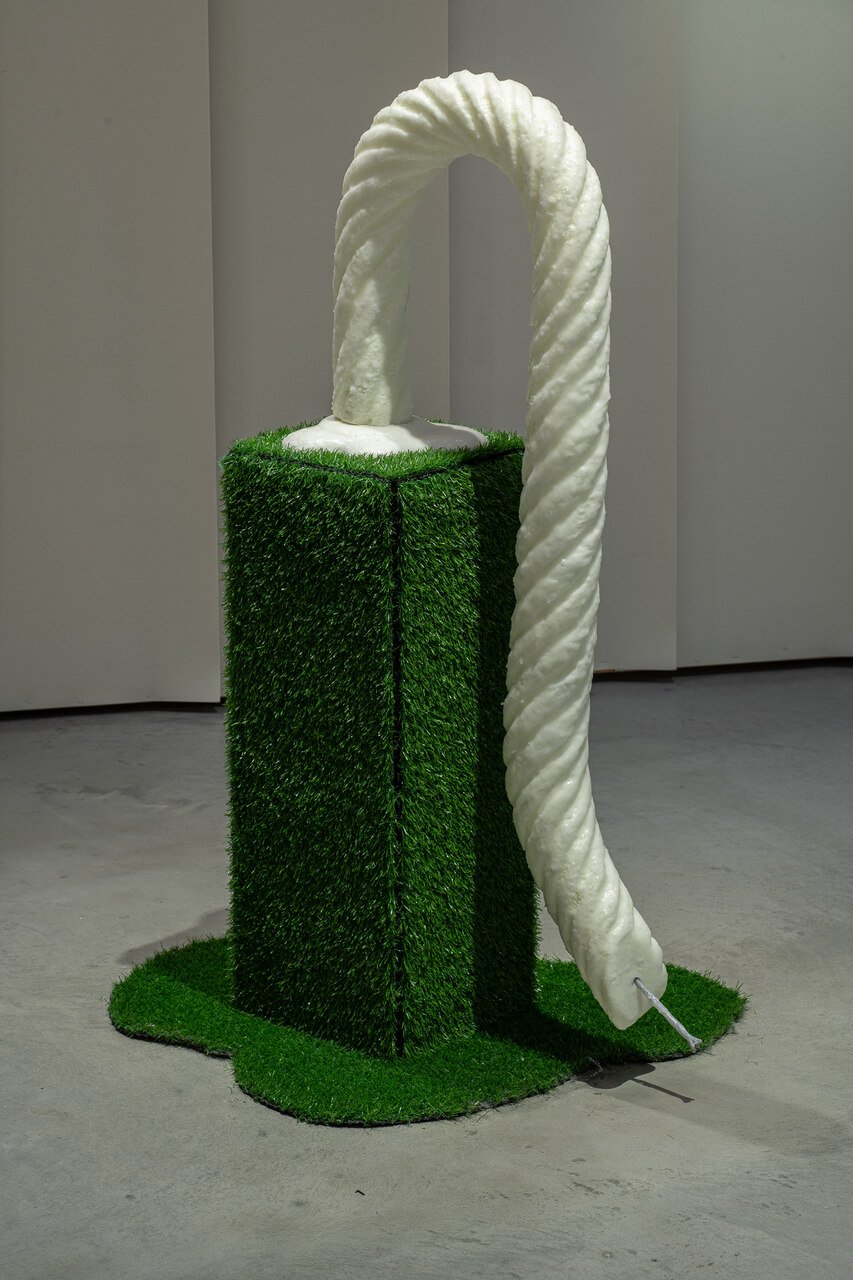
photo: Jonas Balsevičius. Image courtesy of MO Museum.
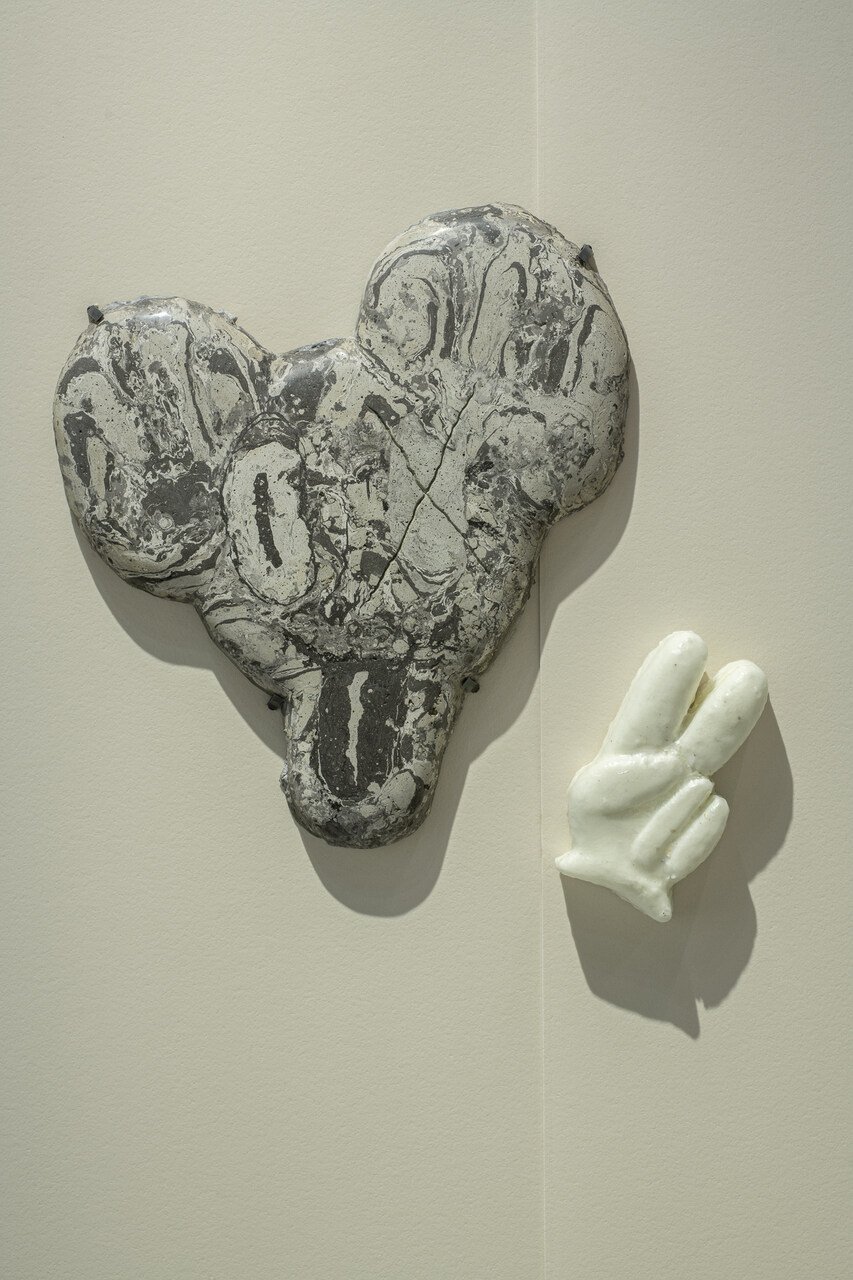
58 × 58 cm; 26 × 15 cm, photo: Jonas Balsevičius.
Image courtesy of MO Museum.
In Paula Tončić’s “archaeological fiction” video Trocadero (2026), we are offered another version of this hallucinatory phygital space, a simulacrum of an inherited memory. The AI-modified video takes us through a space modeled after a Croatian club from the 90s; we float from the exterior to the interior, through floors and rooms and bodies and objects “of Balkan kitsch, car tuning culture, and ruined interiors.”[8] These elements are quite emblematic of the region and can be found across many different practices, which can begin feeling like an aesthetic rather than a position. While I enjoyed the visual seductiveness of it, what stayed with me was the melting that was occurring between figures and the spaces they existed within. This gesture felt so strongly inspired by an inability to maintain form and stability amidst the timelessness, placenessness, and disorientation of this blended physical/digital world which has been set on warp speed and constantly demands our attention.
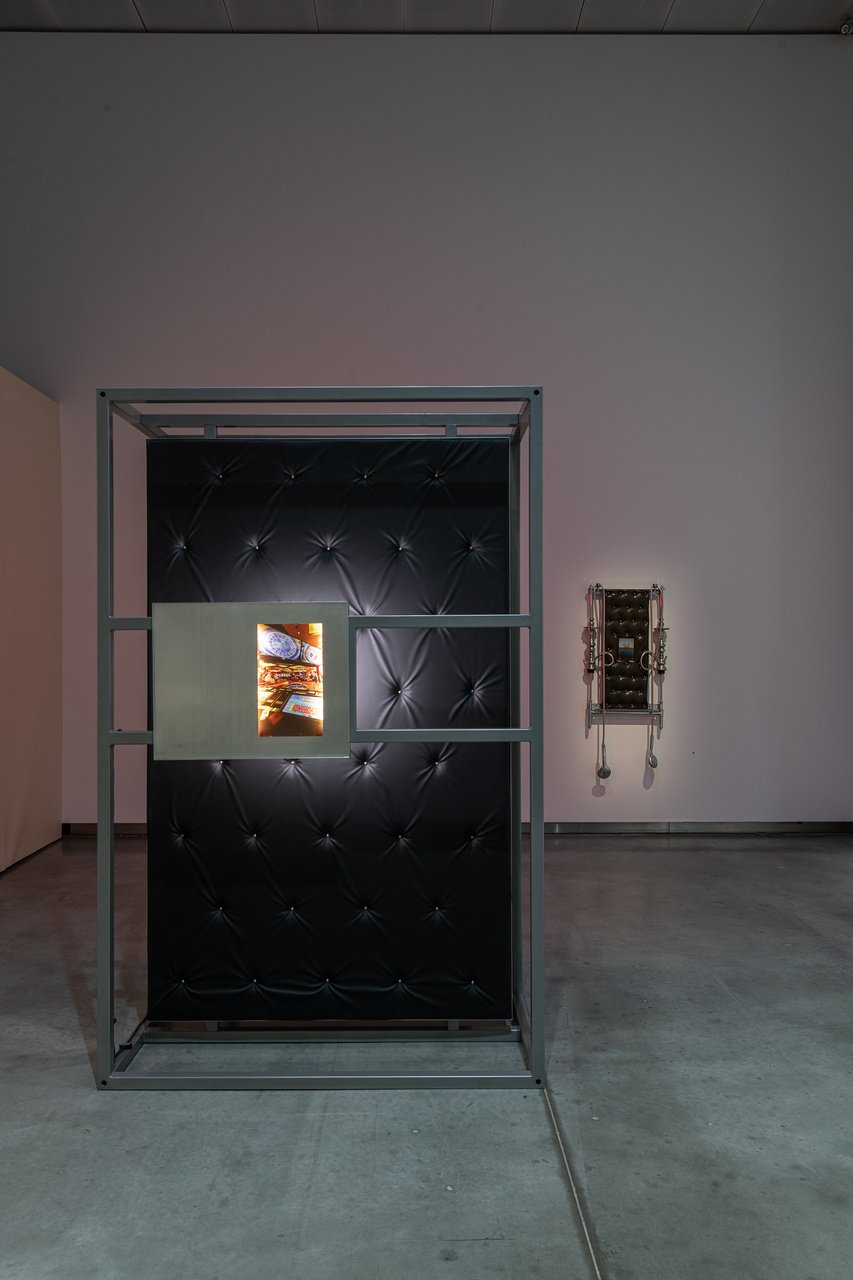
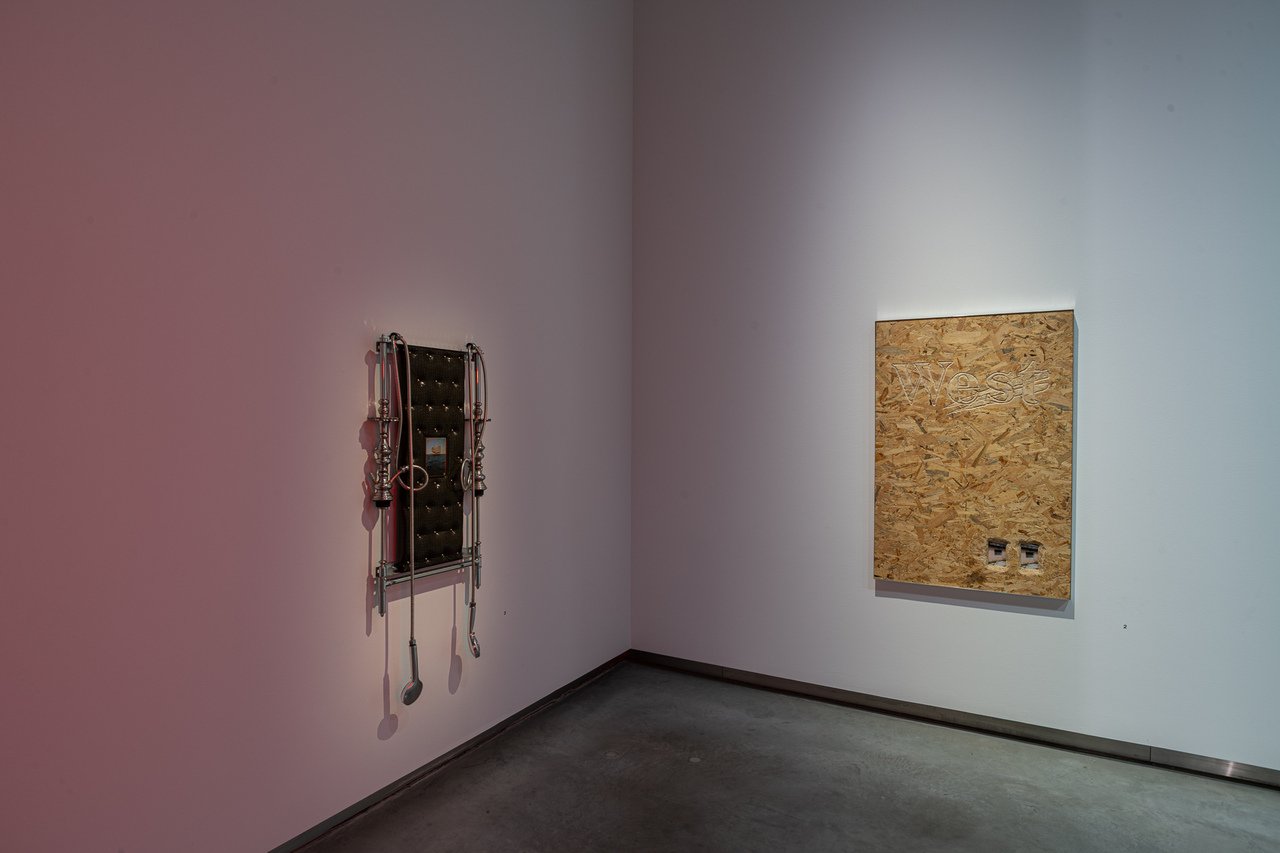
There’s one more thread to lace into all of this which might most closely be read as nostalgia. Perhaps it’s not necessarily the longing for that which was but rather that which is not whatever this now is. Articulated in the work of US-born Bulgarian artist Aaron Roth, whose material language is adjacent to Tončić, recycles what the exhibition publication calls the promises of capitalist transition: images of cars, private jets, jewelry, designer clothes, and alcohol, which appear as emblems of a world whose abundance remains unflinchingly visible even when access to it does not. “Gilded expectations” meet “grey realities,” while the nouveau riche aesthetics of the 1990s collide with the smoother visual language of European integration and its institutional infrastructures. Being an American who has lived in Poland for over a decade, it feels akin to the “American Dream” that has so famously occupied the desires of Gen Z’s parents, and probably until around 2016, Gen Z as well. This inherited fantasy – for all of us – has had many consequences, some positive for sure and many decidedly less-so. But regardless, the lingering longing for and aesthetics of this dream are still palpable, even if it’s mostly now in the form of a banal visual vocabulary of synthetic luxury as defined via global platform culture. The promise of joining “the West” was political, economic, and aesthetic, and while there is still something lustworthy in it for many Millennials, I think it’s safe to say that Gen Z has read the writing on the wall and is trying to find a different way out.
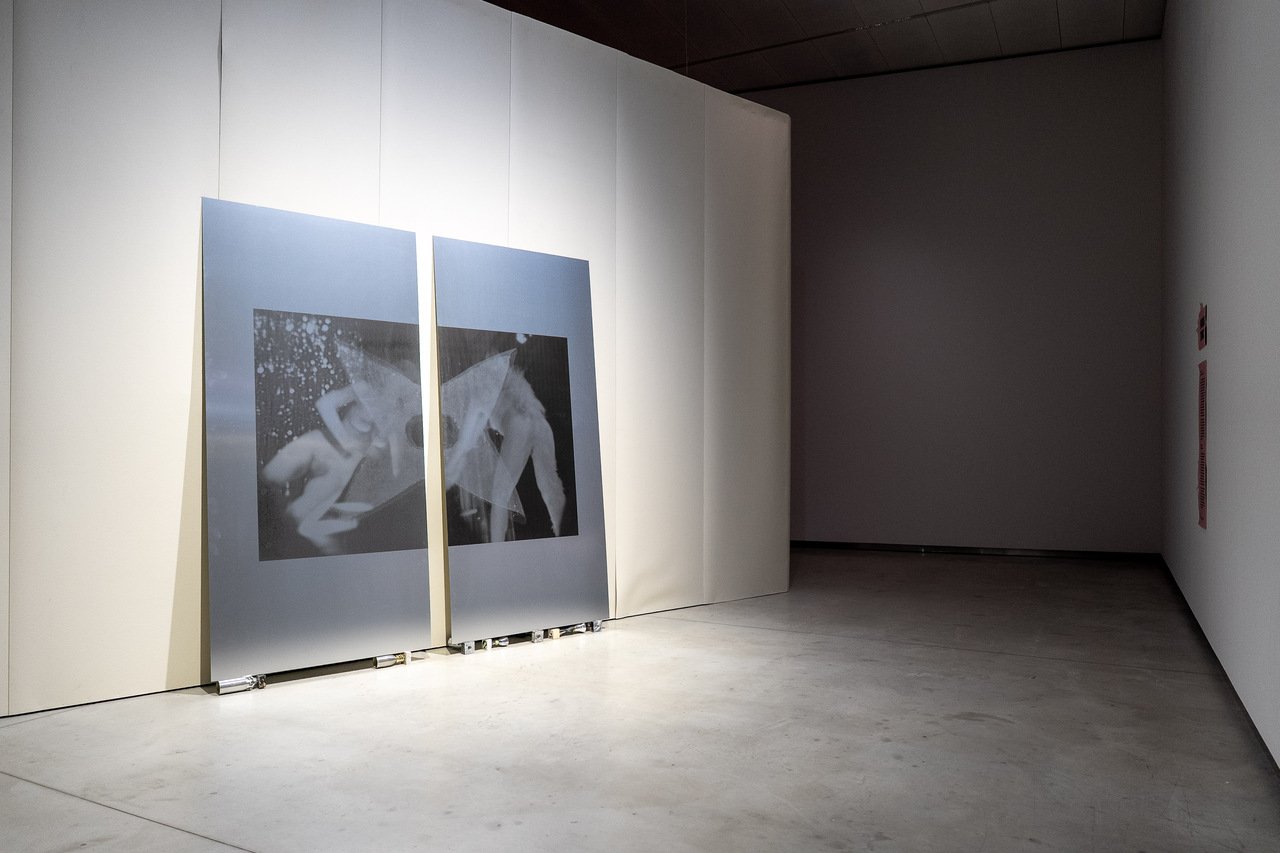
photo: Rytis Šeškaitis. Image courtesy of MO Museum.
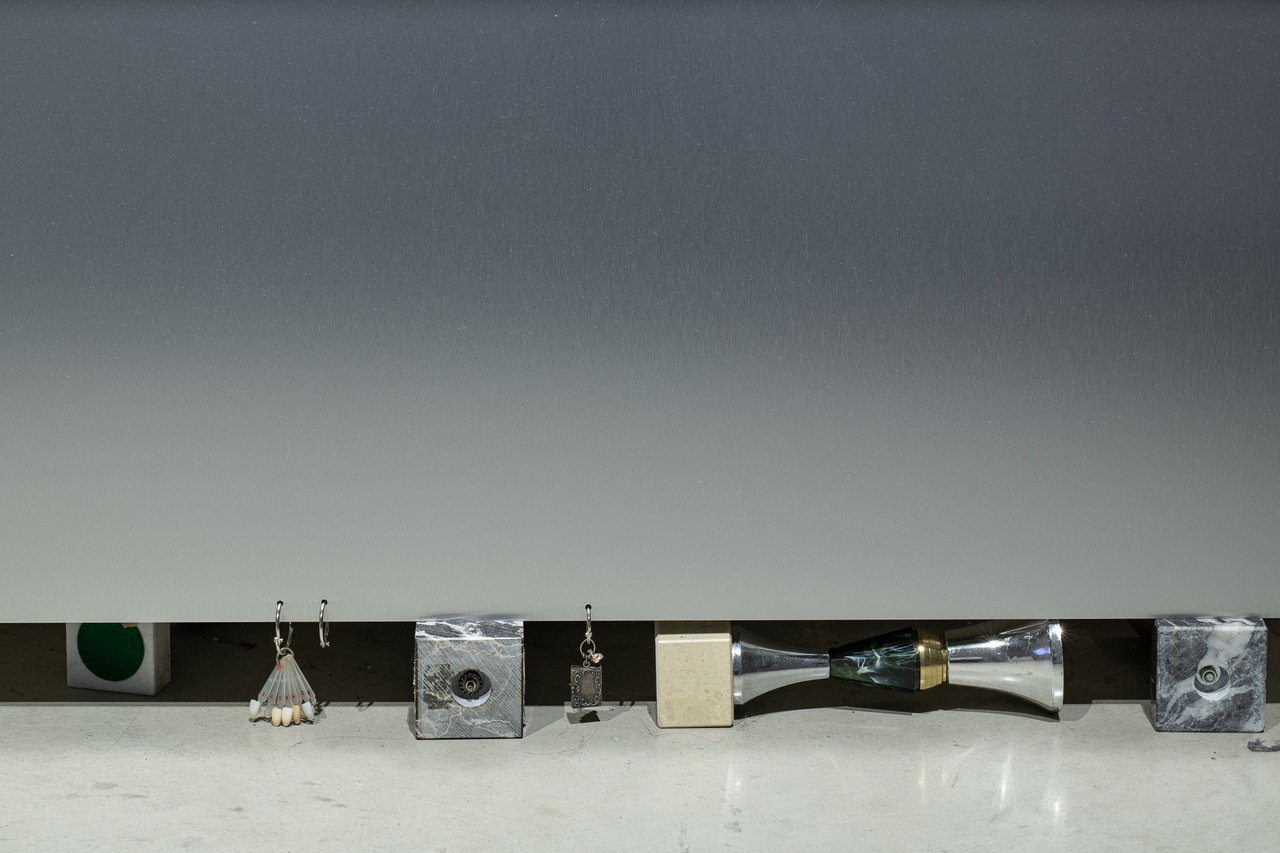
Through all of this, I found myself returning to a second venerable reference, Hito Steyerl’s essay In Free Fall: A Thought Experiment on Vertical Perspective (2011) where she describes the relationality of falling, that we don’t actually feel it if everything is falling/melting/imploding at the same rate. It instead becomes a synthesized stasis. In the exhibition publication, the erosion of permanent frameworks is connected to an idea of authority becoming horizontal, with care emerging as a form of mutual regulation under unstable conditions. In a section of Novotný’s text called “Digital Closeness,” he writes, “Personal branding, omnipresent in digital culture, may appear narcissistic, yet it is rarely egoistic. The self that emerges here is collective, relational, and deeply embedded within networks…Resonance and circulation become key social values.”[9] True? But connectivity is not connection, especially when it is produced within the confines of a private-interest global social media platform. The weakening of one hierarchy does not mean the disappearance of all hierarchies, especially when it occurs within an unflinchingly market-oriented structure where the right kind of engagement is rewarded with visibility and the wrong kind is punished with invisibility. The privileges and barriers that exist IRL are being and will continue to be reproduced online: the bonds, kinships, bubbles, and echo chambers – no one is exempted from filtering and pre-selection. We can try to subvert it, “trick” it, bend the rules, but ultimately, that horizon is disappearing right alongside us.
I found many works in this exhibition particularly powerful and was excited to learn about quite a few new (to me) practices, including some mentioned above as well as Mara Verhoogt and her completely unsettling video featuring a diseased genital-faced character who engages in some pollination-like gestures with cut flowers (Lovebug, 2024), and the endlessly opening roller shutter sculpture of Mikelis Murnieks (Doomscroll, 2019-2026). I also found myself recognizing a particular mixture of irony and melancholy that predates Instagram and the Internet and I would say has been perfected in this region, but I would argue that since the US has now worked its way to the top of the list of “shithole countries,”[10] this condition is starting to become more and more commonplace not only in Eastern Europe but also across the “land of the free.”[11]
I leave Gen Z. All At Once a bit worried that we have maxxed-out the potential of irony, but also fascinated by how something I thought to be effectively fixed – like the concept of authenticity – can shift so much through the expansion of temporal engagement. But perhaps most importantly, I am ardently reassured by the fact that so many of us are confused and angry and refuse to accept convention, but instead are looking for ways to use it as a way of resisting and reframing this apocalyptic freefall.
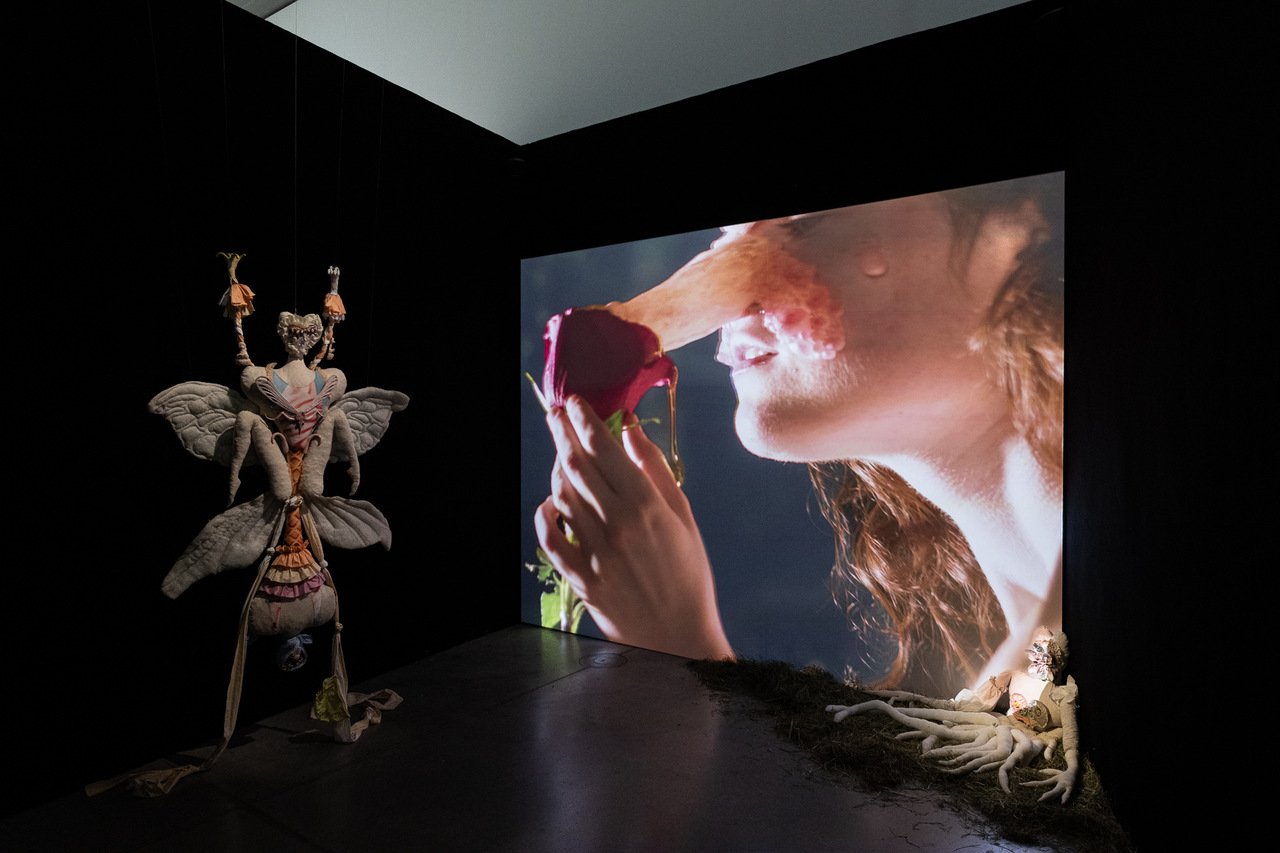
Image courtesy of MO Museum.
MO Museum, Vilnius, photo: Rytis Šeškaitis. Image courtesy of MO Museum.
[1] Novotný, Michal. “Gen Z. All At Once!” Gen Z. All At Once, edited by Audra Kairienė and Gemma Lloyd, BALTO print, 2026, 19. pp. 19-25.
[2] The Academy of Arts, Architecture and Design in Prague
[3] Kuprytė, Agnė. “A Conversation with the exhibition curator Michal Novotný.” Gen Z. All At Once, edited by Audra Kairienė and Gemma Lloyd, BALTO print, 2026, 51. pp. 51-56.
[4] Ivanauskienė, Milda. “Foreword.” Gen Z. All At Once, edited by Audra Kairienė and Gemma Lloyd, BALTO print, 2026, 9. pp. 8-9.
[5] “…the curators deliberately avoided seeking confirmation of preconceived expectations or established images.” ibid.
[6] Armonas, Marius and Novotný, Michal. From the artist descriptions, Gen Z. All At Once, edited by Audra Kairienė and Gemma Lloyd, BALTO print, 2026. pp. 115.
[7] Berger, John. Ways of Seeing. British Broadcasting Corporation / Penguin Books, 1972.
[8] Armonas, Marius and Novotný, Michal. From the artist descriptions, Gen Z. All At Once, edited by Audra Kairienė and Gemma Lloyd, BALTO print, 2026. pp. 111.
[9] Novotný, Michal. “Gen Z. All At Once!” Gen Z. All At Once, edited by Audra Kairienė and Gemma Lloyd, BALTO print, 2026, 22. pp. 19-25.
[10] A 2018 quote from US President Donald Trump in relation to immigration to the US by people from particular countries.
[11] Key, Francis Scott. “The Star-Spangled Banner.” 1814. Poetry Foundation, www.poetryfoundation.org.
Artists: Aaron Roth, Ant Łakomsk, Denisa Langrová, Dzelde Mierkalne, Dominika Kováčiková, Helena Parys, Katrīna Biksone, Madlen Hirtentreu, Mara Verhoogt, Matyáš Tserhack Maláč, Mikelis Murnieks, Morta Jonynaitė, Nikola Balberčáková, Olga Krykun, Paula Tončić, Emilija Povilanskaitė, Clara Schweers, Sarah Nõmm, Tornike Gognadze, Valentina Várhelyi, Weronika Wysocka and Oksana Pawełko
Exhibition Title: Gen Z. All At Once
Curators: Michal Novotný, Marius Armonas
Venue: MO Museum
Place (Country/Location): Vilnius, Lithuania
Dates: 18.04–30.08.2026
Photos: Jonas Balsevičius, Rytis Šeškaitis.