This text is one of four that was commissioned by the team of MOST to accompany their satellite program for the 2025 Kyiv Biennial, “There Is Nothing Solid About Solidarity.”
Maxim Poleacov
A newspaper is not only a collective propagandist and a collective agitator, it is also a collective organiser. In this last respect it may be likened to the scaffolding round a building under construction, which marks the contours of the structure and facilitates communication between the builders, enabling them to distribute the work and to view the common results achieved by their organised labour.1
Samizdat – experimental, low-run, DIY (do it yourself) self-publishing. In the case of the 3rd Space Studio, samizdat became a means of communication and organising, facilitating the development of a collective mode of production, for building relationships and conversations on a certain topic. An opportunity for a political act to compensate for blind spots in dominant mass narratives, a reduction of the flickering modernist heritage to a level that provides a sufficient functional minimum for a small artistic group. Such shared studio practices lead from spontaneous forms of togetherness to self-constitution, preventing institutional alienation.2
***
I will speak from the position of coordinator of the samizdat 3rd Space Studio at Casa Zemstvei (House of Zemstvos) Cultural Center in Chișinău – a place that a broad group of artists, activists, and other cultural operators articulate as the main stronghold of and material base for the independent cultural scene of Moldova. Casa Zemstvei is currently a place where various organizations and cultural initiatives, often self-organised and community-based, attract a lot of visitors and people interested in broadly understood cultural activity (workshops, film screenings, exhibitions, talks, etc.). However, this vision does not align with that of the official authorities, who consider the building only as a part of the Ethnography Museum and as such, do not recognize its role as a cultural center, which translates to lack of care for the building and the communities it hosts. As a result, Casa Zemstvei is a place which is constantly struggling against the annual threat of eviction as well as decaying conditions: it is unheated in winter, which has provoked various problems associated with both physical and mental health,or for example, collapsing ceilings which has led to the conversion of publishers into construction workers, and so on. Such situations were tempered by flashes of opportunity for cultural production.
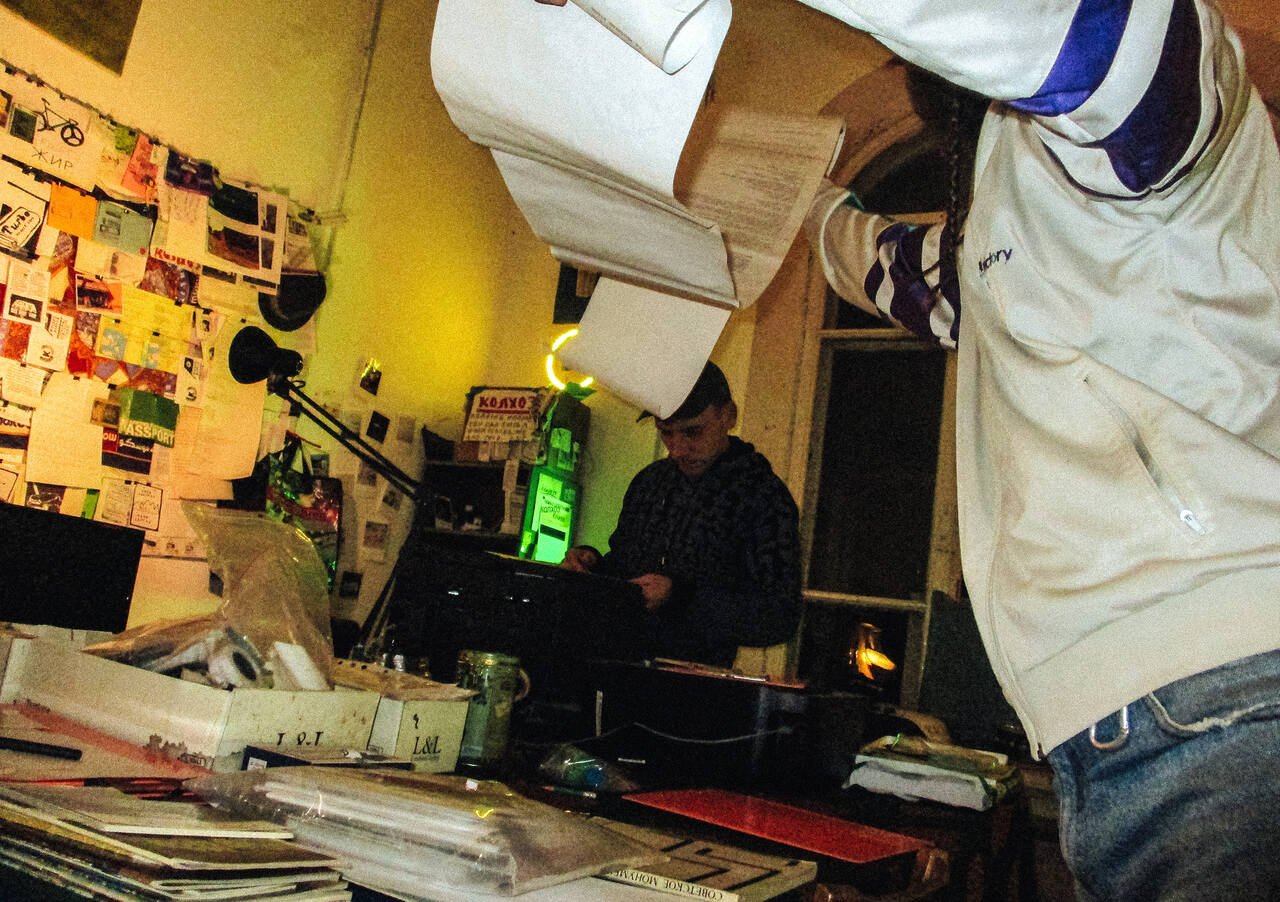
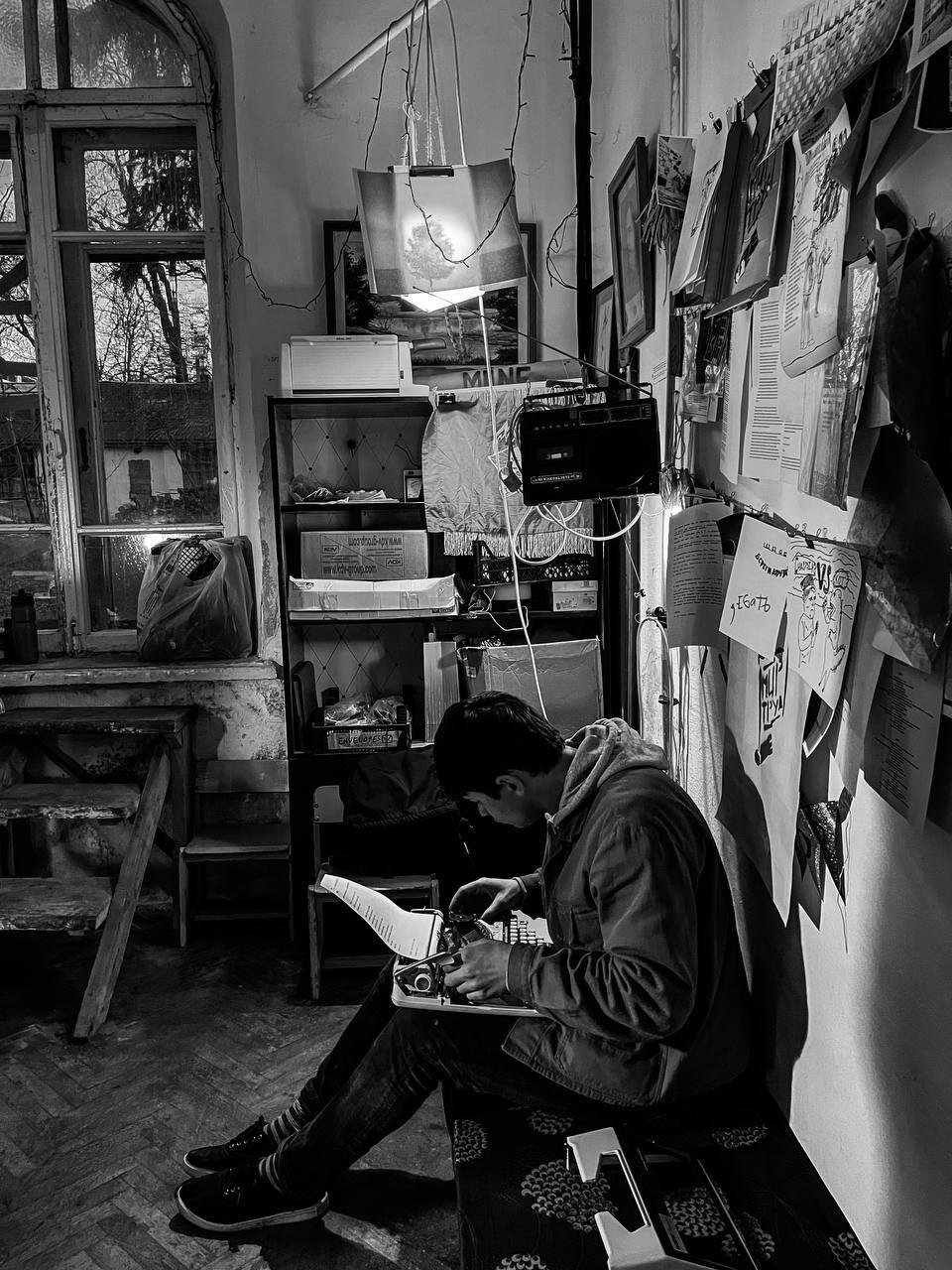
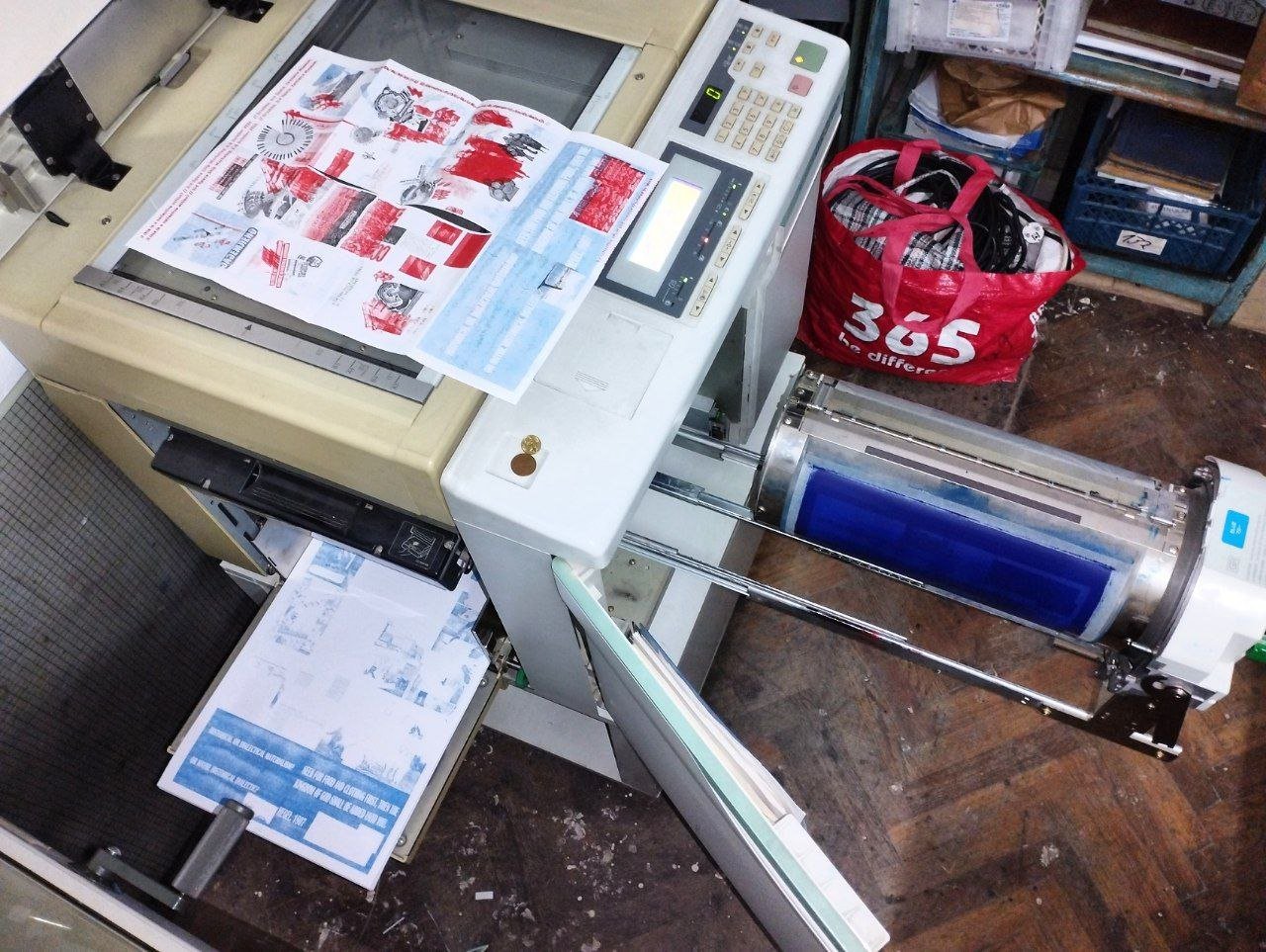
It is from this substrate that such a samizdat studio emerged as part of the logic of an open, collective infrastructure for artists supported by the NGO Young Artists Association “Oberliht.” In short, the 3rd Space Studio is a communal, one-room workshop dedicated to collective DIY publishing, collaborative graphic design, and independent editorial experiments. Since 2018, the space has functioned not only as a physical infrastructure but also as a set of methods for cultural work in field conditions, facilitating collective processes, research, and exercises based on the production of small-run prints. Production of zines and other printed matter often becomes part of modular, local, or trans-regional programs from the fields of culture, socially engaged art, or activism. It is why the logic of each zine depends on the project or specific organization/initiative involved in the creation process. The modules 3rd Space Studio is responsible for developing can be summarized as collective research through publishing. Thus, publishing here becomes a friendly service for communities and a wide range of colleagues; a platform for interaction. The situations created within the studio can be compared to a crossroads, where different logics, needs, and both practical and theoretical tasks meet, become acquainted, and co-exist.
The aforementioned layers forming the context are important for the description of the samizdat practices located in Casa Zemstvei because they do, in many ways, determine the means of operation. Material conditions shape this cheap printing outlet, which maintains relevance to the local ecosystem. The intention to operate within a specific mode of collective production was driven both by challenges that could not be resolved alone and by an attempt to formulate a response to the noticeable dominance of individualism in the turbo-capitalist regime of art and cultural industries. These intentions were initially enshrined in the name itself – 3rd Space Studio – explained as a kind of paraphrasing of the socio-cultural concept “The Third Place,” as proposed by Ray Oldenburg in his book The Great Good Place (1989) to designate communal place as distinct from the home (first place) or job (second place).
Kolxoz Collective were the founders and first residents of the studio – the ones who set the vector of development for subsequent inhabitants of this place. Now, Kolxoz is a collective drifting somewhere between Moldova, Serbia, and the Czech Republic. The concept and working methods of Kolxoz are based on activating places through temporary publishing and distribution hubs, open studios, and social spaces. Their current research explores collaboration using readily available or obsolete technologies. Decisions about the outcomes of the collective usually occur according to the open source spirit.
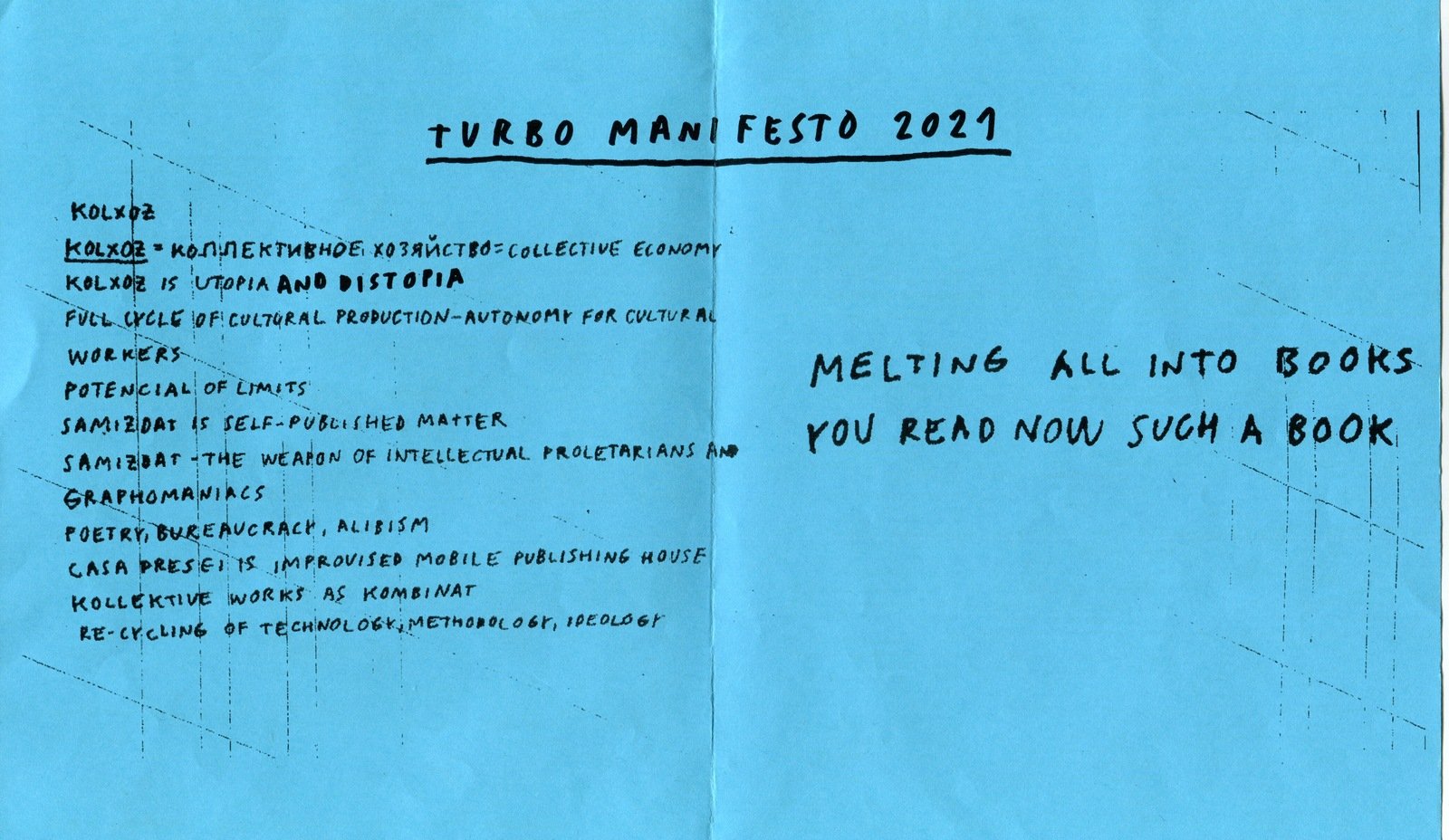
The pocket-sized printed matter produced in 3rd Space Studio follows the “potential of limits” motto and includes various types of documents, manifestos, maps, brochures, leporello and many other formats. And now, using this text as an opportunity to analyze the initial 3rd Space Studio impulses, which were more intuitive than intentional, I am collaging it with sentiments I read later in Benjamin:
Significant literary effectiveness can come into being only in a strict alternation between action and writing; it must nurture the inconspicuous forms that fit its influence in active communities better than does the pretentious, universal gesture of the book – in leaflets, brochures, articles and placards. Only this prompt language shows itself actively equal to the moment.3
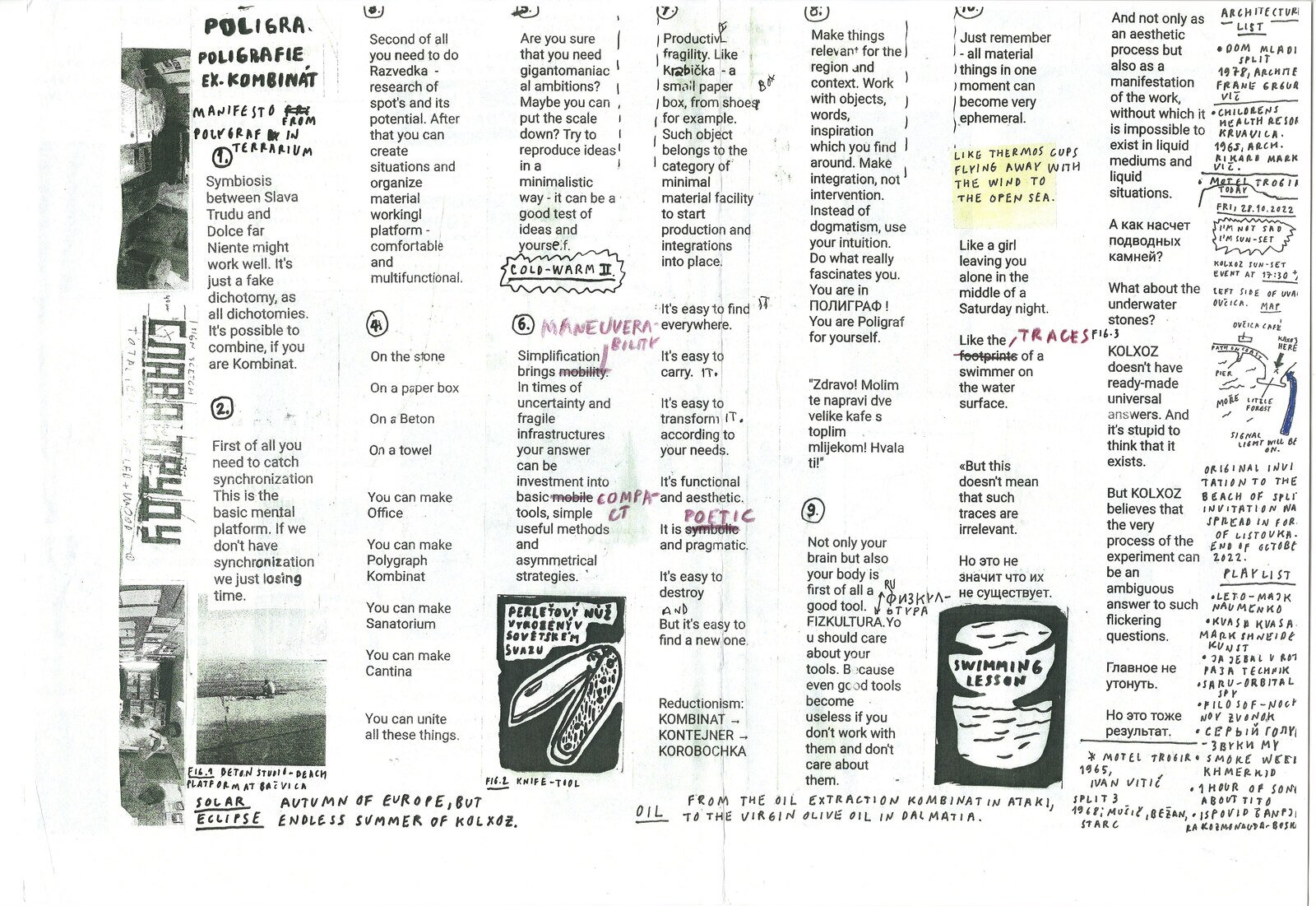
So, let’s return to what I briefly touched on above: if you doubt the unfounded aestheticization that leads to the fetishization of a product, questions of function arise. I mentioned printed matter as a means of communication. The next question then becomes: if it is a means of communication, then with whom? If you’re not targeting a mass market, you have to figure out who specifically you’re addressing. First of all, it should feed the internal needs of the collective. In the process of formulating and producing such supporting documents, printed objects with self-descriptive, self-reflective, and statutory functions, a process of synchronization occurs. If we don’t synchronize, we’re just wasting time. This allows us to establish certain starting points, as well as a primary navigation and coordinate systems for the collective, which also helps to understand what to strive for. This knowledge has a constitutive role, for samizdat allows us to remind ourselves what to appeal to in the event of disputes and emerging contradictions.
The next important function that samizdat plays in the 3rd Space Studio can be described by one word: “signals.” This is, first of all, communication that is addressed externally. It aims to find like-minded enthusiasts or potential collaborators, or just new friends. Those who are ready and able to read the signal. The function of signals is realised by such printed matter as letters, listovka (leaflets), instructions, postcards, and reverse open-calls for organisations ( the idea is that artists are choosing institutions, not vice versa, as it usually is). Distrusting the uncontrolled algorithms of social networks and their methods of representation (which lead to consumer automatism of such services from monopolizing corporations), the studio welcomes alternative distribution methods, such as “human post,” where information is distributed from hand to hand, relying mostly on acts of human interaction.
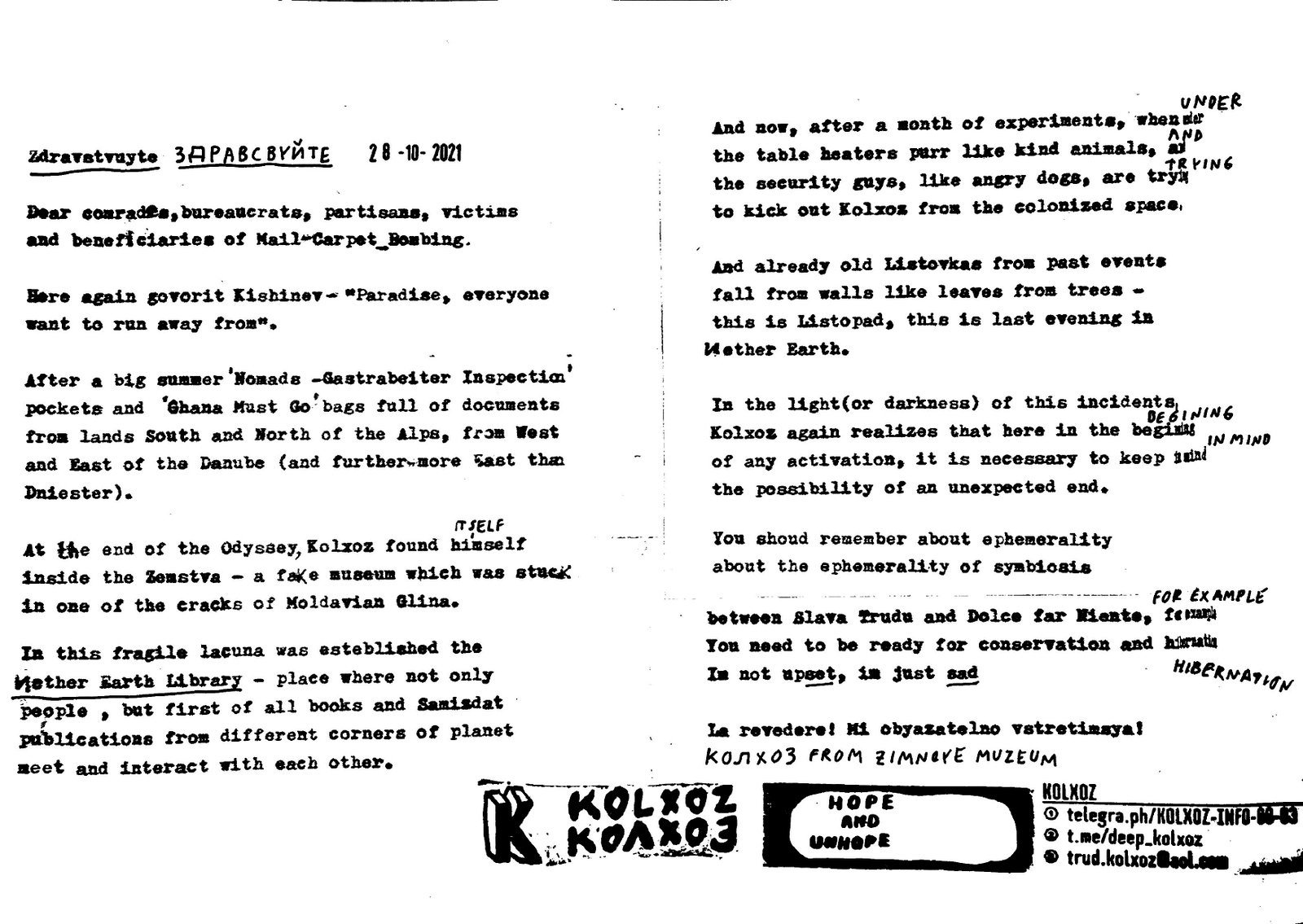
Continuing the idea of signal distribution, an accompaniment, or often even a pretext for the presentation and distribution of printed materials at 3rd Space Studio happens to be the cafe-buffet “Orbita” – a self-organized catering service. This satellite program, in parallel with intellectual food, takes into account basic needs, such as warm soup or Pridnestroviano (strong black coffee with KVINT cognac from Tiraspol) – producer of the shiny eyes effect – during the cold November Open Studio event, and sends a high quality signal for a wide range of people capable of understanding its function and idea.
These practices match perfectly and share a sensibility with the practices of Mexican conceptual artist and publisher, Ulises Carrión, the person who broadened the idea of what a book can be. ”When an artist is busy choosing his starting point, defining the limits of his scope, he has the right to include the organization and distribution of his work as an element of the same work. And by doing so, he’s creating a strategy that will become a constituent “formal” element of the final work.”4 We were interested in continuing this tradition, which called for practical viability testing. Equipped with experience developed in the process of running 3rd Space Studio, the Kolxoz Collective started to create and print samizdat in various environments. It often happens in field conditions: on the tables of a gas station cafe, at flea markets or public beaches. In these new situations, in new countries or continents where the collective happens to find themselves, the working methods of samizdat are sharpened, refined, adapted to the momentary needs and are recorded through the practice of samizdat itself. This can be illustrated by an example from the concrete beach of the Croatian city of Split, where we managed to compress huge polygraph kombinat (printed matter factory) into a cardboard shoe box or even a pocket, the goal was to retain the function of printing a gazetka (small newspaper). Ambitious, somewhere deliberately speculative like a promise to oneself, but often coming from pragmatic needs, such experiments recycle methods and ideas known from underground cultural practices developed in Socialist Bloc countries. What back then was developed as a response to the need for creating and sharing ideas that didn’t fit into ideologically driven official culture is now transformed into tools helping small mobile collectives to function in contemporary cultural frameworks, leaving material traces of communication with colleagues and friends any place they feel they need to do it.
Kolxoz’s strong charge in the first three years of 3rd Space Studio’s existence set the impetus for further development. In parallel, the increase in the number of visitors and their mostly non-professional, rather amateur artistic character contributed to the transformation of the understanding of the space’s role and function. It started to be considered as a reenactment of a “House of Culture,” which used to be a common type of institution in Soviet times. It used to be a place where workers could come after their main job, to satisfy their need for creative self-expression in various kruzhok (hobby groups). Today, 3rd Space Studio, with its non-commercial orientation, answers similar needs of different people and serves as an alternative to the prevalent contemporary consumer-based forms of recreation, like visiting shopping malls, scrolling social media, or ending up in a situation where access to cultural events is only possible if you have certain amount of money. This coherence of people’s needs and what a self-organised publishing space with a very basic set of tools may offer to them leads to observations, and a certain critical view towards the contemporary cultural field, which is expressed in the maxim we formulated, “We need not only and not so much galleries, but Houses of Culture.”
In 3rd Space Studio, again, such an institution as the House of Culture was in a way reduced to the level of one room, and to the capabilities not of the state, but of the grassroots organisation. Meanwhile, publications have also changed: their methods of production, which no longer satisfies the needs of two to three people, but, for example, ten. The content and tonality of such printed matter reflects the nature of the new resident – Drujba Collective – which is an expanded team, and in the past four years has become the most active community at 3rd Space Studio. During a recent discussion organized at the studio, together with tranzit.ro/Iași and HDK-Valand/CAPIm/Gothenburg, the question of whether a place can produce collectivity was posed. And if so, what kind. Reflecting on this question, I began recalling all the collaborations, duets, alliances, initiatives, pairs, temporary and ad hoc cooperations that aren’t yet named – the entire primordial soup I’ve observed as a coordinator over the past eight years. As it usually happens in the region, these collectives have a very pop-up character, their activity mostly lacks documentation, but their most important function – connecting people and keeping the cultural field alive under complicated conditions – is mostly realised. And the printed materials that helped me reconstruct these unions during the presentations about the described period (2018-2025), appeared to me as a unifying mechanism, a very organiser in and of itself. Samizdat, on the one hand, became the press organ for these unions. A mouthpiece, a platform or a social glue, or all three at once. In reference to mnogotirazhka (large-circulation newspaper) in every Soviet industrial enterprise, I might call our studio’s samizdat a malotirazhka (small edition publication). This is how a print run of brochures can grow out of a single piece of stengazeta (“wall newspaper”).
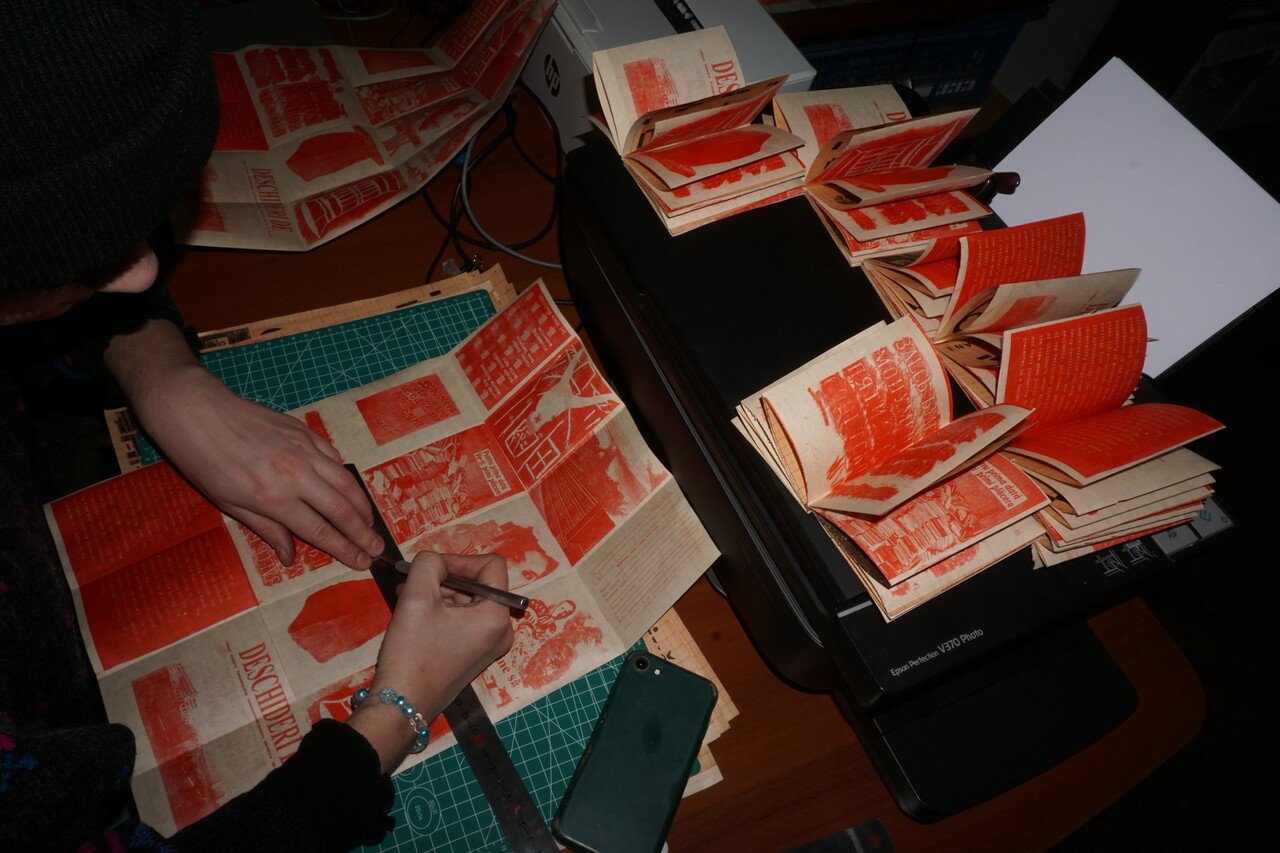
Through all the experience touched upon in this text, a directionality emerges in the area of organizing collective labor practices, experiments in the field of autonomous cultural production, and of complete cycles of printed matter. The results of such are practical research into the powers, strengths, and potentials of small collectives, and can be seen as an embodied critique of social alienation, addressed through the recreation of situations in which the means of production and distribution were not yet separated from their producers. And within the studios, among other things, we talk about certain huge topics, such as Modernism or Cosmos or lack of historical narrative from the perspectives of local working-class movements and domination of national-bourgeois positions. Despite the limits and challenges we are facing on a daily basis, connected with lack of possibility of proper representation or of structured archiving of all the matters produced, there arises a desire to make the scale of conversations happening at the studio relevant to our level of production, and so printed ephemera appears, which may now be in the margins, but subsequently have the chance to unite into books, just as the precarious workers of all countries have the chance to unite.
Below we will try to trace how this looks using four specific examples, which were chosen as illustrative cases demonstrating the studio’s work in the field of collective cultural production.
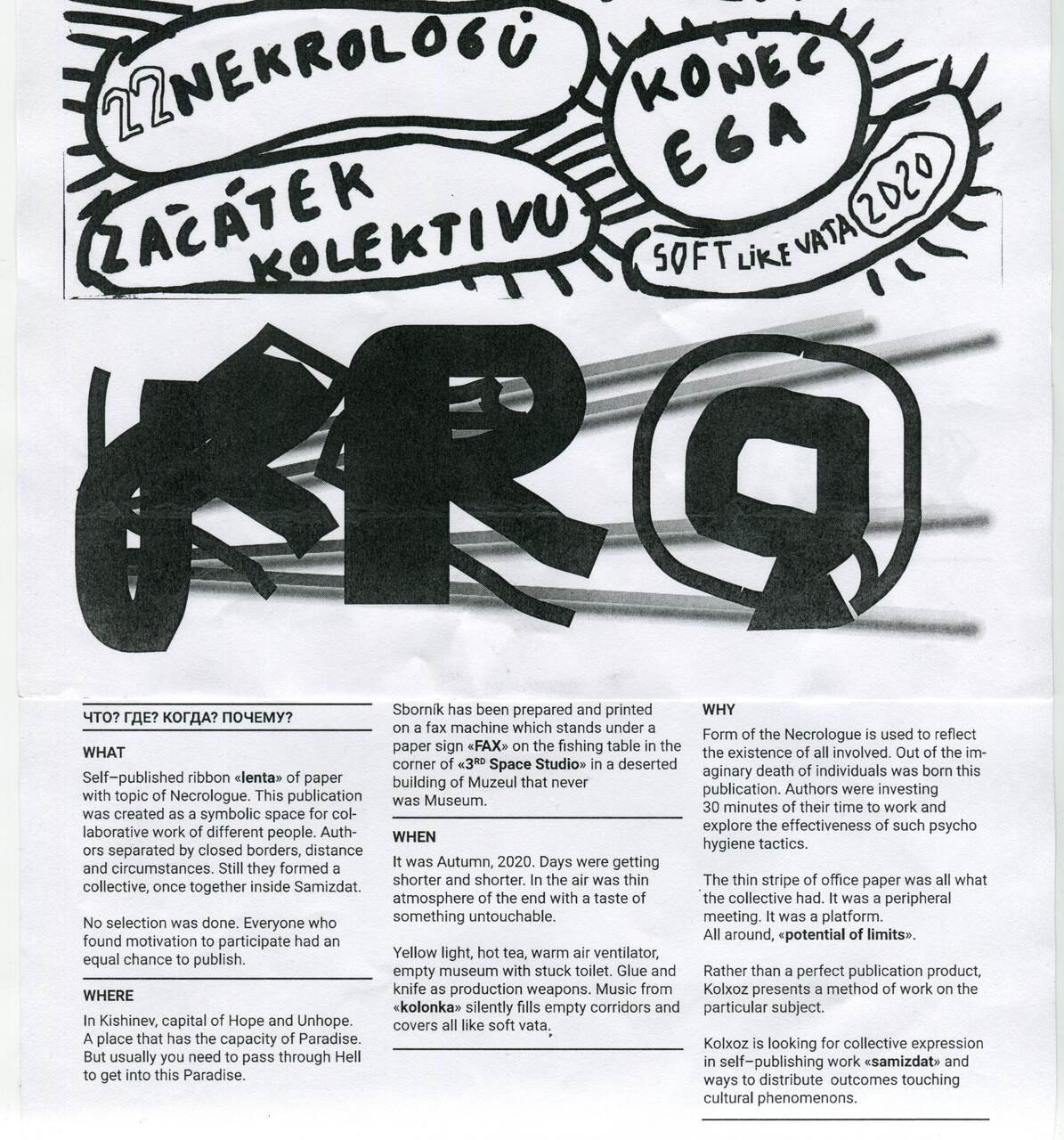
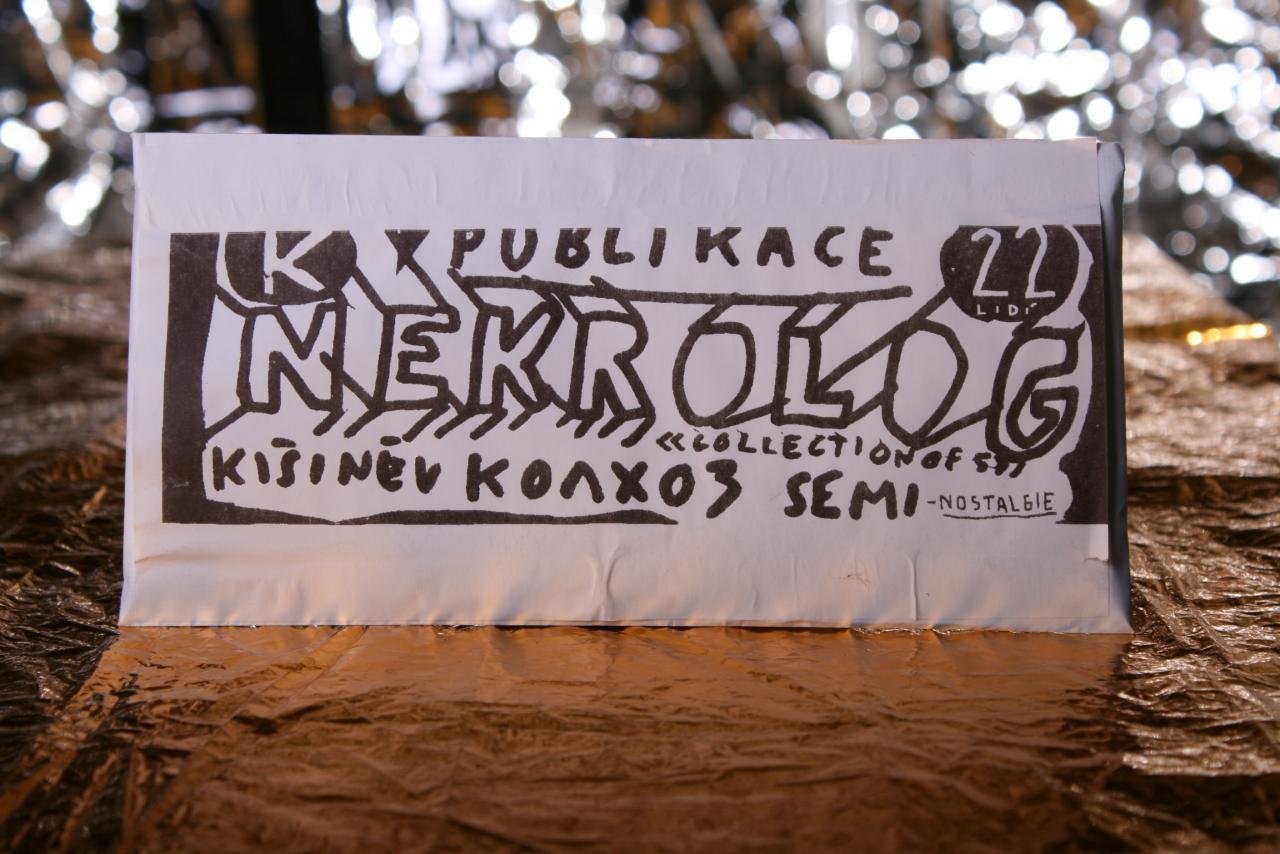
SBORNÍK NEKROLOGŮ
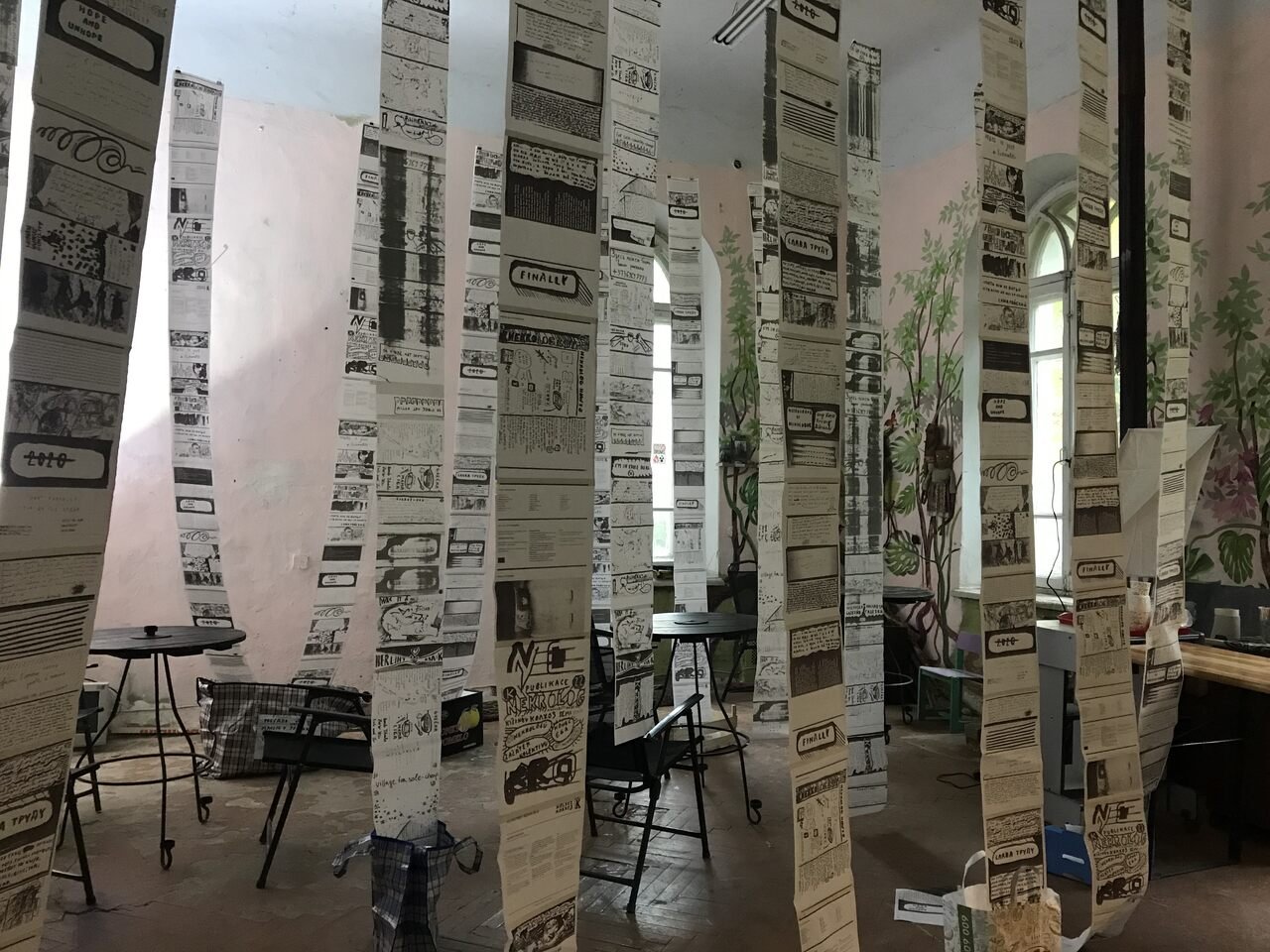
This zine is a 4.5 meter-long ribbon that can be folded as a leporello into a postal envelope. The edition was printed on thermal paper using a fax machine. This printing method corresponds to one of the studio’s basic principles, “Recycling of technologies and methods. Exploring outdated and forgotten tools, practices, machines that have lost their original functions and reimagining their purpose for a new context.”
Over the course of several autumn months of 2020, the Kolxoz Collective, which at that time was the studio’s main active driving force, distributed a handwritten open call under the slogan, “Death of the ego; birth of collectivity.” This manual, How to write your own obituary, was spread among both studio visitors and friends/colleagues around the world. It proposed imagining that you had already died, and what you could write or depict in connection with this fact. It was developed as an individual psycho-hygienic tactic and as a symbolic space for the creation of a temporary collective in a time of fragmentation and disunity. The 22 authors who contributed to this publication each received their own copy by post or by hand. This is also related to the principle of 3rd Space publishing, the number of copies must correspond at least to the number of people participating in the creation of the publication.
The presentation took place in cafe-buffet “Orbita.” Sitting at the tables of this makeshift cafe, visitors could satisfy their basic needs while simultaneously touching the contents of the zines, which flowed from the ceiling to the floor like paper waterfalls. This book launch event was called Up to Ground, Down to Cosmos. Semi-nostalgia, almost-melancholia. Autumn Necrologue Salon and, as a process of the creation of the publication, took place as part of the “Edu-Art” course — an informal program of art education organized by the Moldovan Young Artists Association “Oberliht”. The course’s theme was the periphery, so the zine’s character seemed relevant not only to the geographical and socio-political aspects, but also to the human life scale, even acquiring a certain metaphysical connotation.
KRUGOZOR. CEVA DIN JUR
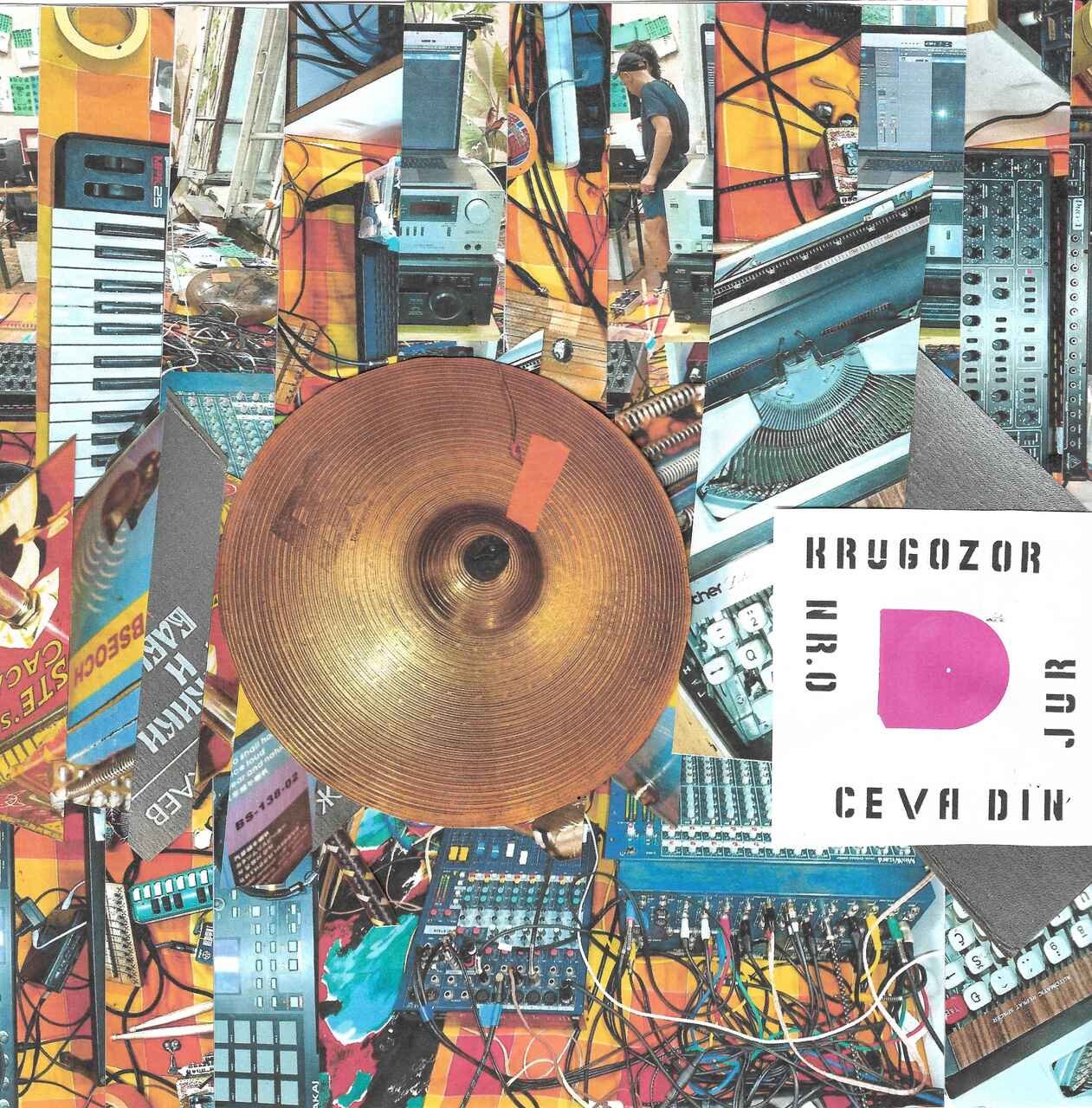
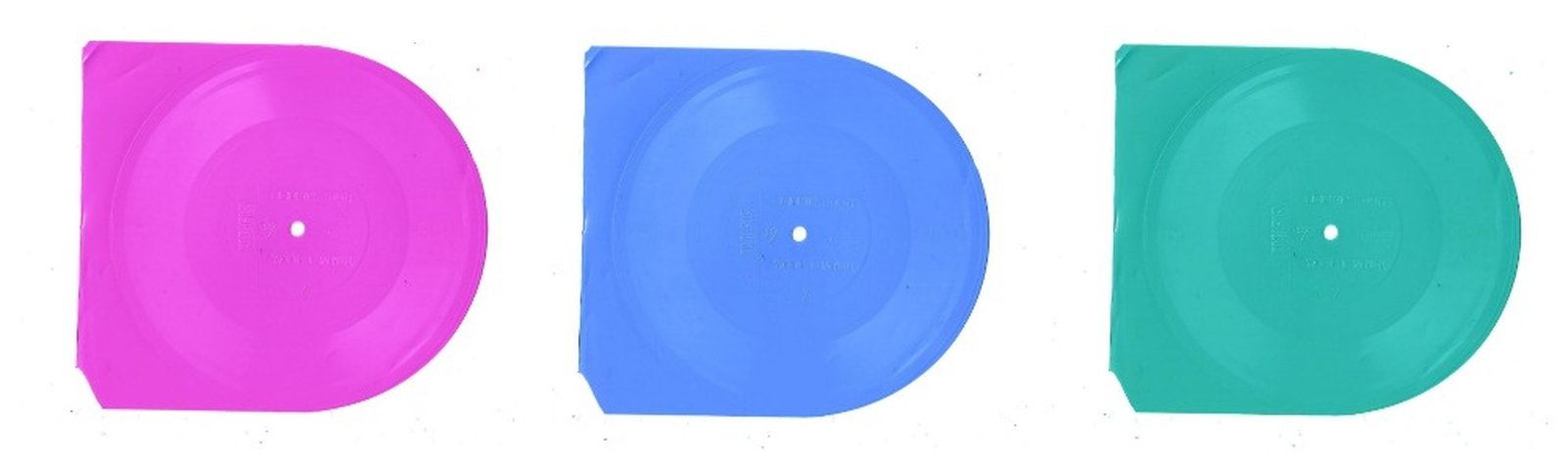
The main feature of this square zine is the combination of printed and sound matter into one publication. Stylistically and conceptually, this is a tribute to the Soviet magazine “Krugozor” (“The Outlook”), one of whose most memorable features was the presence of color flexible discs for vinyl players inside the publication.
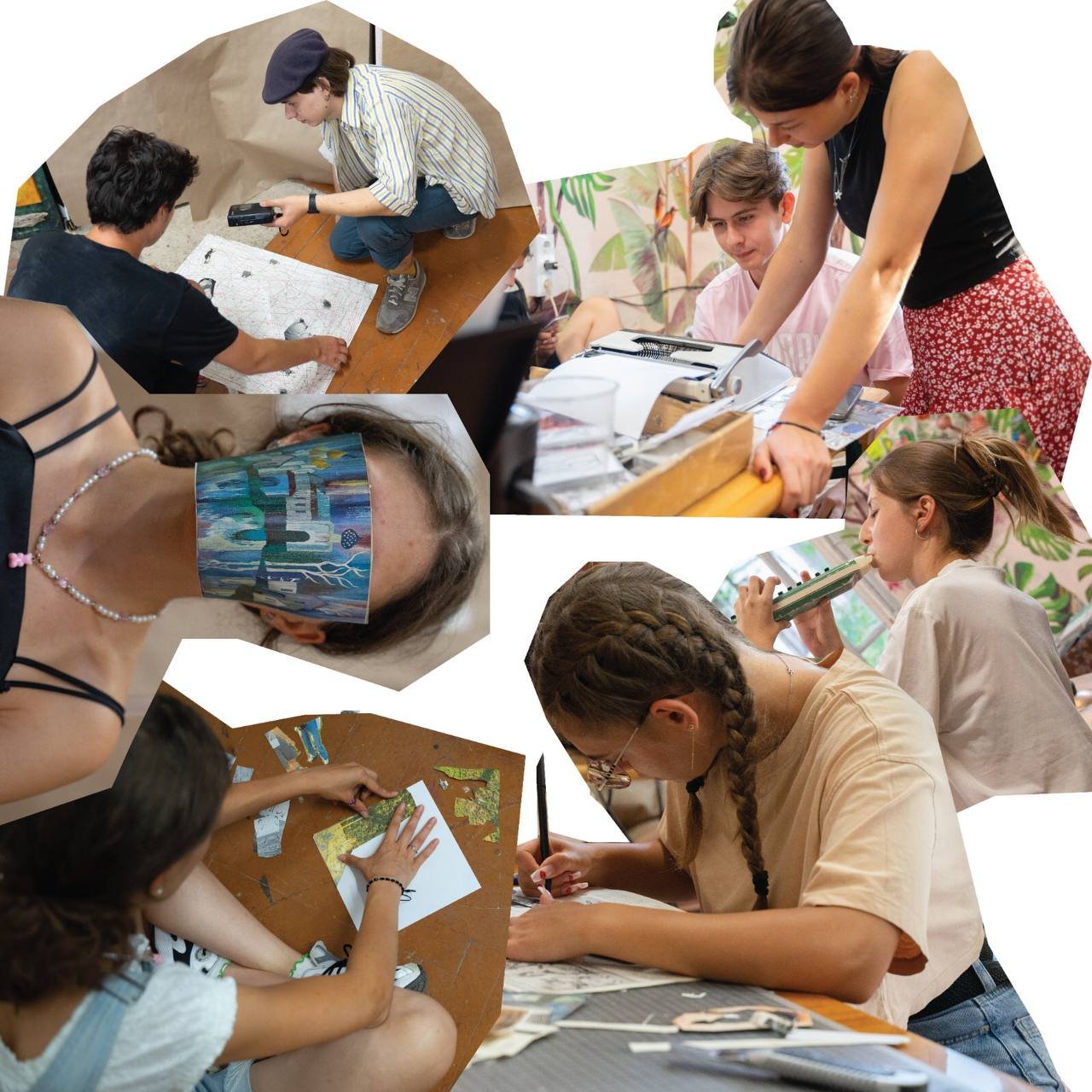
The creation of this zine is the result a collaborative effort between the Zvukotok Sound Studio, the Drujba Collective, and a large group of teenagers who came to Chișinău from the small Romanian town Târgu Neamț as a part of the organisation “CEVA” Performing Arts Educational Center. At the end of August 2023, there were three days of coexistence in the Stalker Garden – a semi-abandoned green area behind the windows of 3rd Space where all participants of the process cooked food together, built temporary infrastructure, organized themselves and inextricably combined these basic tasks with artistic ones. This illustrates a direction related to the following thesis, “Multifunctionality and transformability as an ecology of space use. This involves experimenting with other functions in the studio beyond only the work environment.”
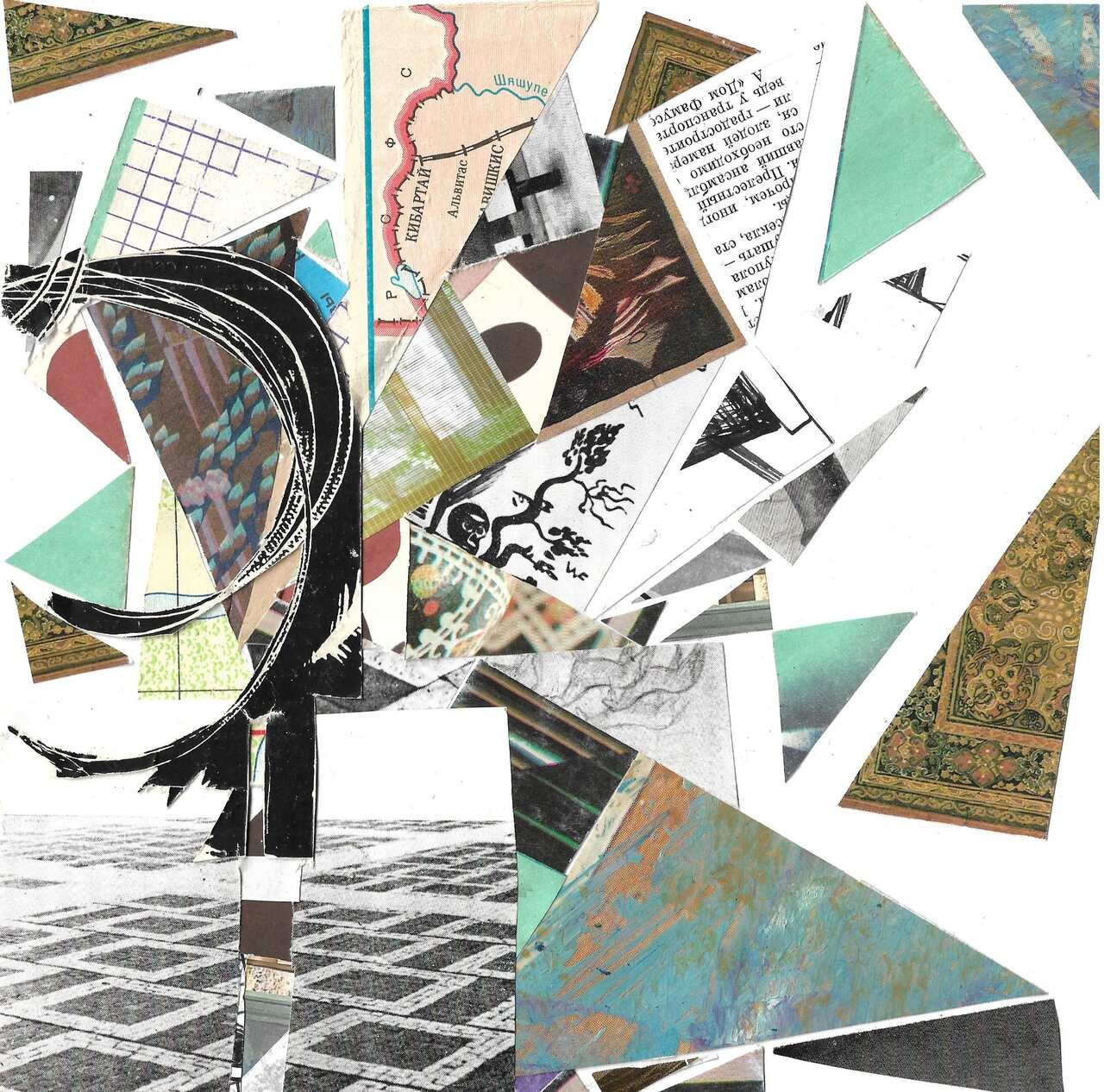
The collages that make up the zine’s visual line were assembled by the participants from old magazines, newspapers, and other scraps taken from a box that for many years, served as a paper dump, where different studio visitors brought unwanted printed matter for further recycling. The zine’s musical portion consisted of a collective, kaleidoscopic mixtape assembled from scraps of conversations collected by the participants at Chișinău’s central market, sounds produced with DIY musical instruments, and archival audio. The final track was recorded on a CD, packed in special sleeves styled to resemble those original flexible discs, and became the zine’s foldouts.
C Ă L U Ș A R * E L E H Î R T O P
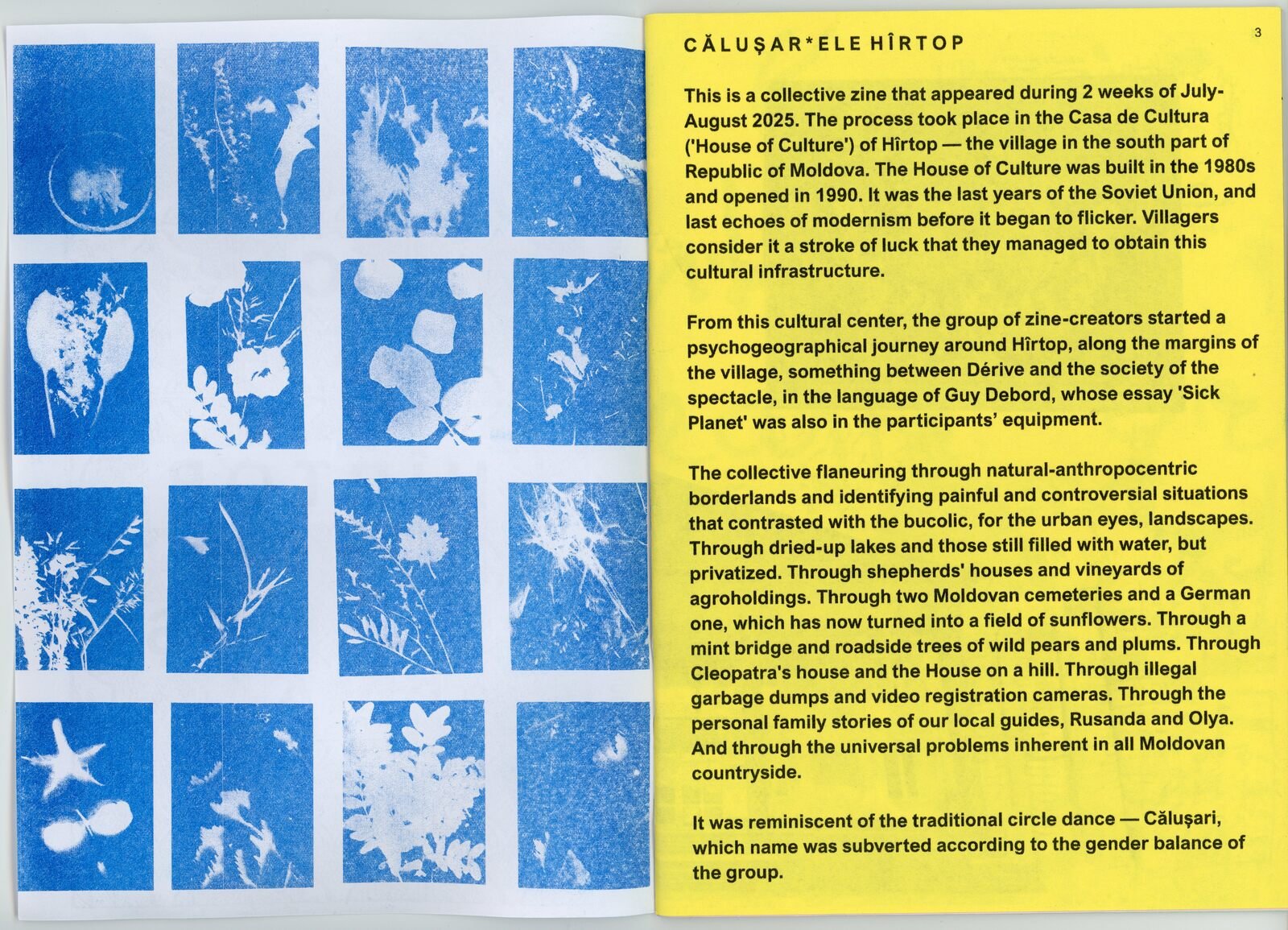
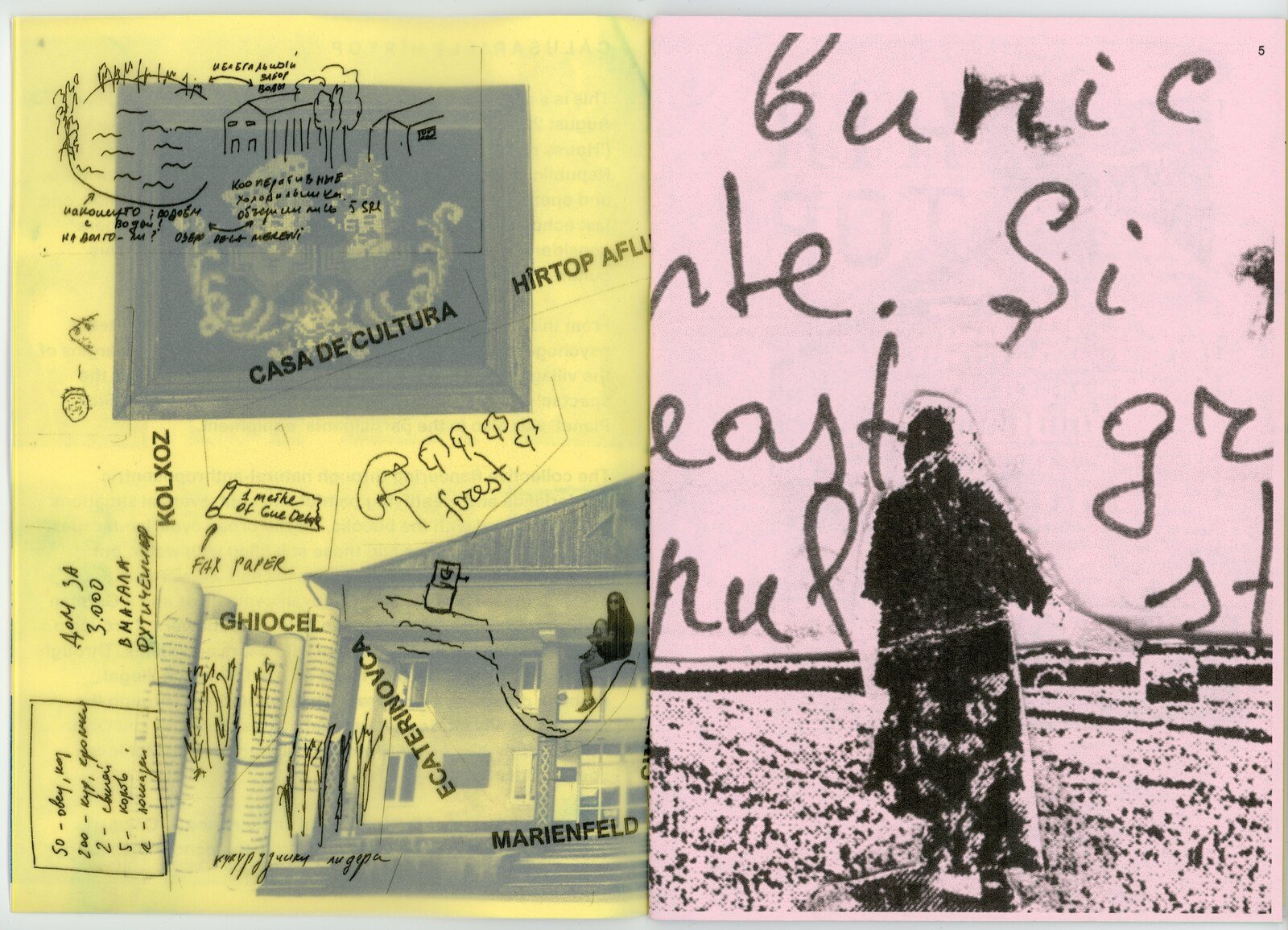
This zine features a cover in the same blue color traditionally found in many rural Moldovan homes. It also features a pattern from the interior of the House of Culture in the village of Hîrtop, in southern Moldova. The publication was created as part of the Youth Action Lab (YAL), a summer school for young people from Moldova and Germany who feel committed to environmental and community action. In this program, led collaboratively by ArtaAzi (Hîrtop) and Coopera (Berlin), the 3rd Space Studio team was responsible for organizing the process of collective publishing, facilitating joint printing workshops and providing exercises to translate group expression through one material object. Traditionally, zine production used a combination of manual and machine printing. Images and text were created with cyanotype, stencil, and typewriting methods. And replication unite RISO and laser printing.
This was a collaboration not only between people but also between spaces. The first part of the lab was organised in the House of Culture in Hîrtop, where participants collected material for the spreads and where the studio operated as a mobile publishing house. The second part focused on postproduction, presentation, and distribution. This part took place in Chișinău, at 3rd Space Studio — a place that has always strived to recreate, maintain, and preserve logic of the House of Culture, this institutional heritage and function in society. Even with a reduced level of capabilities, this model of a cultural institution can be implemented not only for visitors seeking entertainment or consumption, but also as an opportunity for those who want to try themselves as cultural producers.
OPTIMIZATION
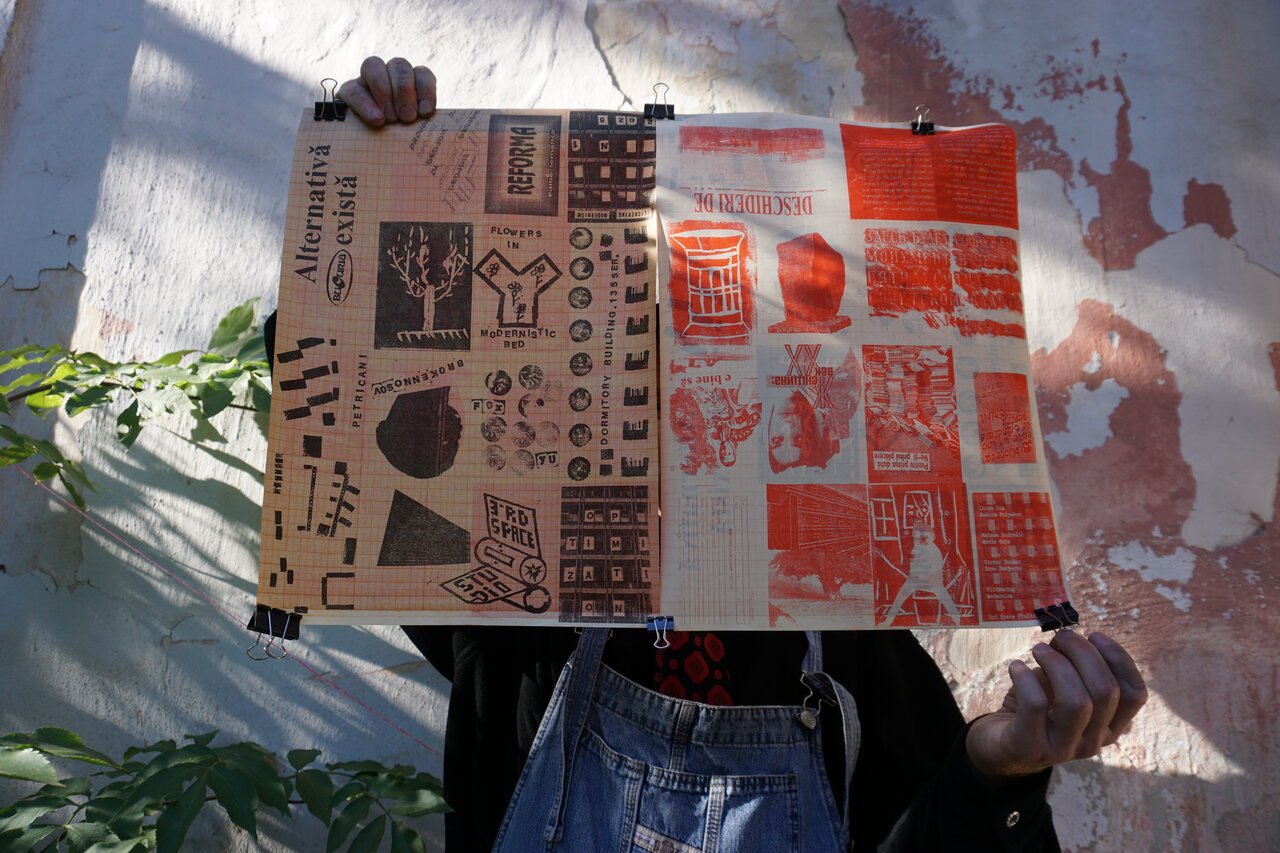
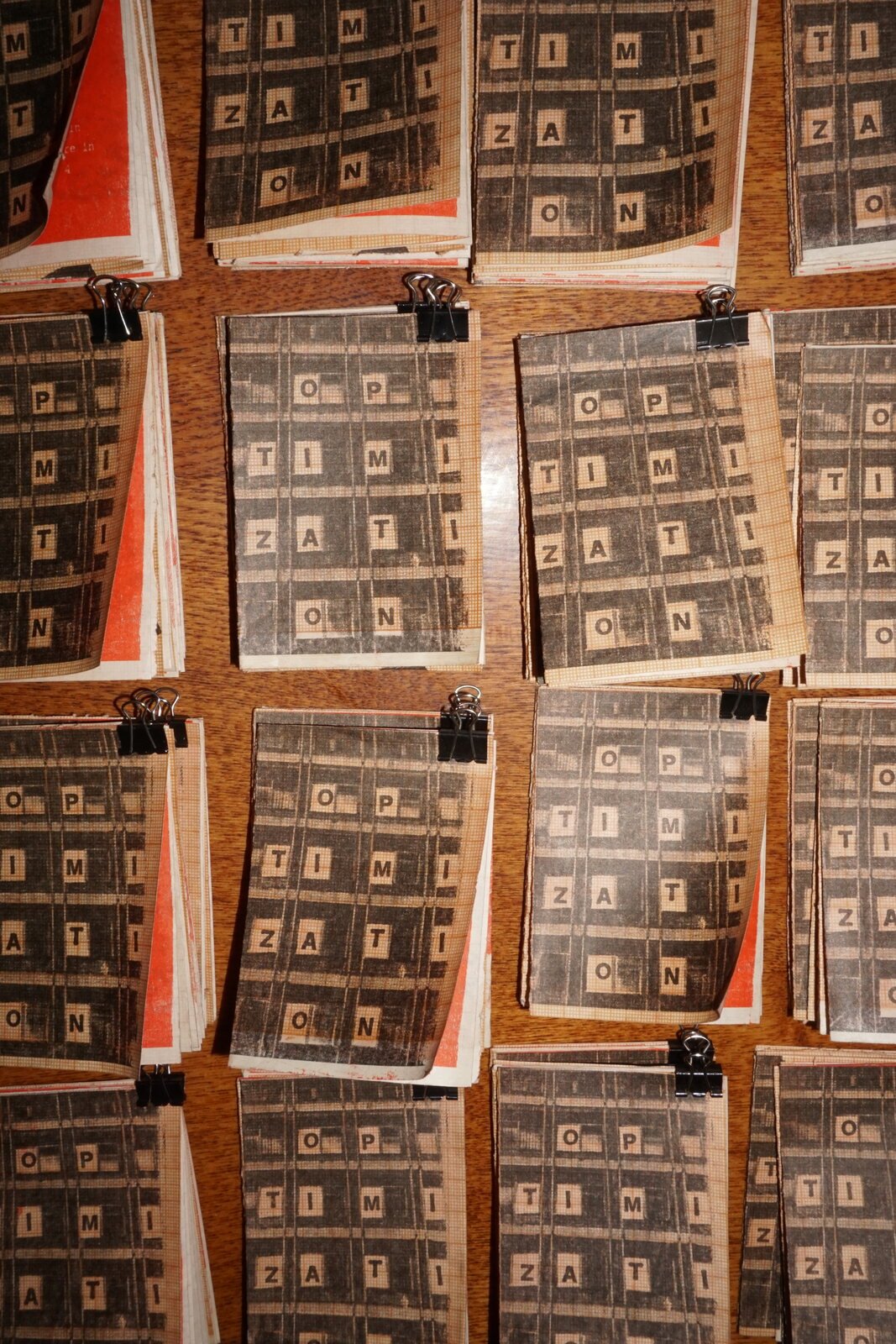
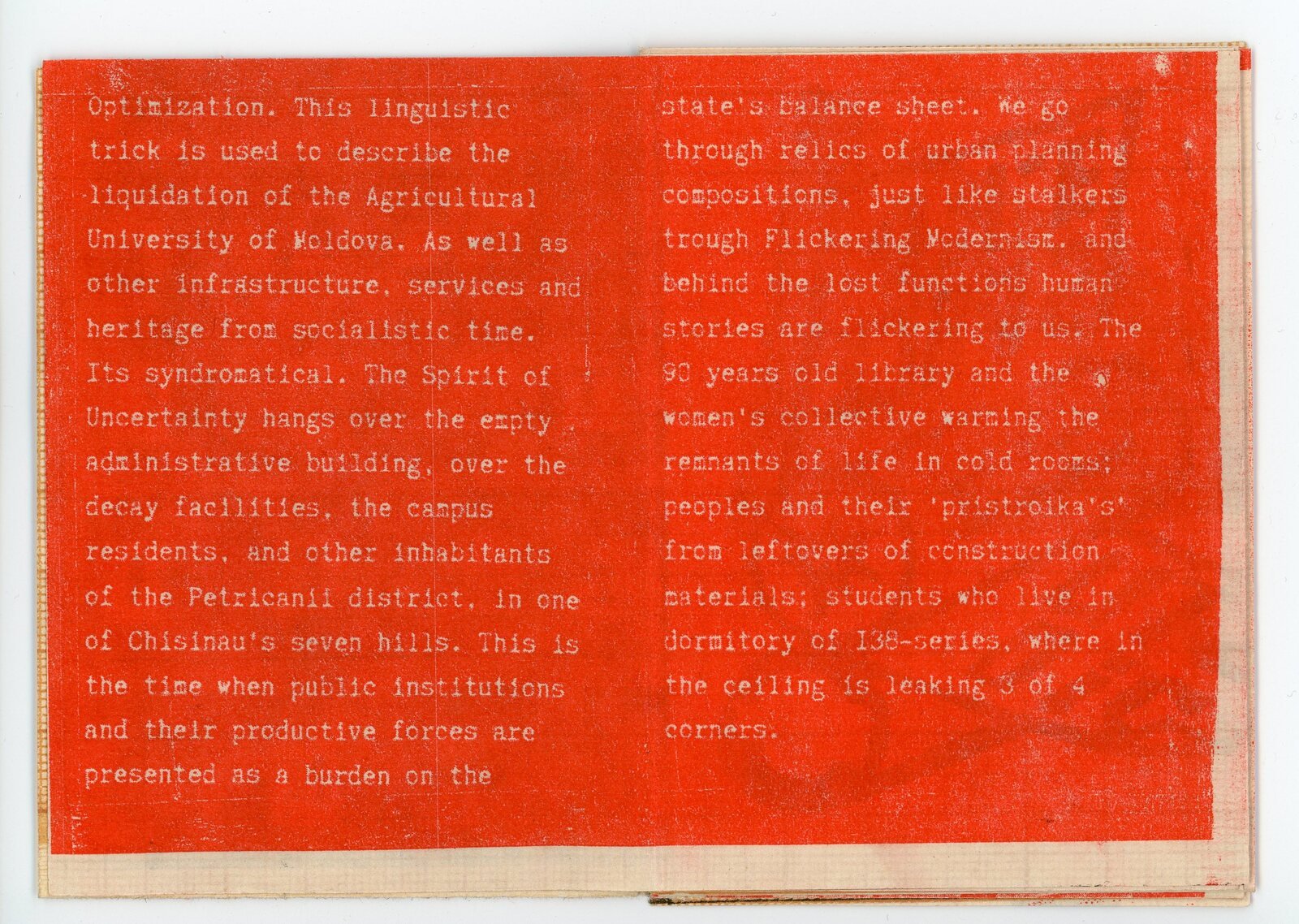
The title of this collective zine repeats the spell that circulated around the process of disappearance of such institutions as the Agricultural University of Moldova – a landmark educational center, given the country’s economic specifics. The edition of thirty copies was printed on architectural graph paper, a reference both to the modernist planned organization of urban space and the city walk Relics of Urban Planning Compositions. This walk took place on the first day of the experimental small-scale publishing laboratory “From the hill to the valley,” which took place in the 3rd Space Studio within the framework of the SCA2025 program organized by the Oberliht Association. There was a field trip, which consisted of an artistic exploration of Petricani Hill, one of the microdistricts of Chișinău that was built during the socialist period, famous for its former agricultural institute. One of the purposes of the walk was to visually observe how, under this slogan of necessity, infrastructural and institutional degradation is taking place.
The workshop was part of a comprehensive, mosaic-like program of artistic explorations entitled Flickering Modernism. The traces of modernist traditions – public services, urban spaces, telecommunications, ideological and educational infrastructures – still persist in the landscape, even as their functions have dissolved. Flickering Modernism explored these shifting, vanishing, or repurposed structures and subjectivities, asking how modernity continues to shape social life, spatial experience, and collective imagination amid its erosion.
The practical part was focused on techniques that could help reduce large scale modernist ideas to the level of handicraft or artisanal types of production, searching to provide a basic functional environment for the temporary collective of workshop participants. The workshop was questioning specifically how information, visual materials, observations, reflections, and conversations gathered during the walk could be transformed into a new artistic form, into an art work as a construction – despite its pocket-sized dimensions and production limitations, which would follow the modernist tradition and organize collective efforts around itself. A roll of Soviet graph paper became the landscape for a microdistrict publication, featuring linocuts of small architectural forms, modular geometric stamps of prefabricated panel houses, photo collages of residents, and phrases composed from fragments of memories and things that never happened.
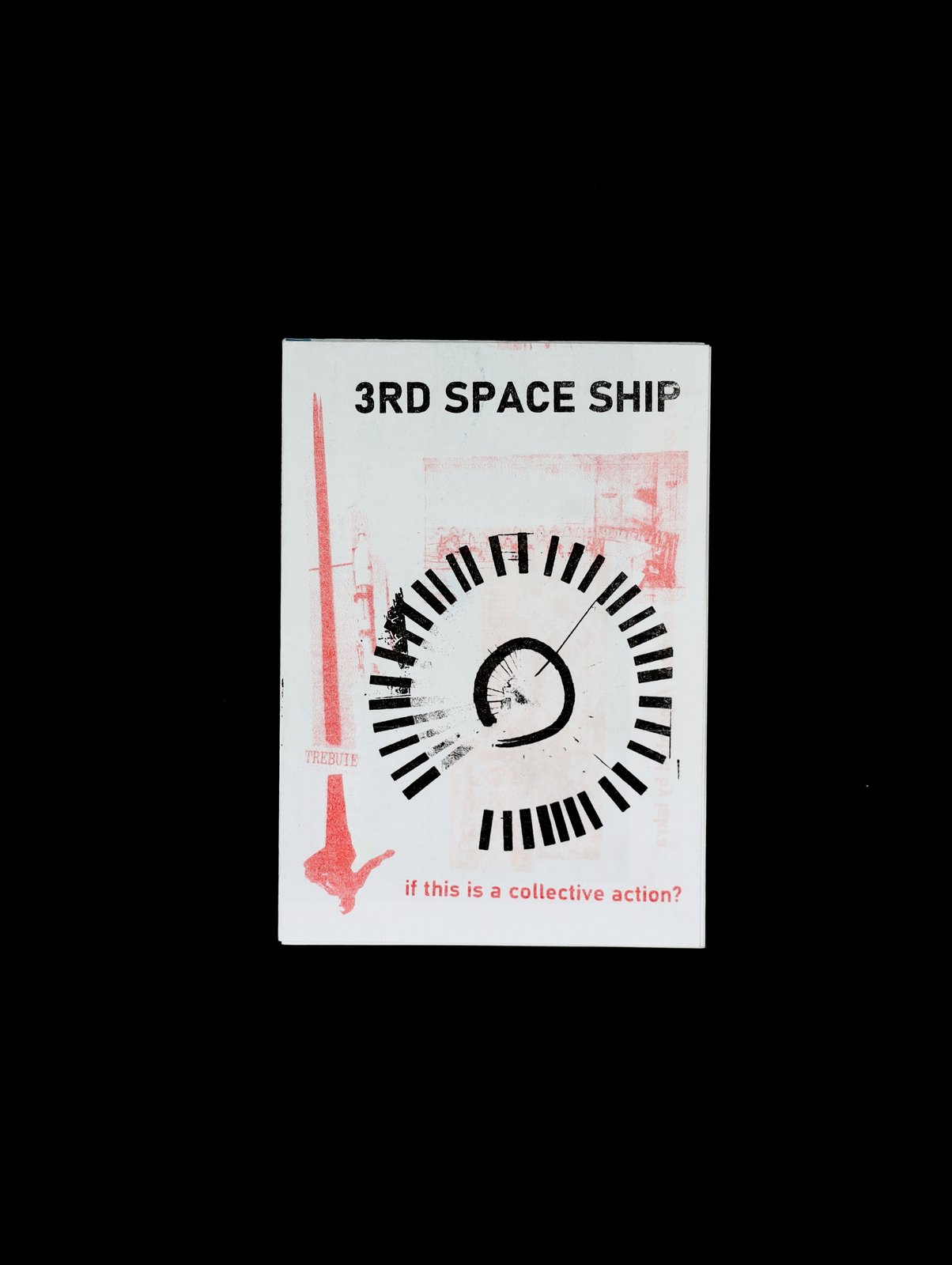
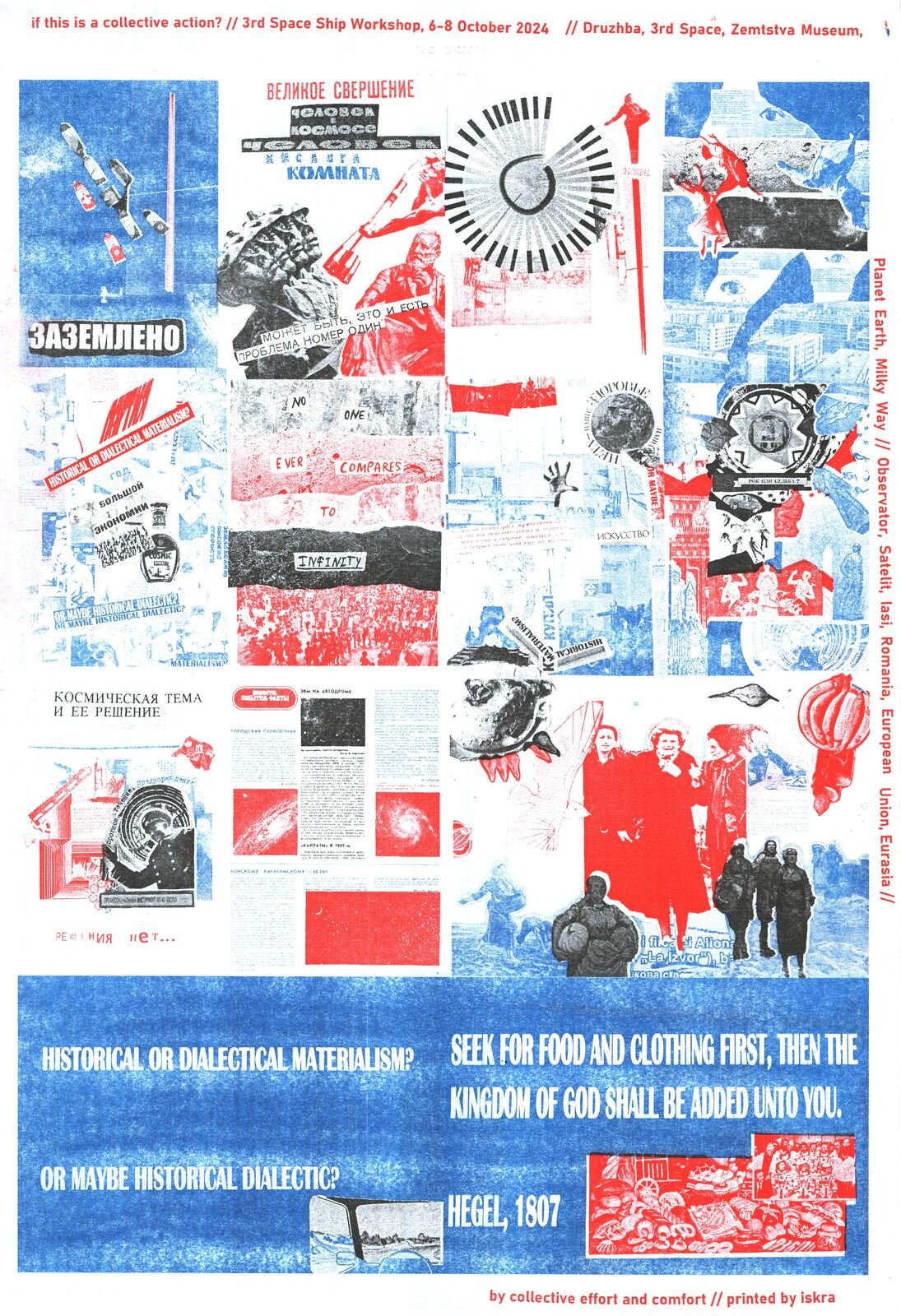
IF THIS A COLLECTIVE ACTION?
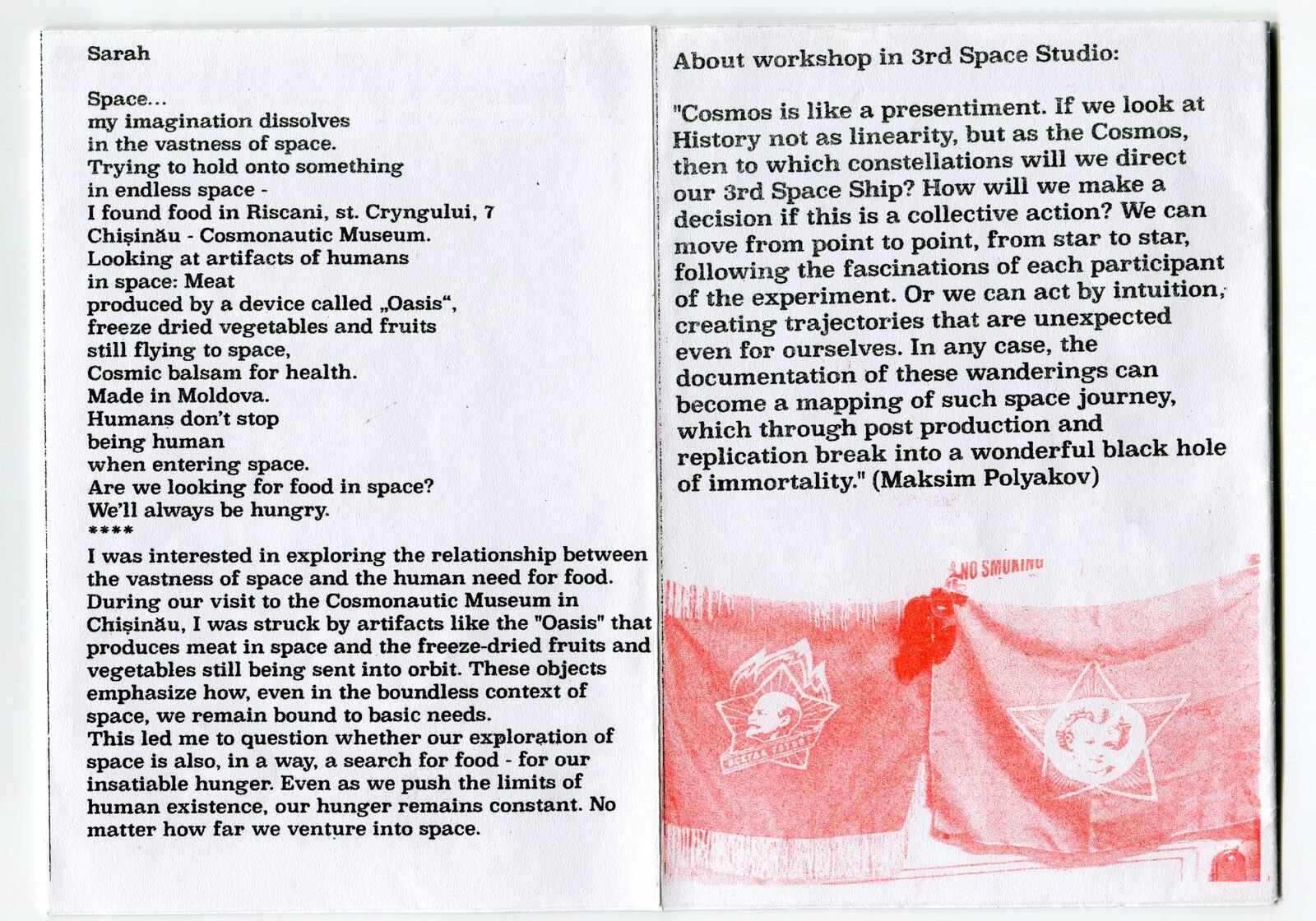
This folding A3 format zine is a collection of posters combined into one common poster and additional texts from each of the authors. Texts are related to the process of production and the perception of each participant about this common process. This zine appeared during the workshop 3rd Space Shipled by Drujba Collective and organized by Satelit Association (Iași, Romania) in the frame of Observator – a project which maps representations of the universe in contemporary art. Important questions raised at the meeting were “who is observing?” and “from what position is the observation taking place?”
To work with these issues and challenge linear notions, the group turned to collective reading of Walter Benjamin’s essay “Theses on the Philosophy of History.” Through this practice, the group became equipped for an excursion to the Yuri Gagarin Cosmonautics Museum – an amateur museum at the Young Technicians Station in Chișinău. Observations and visual materials obtained there formed the basis of the zine.
P.S While this text was in development, the weak thread that has long hanged the complex situation of the Casa Zemstvei cultural center has been cut by the authorities, who have demanded eviction by the spring of 2026. On the one hand, communities faced with this impossibility aren’t too opposed to the official reason – restoration of this decaying architectural heritage, and the understanding that such work is long overdue. On the other hand, without any guarantees or a vision for the return of the cultural center inhabitants to the building after reconstruction, without alternative infrastructure solutions even for the near future, communities are left in total uncertainty and are directly confronted with their needs and problems. This sticky uncertainty also covers the future of 3rd Space Studio. Now it’s hard to believe the possibility of re-assembling into the previous configuration. And the attempts to predict anything only evokes bitter smiles. We will probably only be able to fully know its value after we have finally lost this space.
***
Maxim Poleacov was born in Tiraspol and currently works in Chișinău (Moldova) as cultural operator, publisher and coordinator of 3rd Space Studio — communal workshop for diverse practices related to DIY Printed Matter. Maxim’s ongoing research focuses on methodologies for “samizdat” (low-run self-publishing), and approaches this practice as a platform to build and develop conversations, social situations, and communication spaces. Examples include grassroots editorial experiments and distribution centers, open studios and temporary services such as pop-up cafes or libraries. He examines how publishing becomes a means of interaction and a tool for organizing collectives.

“There Is Nothing Solid About Solidarity” gathered artists, curators, researchers and collectives who hail from regions widely known as Central and Eastern Europe, the Middle East and Central Asia, offering a space for interrogation of the institutions and frameworks that have led us to this current geopolitical environment and the initiatives that have flourished as a result. The program presented a spectrum of organisational forms – from individual grassroots projects and community centres to research endeavours that examine historical expressions of solidarity, friendship and allyship, and was presented as a forum held between M HKA, De Studio, De Cinema, and TICK TACK Cinema (Antwerp) from 24 – 26.10.2025.
“There Is Nothing Solid About Solidarity” has been curated by the MOST Magazine co-editor-in-chief team and Yulia Krivich. The program was supported by the Adam Mickiewicz Institute (Warsaw) in collaboration with M HKA, De Cinema, and De Studio, and co-financed by the Ministry of Culture and National Heritage of Poland, in partnership with the Polish Institute in Brussels.
You can find the other texts from this series linked here:
“‘Eastern Europe’ in Air Quotes” by Petrică Mogoș and Laura Naum
“DECOLONIAL SOLIDARITY” by Svitlana Matviyenko
- Lenin, Iskra, No. 4 (May 1901) ↩︎
- Adapted from the description of 3rd Space Studio, Chișinău, Moldova ↩︎
- Walter Benjamin, One Way Street, 1928 ↩︎
- “Ulises Carrión. Dear reader. Don’t read”, 09.02 – 30.04.2017, Museo Jumex, Mexico City. Curated by Guy Schraenen ↩︎
Participants: Noor Abed, Alaa Abu Asad, Nika Autor, Asia Bazdyrieva, eeefff, fantastic little splash, Floèmee, Samah Hijawi, Irfan Hošić, Saodat Ismailova, Katarina Jazbec, Nikolay Karabinovych, Dana Kavelina, Yasia Khomenko, Bogdana Kosmina, Daryna Mamaisur, Svitlana Matviyenko, Petrică Mogoș, Beatrice Moumdjian, Laura Naum, Elif Satanaya Özbay, Alpesh Kantilal Patel, Oleksandra Pogrebnyak, Maxim Poleacov, Dilda Ramazan, Basyma Saad, Selma Selman, Nour Shantout, Firas Shehadeh, Malaka Shwaikh, Antonina Stebur, Tytus Szabelski-Różniak, Asia Tsisar, Kat Zavada, Driant Zeneli
Forum Title: There Is Nothing Solid About Solidarity
Curated by: MOST Magazine co-editor-in-chief team and Yulia Krivich
Venue: M HKA, De Studio, De Cinema, and TICK TACK Cinema
Place (Country/Location): Antwerp, Belgium
Dates: 24 – 26.10.2025