

Agata Pyzik
I keep having the feeling that the MOST editorial team sent the wrong person to Prague. Over a month after the Biennale Matter of Art opening I kept feeling very giddy about it, only to realise after I finally sat down to write it up that this giddiness came chiefly from finally seeing the refurbished permanent exhibition at the Trade Fair Palace, the main site of the biennale. I am hopelessly retro, one of those bores at the party who will want endlessly to talk about some obscure surrealist kitsch from the 1950s and I probably care about literature way more than I do about art anyway. I live in hope of not being discovered, I multiply disguises.
I wanted to come to Prague to secretly indulge my fin-de-siècle decadent tastes and pretentiously flaneur the shit out of the place, given its extraordinary architecture. But it absolutely didn’t happen. I arrived one night early, at a women-only hostel in the dead center of the Old Town, but the torrential rain turned my wandering plans into stumbling from one drinking establishment to another, realising how much I actually enjoy the absolute touristic nightmare that is going on there 24/7. I’m happy to report that very little in central Prague has changed since the 1990s: bars still employ men playing acoustic versions of the Scorpions and Radiohead’s “Creep,” karaoke goes on at any time of the day and people seem to unashamedly enjoy themselves being absolute cliches. In my hostel I’ve met a girl from Martynique, who was super excited to see a stand-up about Franz Kafka in one of those super dodgy-looking private theaters hidden in one of those cute houses in the medieval old town. Prague is like Cracow on steroids. I loved it.
The next morning I hastily washed off the stench of too much knedlíky and rushed towards the Trade Fair Palace, built in 1925 and still the coolest building in Prague, embodying the sleek, modernist aspirations of Czechoslovakia before dictatorship and fascism. The main exhibition of the Biennale Matter of Art took up a significant chunk of the ground floor and it was interesting how this elegant building showed such adaptability to the fluffy contemporary art installations. Fluffy? But isn’t this a very politically engaged and serious show? There’s been a proliferation or even, if we dare to say it, overproduction of “political, engaged” biennales in recent years. This is the first time I attended the Prague biennale, which debuted in 2020 and since the beginning, understood that its strength doesn’t lie in spectacularity but in building a local network of connections. Prague speaks of a different past and present than Berlin, Warsaw, or Graz, where very similar events take place (e.g. Warsaw being the main host of the Kyiv Biennial in 2025). Do we need more biennales is another issue. I haven’t yet gone to Venice this year and I probably won’t, lacking various kinds of resources, but with every new edition of every new biennale there is a question whether the formula can sustain itself, given the exploitation of the resources and costs, which very often stand directly against the very goals such exhibitions are trying to achieve.
Matter of Art is certainly very aware of this. From the get-go there’s a focus on the local and Eastern European scenes and especially collaborative projects, while smartly engaging with the current political agenda. What I liked was that the theme of “matter” also suggests rooting it firmly in the actual content of the art and its material forms rather than being ideas-oriented only. The way I read the title “Necessary Wishes” was: how can we respond to the current horrors with practices firmly rooted in the questions of art itself and which art practices are more likely to successfully speak of these issues? To me it almost has the undertones of “magical thinking.”


photo: Marie Matula Sieber. Image courtesy of Biennale Matter of Art.

photo: Tereza Havlínková. Image courtesy of Biennale Matter of Art.
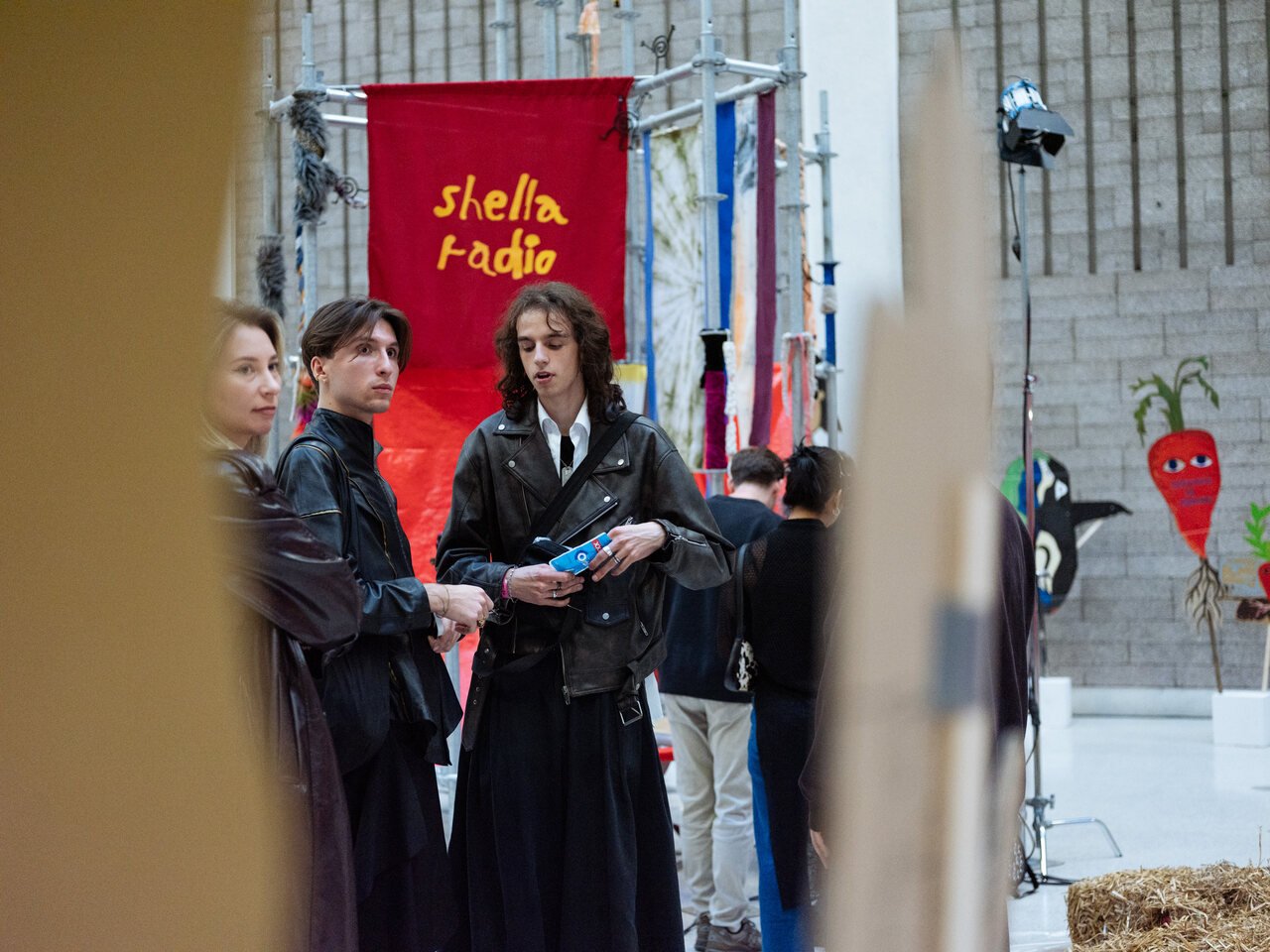
It’s true that art today has a particularly difficult task of being somehow “critical” and attractive to the viewer, to disrupt the neverending streaming of news and attractions beaming from our phones. This is addressed by the architecture of the Great Hall of the Trade Fair Palace which has been designed by the RUINA Office through a series of scaffolding, tents, and projection boxes – installations that invite participation and are painted in bright, red and pink colors. This biennale, curated by the international team of Jaroslava Tomanová, František Fekete, and Jakub Gawkowski is first and foremost about community and is often expressed in a playful, tactile way. This “warmth” is used both to entice us to watch or experience art which obviously often speaks about things that are difficult or depressing, but also to counter it. I believe this is precisely why the curators invited Taring Padi – an Indonesian “art workers’ collective” that, as they emphasize, is best known for viewing art as a collaborative process rather than a finished material product. Fortunately, the echoes of the 2022 scandal and false accusations of antisemitism surrounding their mural at Documenta 15, curated by Ruangrupa, have since died down; Taring Padi has brought a series of specially commissioned lithographs to Prague addressing the genocide committed by Suharto’s military junta against citizens suspected of communism – an atrocity for which there has never been any reckoning. Taring Padi was formed in 1998 as a form of resistance against the dictatorship and continues to grapple with the same issues; the regime lives on symbolically, given that the dictator’s son took power after him. In Prague, the collective conducted workshops on creating activist banners with local groups, and the results are scattered across a large part of the exhibition hall. These banners – or rather, cardboard puppets – are sometimes amusing or even silly, yet their purpose goes beyond mere visual political communication. In Indonesia, Taring Padi conducts similar workshops with various oppressed communities; the banners serve primarily to increase the visibility of demonstrations and to provide protection against both the sun and police violence. Knowing this, I viewed these often whimsical-looking effigies in a completely different light: their true value lies in the collaborative effort, the negotiations that shaped them, and their future use on the streets.
This leads me to reflect, however, that – as always – activism transplanted into a gallery setting loses a great deal of its expressive power when it is reduced to its material form, which, in the case of an initiative like Taring Padi, is actually the least significant part of the entire process. A similar impression arises from the installation dedicated to Shella Radio – a radio-activist collective whose members have roots in Arab countries and “shella” means “friends doing things together” in Arabic – that raises awareness about artistic and socio-cultural issues, but also rent hikes, and evictions, while also organizing parties and simply fostering a sense of fun and togetherness. No matter how cleverly the presentation is arranged amidst the scaffolding, it cannot change the fact that Shella Radio “happens” in clubs or on the streets, whereas the museum setting petrifies and kills it. I believe a more engaging presentation is possible, but it’s always a negotiation between the available space and your possibilities: here, I didn’t find it entirely convincing. It worked much better with the giant installation by Rufina Bazlova and her #FramedinBelarus project (with Stitch It Collective), with almost 700 vyzhyvankas (white sheets of fabric with traditional folk embroidery technique) which she’s been carrying on since 2021, after the 2020 election, where democratic candidate Sviatlana Tsikhanouskaya beat Alexander Lukashenko. It resulted in unprecedented political repression. Each piece has been created in collaboration with volunteers from all over the world and is dedicated to a single political prisoner in Belarus, with his or her name on it. The installation creates a powerful, concentrated message while simultaneously resembling a sanctuary with a truly contemplative atmosphere.

Image courtesy of Biennale Matter of Art.


I’ll admit, my first impression that morning was being tired: tired of finding similar threads and connections, of exploiting similar ways of storytelling and narratives. What do I mean? Firstly, the focus on autobiography. As autofiction has become one of the most obsessed-about ways of storytelling in literature, similarly, art-making has been taking the “personal is political” formula way too literally for a very long time. I’m tired of autobiographies, I crave fiction. I want to be told beautiful tales which support a higher sense of truth nonetheless. I don’t want to be blackmailed by fake sympathy when I feel the piece isn’t working for me, I don’t want to be shut down from a moralistic position. At the same time, the artist’s own life has been art “matter” and material since time immemorial. At Matter of Art I saw it being done well and less well.
Let’s begin with the former. The exhibition puts an extra focus on artists from the Middle East. This has already been very successfully done by the Warsaw chapter of the Kyiv Biennial, with the subtitle “Near East, Far West,” to establish this political and mental connection of shared oppression. Huda Takriti is a Palestinian born in Syria and her video On Another Note (2024) follows several women in her family, chiefly her mother and grandmother, who suffered from various forms of displacement caused by the politics of Israel. This dreamy, blurred video shows Takriti’s mother telling their family story, but also the act of sewing and embroidery as some kind of therapy. These works, which surround the video in an installation, remain unfinished. To Takriti’s mother, this symbolises the unfinished genocide and abuse going on since the Nakba. No less melancholic was the brilliant tripartite Here, for Now (2026) by Leila Basma and Zaher Jureidini, two Lebanese artists who’ve been living in Czechia for years and for the sake of this new work, they filmed fellow SWANA (South-West Asia and North Africa) living there, too. The most dramatic story concerns a woman who was forced out of Palestine as a teenager and who described the initial internment in a refugee camp in a bloodcurdling way. We don’t see her face, but we see the certainty with which she draws the floor plan of the camp even 20 years later. Her memory work is necessary, to preserve the world she lived through from fading. Yet it’s possibly also something which contributes to her “immigrant stress” and doesn’t help her relax in her adoptive country. Art comes often from weakness and exhaustion, as nomadic Ukrainian artist Yana Bachynska, a.k.a. Jan Bačynsjkyj continues to say, with every stop on his itinerary being a pretext to sew together these fluffy bas-relief sculptures, which he’s been making since the beginning of the full-scale invasion.
“Resistant visions grow from the exhausted, from those close to the ground” we can read in his statement, and they have never seemed more sad to me than this time, particularly one of the “faces” smiling at us in the form of a sewn-on comb (Ongoing Apocalypse, 2026). Another particularly brilliant work melting autobiography and a wider issue was Das Kapital (2023) by Željka Aleksić, a heavy book documenting every single shitty job she had to do as a Serb in Vienna, studying at the prestigious Academy of Fine Arts. With a working-class background, she had to support herself throughout this period working mostly as a cleaner. The book contains all the payslips, receipts, and official documents from the Austrian state as well as documentation of her own body and the toll the physical work took on her. Hilarious as much as scary and astute, her book reminded me of the works of Romanian filmmaker Radu Jude, who recently treats cinema as a way to highlight social oppression in former communist Eastern Europe, doing it in a lighthearted way. Aleksić is not asking for your sympathy – to her, this work is all about the price tag. She had to make a total sum of €54,312 to gain her diploma, which, incidentally, she has included in the cost of the work, which is now for sale.
This might sound like a work we’ve seen before, but the intimacy and focus on delivering the clear-cut truth made this work shine. I can’t say that about many others, such as the installation Where Even The Ravens Daren’t Go by Adrián Kriška, which seemed a bit exploitative and lazy. Kriška lives with his partner in a dilapidated house they bought in Fuerteventura, where they try to create an alternative “colony” and a way of life. Unfortunately, to make a work on this, Kriska goes to the most quoted artist and gay patron-saint in recent history, Derek Jarman, and becomes the millionth young queer artist inspired by “Prospect Cottage.” In my view there should be at least a ten year ban on gay artists referencing the famous little house in Dungeness – okay, seven if we are feeling generous. Generic imagery of country life here is interestingly inspired by the furniture factory the artist’s parents owned, and I’d even consider this as a nice way of referencing a family with a decidedly unartistic, bourgeois background if the artist wouldn’t have opportunistically put a Palestinian flag on one of the pieces. The installation suffers from not really knowing which fashionable subject it wants to reference and is therefore stuck in the middle of them all.

Image courtesy of Biennale Matter of Art.


“Stuck” is an appropriate word describing a lot of queer art, whose references at the biennale mostly didn’t speak to me. I remain an agnostic when it comes to Georgian David Apakidze’s art, whose work I first encountered at the Parajanov-adjacent show in Warsaw’s Zachęta National Gallery of Art. His installation here, The Last Basilica (2026) was definitely more successful than the AI-generated fantasy portraits of ancient gay bazaar merchants that he presented apropos Parajanov. No doubt deeply invested in his country’s history as well as a “moral reform” of some kind – Apakidze is openly gay, but also a believer and a member of the Orthodox Church; the very same which preaches that “his kind” has no place in a healthy, God-abiding society. The artist then reimagines one of the symbolic churches of this institution, Bolnisi Sioni, the first ever basilica in Georgia from the 5th century, as a dark, felt-clad room with stained glass images representing pop culture much closer to the LGBTQ+ community. While I believe Apakidze is a very cannily-thinking artist, I am yet to see a single work of his which is anything more than just slightly shallow ripping off symbols without reinterpreting them. This area of the exhibition is more generally devoted to LGBTQ+ stories, and, I think contemporary Gen Z LGBTQ+ art is particularly prone to a certain pop attractiveness and glamor above content.
Works of Jan Durina or Tina Bxqt both examine difficult, even toxic aspects of being within the LGBTQ+ community, which can be at times hypercapitalist and hyperconsumerist in its obsession with beauty, looks, and surface. Durina creates sculptural pieces of clothing or fetishes, all exaggeratedly, excessively covered in glitter and sequins and photography using BDSM aesthetics, while Bxqt created a pool with a video projection where party participants slowly devour each other. To me their works were less of a celebration, and more spoke of exhaustion with an overaestheticisation and fetishization of violence – dangerously close to homophobia – while intensifying the very thing they strive to critique. There’s this pervasive feeling that any aesthetics might be just another empty and shallow fad, and yet, aesthetics might be sometimes a question of life and death. In her work “Internal Affairs” (2026), Aliza Orlan strives to create a symbolic home for trans bodies. She created a lush collection of little sculpted objects in pastel colors, which betray inspiration by such modernist, avant-garde artists as Czech surrealist Toyen or the American, Georgia O’Keefe. I see the choice of this aesthetic mainly because these artists challenged gender binarism, which Orlan, who is openly trans, wants to question as well. Orlan is eager to incorporate modernism into the super-contemporary aesthetic of cuteness associated with queerness, therefore rooting trans bodies within history.


photo: Jonáš Verešpej. Image courtesy of Biennale Matter of Art.

In turn, I was incredibly taken by the very classic archive of Jürgen Baldiga, the East German artist who documented extensively the decay of his body from HIV and then AIDS while he still tried to be as active as an artist and person as possible, surrounded by friends and community (his archive displayed here, with pictures taken between 1988 and 1992 is now in the care of Berlin’s Schwules Museum). Seen today, these pictures – which include portraits of not just Baldiga but also his friends and collaborators – express a bygone mode of being within a community, which many younger queers wish could still be possible, and which was undone by not just AIDS, but by various complex ways in which late capitalism undermines communities. I felt the short film Angel Artur Snitkus by AntiGonna, where the late Ukrainian queer artist, who died in combat in 2024, was in an interesting way related to this, but this time it’s the war, not illness, that’s destroying the community. In the video, Snitkus is seen as the glamorous star of his artistic community that he truly was. While obviously extremely touching, the video poses a question of whether after his death, as well as that of Davyd Chychkan, another towering figure of the Ukrainian left-underground art community who was killed in combat last year, whose works are also hanging in the same exhibition, these communities can truly go on. Perhaps they can’t, at least not in the same way.
Before you’ll suggest that this author only loves tragic gays who suffer, die, or are killed, I happen to also love the humorous and dynamic work presented here by Publik Universal Frxnd. PUF, aka 40-year old Richard John Jones, who has named themself after an 18th Century non-binary, female-born radical English Quaker preacher. The group of works they presented at the biennale explore the deep, complex history of queerness intertwined with the industrial revolution. Inspired by the writer Sadie Plant of CCRU fame, who was an early explorer of “cyber space” and its relationship to various aspects of gender and body mechanisation, they got interested in the punch cards used in early mechanised looms, which were the first examples of digital translation of complex movements of the body. They then connected this with traditional clog dancing, popular in the area they grew up in East Lancashire, which emerged from the workers tapping on the floor during work. They then designed customised gym equipment, which is a part of a bigger installation called Industry and Idleness (2021), which serves rather as mocking the obsessive striving for a perfect body, parallel to the Protestant and capitalist value of being a perfect worker. This recognition of universal “work” being a necessary contemporary foundation of work, play, and pleasure (the gym equipment here has more than a whiff of BDSM and torture) puts queerness into an interesting focus, as today it is almost impossible to say for sure whether any aspect of our lives hasn’t become just another chore, and that also includes sex and various aspects of “performance,” and how this all affects intimacy. This is intelligent work which doesn’t come across as overtheorised at all, with a lot of self criticism involved, even if its point is perhaps maybe too obvious. I also appreciated the inclusion of veteran Anne-Mie Van Kerckhoven – a committed feminist who was a pioneer of early digital art, using screens, mass media, and porn imagery in her work, but rooting the media experience in the body. Her film Terezin (1995) was shown on a tiny screen, mixing retro soft-porn “pin-ups” and pictures from the former Nazi concentration camp in Theresienstadt. I was taken aback by her use of the classic German baroque music of Bach. But this work is not about the Debordian critique of the Enlightenment and spectacle or a provocation in the style of Dušan Makavejev, it’s an early reflection on the musealisation of Shoah and what the artist described as the “shocking neatness” of the display, which she associated with the omnipresent tidy, aestheticised depictions of women.


Image courtesy of Biennale Matter of Art.

While the main exhibition seemed a bit disconnected in what it was trying to deliver, the other presentation in the town of Pardubice, a two hour journey on which we were all taken by bus, seemed so much better married with both exposition and subject. GAMPA (City Gallery Pardubice) is a terrific architectural project of urban regeneration; at a former factory site, covered in profuse amounts of rust, it managed to be spectacular and intimate at once. This show had a better focus: the works were sharper and worked on their own terms. It begins and ends with a huge video installation. In the first, Ovary (2021) by Portuguese artist Isadora Neves Marques, we see a gay couple who wants to have a child by implanting an ovary inside a male body, to the tune of Lana del Rey’s song “Let me Love You Like a Woman,” which is deconstructed by the very content of the video. We observe something looking like medical procedures interspersed with soothing images of waves and it remains unclear in the end, whether the implantation proved “successful,” which keeps it true to life. The film is speculative though: wouldn’t it be great if we weren’t so dependent on fixed biological identities? This soon-to-be perimenopausal cis-gender woman agrees, and it’s part of the reason the other video, bookending the exhibition, resonated with me most.
Zveromedze (2025) by Alex Sihelsk* – which, at almost an hour long, should be criminalised in a gallery setting, yet I didn’t mind – I so much enjoyed its absolutely insane and unhinged combo of folk tale, mythology, nature, animals (namely goats, lots of them), self-exploration, ecology, romance, and, last but not least, Interslavic language – which made me constantly question what I actually heard. Sihelsk*’s own performance as the non-binary shepherdess who makes the real and the magical worlds collide, is incredibly physical and pretty fearless. The cinematography was great and I truly cared whether this young person will finally find their way home, i.e. their way out of gender dysphoria. The film was shot in the borderlands of the Czech Republic, Slovakia, and Poland’s Carpathian mountain region, and is part of the artist’s utopian and pacifist plea, with war-ravaged Ukraine just round the corner. This sat brilliantly next to a few archival works, such as the extraordinary animation Life (1965) by Iranian FAMU-trained artist Nosrat Karimi, which is an incarnation of the modernist faith in a “better future.” An eco-utopia, it’s a symphony of plants influenced by Disney’s Fantasia as much as by traditional Persian art. It’s a vision of a natural world which is able to exist without the intervention of man, and how it prospers as a result. Even if humans are such a failure, they can always fail better. Just next to them there’s a cosy table display by Cezary Bodzianowski, who celebrates failure and uselessness, and his pointless little sculptures using teabags “Herbalife” (2023) are a nice reminder of how little impact we have on the world as individuals. I love their fragility and temporality – they were so hot once and now they have the sadness of a cold tea, which reminds us daily how our forgetfulness and lack of care contributes to making this world a worse place. Thank you, Cezary.
I couldn’t stay for the whole opening weekend, which included an entire afternoon-evening session in Tusculum Gardens, organised by the Ukrainian GALAS Collective, which does fundraising for war-related causes by organising evenings of collective cooking of traditional Ukrainian cuisine and good old raves. This was perhaps an answer to my previous complaints about Taring Padi and Shella Radio being locked in a white cube. It is obvious many contemporary artists are desperate for a community in a world which endlessly atomises us, strives to loosen ties and bonds between us and leaves individuals to struggle alone, as suggested earlier by Željka Aleksić in Das Kapital. Within late neoliberal Western societies, art is mostly a task done alone and I can understand the need to create even ad hoc communities for the sake of a biennale, however fleeting.
Matter of Art “Necessary Wishes” wanted to showcase this creation of communities in various parts of the world and across cultures as a kind of universal desire, but it’s clear that the need for togetherness will stem from something different for white, still privileged Western artists, who can travel to Fuerteventura and envision an alternative community there, and an existential necessity for someone like Taring Padi, living under a dictatorship. The truth is, however, that in five minutes we could all wake up in a dictatorship or war; no one, or almost no one, is free from it. There’s no point in forcing divisions between refugees from the Middle East and us from Eastern Europe, who are hosting them today. Let’s simply host them better than we are now.

Artists: AntiGonna, Noor Abed, Szymon Adamczak, Željka Aleksić, Gleb Amankulov, David Apakidze, Yana Bachynska / Jan Bačynsjkyj, Jürgen Baldiga, Leila Basma & Zaher Jureidini, Rufina Bazlova / Stitch It Collective, Ștefan Bertalan, Cezary Bodzianowski, Tina Bxtq, Michal Durda, Jan Durina, Fůd, GALAS (Галас), Hana Garová, Ladislava Gažiová, Davyd Chychkan, Nosrat Karimi, Seba Kayan, Anne-Mie Van Kerckhoven, Adrián Kriška, Běla Kolářová, kroužek intersekce, Isadora Neves Marques, Nadia Markiewicz, Zoi Michailova, Shabu Mwangi, Aron Neubert, Aliza Orlan, Bronislava Orlická & Zuzana Smrkovská, Taring Padi, Cezary Poniatowski, Publik Universal Frxnd, Margaret Raspé, Nour Shantout, Shella Radio, Alex Sihelsk*, Felipe Steinberg, StonyTellers, Alina Sokolova, Fedir Tetyanych, Huda Takriti, Liliana Zeic, Jiří Žák
Exhibition Title: 2026 Biennale Matter of Art, “Necessary Wishes”
Curators: František Fekete, Jakub Gawkowski, Jaroslava Tomanová
Venue: National Gallery Prague – Trade Fair Palace, GAMPA – City Gallery Pardubice, Tusculum Prague
Place (Country/Location): Prague, Pardubice, Czechia
Dates: 12.06–13.09.2026
Photos: All images courtesy Biennale Matter of Art.