

Heinrich Dietz and Johanna Thorell
Grip harsh iron rather than the tender wheat,
Destroy whatever can destroy others first.
Ovid, Fasti, The Robigalia1
In Roman mythology, an obscure deity of indeterminate gender, sometimes referred to as the feminine Robigo, other times as the masculine Robigus, appears in a few sparse sources. On its festival day in April, Robigalia, the deity was appeased through rituals to protect the crops from wheat rust, a fungal disease that afflicted grain and triggered massive crop shortages and devastating famines into the 20th century. The deity’s name echoes the Latin “robigo” or “rubigo”, meaning rust and decay, which encompass phenomena as diverse as grain blight and iron corrosion.
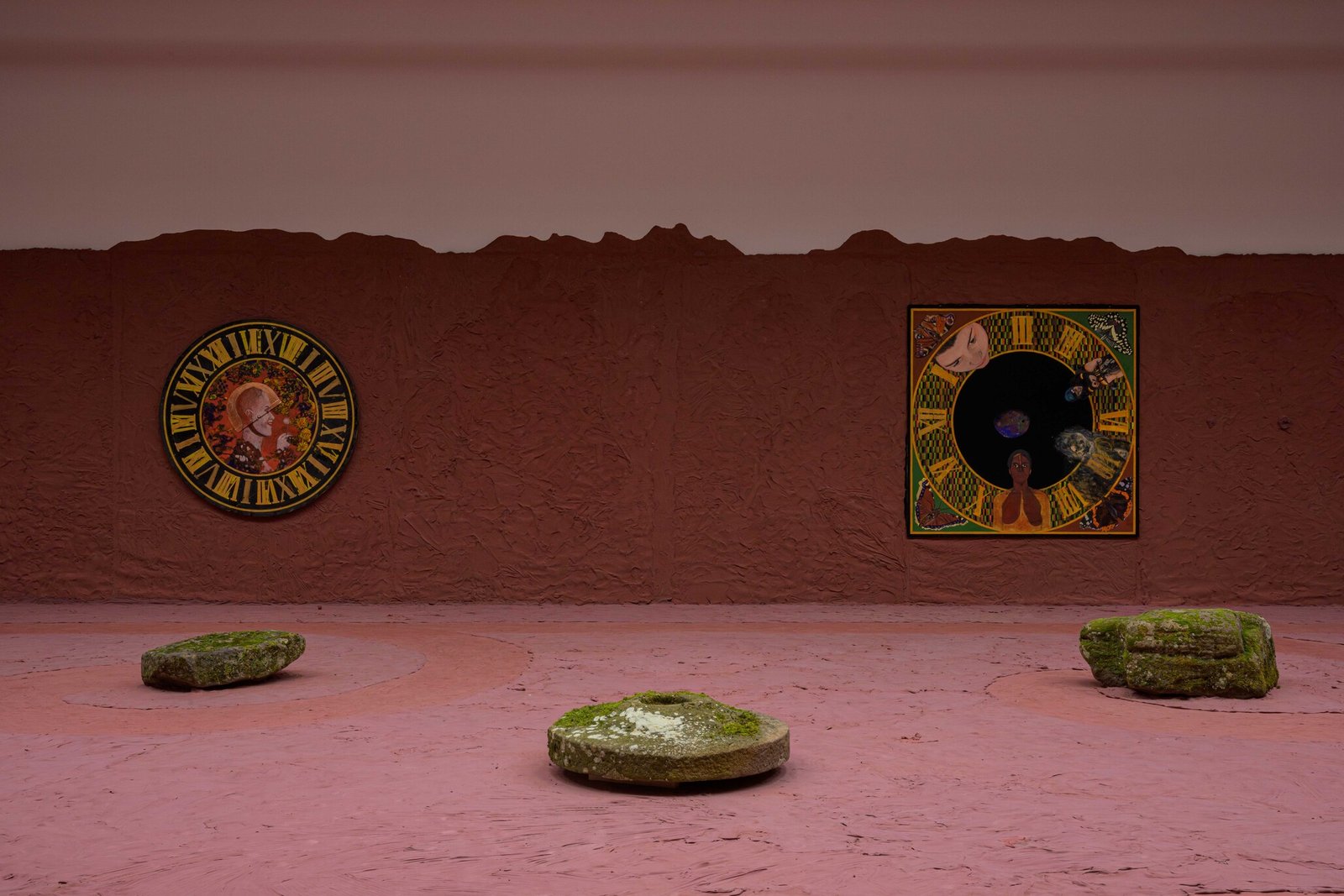
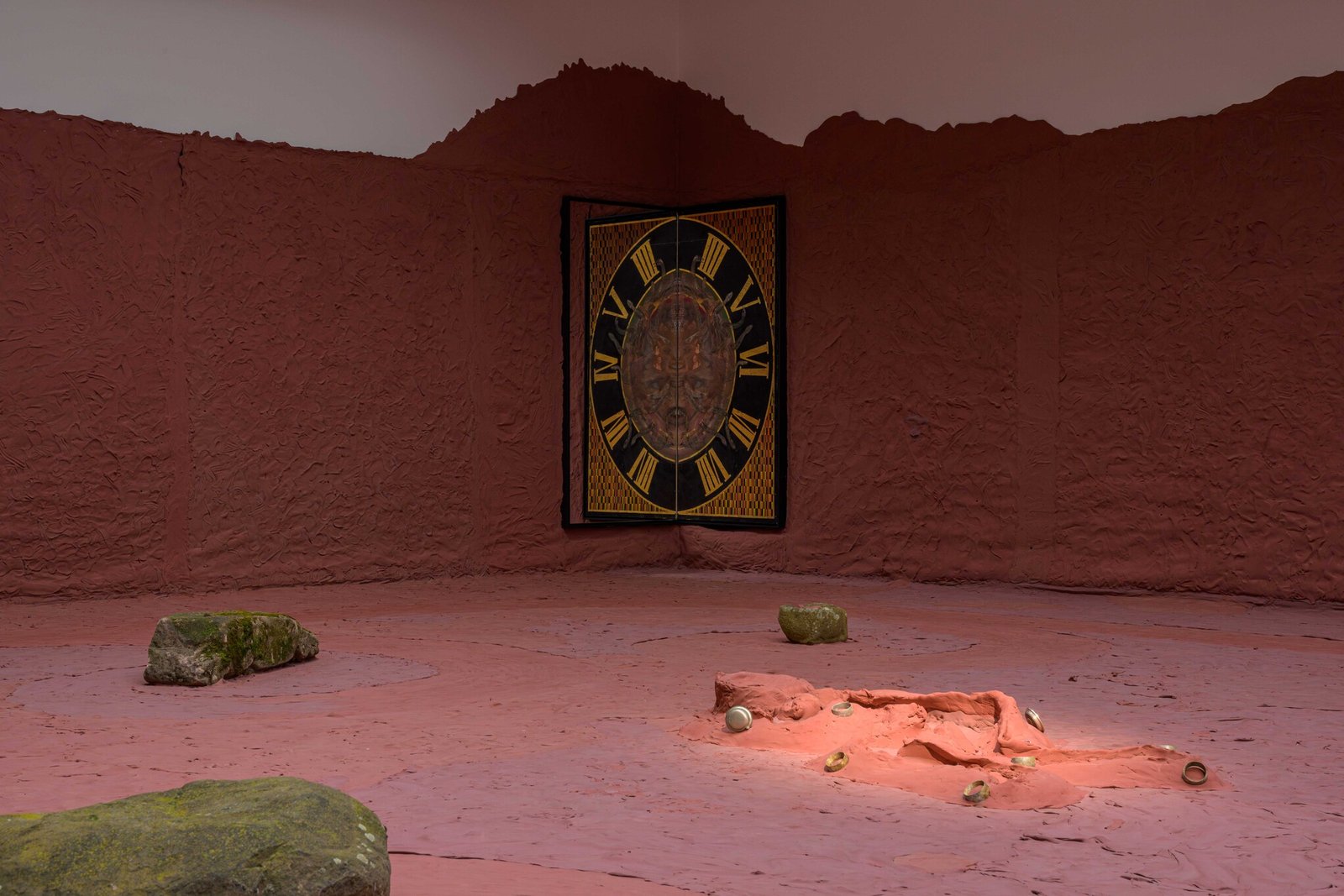
Stanislava Kovalčíková’s exhibition Rubigo invokes processes of rusting and decay. On a material level, as well as through images, it confronts us with deterioration and disease, transience and absence. Decay and erosion are also inscribed into the image supports themselves. The enamelled clock faces of decommissioned tower clocks are weathered and rusted, their surfaces scratched and corroded. Yet Kovalčíková frames disease and decomposition not merely as processes of decay, but as transformations harbouring the potential for renewal and the disruption of established orders while bearing witness to vulnerability and resistance.
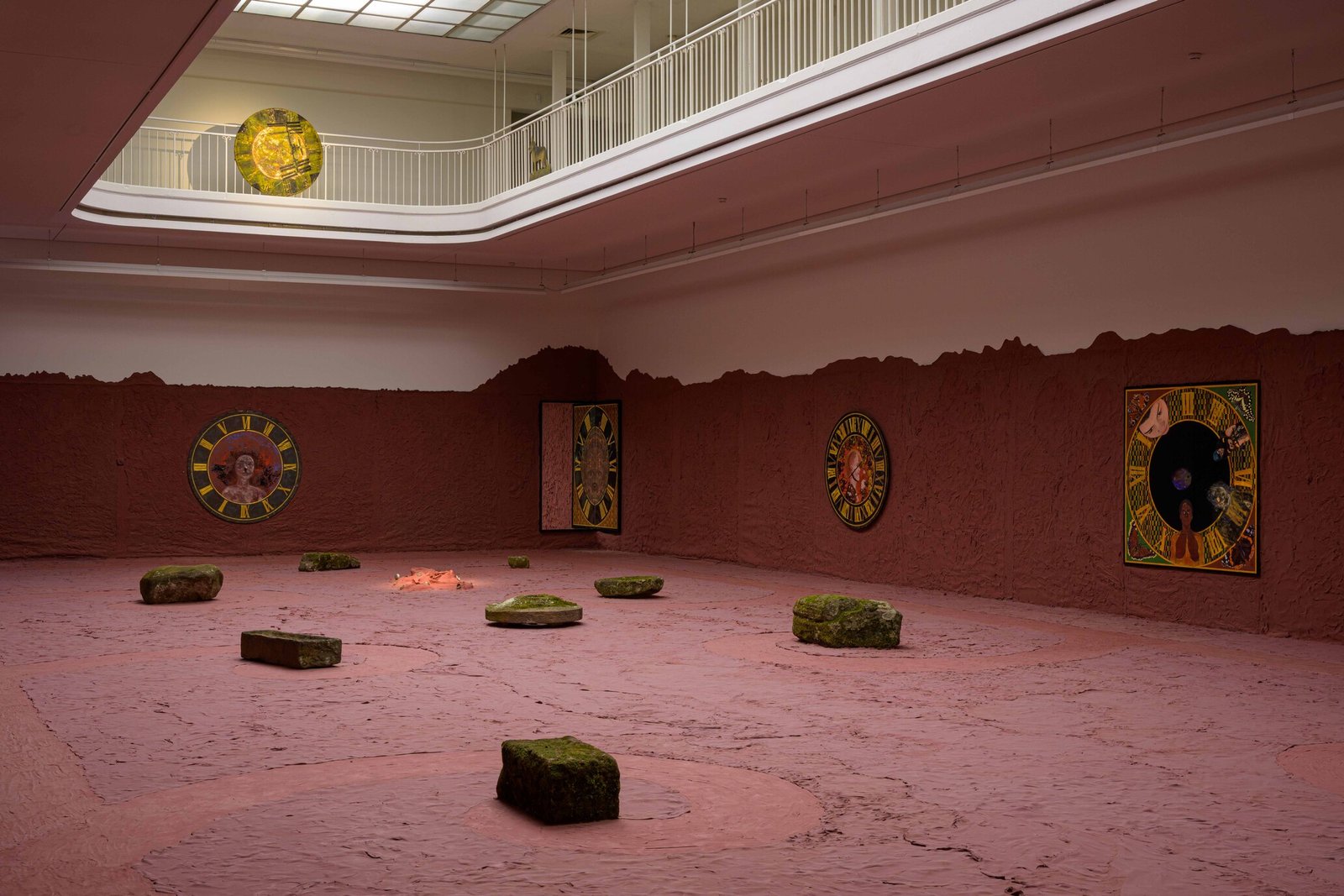
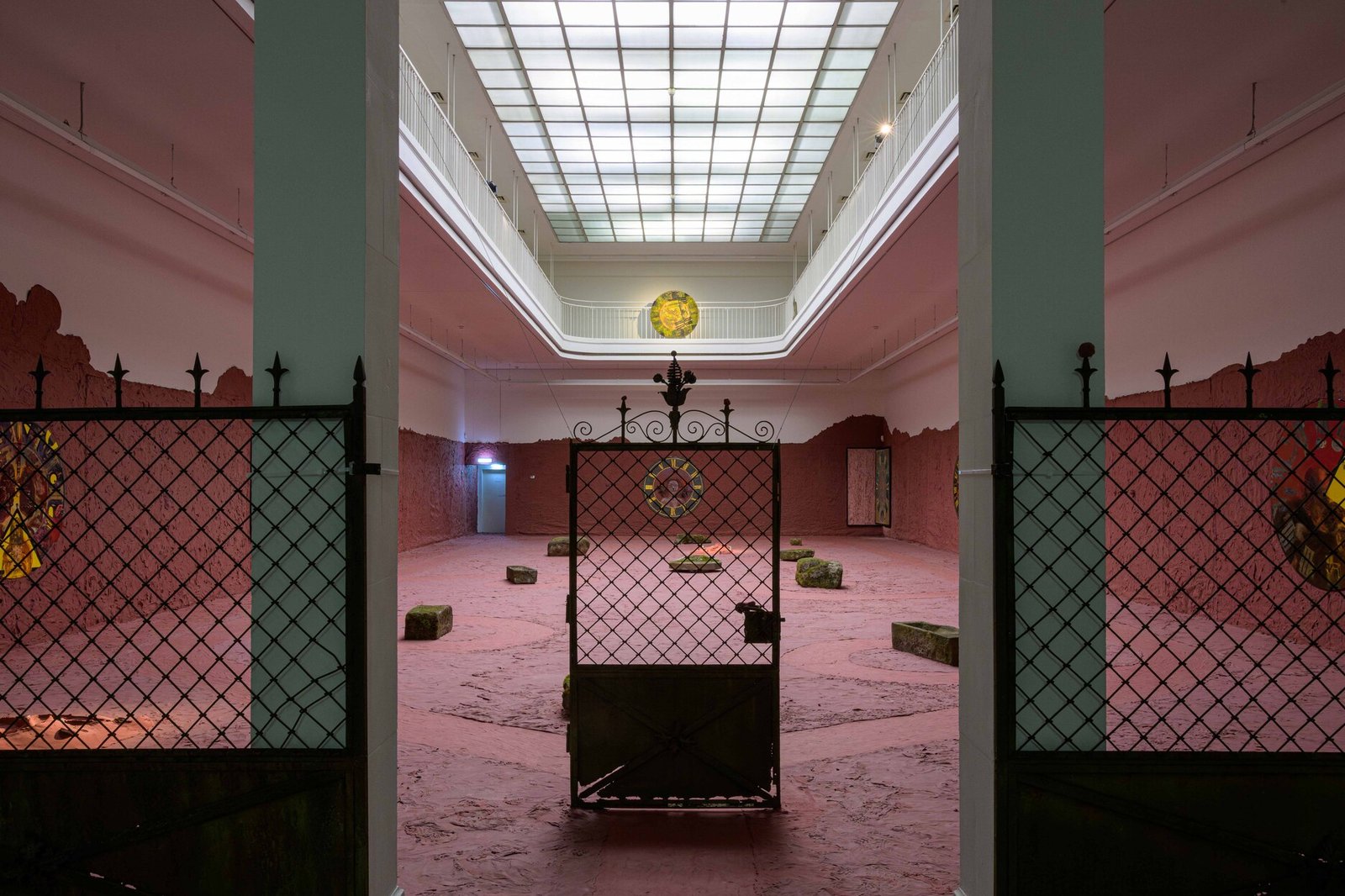
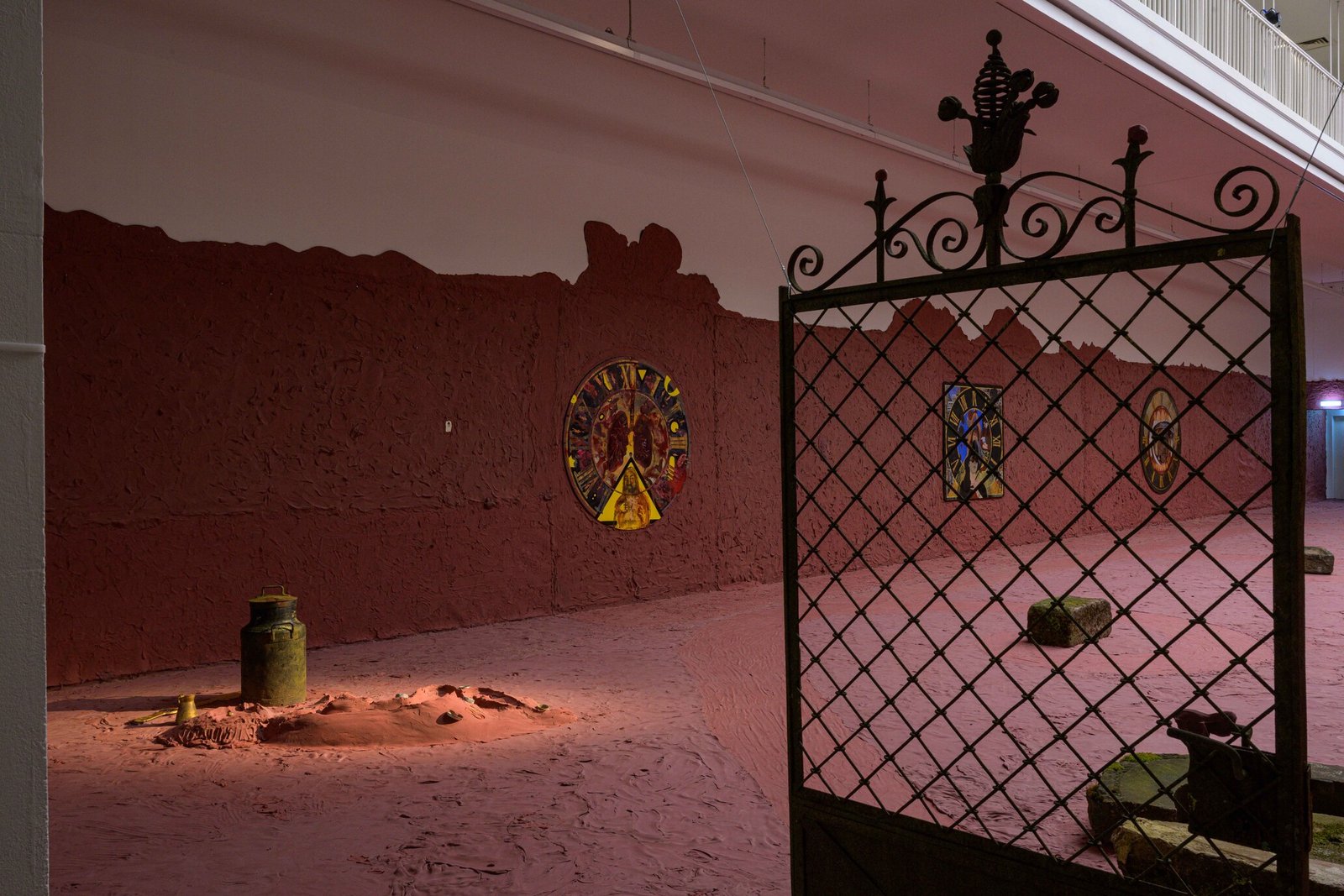
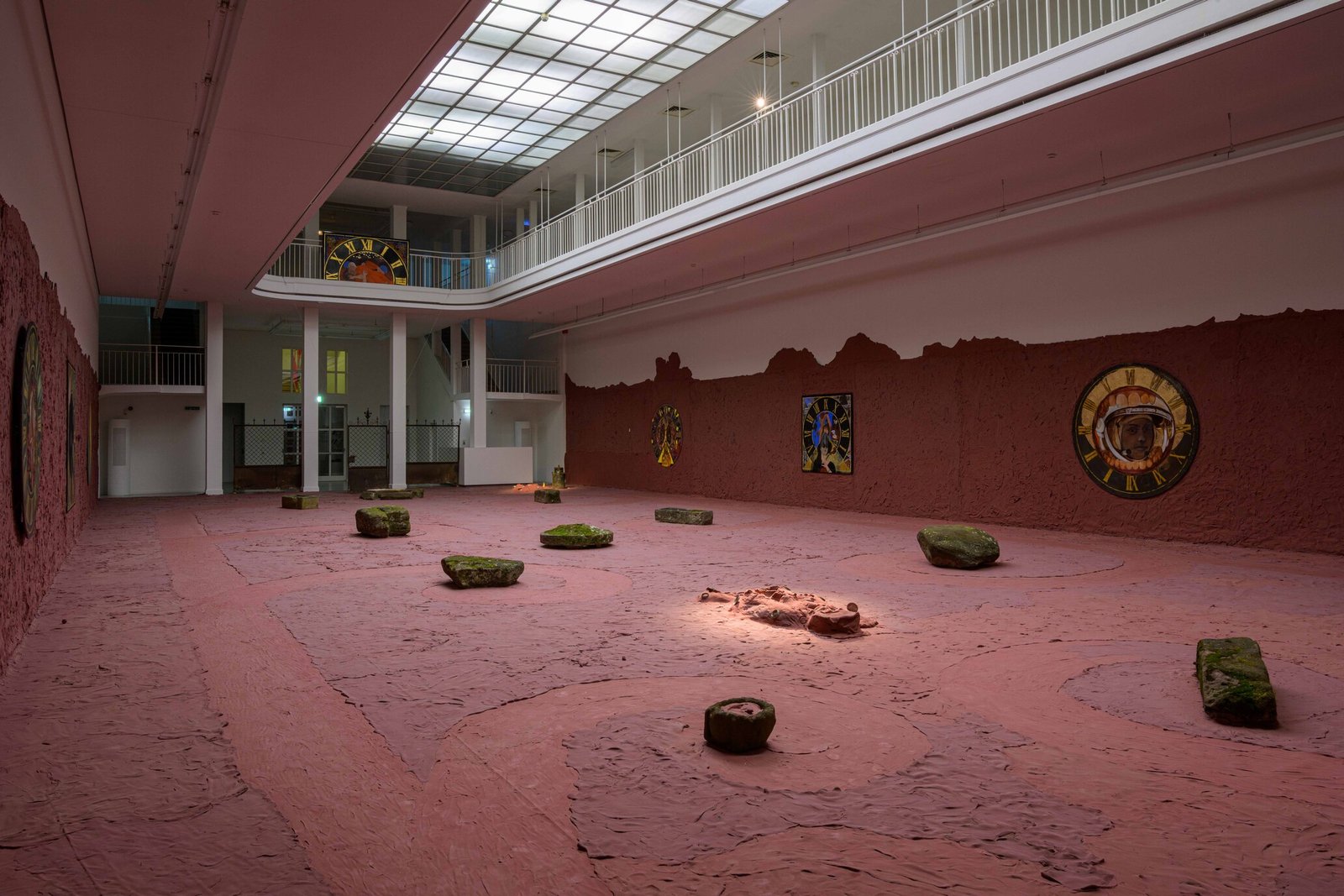
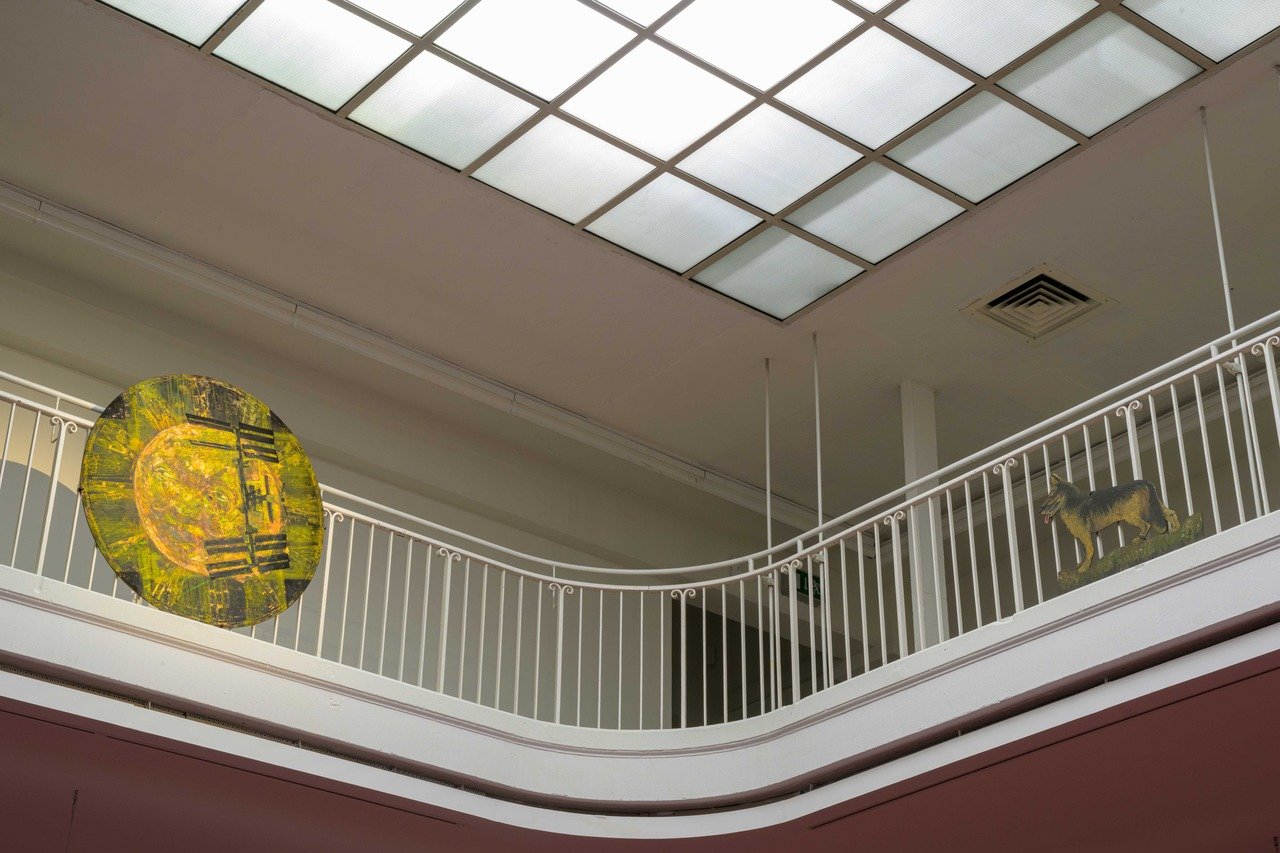
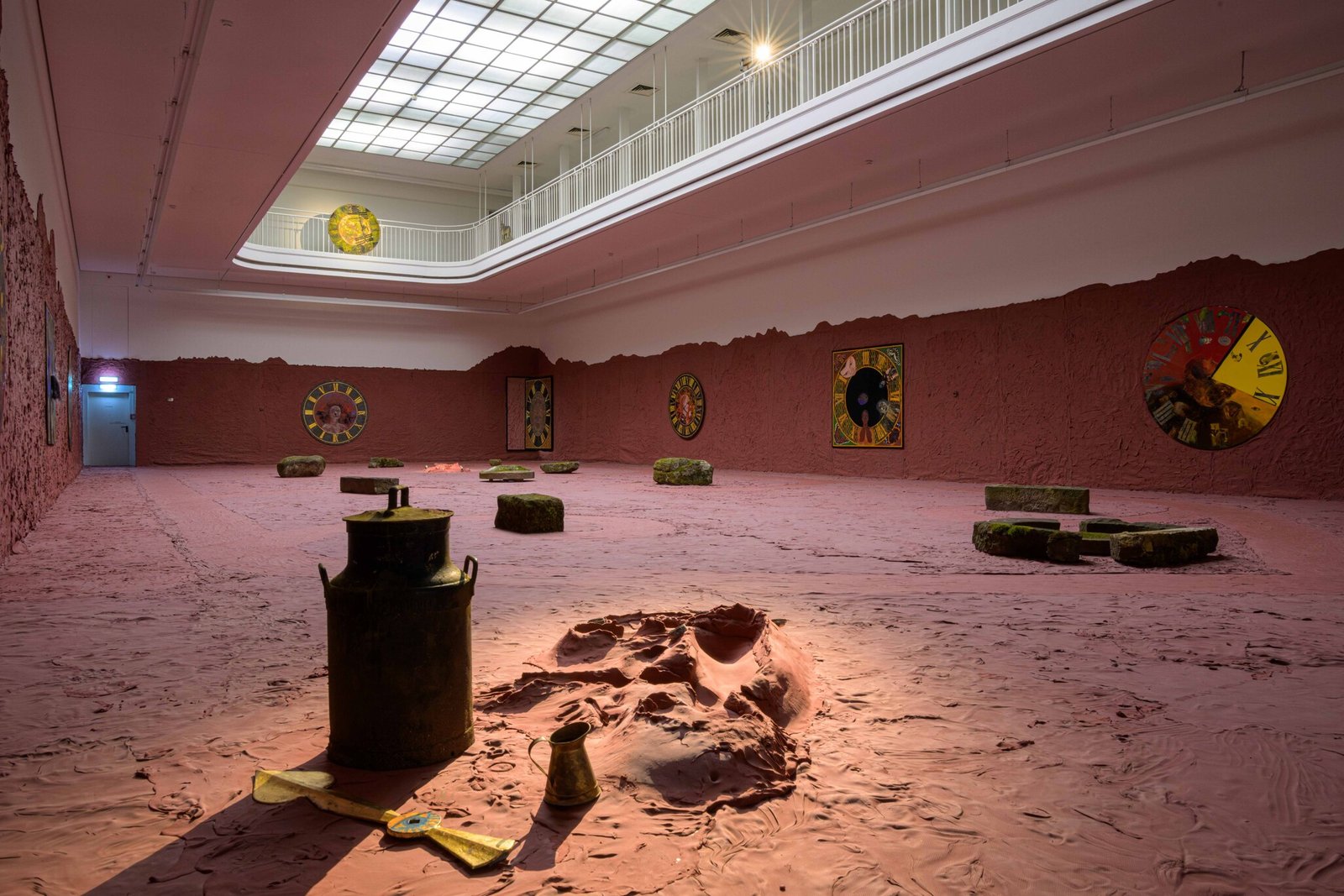
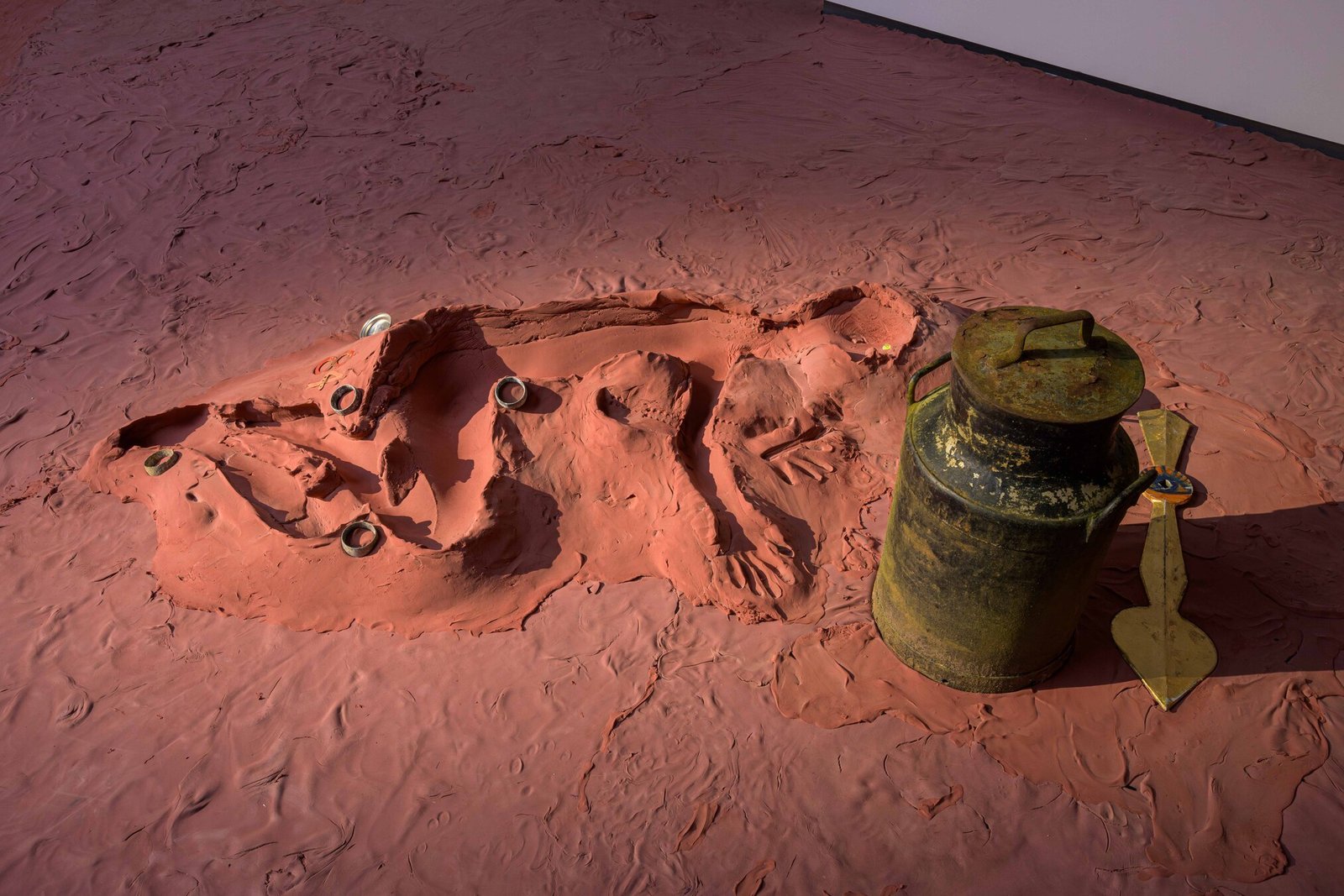
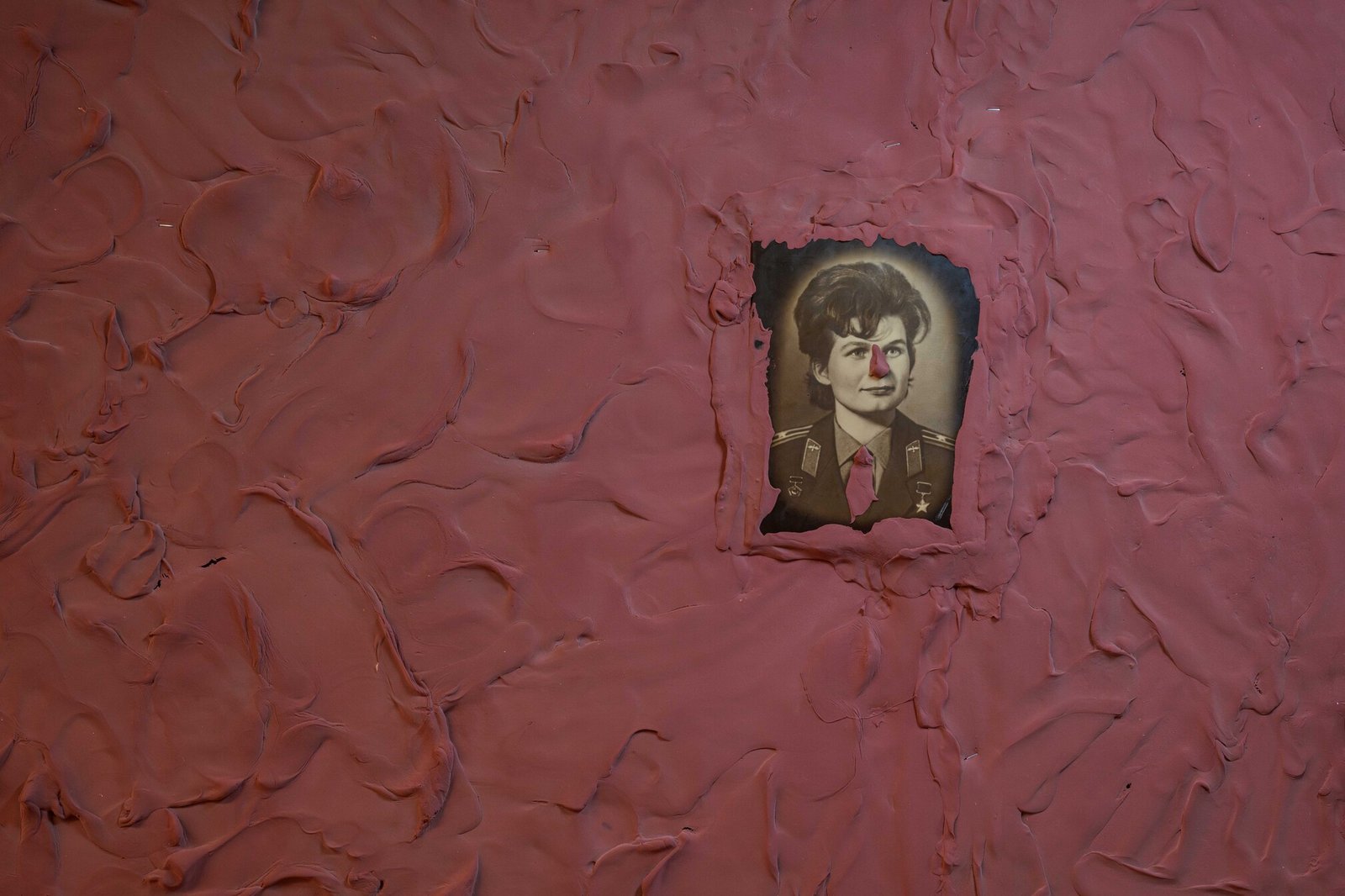
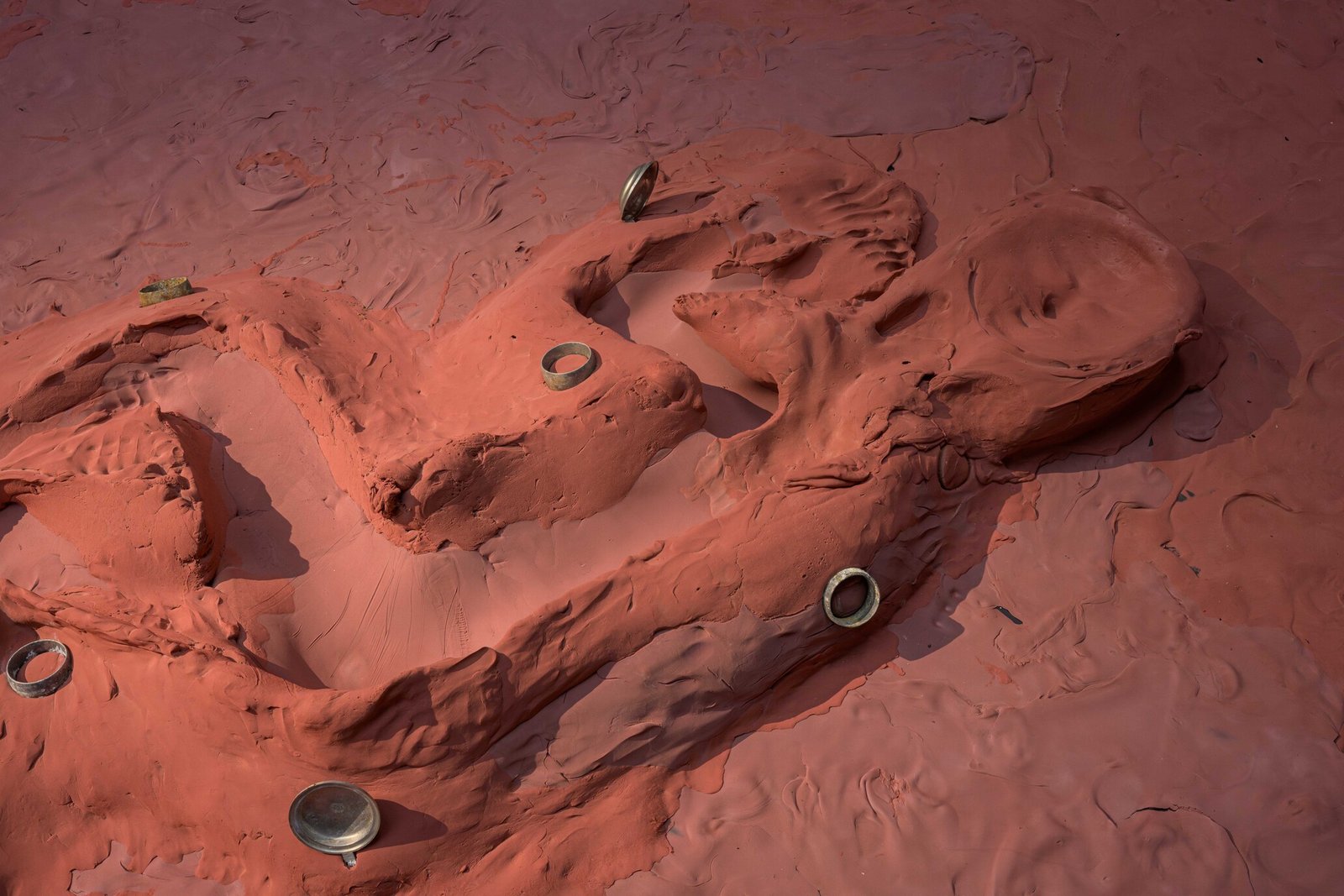
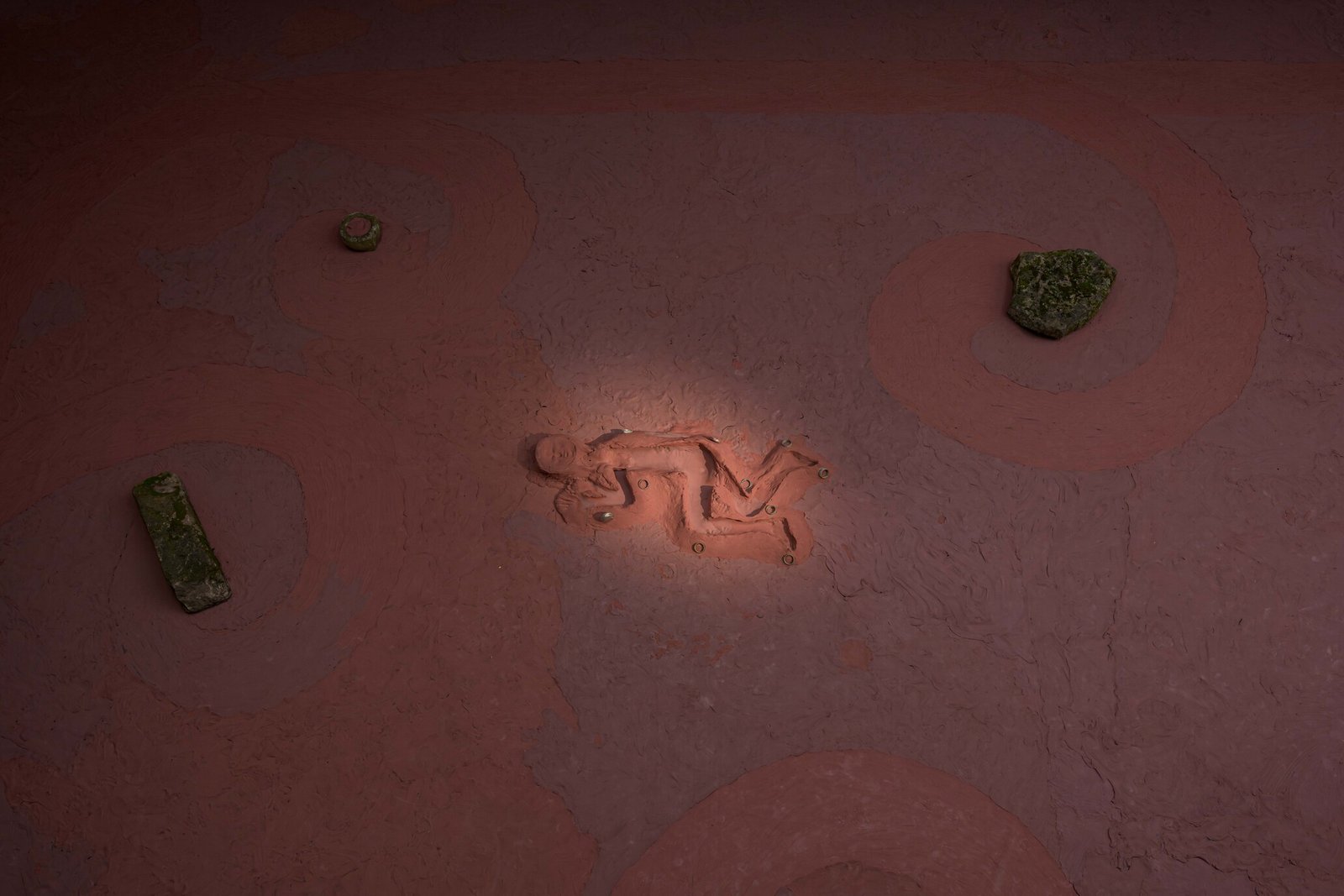
For her paintings, Kovalčíková has created an environment out of flesh-coloured plasticine. This setting serves as a “holding environment” for the works – in the sense of the protective, nurturing space conceptualised by psychoanalyst and paediatrician Donald Winnicott. The synthetic modelling clay, best known as children’s playdough, is also used in rehabilitation therapies. At the same time, the material recalls petrochemistry’s promise that plastic can be moulded into almost any object, yielding a nearly unlimited variety of new consumer goods. In the form of microplastics, this promise finds its toxic fulfilment in organisms, soils, and oceans, shaping our planet’s biological, geological, and atmospheric processes far into the future. Cultural theorist Heather Davis aptly described plastic as the “living dead among us”2: it breaks down into ever smaller particles but never fully disappears, leaving most plastic that has ever been produced still present on the planet.
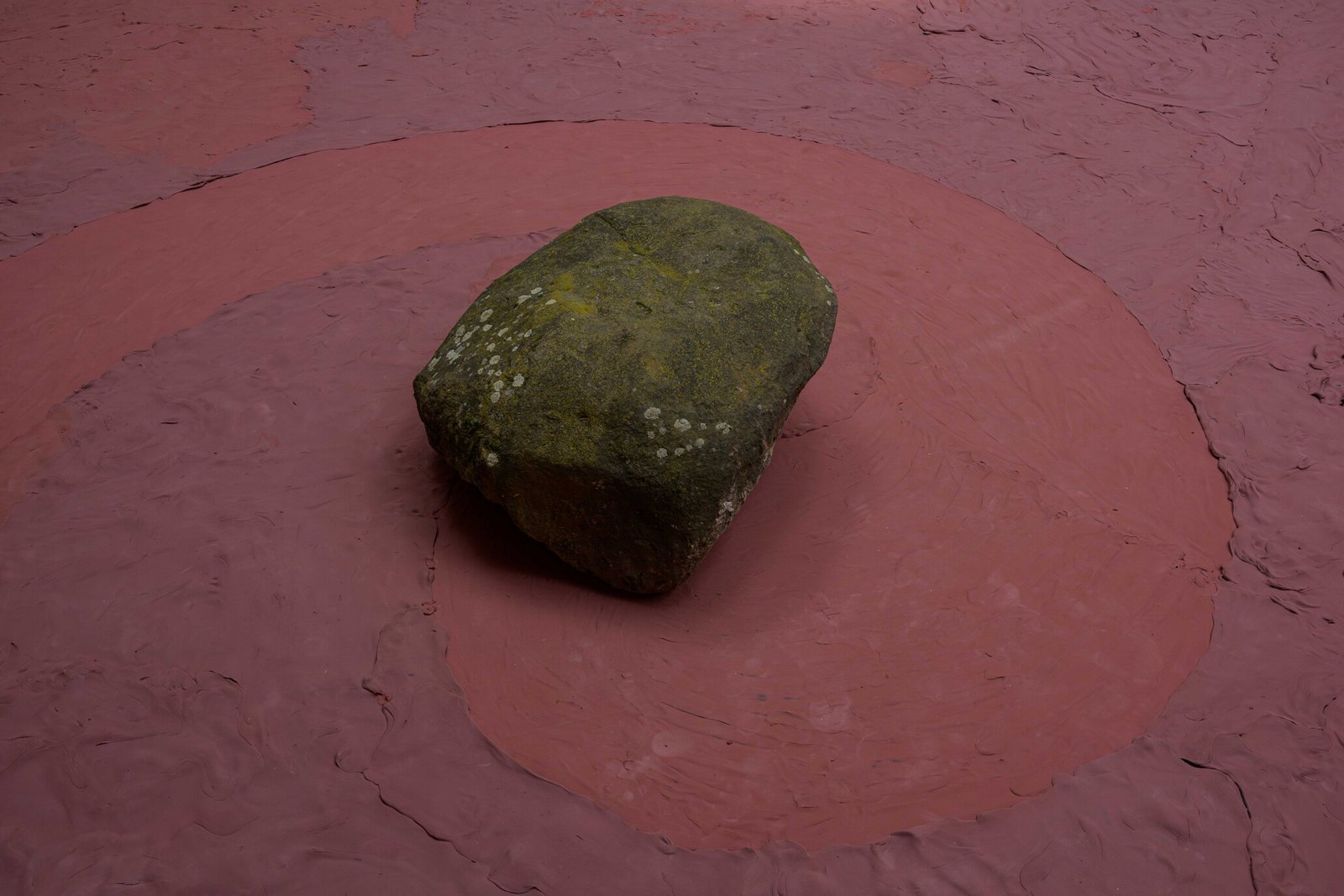
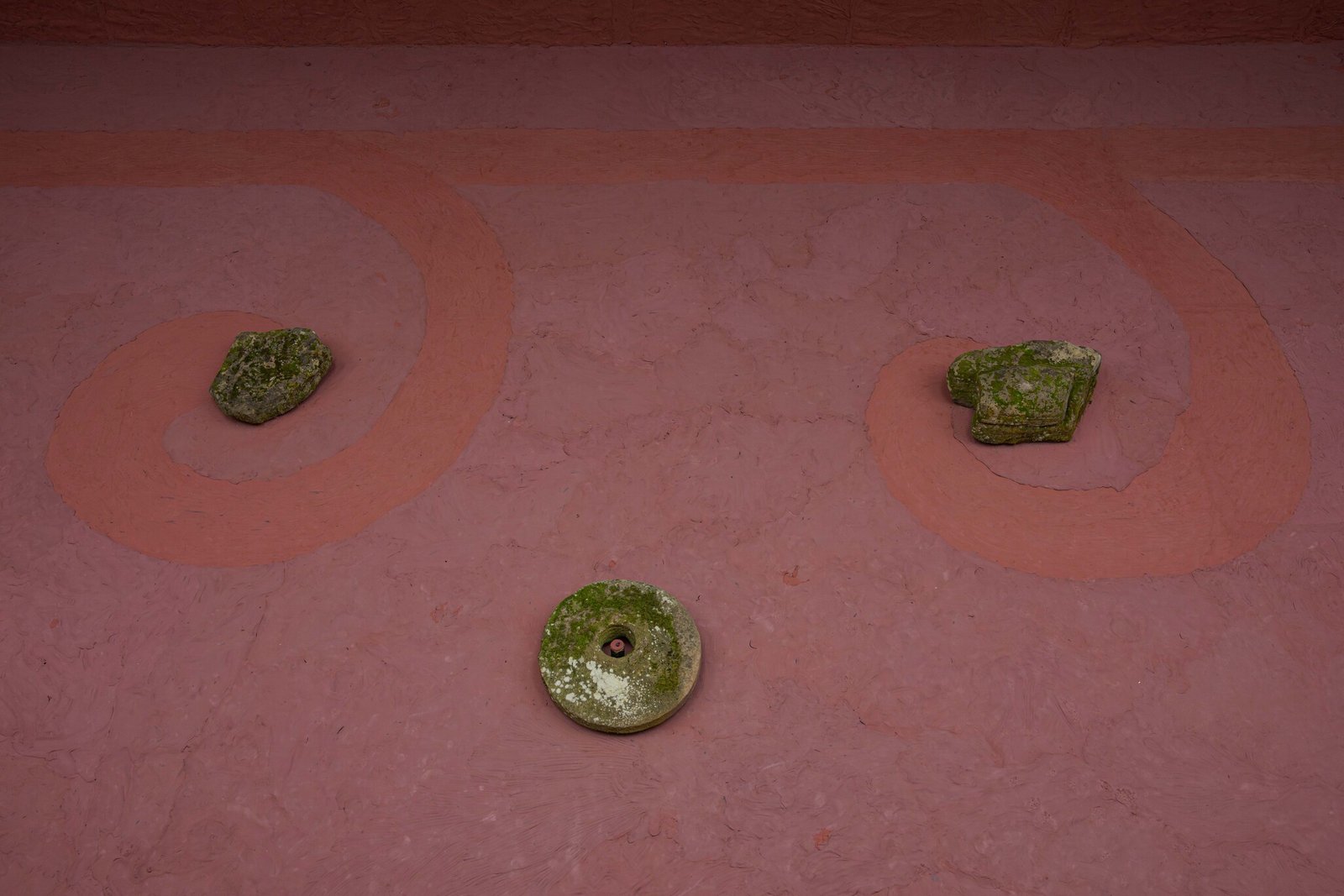
Viewed from above, the paths running across the plasticine converge into an ornamental spatial drawing reminiscent of Land Art. Yet unlike Land Art, this is not a violent incision into a “natural” landscape, but the creation of an artificial landscape within an exhibition space. The scattered boulders and stone troughs can serve as seating for viewing the paintings. They are made from the same red sandstone that was used in the construction of Freiburg Münster. Arranged in this way, the stones create an atmosphere that might recall Stonehenge, as if one were moving through a field of archaic markers – relics of rituals whose original meaning has long been lost. The colour of the plasticine not only reflects the red tones of the Münster, but it also evokes iconic red rooms, such as the suffocating interior of Ingmar Bergman’s Cries and Whispers (1972) or the psychedelic set designs in Dario Argento’s Suspiria (1977).
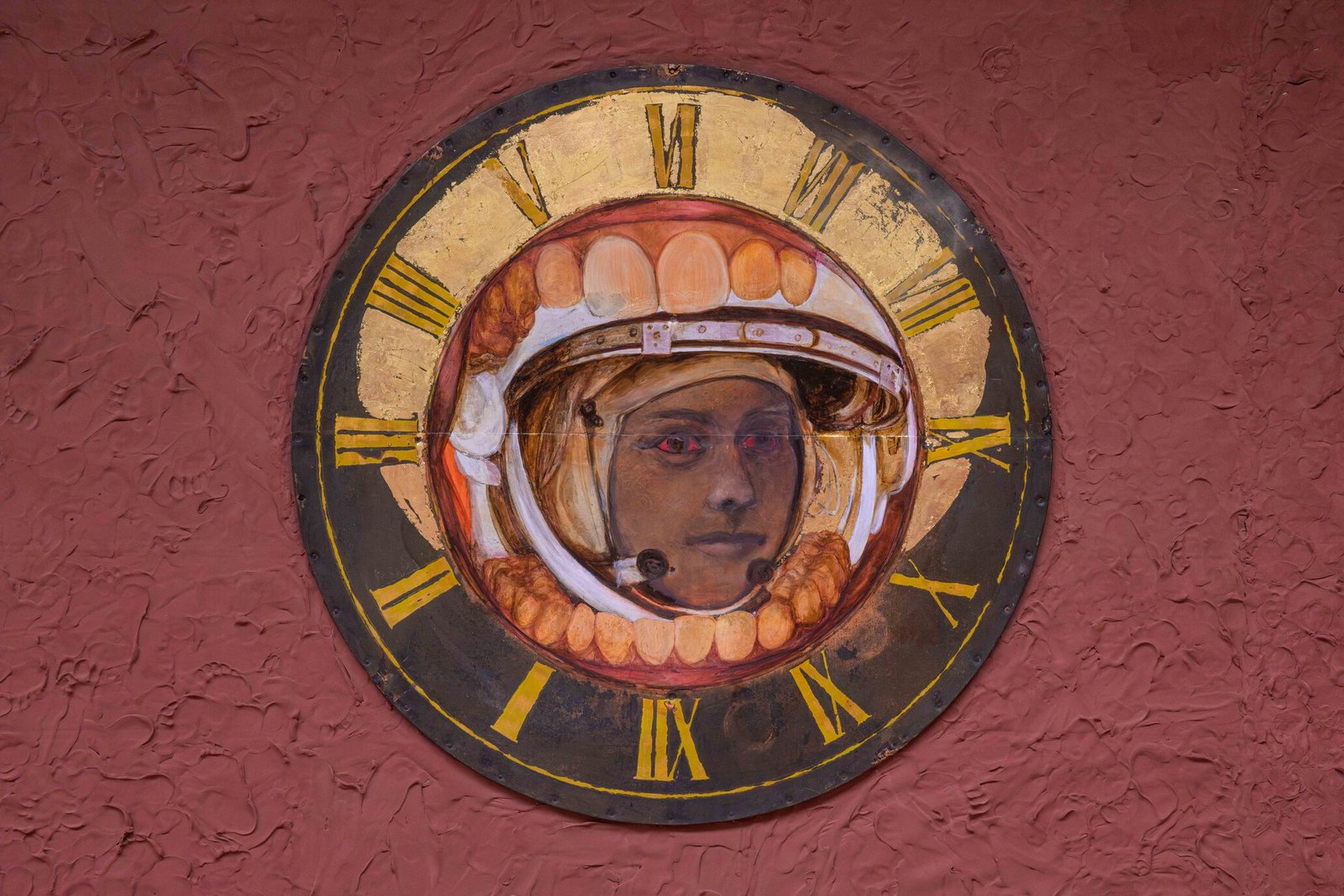
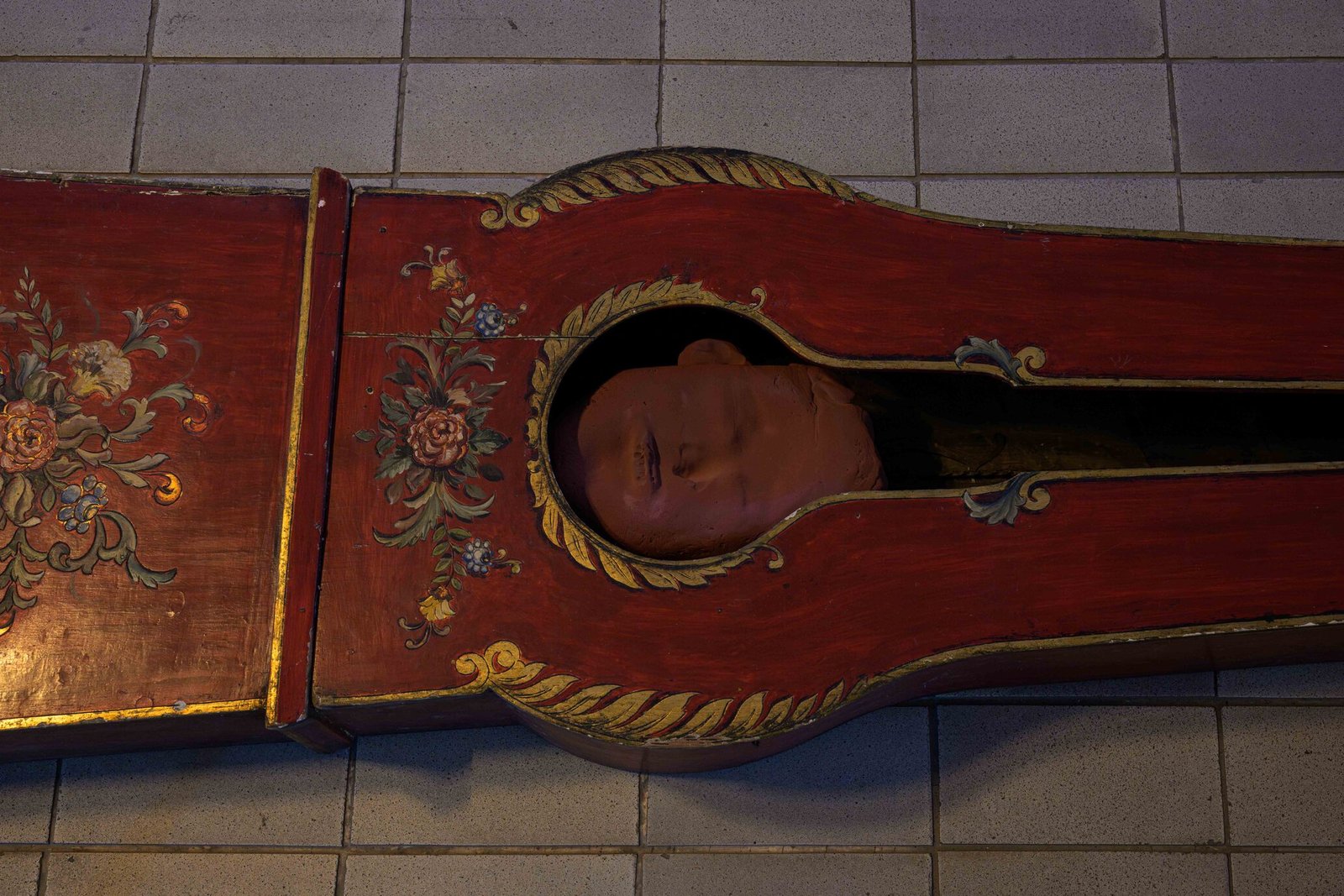
The hollow spaces left after countless imprints of hands and feet bear witness to the labour-intensive working of the material, to human bodies that were once present and actions they enacted. These organic structures contrast the pristine surfaces and geometric coolness of modernist architecture, thereby also subverting the idea and practice of the white cube, the supposedly neutral exhibition space of contemporary art. The amorphous surfaces resemble a weathered facade, as if Kovalčíková’ s sculpting of the room has turned the outside in. At the same time, it is as if the insides of a body had been turned outward. Thus, the environment evokes enclosure within a body. The yielding yet resistant materiality of the plasticine, along with the muffled acoustics, intensifies the impression of being inside a complex architecture of bodily tissue or a monumental padded cell. In the regressive desire “to return to the womb”, the uterus symbolises the promise of security, protection, and warmth. Yet this primary environment also awakens the fear of being swallowed, much like the cosmonaut-saint in Kovalčíková’s painting By Hunger and Habit (2026), who is devoured by an eager mouth.
In Octavia Butler’s science-fiction novel Dawn (1987), the protagonist awakens in a prison-like cell. One scene describes her exploring the material properties of her new surroundings. It eventually turns out to be the organic, living matter of an extraterrestrial spaceship:
She had beaten it, kicked it, clawed it, tried to bite it. It had been smooth, tough, impenetrable, but slightly giving (…). It had felt like plastic, cool beneath her hands.
‘What is it?’ she asked.
‘Flesh. More like mine than yours. Different from mine, too, though. It‘s … the ship.’3
In Rubigo, however, this mothership is not an idealised womb, but a decaying, exhausted body. Once this malleable and endlessly yielding plastic medium dries, it becomes hard and will slowly disintegrate over the course of the exhibition. The plasticine retains the imprint of every step, every instance of pressure, every form it has been given. This material process resonates with philosopher Catherine Malabou’ s conception of plasticity, which she contrasts with elasticity. Whereas elastic, flexible materials can bend and then return to their initial form, plasticity names the ability to receive form while being irreversibly altered.4 Transposed into a political and social realm, Malabou links “elasticity” to neoliberal demands for endless flexibility and adaptability, and the expectation that subjects can be indefinitely put under pressure, depleted and yet return to an original form after rest. By contrast, Kovalčíková’ s hardened plasticine offers an image of material fatigue.
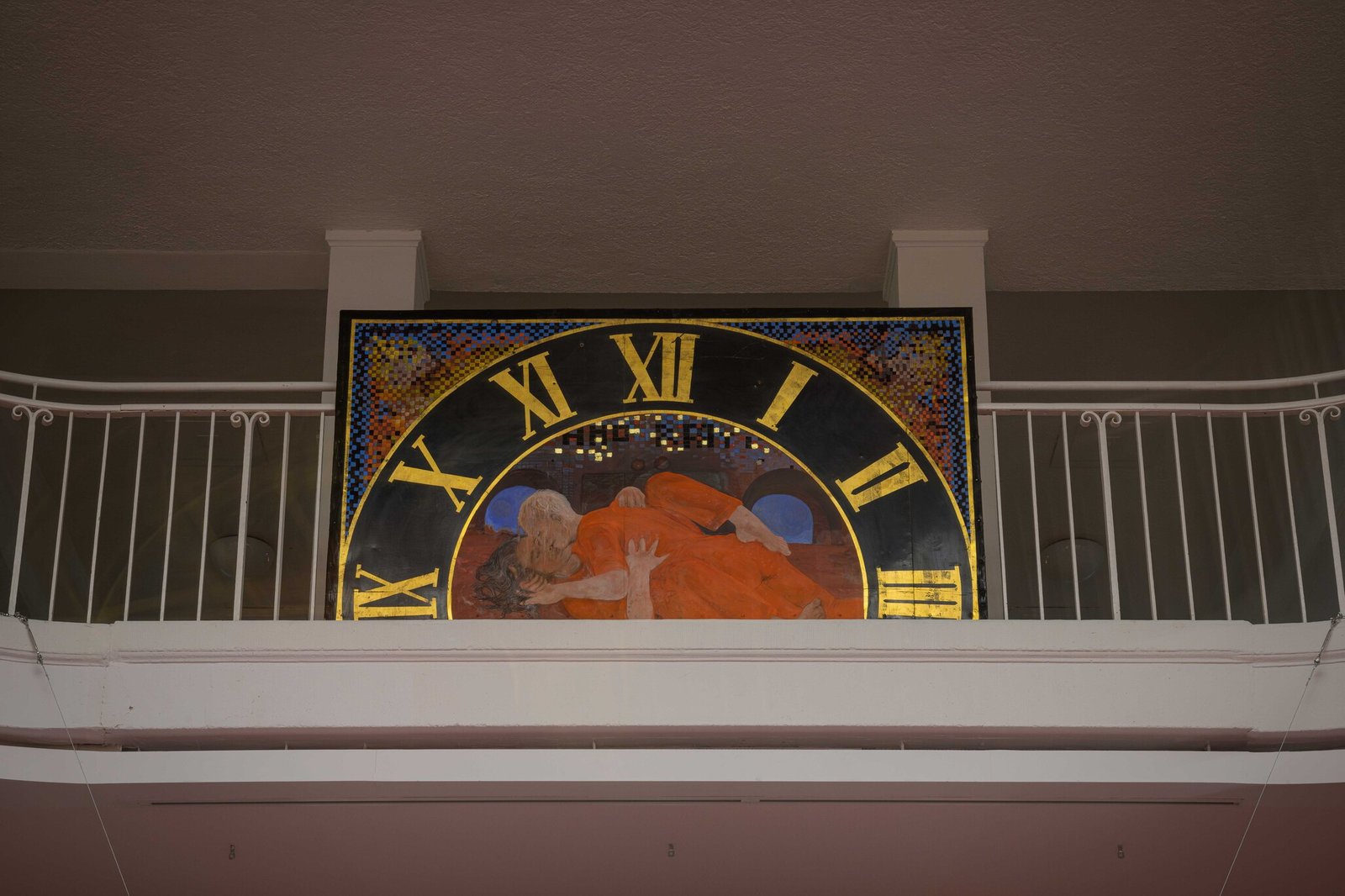
In “On the Concept of History” (1940), Walter Benjamin evokes a scene from the July Revolution of 1830 in Paris, where insurgents were seen firing at the dials of clock towers as if attempting to arrest time itself.5 An eyewitness, relayed by Benjamin, compares the revolutionaries to the biblical figure Joshua, who brought time to a standstill by asking God to stop the movement of the sun. Benjamin understands the act of shooting at clocks – the most ubiquitous and pervasive representation of Western modern time – as an attempt to produce a radical break in the dominant order. The insurgents’ iconoclastic act testifies to the power of timekeeping devices in shaping how time is thought and lived. Representations of time become a political battlefield. In Rubigo, the large clock dials have already been discarded from their once hyper-visible positions on towers and churches. As clock enthusiasts and collectors sought only the mechanics, the clock faces were left behind as nostalgic relics in a secular, contemporary world. Stripped of their hands, they appear strangely silenced and still. Through the artist’ s restorative yet distorting interventions, the Roman numerals are sometimes superimposed, sometimes turned upside down, as if time itself had slipped.
The series of ten paintings on clock faces brought together in Rubigo were produced between 2022 and 2026, an unusually condensed period for Kovalčíková, who often spends several years working and reworking each painting. Yet, with their worn enamel surfaces and rust, the image supports themselves carry the sedimentation of time. The artist thus foregrounds transience and the materiality of time over its abstract symbols and representations. The compositions she paints and collages onto the circular planes further unsettle the clock’s linear, measurable time; instead, time appears layered and folded in on itself. As the title Timeshifters (2026) suggests, Kovalčíková’s paintings and their protagonists seem able to travel through or slip between different periods and notions of time.
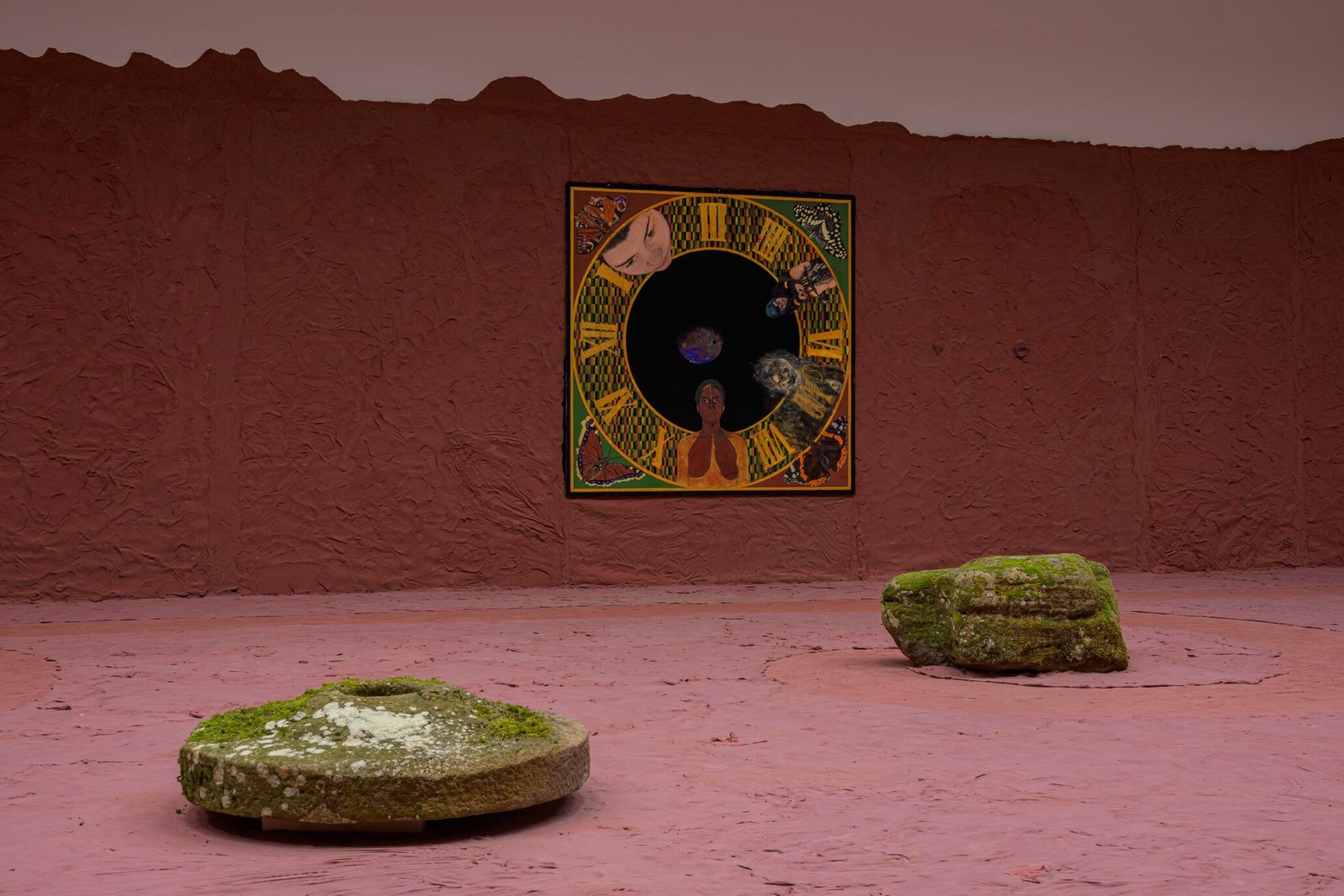
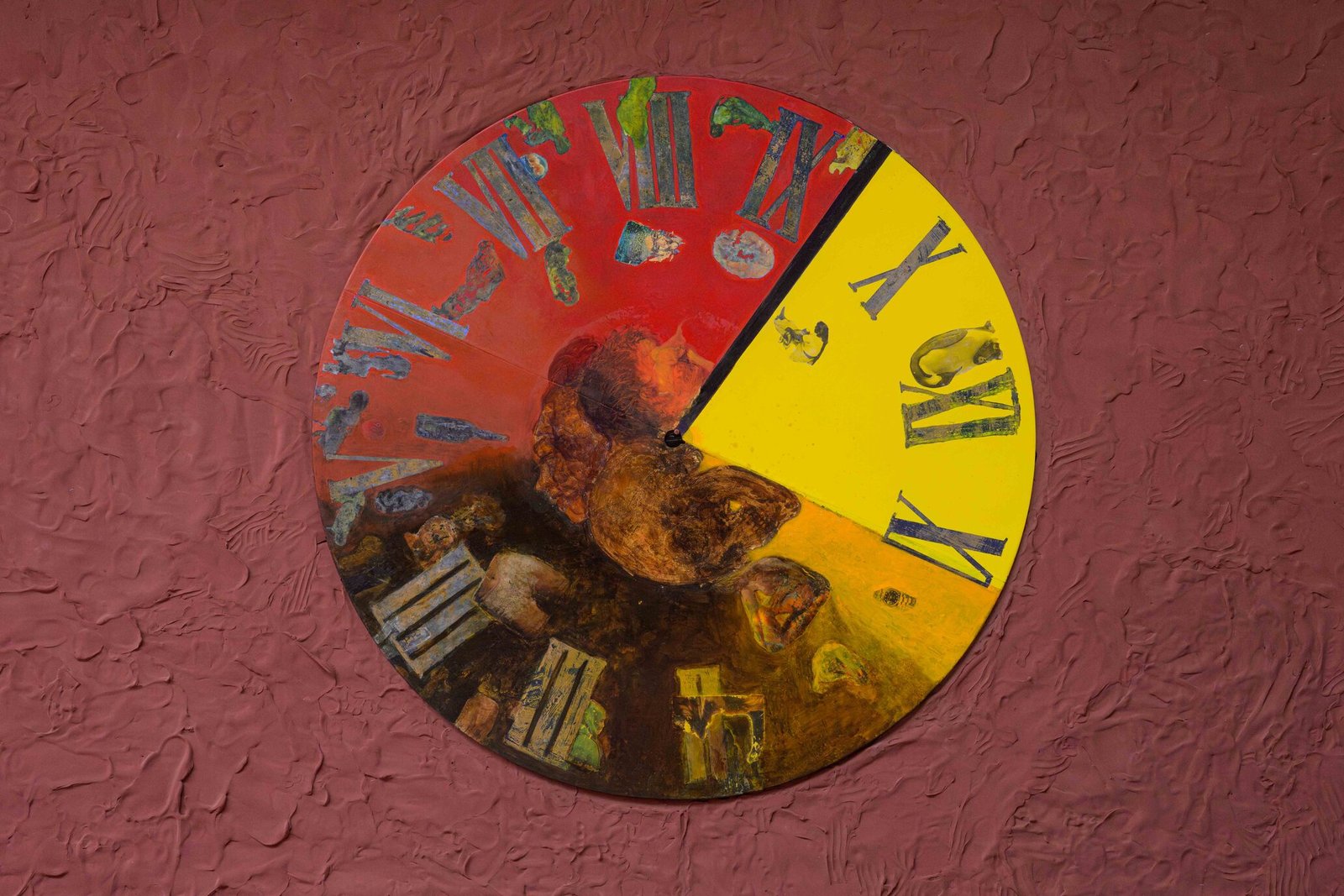
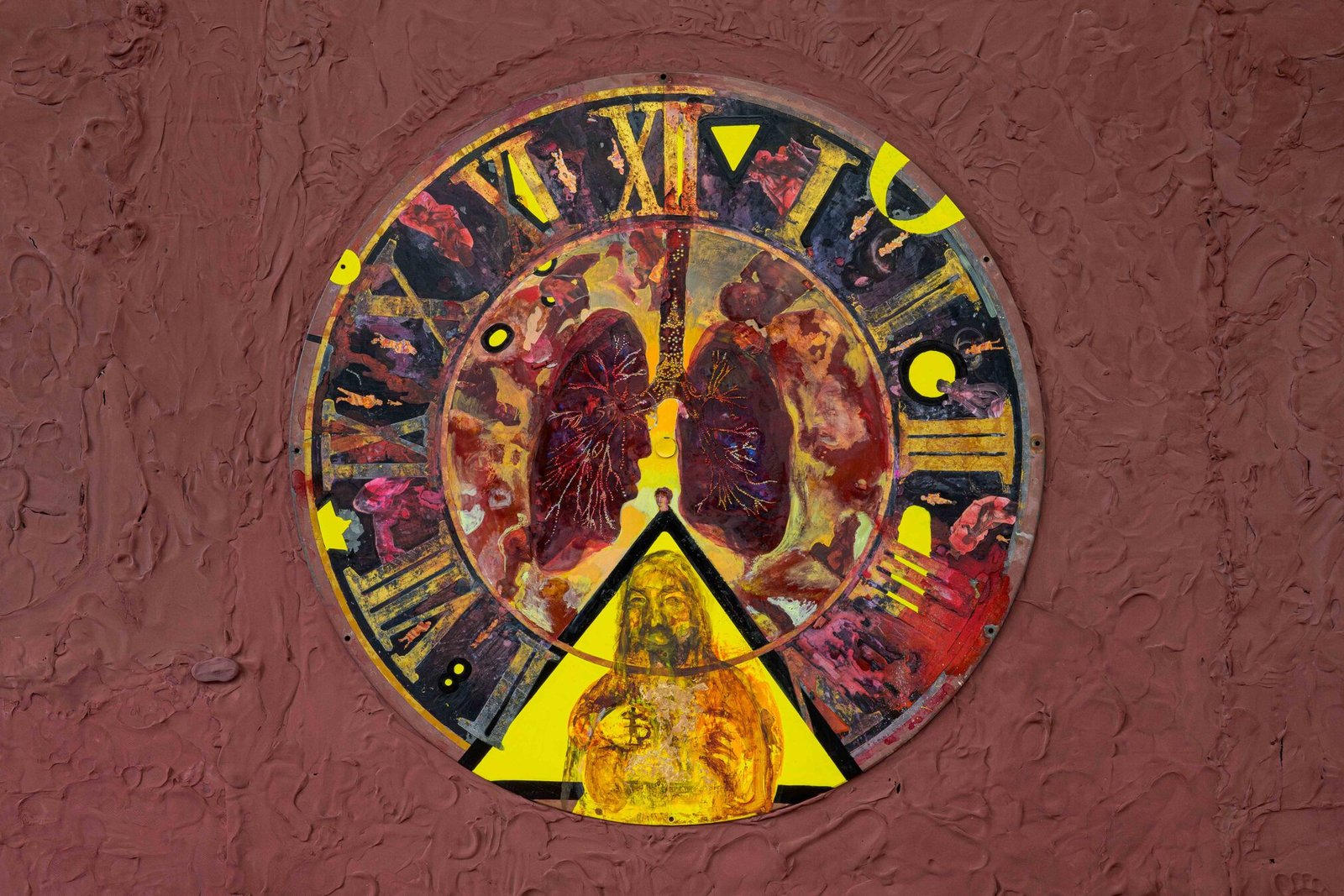
Time travel and other sci-fi tropes are often tied to futuristic technologies, to visions of possible futures. Yet even when science fiction is set in other, often remote space-times, the genre essentially reflects contemporary desires and anxieties back to us. Andrei Tarkovsky’ s Soviet sci-fi classic Solaris (1972), for instance, transforms a space voyage into a journey into the human psyche. In the sensorily impoverished and hostile environment of the space station, hallucinations, ghosts, and dreams burst forth – apparitions that unleash destructive force yet also enable confrontation with the past and make the present more bearable.6 In this lineage – and unlike sci-fi that imagines generative, utopian futures – Kovalčíková’ s paintings carry something distinctly dystopian and unsettling. Here, gravity falters, orientation slips, and figures drift across the corroded surfaces within an iconography drawn from disparate historical and contemporary sources: from Ancient Greek mythology and Roman coin portraiture, from Renaissance painting and baby yoga manuals, from advertisements and banknotes to sex toys and cigarette butts. Through collage, she incorporates material fragments from everyday life into the picture plane, as if the image wanted to devour as much of the world as possible. If Kovalčíková’ s pictorial worlds have hitherto been populated by androgynous figures, this new series foregrounds and pays homage to female companions, real and fictive.
In Why Would You Want to Win at a Loser’s Game? (2024), the receding Earth at the centre of the painting places us at an extraterrestrial vantage point, as if we were seeing the planet through alien eyes, witnessing the absurd game humankind has invented for itself. The “loser’s game” is not only a game rigged from the outset, or one in which the only winning strategy is to minimise mistakes; it can also be read as a metaphor for our world. In the painting, we glimpse a man setting himself on fire in an act of political protest and radical refusal to live under the current order. Nearby, a racing cyclist becomes a contemporary allegory of speed and competition. Below, a paraphrase of Rebecca Horn’s Rotbrust (1971), produced in response to the artist’ s lung illness, where she rendered her lungs in dark orange directly onto her exposed torso. Taken together, these elements of protest, competition, and disease seem to suggest that this world is making us sick. This is also true of the arguments Johanna Hedva advances in the auto-theoretical, manifesto-like “Sick Woman Theory”(2020), where they insist that our world has been built against the survival of some. We are all continuously reliant on infrastructures of support in order to live, yet the world we live in does not guarantee care for everyone. Hedvaeven goes so far as to claim that “to stay alive, capitalism can not be responsible for our care – its logic of exploitation requires that some of us die.”7 Against this world and the rules of its game, Hedva locates “the most anti-capitalist protest”8 in caring for another and for oneself. Challenging the rules of our world, changing the game altogether, is what Kovalčíková seeks to do through painting. Her works move between images that mourn a world on the verge of disappearance and portals that open onto other worlds or other ways of being within this one.
Stanislava Kovalčíková (*1988, Slovakia) lives and works between Paris and Dusseldorf. Rubigo is her first solo exhibition in Germany. Selected solo exhibitions: ret rie vers, Emalin, London, UK (2024); A Lover’s Discourse, Aspen Art Museum, Aspen, CA (2024); First Rays of the New Sun, Antenna Space, Shanghai, CH (2023); Psychroluta, Caprii, Dusseldorf, DE; Grotto, Museum fur zeitgenossische Kunst – Belvedere 21, Vienna, AT (2022); am I dead yet, Peres Projects, Berlin, DE; Imaga, 15 Orient, New York, US (2021). Selected group exhibitions: Means of Reproduction, Emalin, London, UK (2025); Devotion, Trautwein Herleth, Berlin, DE (2025); Stories from the Ground, 9th Biennal of Painting, Museum Dhondt- Dhaenens, Deurle, BE (2024); Cadavre Exquis or the Voluptuous Decay of the Shivering Veril, BRAUNSFELDER, Cologne, DE (2023); Hardcore, Sadie Coles HQ, London, UK (2023); Dark Light, Realism in the Age of Post Truth, Aishti Foundation, Beirut, LB (2022); Do Nothing, Feel Everything, Kunsthalle Wien, Vienna, AT (2021); Wild Dogs, Michael Werner, New York, US (2021); what fruits it bears, CAPC Musee d’Art Contemporain, Bordeaux, FR (2020); Paint, also known as blood, Museum of Modern Art, Warsaw, PL (2019).
1 Ovid, Fasti, trans. A. S. Kline, Book IV: April 25: The Robigalia.
2 Heather Davis, “Life & Death in the Anthropocene: A Short History of Plastic”, in: Heather Davis and Etienne Turpin (ed.), Art in the Anthropocene: Encounters amongst Aesthetics, Politics, Environments, and Epistemologies (London: Open Humanities Press, 2015), 352.
3 Octavia Butler, Dawn. Xenogenesis: I (London: VGSF, 1987), 30.
4 Catherine Malabou, “Plasticity and Elasticity in Freud’ s ‘Beyond the Pleasure Principle’”, Diacritics, Vol. 37, No. 4 (Winter, 2007), 82.
5 Walter Benjamin, “On the Concept of History,” in: Howard Eiland & Michael W. Jennings (ed.), Walter Benjamin. Selected Writings. Volume 4, 1938–1940 (Cambridge, MA: Harvard University Press, 2003), 395.
6 Cf. Jonathan Crary, 24/7: Late Capitalism and the Ends of Sleep (London & New York: Verso, 2013), 20.
7 Johanna Hedva, “Sick Woman Theory”, in: How to Tell When We Will Die: On Pain, Disability, and Doom (New York:Hillmann Grad Books, 2024), 56.
8 Johanna Hedva, “Sick Woman Theory”, 57.
Artists: Stanislava Kovalčíková
Exhibition Title: Rubigo
Curated by: Heinrich Dietz, Johanna Thorell
Venue: Kunstverein Freiburg
Place (Country/Location): Freiburg im Breisgau, Germany
Dates: 21.02 – 19.04.2026
Photos: Marc Doradzillo