
Kateryna Iakovlenko
I
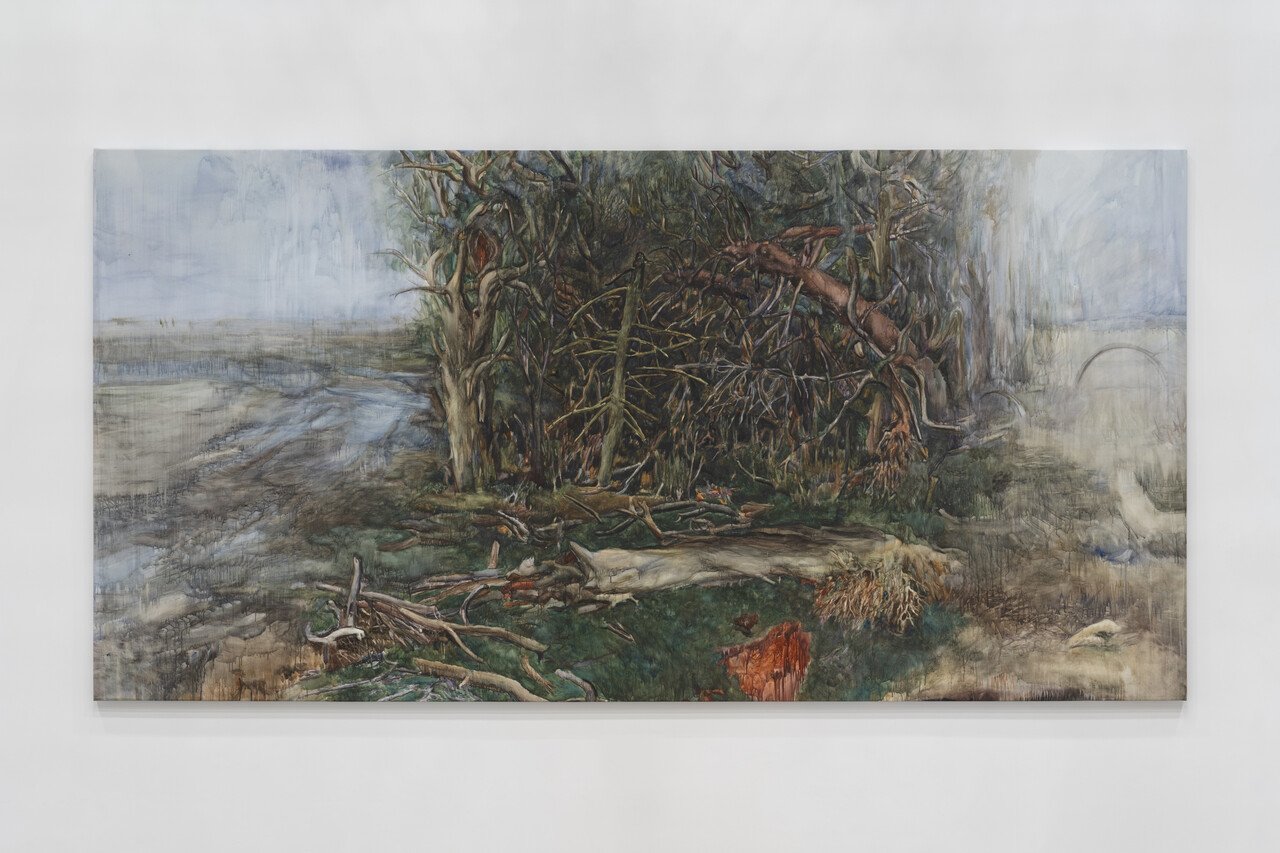
Once, in a conversation, Ukrainian artist Kateryna Aliinyk, originally from the Luhansk region, remarked that her understanding of landscape was shaped by its inaccessibility: even when walking along the same familiar and safe paths, she could only gaze at the rest of her beloved childhood scenery from afar – it might have been mined. She wasn’t the only one following these well-trodden roads; everyone around was cautious, avoiding abandoned or unexplored places. Painting became her way to return, to touch what remained unknown.
My journey to Białystok lasted only a few days, yet something significant happened during that time: I read in the news that railway connections with Donetsk Oblast had been suspended for safety reasons. Those were the last routes by which I could reach my native landscape. The train connections to the two last important cities were closed. Bathed in moonlight, they remain unreachable. Hundreds of thousands of people from these frontline towns have lost their homes and are forced to seek refuge elsewhere.
Thickets, swamps, dark forests, and unmapped territories – all these now carry a sense of threat and danger, for something unknown dwells within them, hiding behind branches. Yet this unknown might be someone in need of help. Someone who speaks another language, who, like anyone else, longs for freedom.
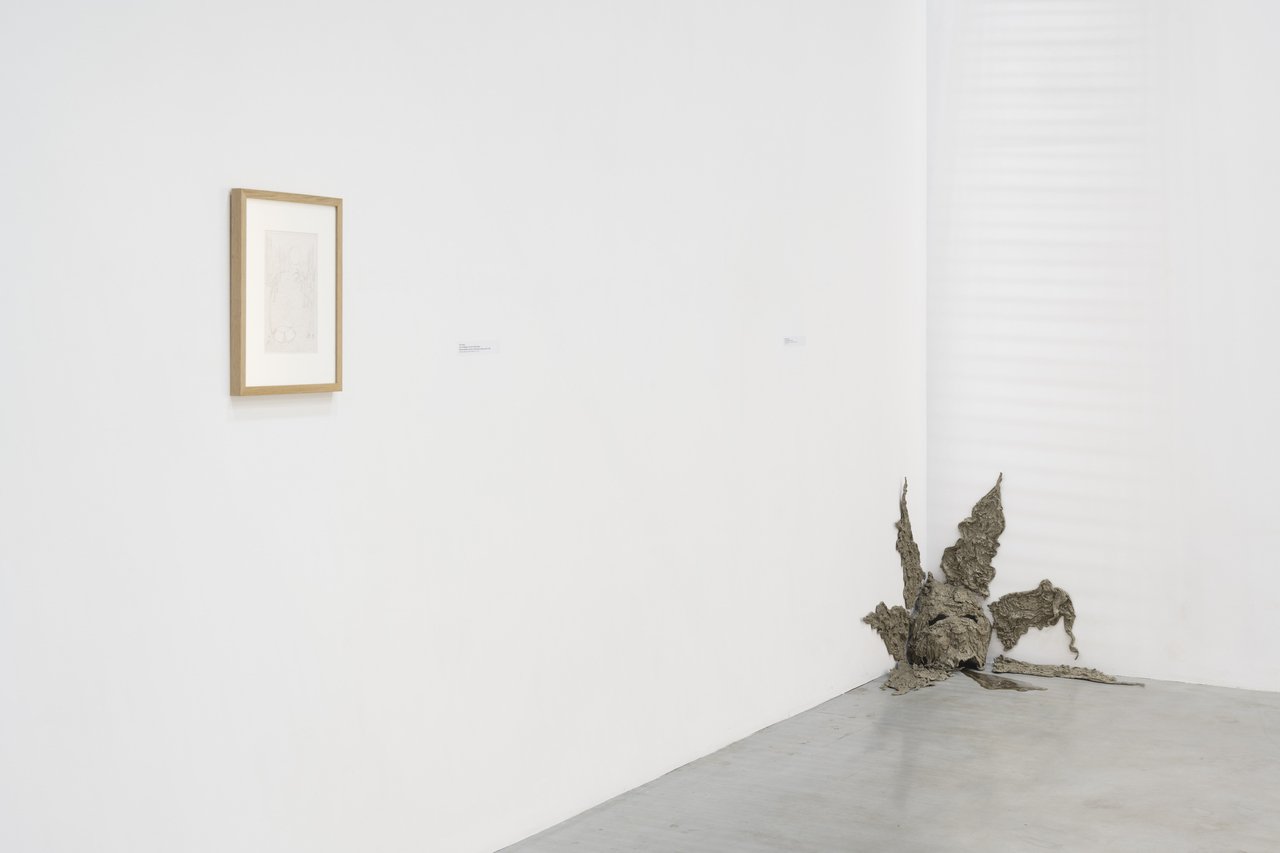
Before my eyes stands a forest drawn by Noor Hasan, a teenager who tried to cross the Belarusian-Polish border and escape violence. Her drawing, Even The Biggest Tree Can’t Hide the Moon, does not express horror – it is filled with hope, embodied by the moon. The moon is a witness, a guide, as it often appears in fairy tales. Yet, in the next room, on the same wall but on the other side, hangs a painting by Krzysztof Gil, depicting an animal with a human face hiding from bullets. The work refers to the long history of Roma persecution, particularly that of the artist’s own family, who were forced to flee inhuman violence.
The roads that migrants tread soon become overgrown: nature seeks to conceal their traces, to protect them from repeated tyranny. But if these paths are covered with grass, how can one find the way back? Is a return even possible? And if yes, to where, to a home that no longer exists?
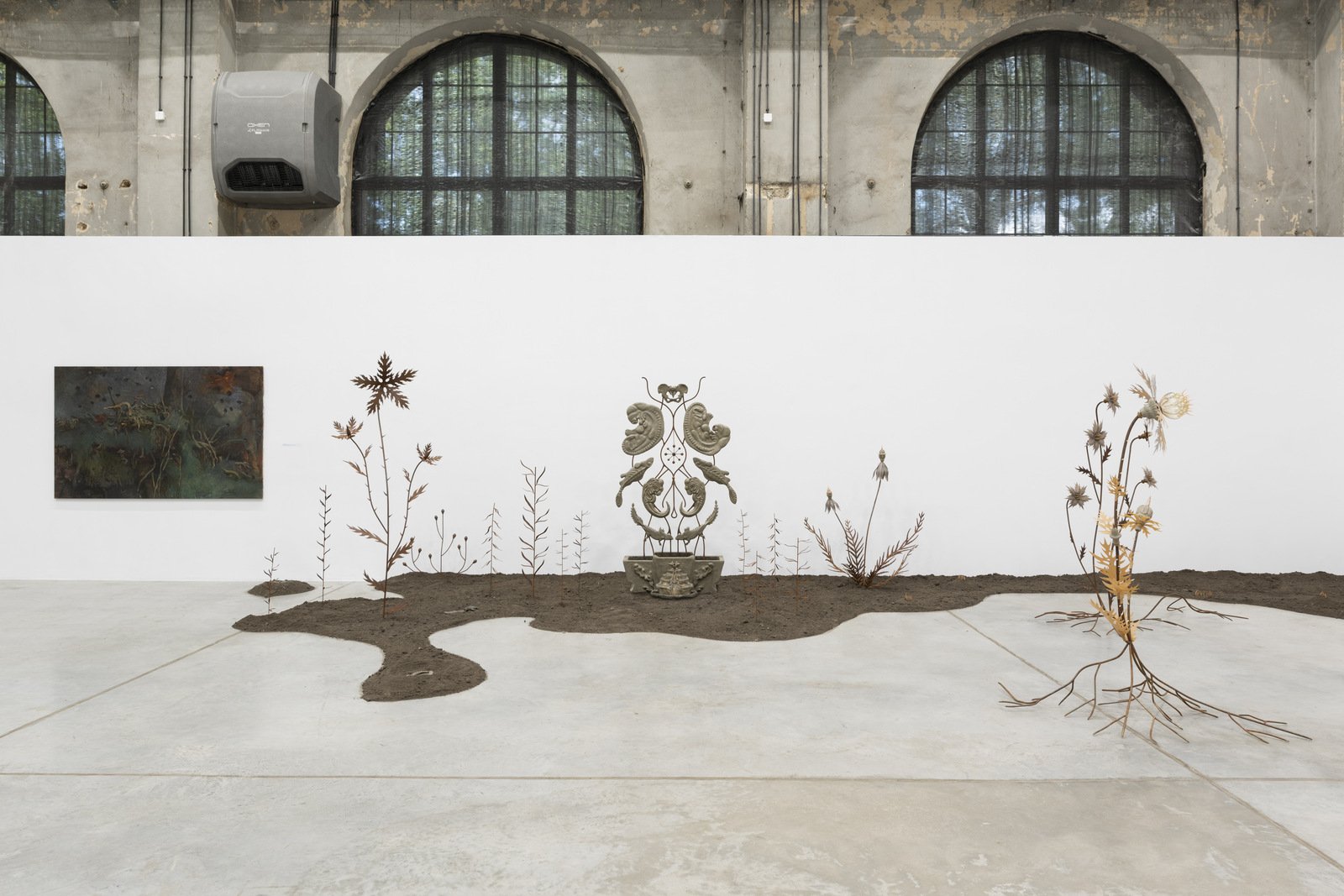
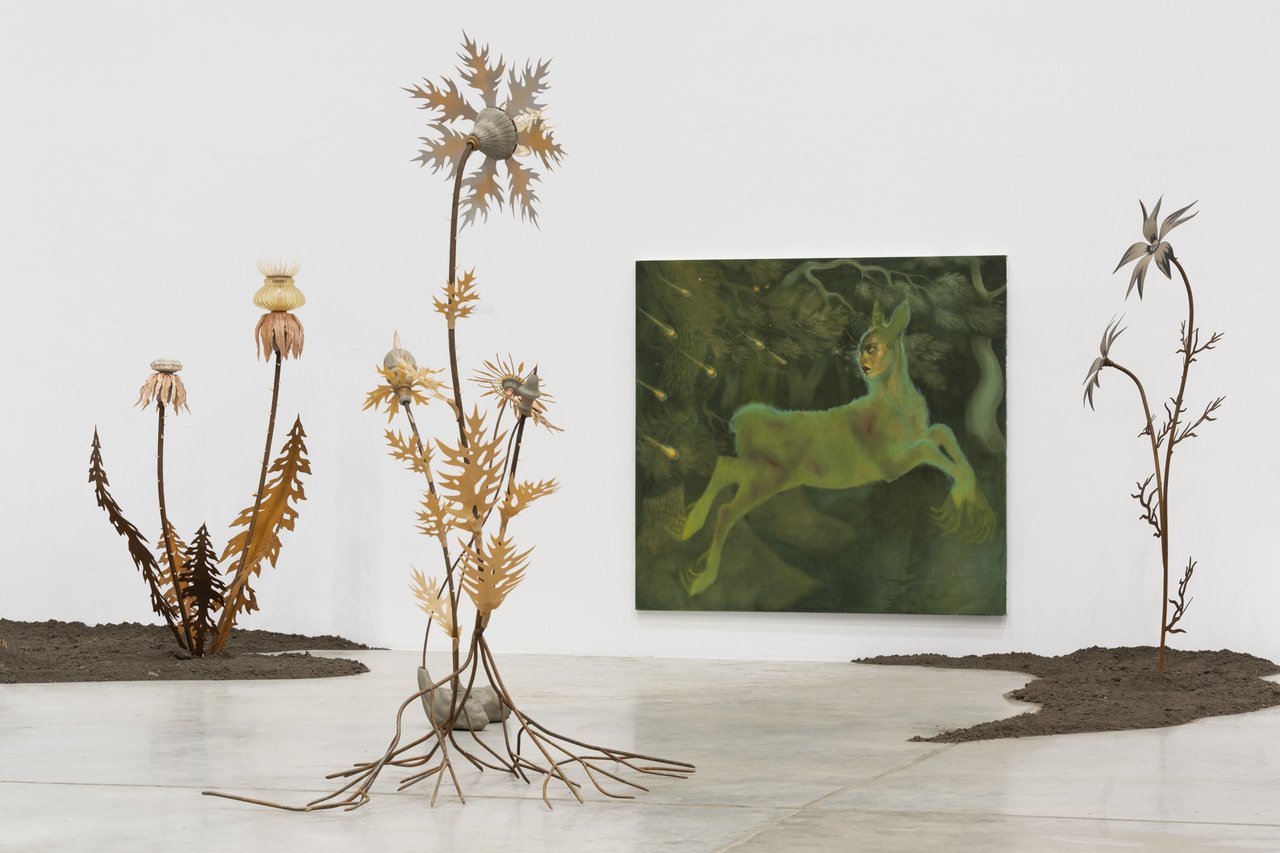
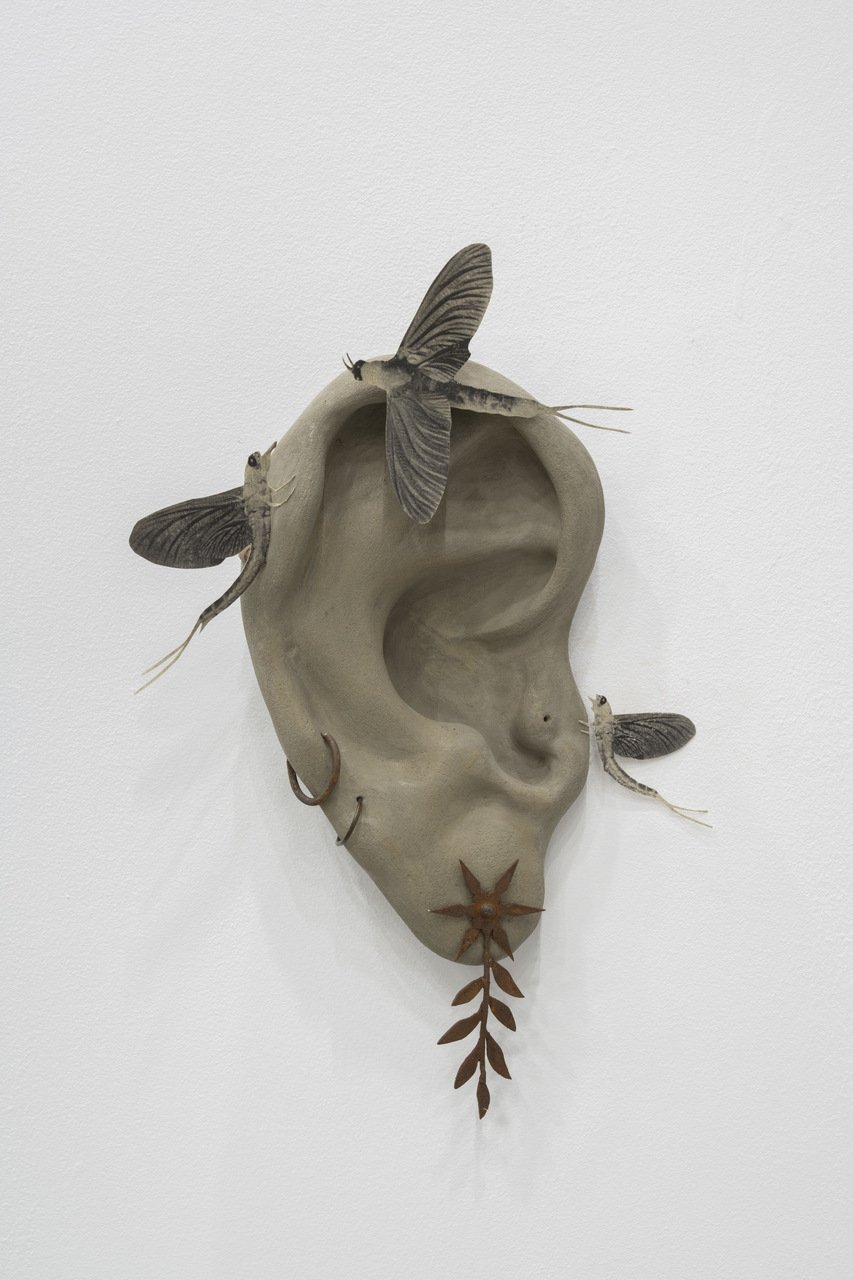
“A key point of reference in our individual practices is the home – the cultural and historical background of the place where we were born,”1 said duo Karina Mendreczky and Katalin Kortmann-Járay, in their manifesto on the site Secondary Archive. They emphasize the difference with those flower-like objects and cocoon-like objects Beauty Was a Savage Garden presented in Cockaigne. But what is home? Is it merely the place where a house once stood, or is it a territory filled with memories and lived experiences?
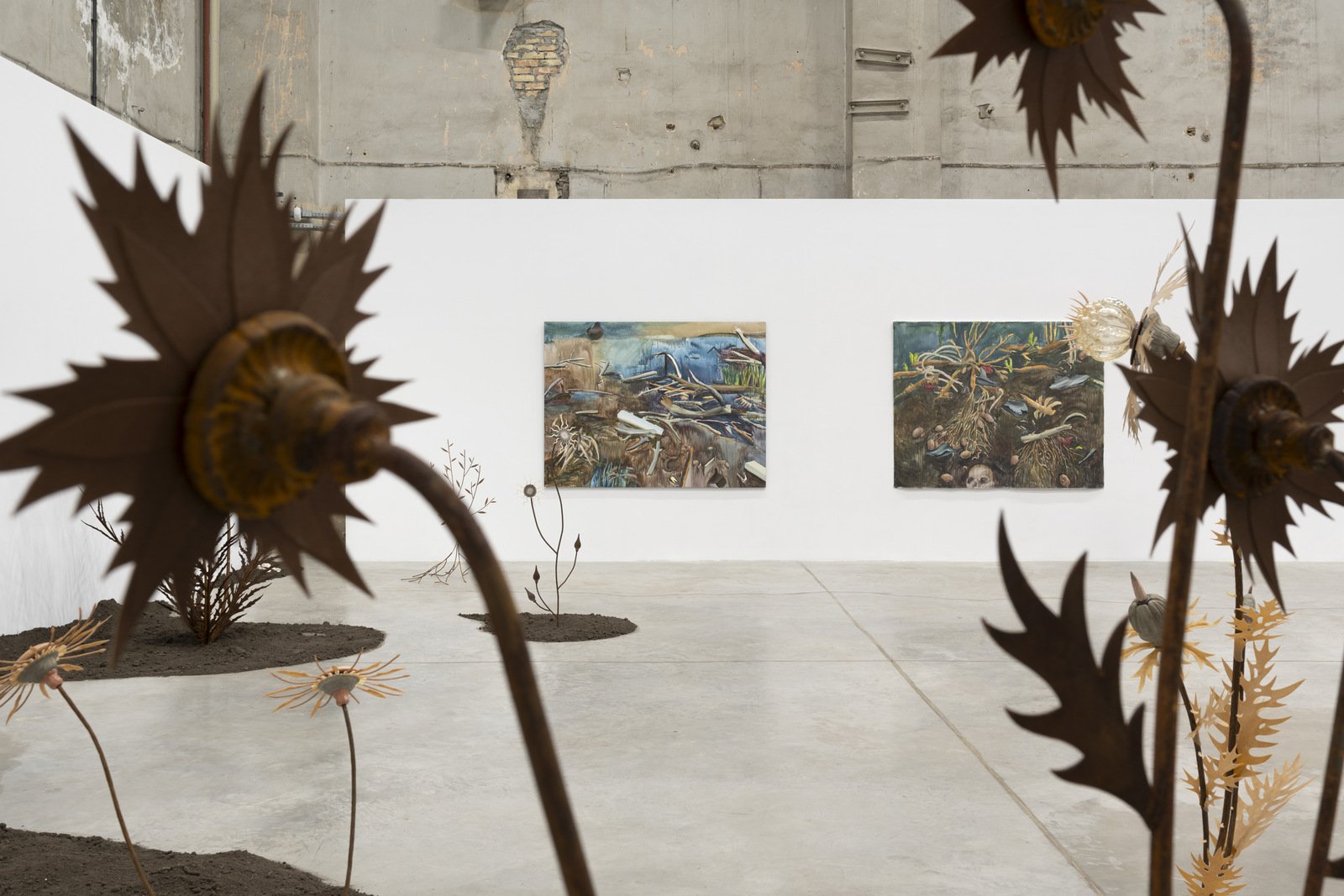
Memory – of what has happened here and of those who once walked these paths. Look here: bones lie beneath the surface (Kateryna Aliinyk, Karina Mendreczky and Katalin Kortmann-Járay); here, the bones are mixed together (Aliinyk again); and there, instead of stems, grow plants resembling human skeletons, traces of spirits, remnants of other beings (Sana Shahmuradova-Tanska, Joanna Rajkowska, and Robert Yerachmiel Sniderman). Memory is what grows from the soil, and what lies hidden within it (Dana Kavelina or Joanna Rajkowska and Robert Yerachmiel Sniderman). It is what lurks in swamps, what glimmers in the morning light, what hides behind branches. It recedes with the water, it is in the rustle of grass and the scent of rosemary.
This memory matters, for it shapes our understanding and awareness of the future – proving that the future, indeed, exists.
II
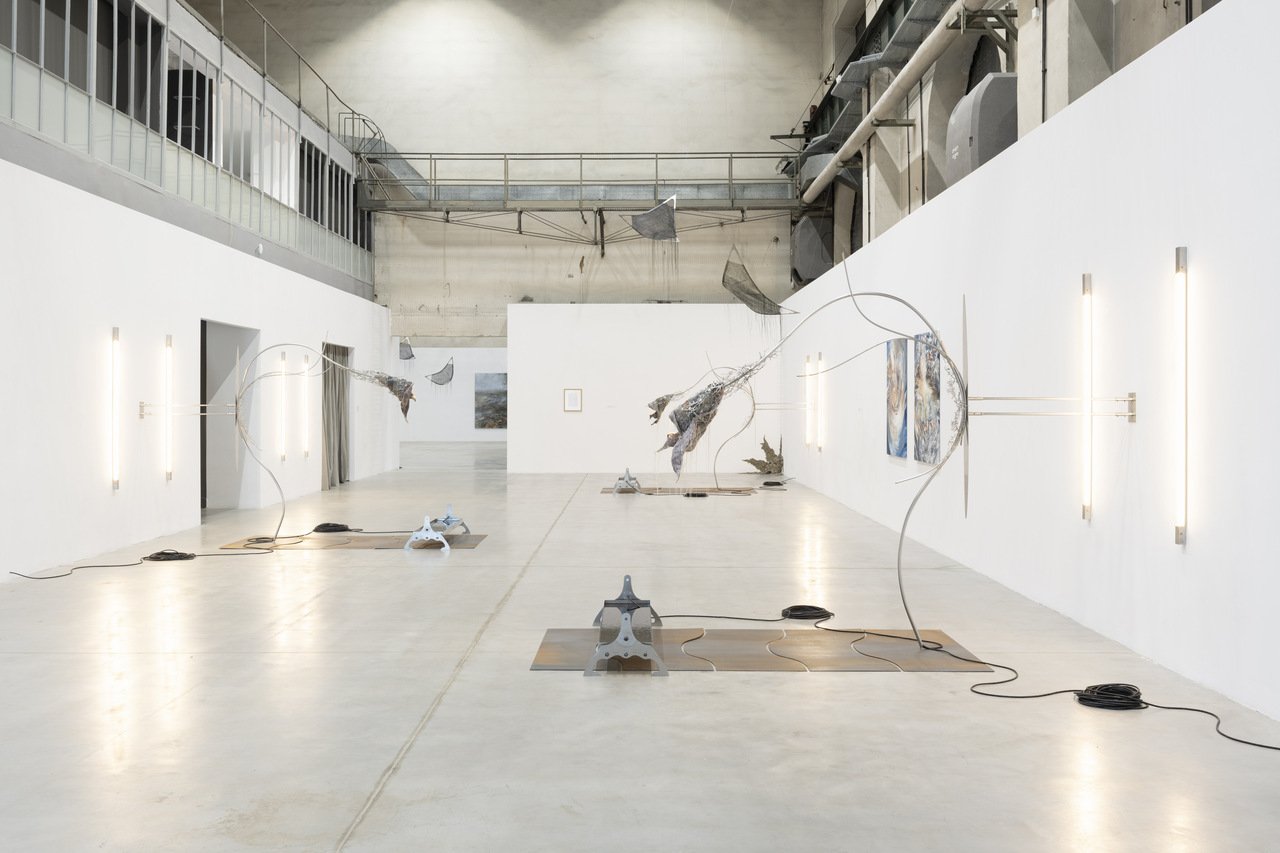
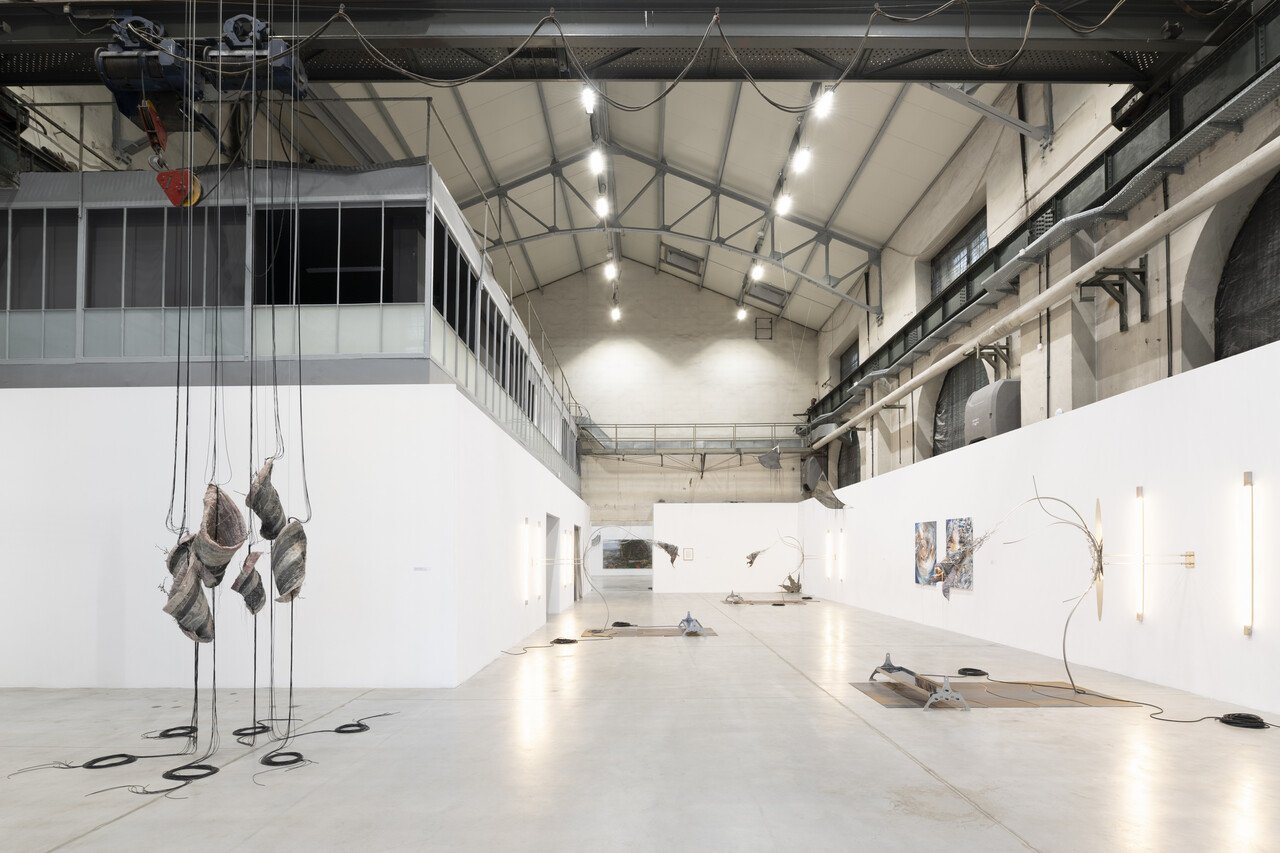
The exhibition Cockaigne turns to the history of swamps – places that once offered refuge to many. Here, at Arsenał elektrownia, this place gains extraordinary symbolic resonance through both the site’s and the city’s own history: Białystok lies at a border, and the Arsenał’s past is rooted in military infrastructure. Part of the power station still operates today, providing light – but when we speak of light in a political and social sense, what becomes its true guide?
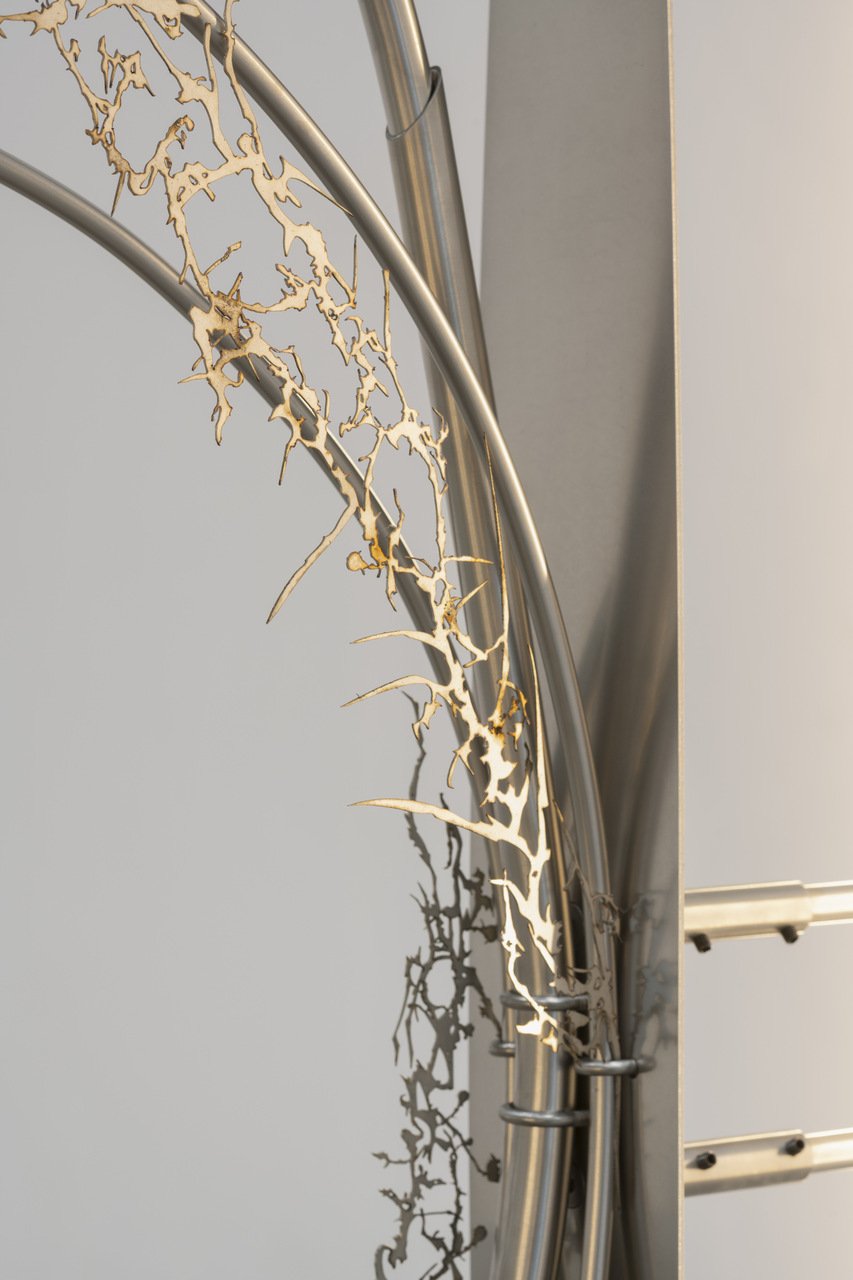
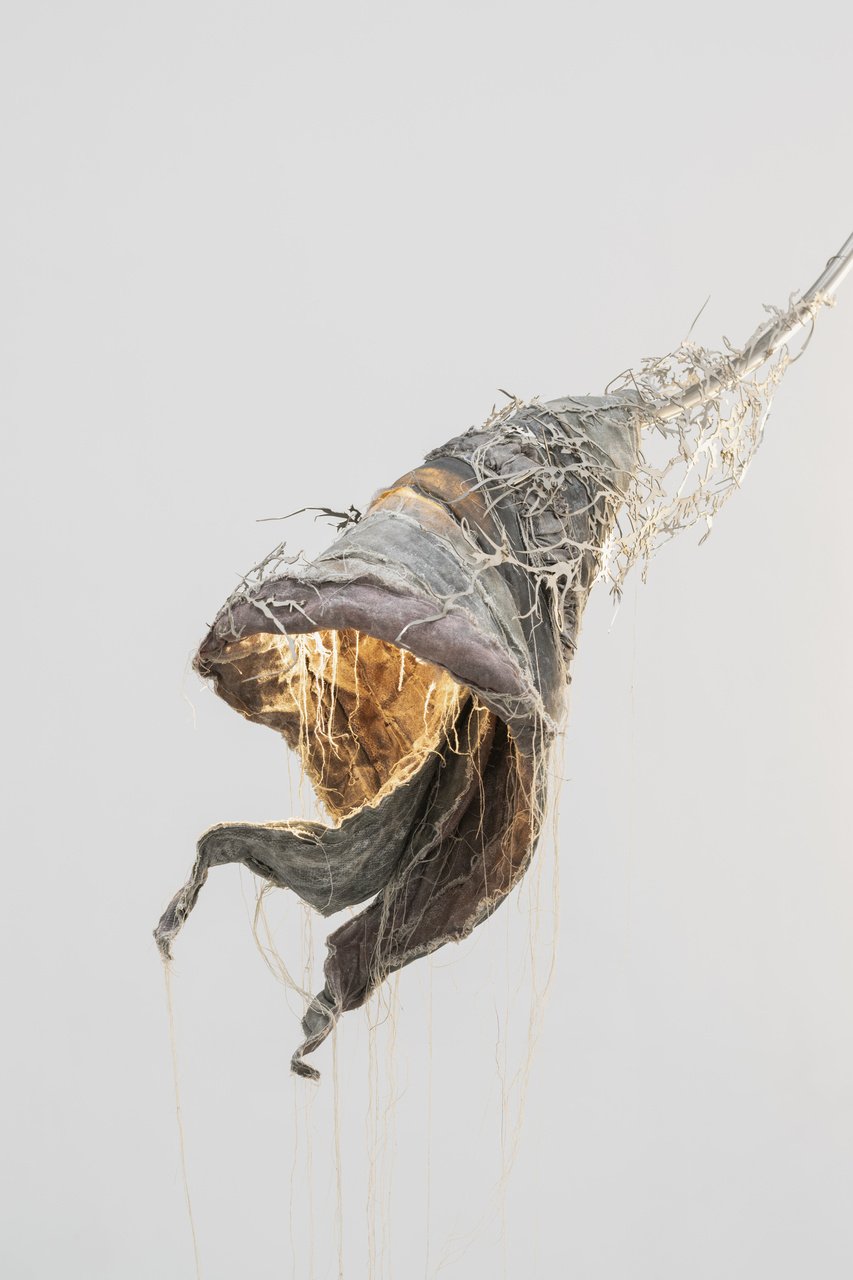
The dramaturgy of Cockaigne unfolds around works that reach toward the mythological. One such point of orientation is the installation by Inside Job (Ula Lucińska and Michał Knychaus), which features the image of a firefly. Giant metal flowers and water fill the space, allowing the viewer to imagine themselves in a utopian forest. Yet this forest is far from idyllic. As Katalin Kortmann-Járay and Karina Mendreczky note: “The ecological crisis and the resulting sense of hopelessness and unfulfillment are driving the growing interest in spiritual approaches and worldviews.”2 Their recurring motifs – flowers and plants – are treated as sentient beings. Created from a mixture of natural and synthetic materials, they emphasize the ambivalent nature of the environment, shaped and constrained by human interference. And these flowers, which can illuminate a path and offer hope, can just as easily take life. This is not mere metaphor: as I gaze at the installation, I notice a butterfly, lifeless in the water. It has now become part of the work.
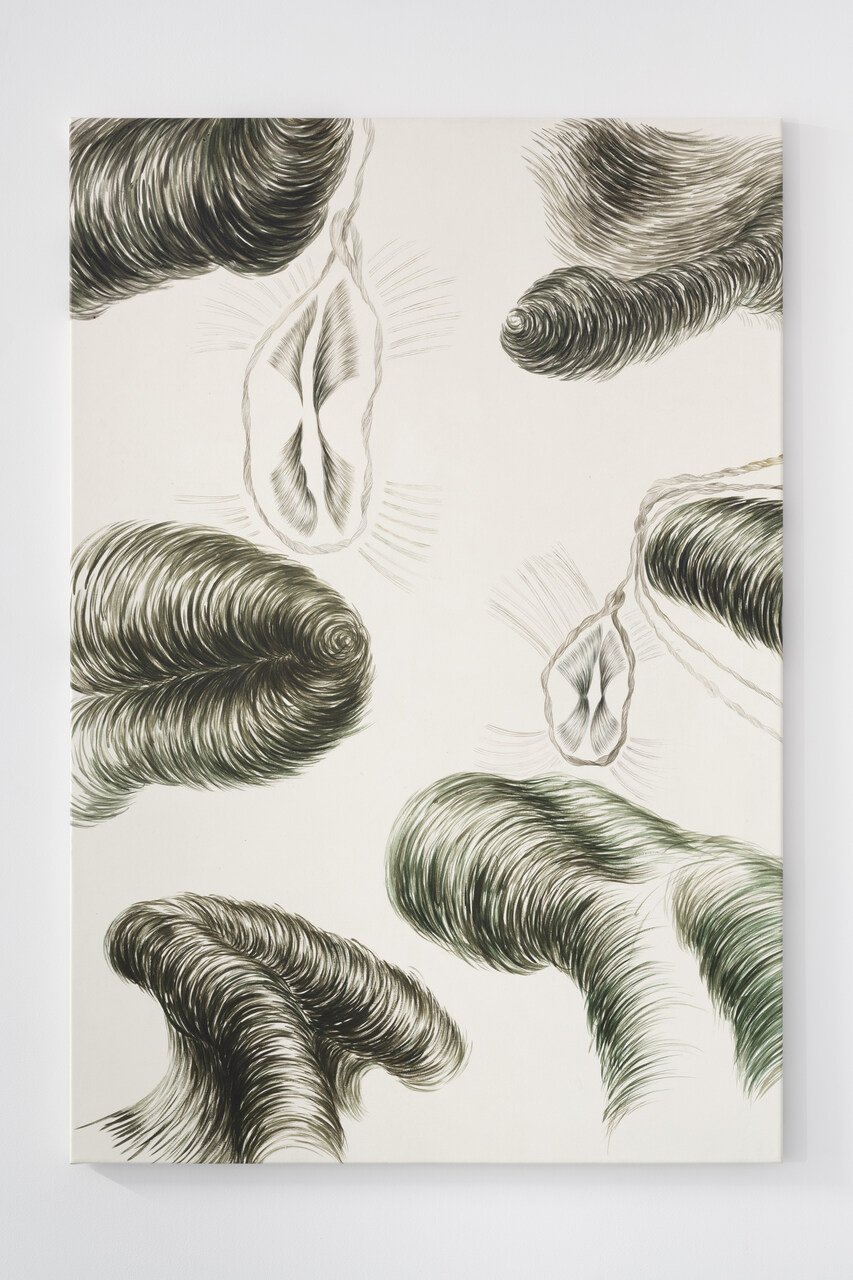
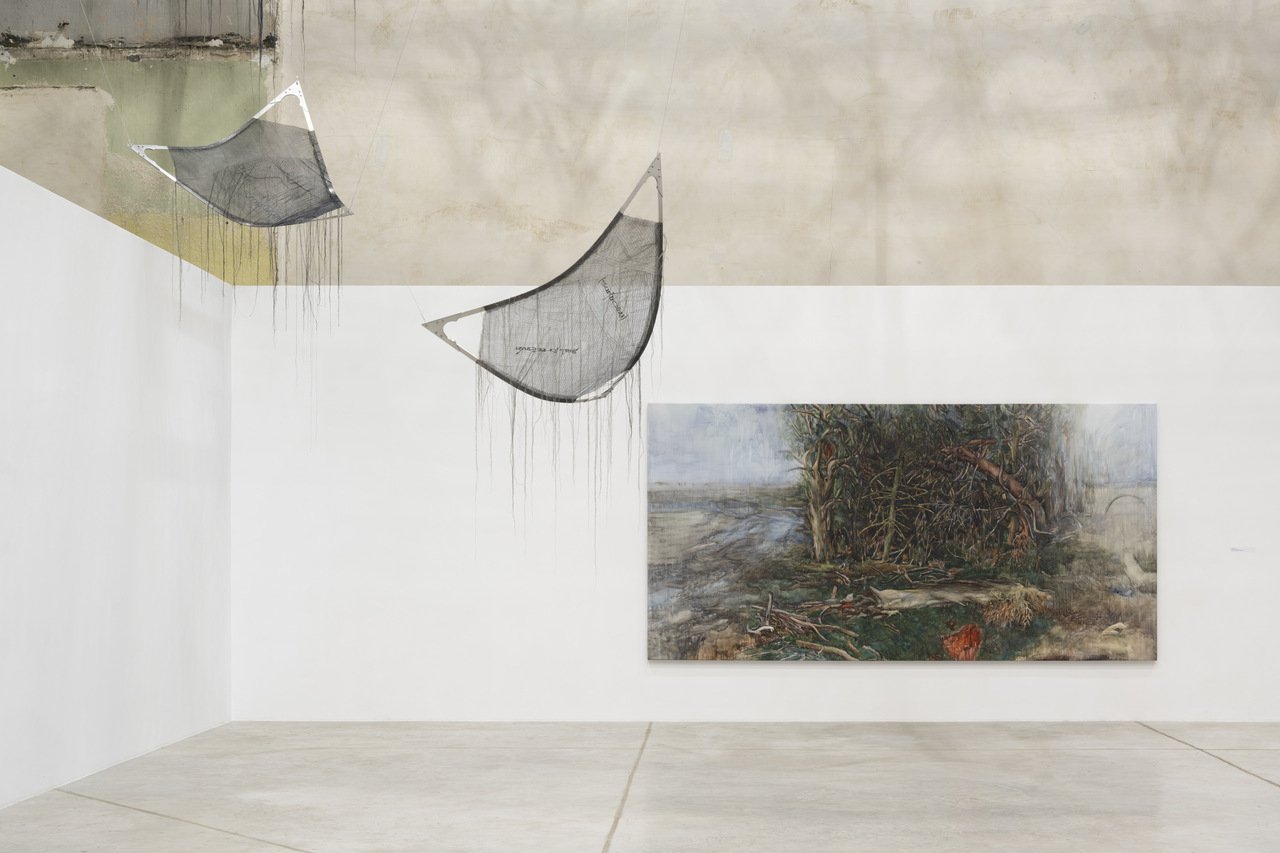
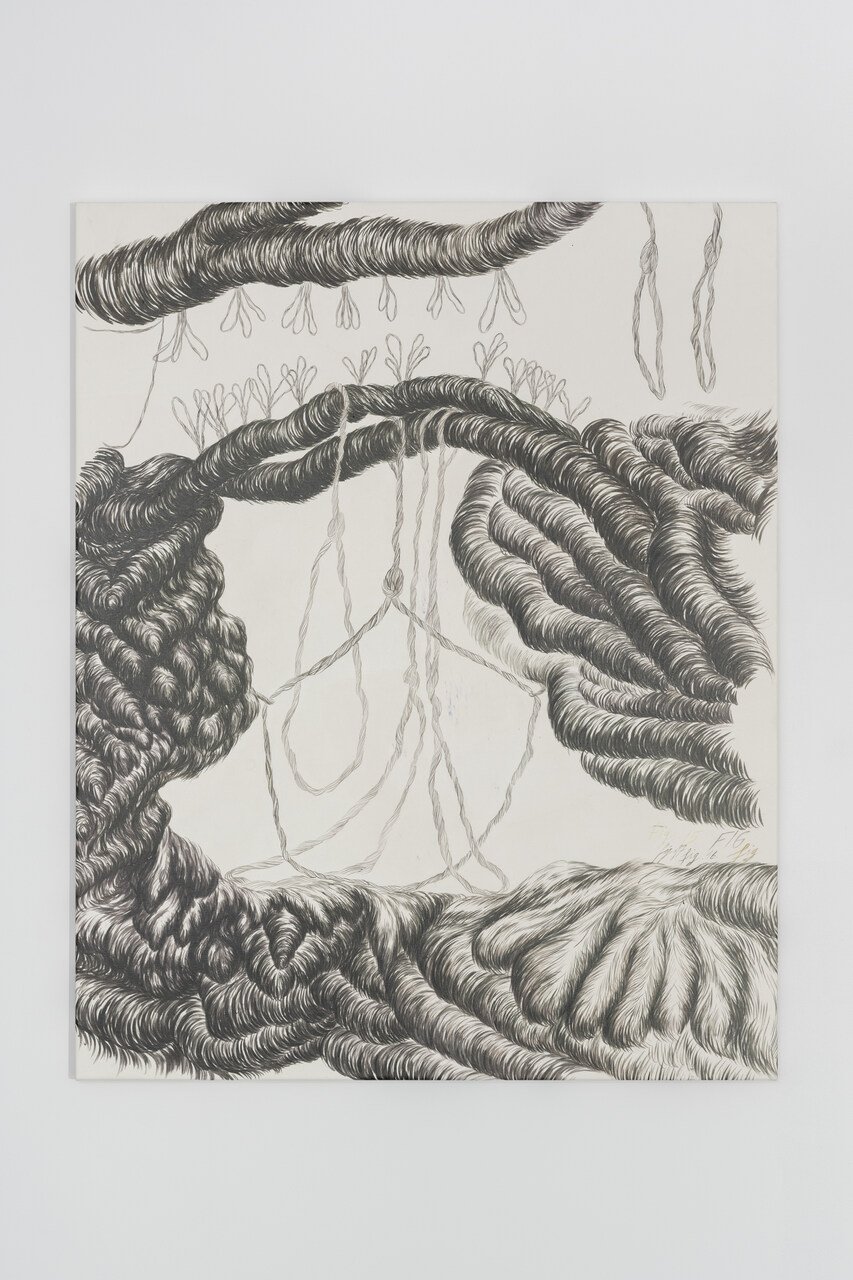
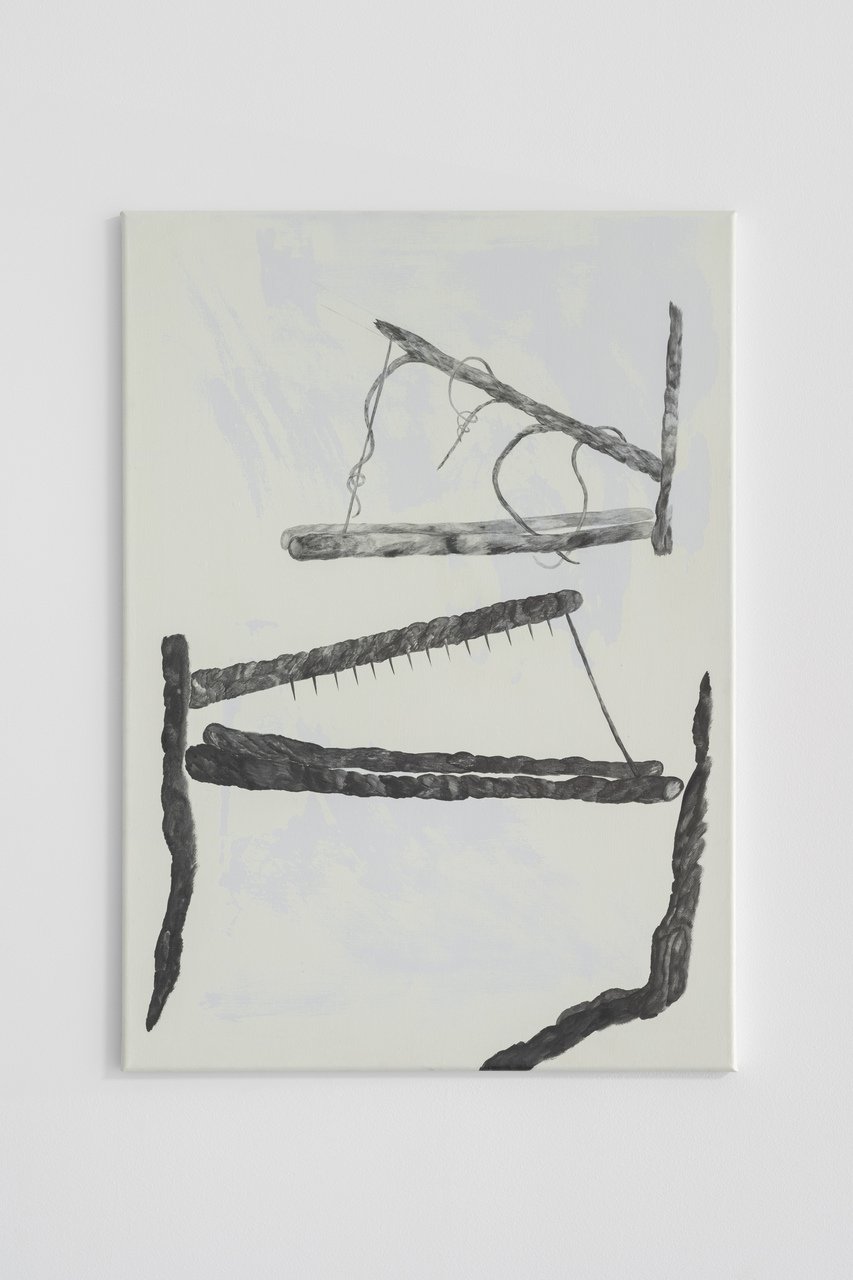
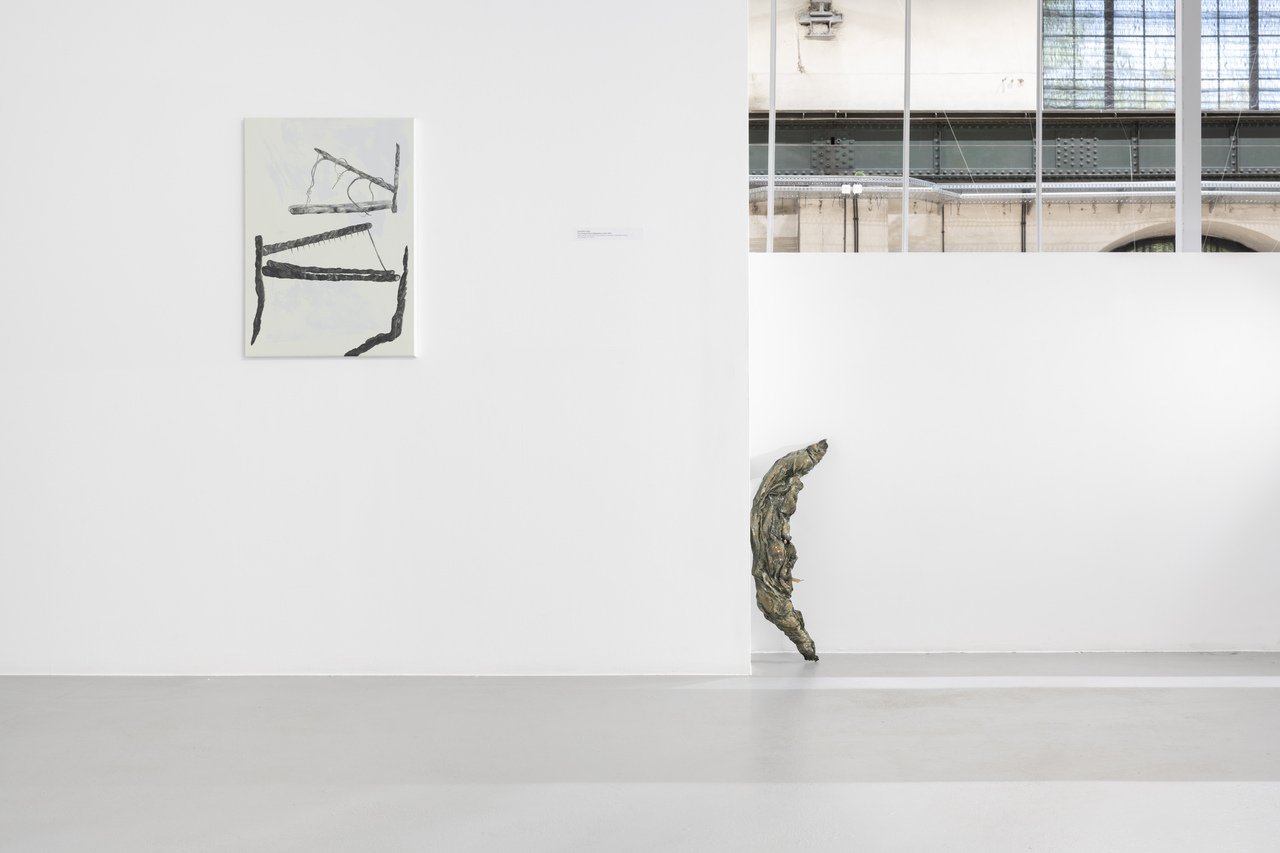
This piece rhymes with the paintings by Dominika Trapp, where vegetation literally becomes a mechanism of entrapment. Referring to animal traps traditionally made in Hungarian communities, Dominika Trapp addresses the idea of imposing limits as a form of shaping the landscape and human intervention in the environment. The ropes, nets, and threads depicted in the work resemble branches and vines, yet in fact become sites of capture.
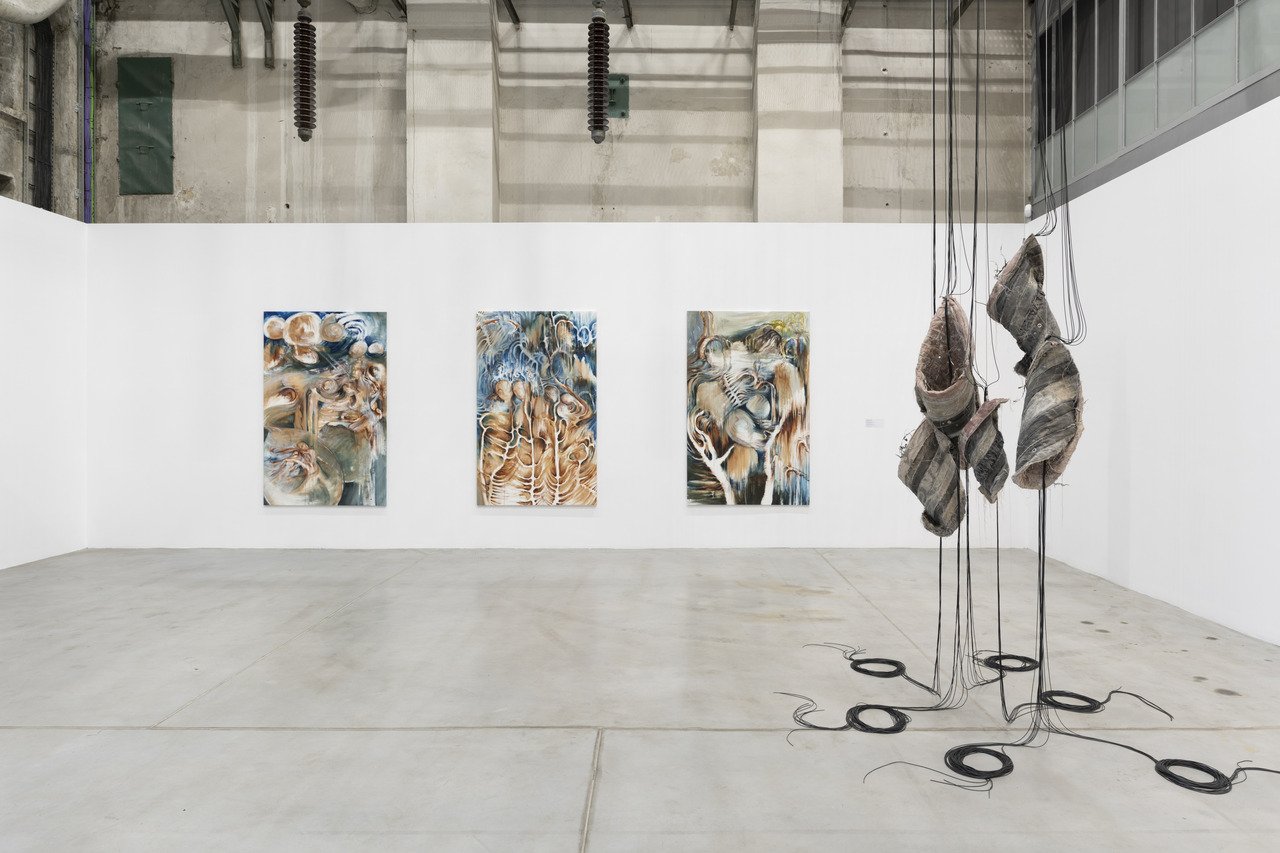
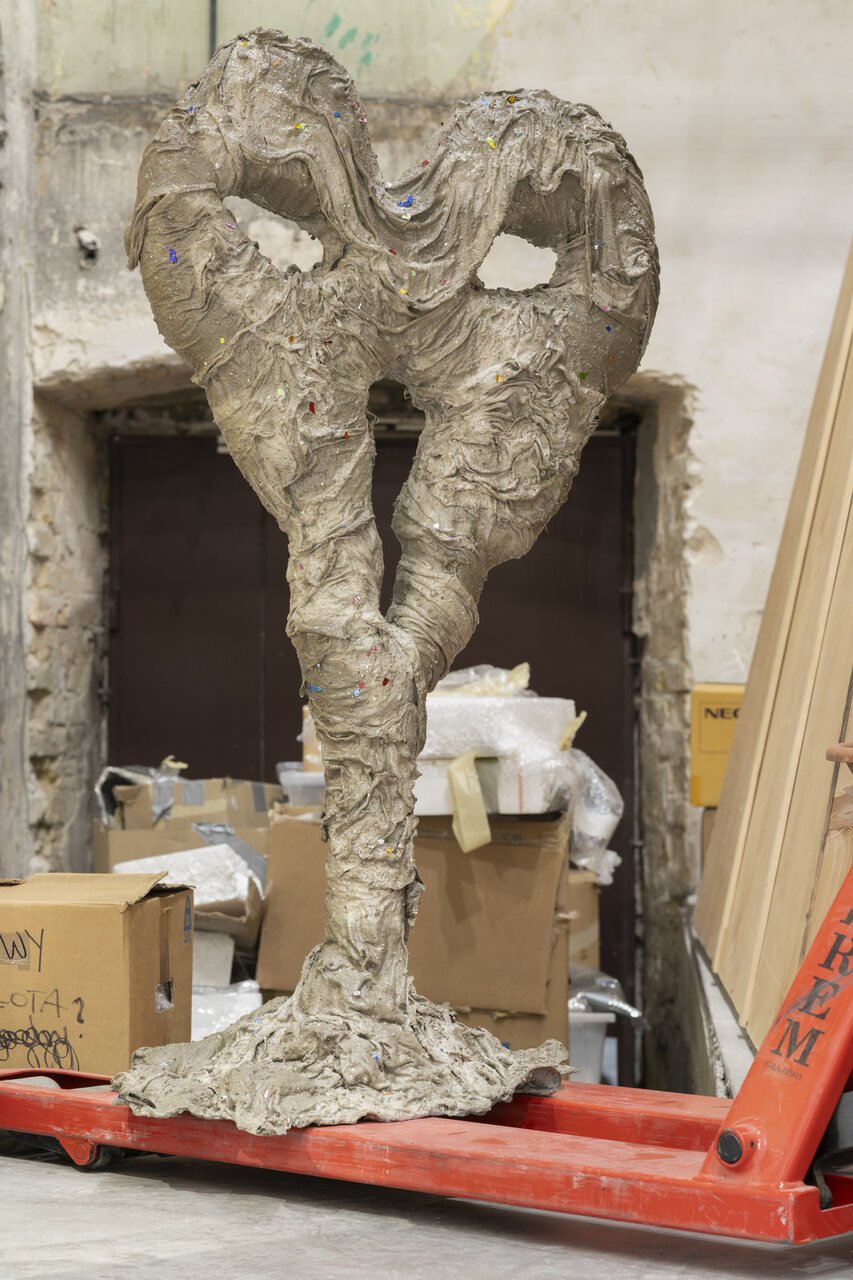
There is another rhyme in this exhibition – another trap: the work of Inside Job (Ula Lucińska and Michał Knychaus) resonates with Dominika Olszowy’s sculpture, made of concrete, muslin diapers, and sand, resembling a fountain. In her works, Olszowy turns to the subconscious as well as to proto-Slavic narratives, weaving in motifs of dreams, tragic stories, and an oppressively real present that one might wish belonged to the past, yet constantly insisting on its actuality. Before the audience stands a wellspring that is no longer alive; it is devoid of water.
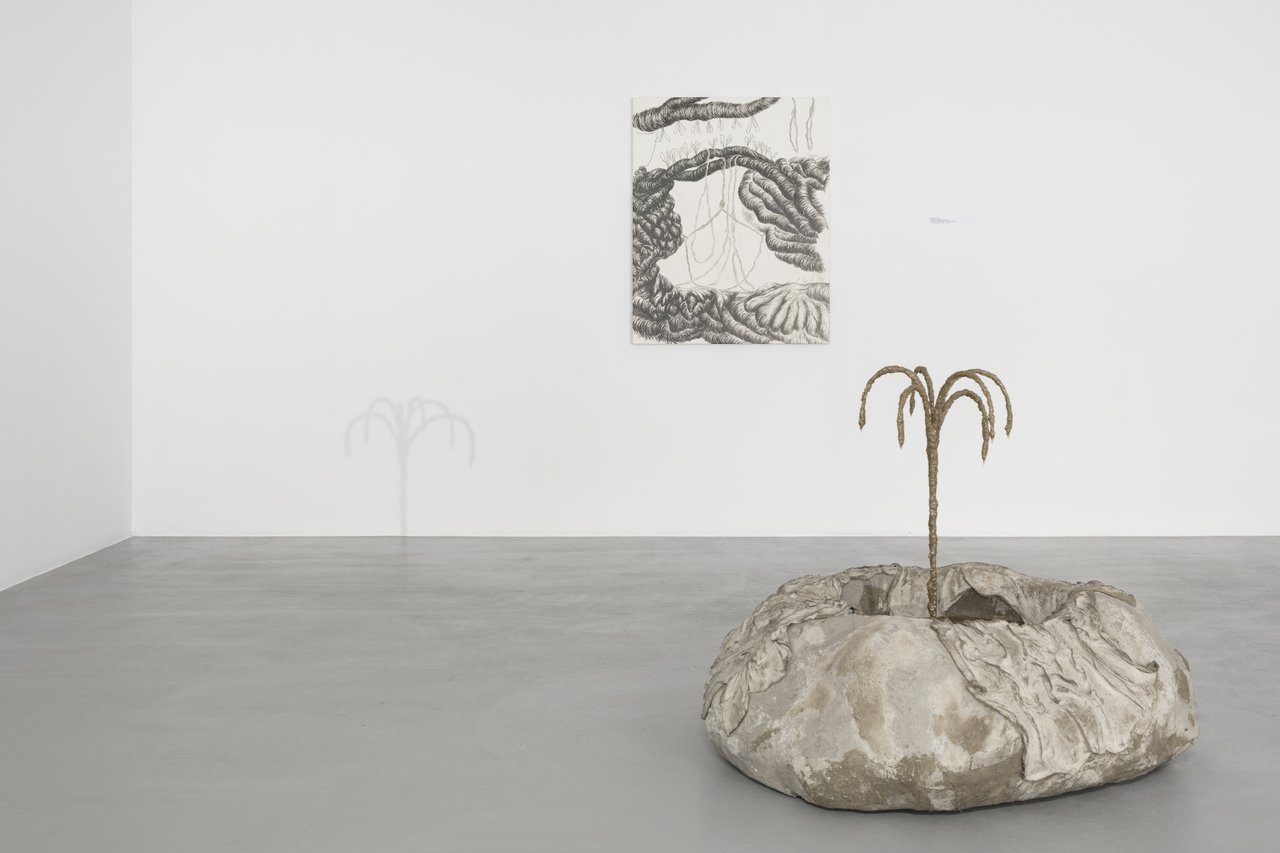
As the exhibition’s curator Katarzyna Różniak-Szabelska notes, death is a recurring motif in the artist’s work. Here, I find myself wondering what happens after death. Art can make such presences perceptible, allowing us to think beyond the limits of the real. Yet the image of the dried-out fountain seems to suggest something else entirely. What can offer a dried-up fountain, what kind of hope, and future, and life. Perhaps, one day, water will flow here again.
“I remember how, after the destruction of the Kakhovka Hydroelectric Power Station, little islands with freshwater creatures drifted down to the sea near Odesa – sometimes a frog, sometimes an entire patch of reeds, sometimes a deer. These islands… they carried something in them – something I hadn’t thought about or felt before, at least not in a way I could recall. They seemed to say: there will always be something, somehow things will go on, always, always, endlessly, movement. Or like a line from a folk song: Don’t laugh, people – things will turn out somehow. In that, I saw both fear and willpower. Those islands. And I remember the roots of the reeds I kept seeing along the shore – so similar to cattails, so lush and juicy. Recently, my friend Yaroslav Futymskyi shared a book describing the Holodomor in his native region and told me how people said they survived by eating reed roots. That absurd combination of river and sea flora and fauna – there was in that horror something like catharsis. Since childhood, I could never choose between the sea and the river. Both forms of water shaped me, and neither ever let me go,” — artist Sana Shahmuradova-Tanska shared this reflection in regards to her painting in the exhibition.
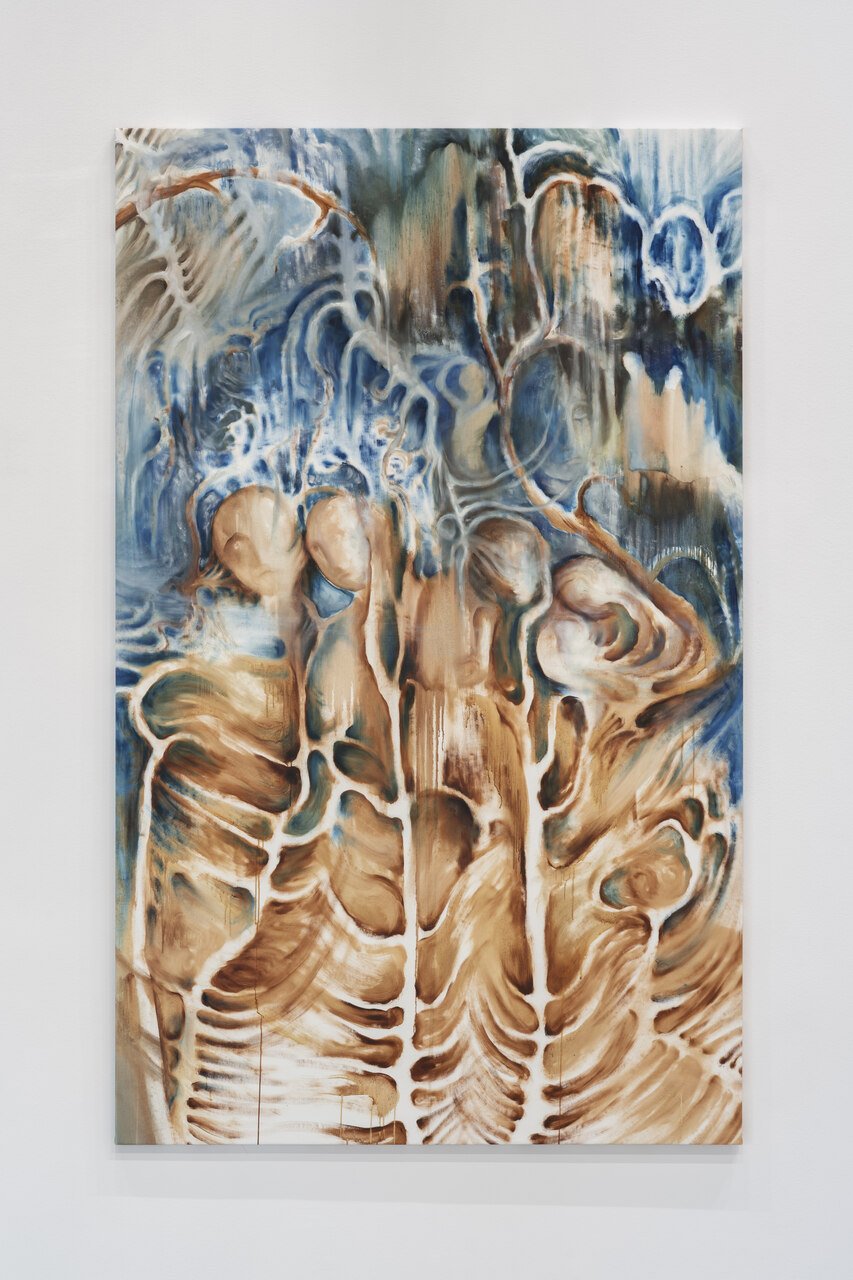
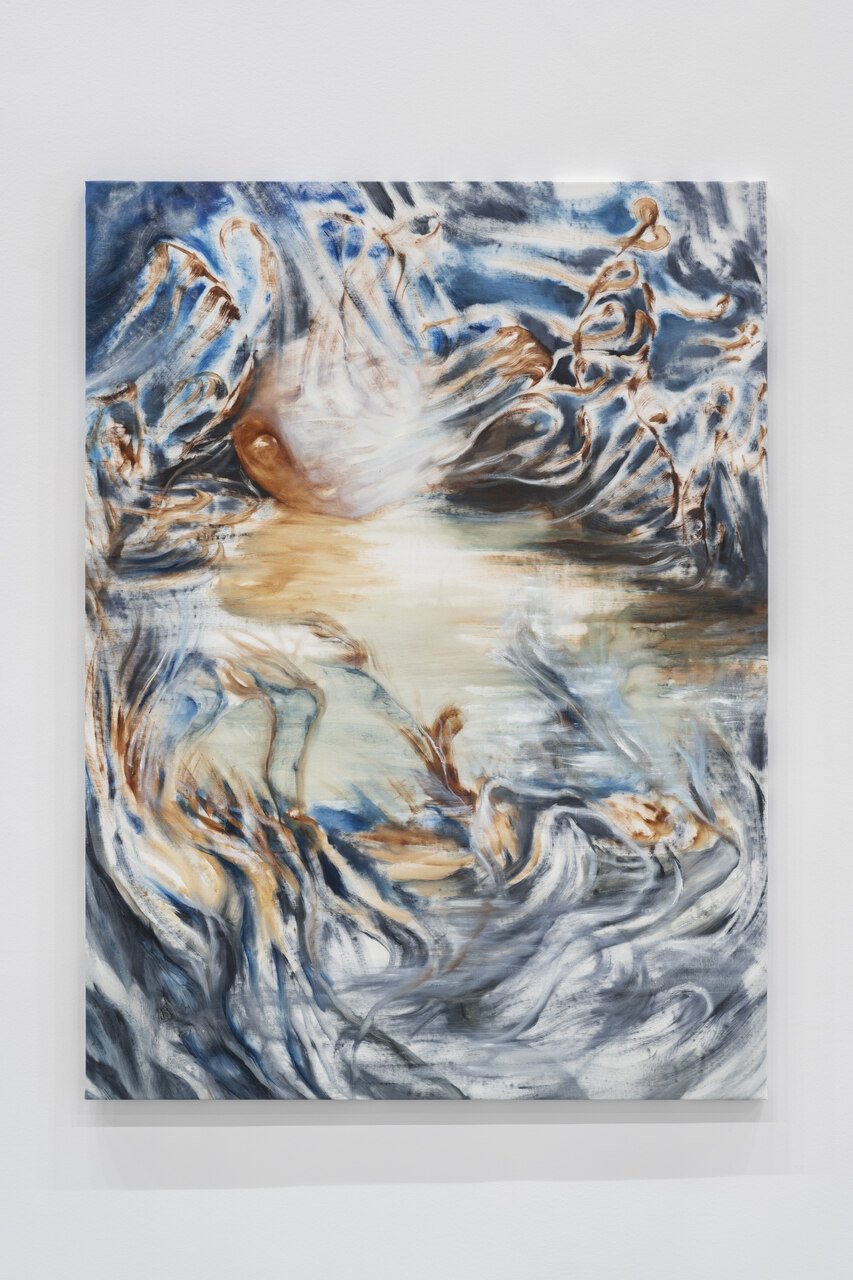
Cockaigne raises questions about ecology and the violence inflicted upon the environment: what future awaits our planet? This conversation about environmental harm and the future unfolds alongside reflections on our own past – on the ideas, attitudes, and relationships with resources such as forests, rivers, and lands that shape our thinking. All of this has been passed down from one community to another across generations, sometimes fading and transforming into myth along the way. Yet for me, it is above all a political exhibition – what future are we preparing for the planet? This “we” reveals the deep entanglements between environment and war, ecology and displacement, and ecology and poverty. But where can one flee when all lands have been scarred by wars raging across the world? Where can one flee when no matter which way the wind blows, it carries the heat of bones and the ashes of suffering?
Wars, even when formally contained by foreign borders, make themselves known through the taste of water, the texture of the soil. The issue is not only that resources diminish because of wars, but that what remains bears the imprint of others’ pain – not even those we know, but those of the near generations, our own kin and distant relatives who haven’t even been born yet; people we know from stories, whose gazes and postures we can still recognize in others.
Where is this utopia? Where is that place that escapes tyranny? In New York, perhaps, where the protagonists of Joanna Rajkowska and Robert Yerachmiel Sniderman’s work once arrived? Yet there, too, they found no peace.
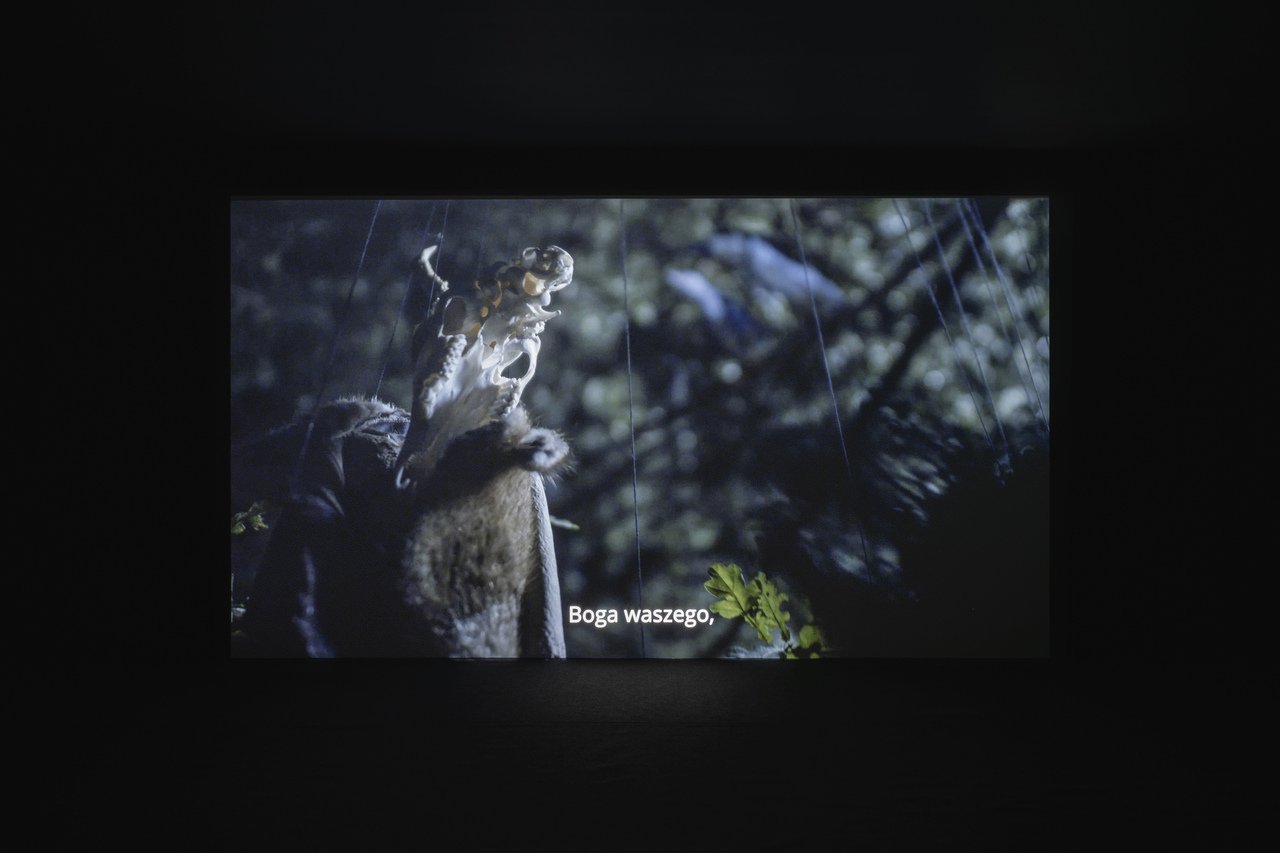
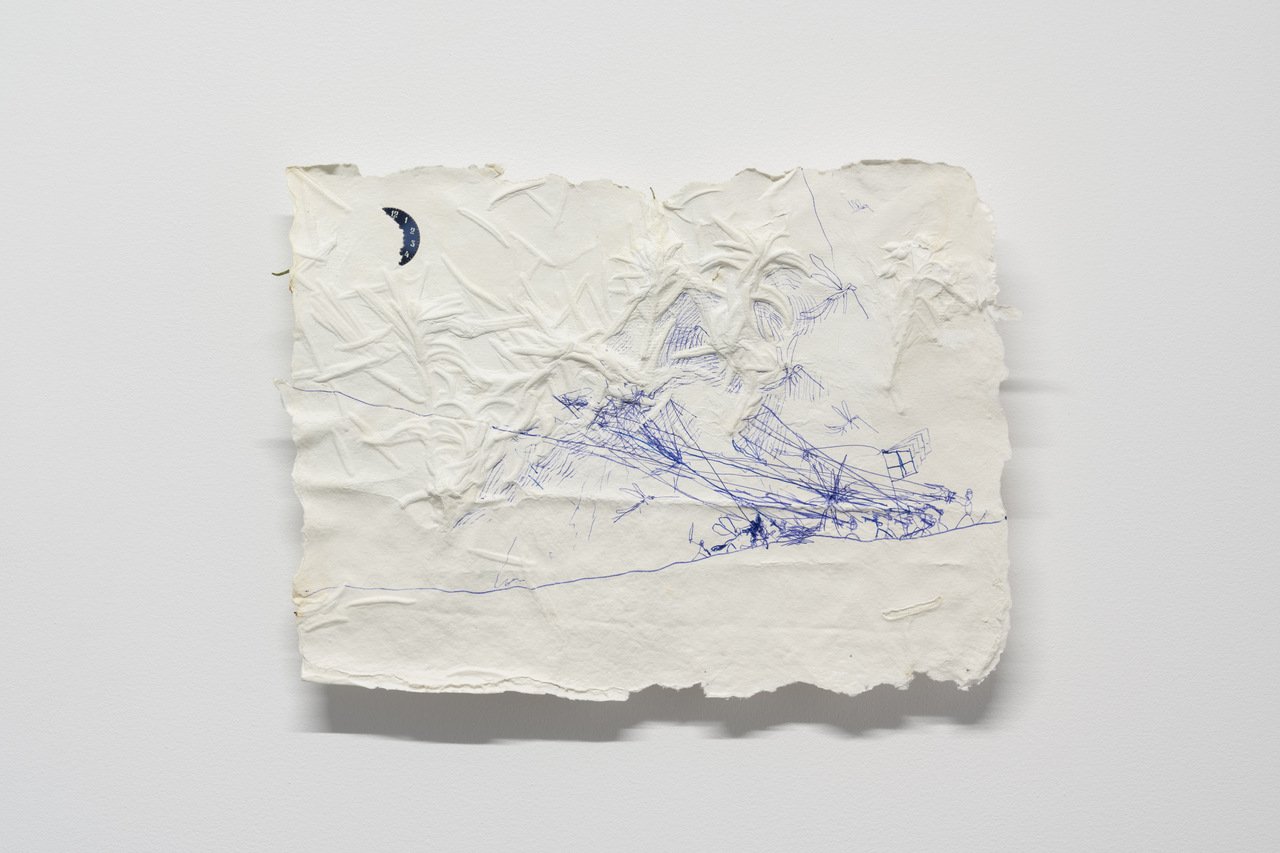
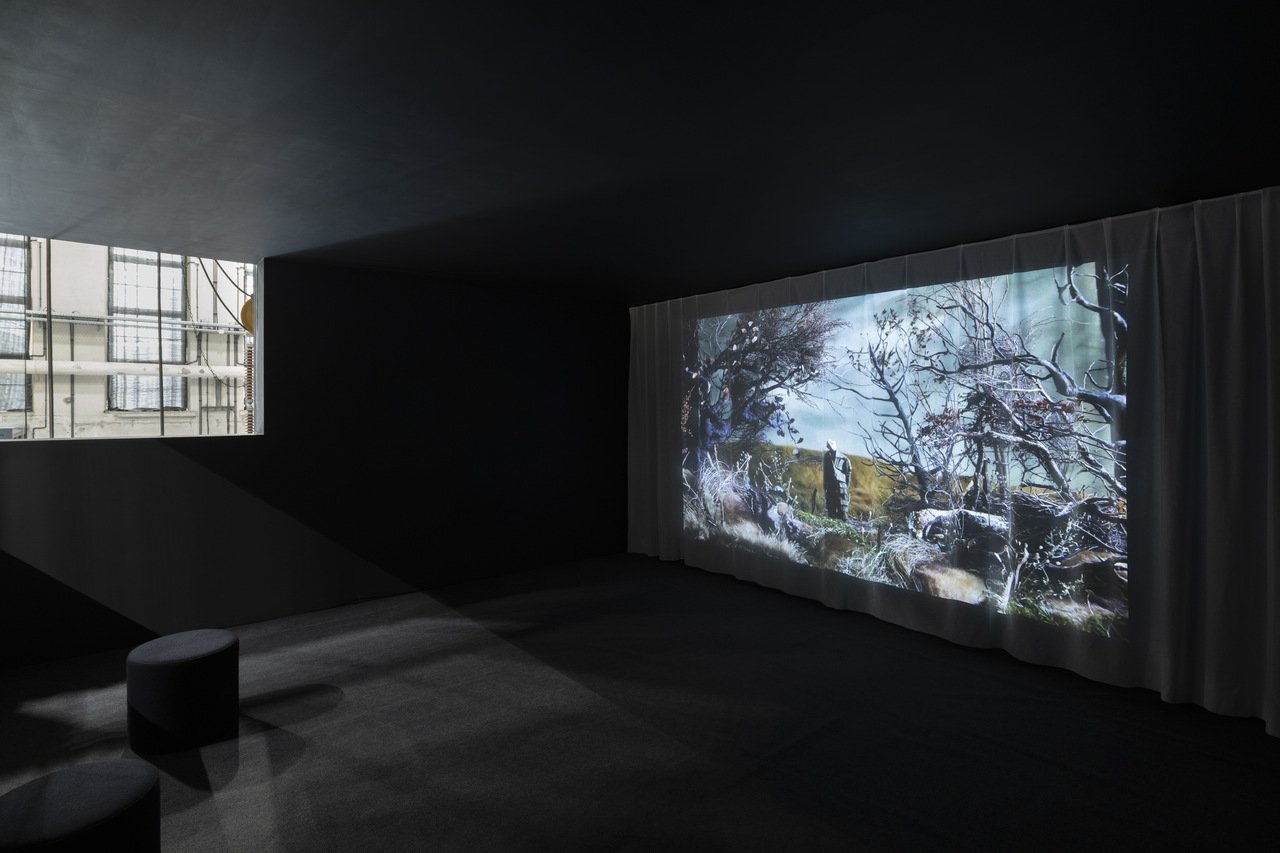
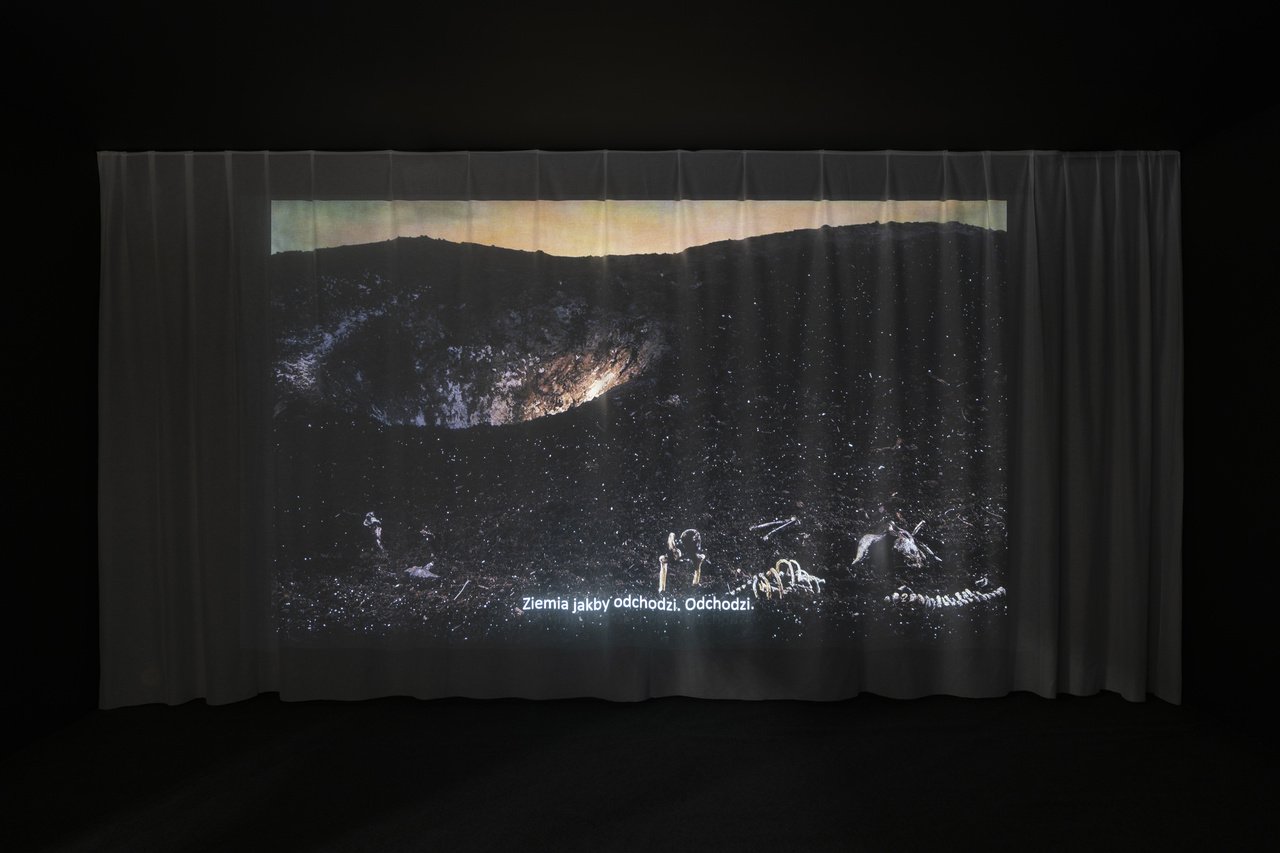
Is there any place like this?
Wars can disguise themselves, like animals burrowing into the earth, violence can mimic the rustle of grass. Utopia, too, can masquerade as something it is not – only to reveal itself as a mirage. What I love about Cockaigne is that it opens a space for such reflections. The works communicate with each other – both across the exhibition halls and across distances in time and meaning. They compel the viewer to alter their path, to move back and forth between pieces, to look again, and to look deeper – to gaze upon the same landscape that, each time, tells a new story.
III
Why does Noor Hasan’s drawing capture my attention? As I look at the moon, delicately drawn in her work, I recall the one-act opera Der Mond (The Moon) based on a Grimm’s fairy tale with a libretto and composed by Carl Orff in 1938. It, too, centers on ritual, myth, and symbolism – where the moon stands for wealth and gold. Four young men attempt to steal it, hoping to make themselves rich and powerful – to subjugate the entire order of the world to their will. But how can one truly possess the moon? And what would the world’s order become then?
This ironic and seemingly light tale carries a far darker undertone: the opera was created during the rise of the Nazis in Germany and, in fact, spoke of the loss of light itself. So today, when I look at the moon – both the real one, standing on the border between Poland and Ukraine, and the one depicted by Noor Hasan, which I recall from memory – I hope only for one thing: that this moon can be preserved.
This text was originally written for a publication documenting the exhibition “Cockaigne” at the Arsenal Gallery “elektrownia” in Białystok and has been adapted for publication in MOST magazine.
1 https://secondaryarchive.org/artists/katalin-kortmann-jaray-and-karina-mendreczky/
2 https://secondaryarchive.org/artists/katalin-kortmann-jaray-and-karina-mendreczky/
Artists: Kateryna Aliinyk, Noor Hasan, Inside Job (Ula Lucińska and Michał Knychaus), Krzysztof Gil, Dana Kavelina, Dominika Olszowy, Karina Mendreczky and Katalin Kortmann Járay, Łukasz Radziszewski, Joanna Rajkowska and Robert Yerachmiel Sniderman, Sana Shahmuradova Tanska, Dominika Trapp
Exhibition Title: Cockaigne
Curated by: Katarzyna Różniak-Szabelska
Venue: Arsenal Gallery “elektrownia”
Place (Country/Location): Białystok, Poland
Dates: 05.09.2025 – 09.11.2025