Sára Vera Bodor
“We are looking for an enthusiastic intern!” It is a familiar phrase, but what exactly do we mean by “intern” in the world of contemporary art? The intern is the “dark matter”[1] holding the institutional art system together. The intern is a seasoned stranger.[2] The intern is an insect crushed between the teeth.[3] The intern is a Labrador, happily smiling as it waits for its owner’s command.[4] The intern is the master’s apprentice in the guild,[5] the intern is Don Quixote,[6] the intern enters and yet remains outside,[7] the intern cleans,[8] the intern performs invisible work — and is invisible themselves. These contradictory attempts at definition point not only to the complexity of the intern’s position, but also to the striking absence of any sustained discourse around internships.
The exhibition Lelkes gyakornokot keresünk! A gyakornoki rendszer láthatatlan struktúrái a kortárs művészetben (We Are Looking for an Enthusiastic Intern! The Invisible Structures of the Internship System in Contemporary Art), held at aqb Project Space, addresses precisely this absence.[9] Curators and critics are often quick to praise socially engaged exhibitions for their “discourse-generating” potential, but in this case, the term is genuinely warranted. This, however, is not simply a result of the curatorial approach, it is also a product of the broader social circumstances. An exhibition may initiate a dialogue within a limited circle, but if the questions it raises are repeatedly swept aside at the social and political level, that circle cannot expand. Meaningful, broad-based discussion — and the possibility of change — never gets off the ground. Now, however, alongside the political restructuring taking place in Hungary, an opportunity has emerged to make the invisible structures of the internship system visible and perhaps to begin reshaping them.[10]
The project is not simply an exhibition; it rests on three pillars: the exhibition, research, and a publication illustrated by Márton Dés. The latter two function as extensions of the exhibition, making it possible to explore a wide range of perspectives and theoretical questions related to internships without reducing the exhibited works to mere illustrations of these theories. Of the many subtopics developed through the project, this review focuses on the relationships between the different actors within the internship system — relationships through which the figure of the intern gradually comes into view.
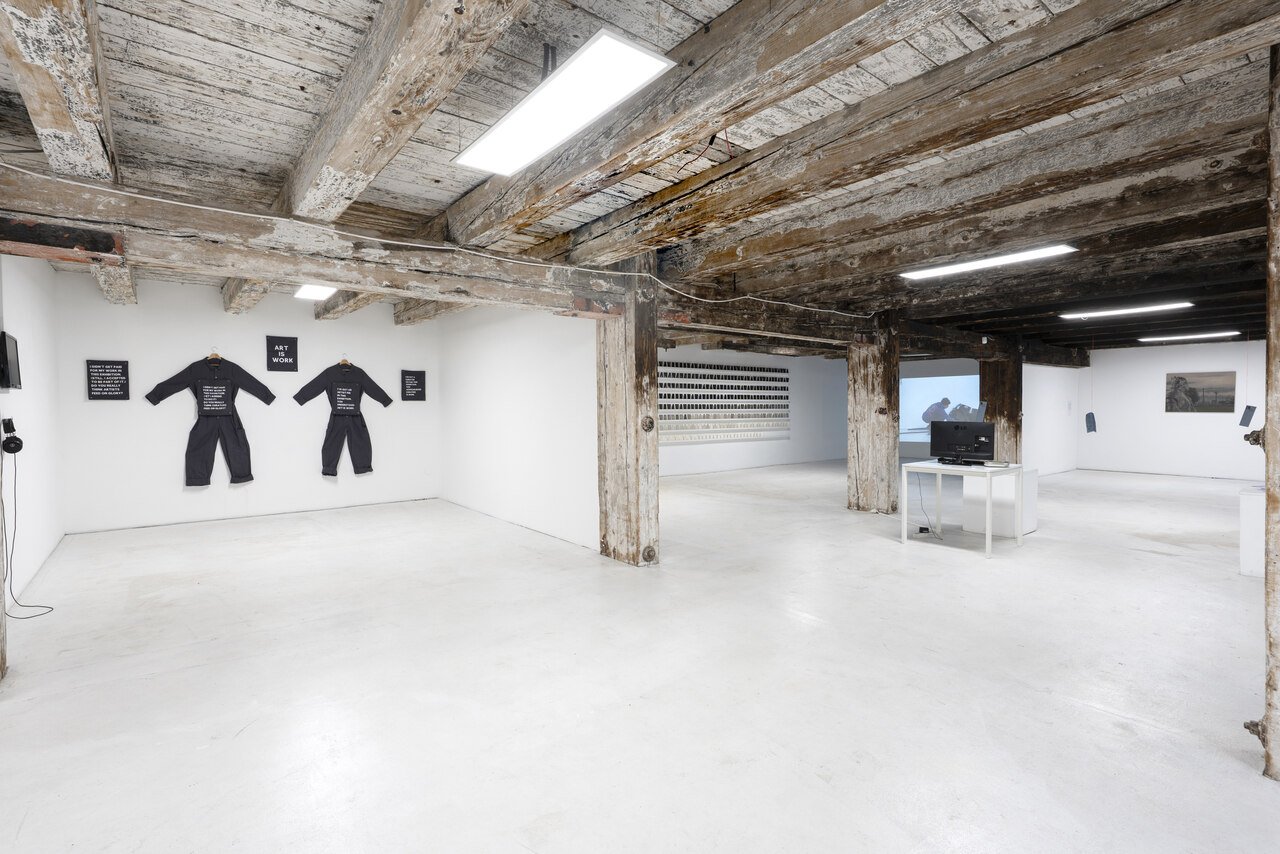
Image courtesy of Míra Mónika Magyar.
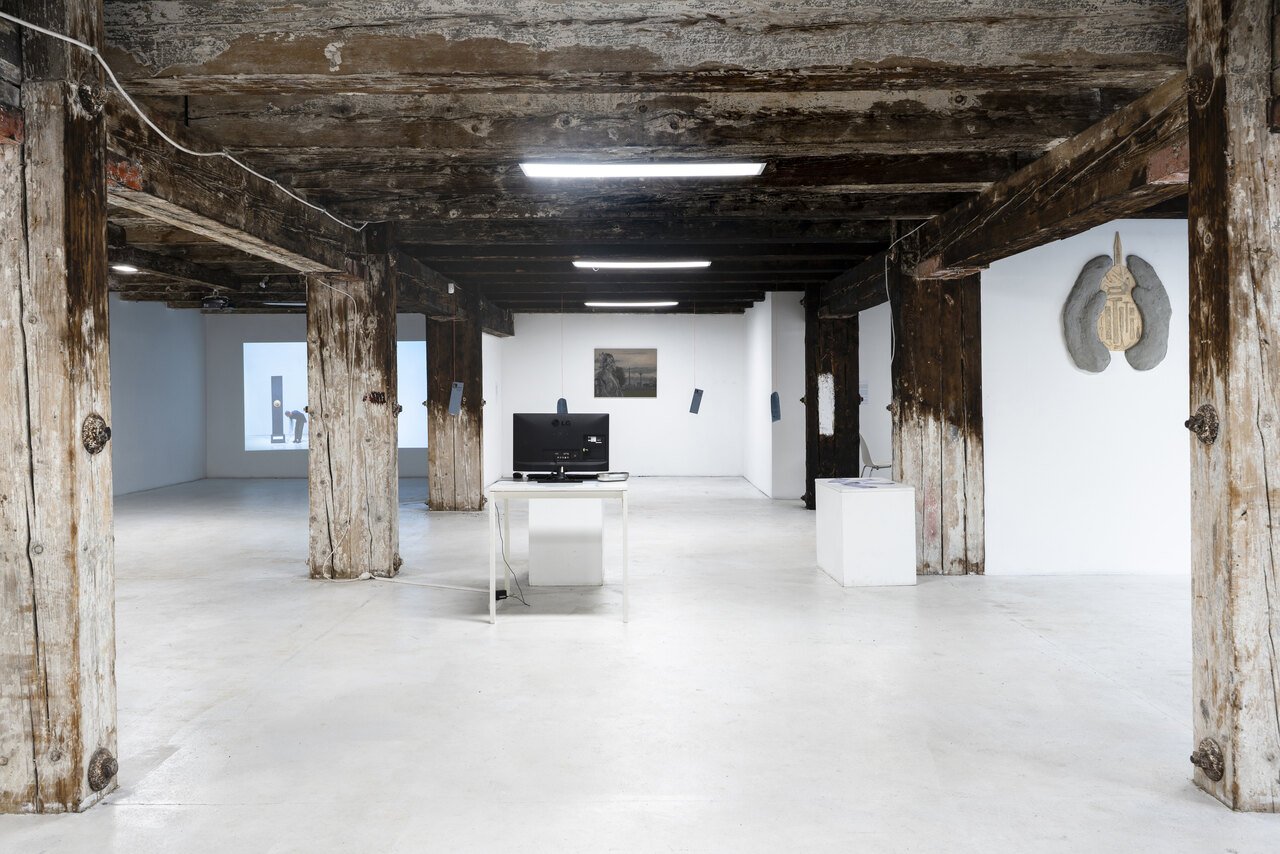
Image courtesy of Míra Mónika Magyar.
The various actors in the internship system — the intern, the employing institution or individual, and the university that requires the placement, to name only the most obvious — generally share the same goals. And yet, they often seem to work against one another. This is precisely what makes the situation appear so hopeless and futile. Again and again, we find ourselves caught in the same vicious circle: financial and human resources are inadequate; there is little time, patience, or capacity to listen to one another; and it is within precisely these conditions that the next generation of the profession is being formed by today’s interns.
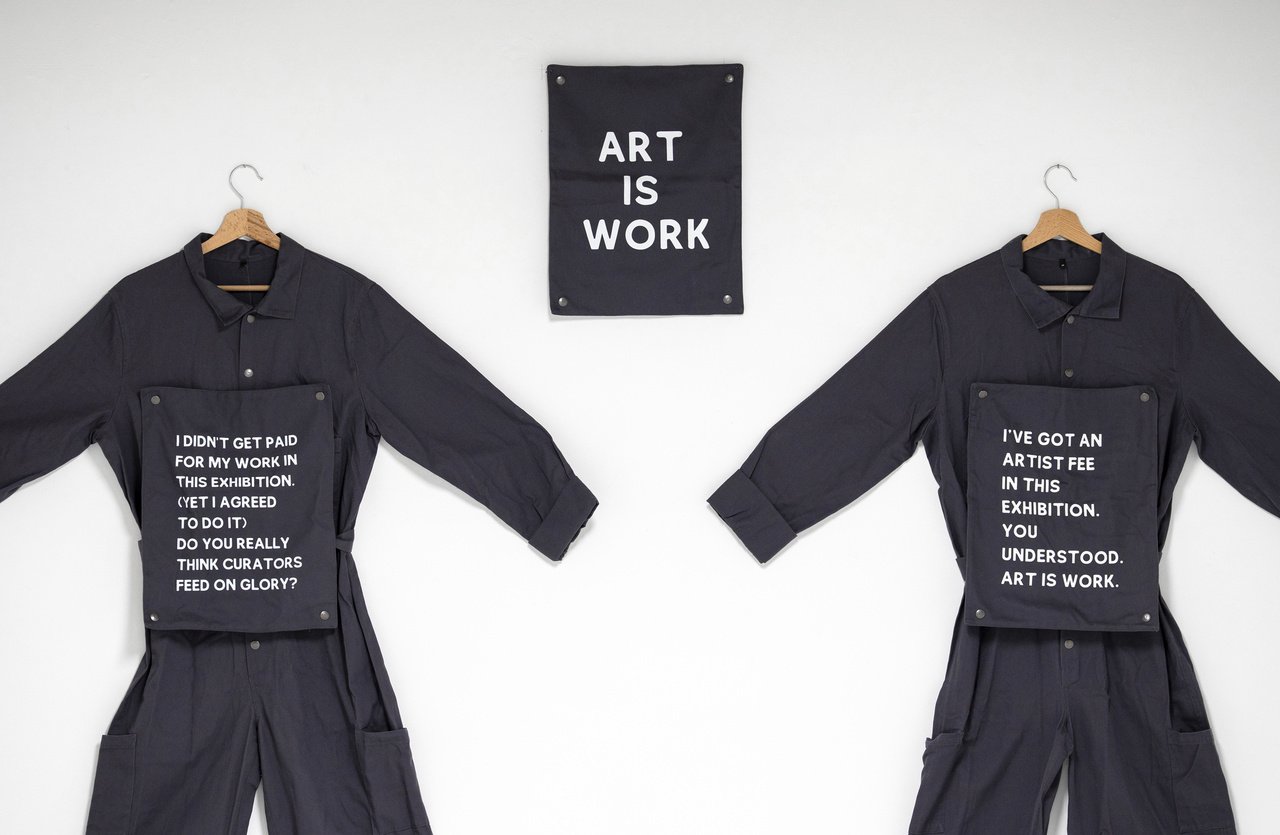
The exhibition space at aqb Project Space immediately evoked an atmosphere analogous to that of the internship itself: a confined space filled with grey works employing seemingly simple gestures, which, on closer inspection, revealed layers of humor and solidarity. This is already apparent in the exhibition’s opening work, Apparatus 22’s ART IS WORK (2011–), which introduces the viewer to the subject through problems affecting the art institutional system as a whole. Black overalls and interchangeable slogans — the props of the Romanian artists’ collective’s performative project — hang on the wall, producing an unsettling impression somewhere between workwear and prison uniform. Their messages address the relationship between artistic labor and money with a directness that is nevertheless often taboo, drawing attention to (self-)exploitation and the lack of recognition afforded to labor within the art field. The artists distribute the overalls among artists and curators through gifting and exchange. Yet the work’s experimental, activist character also calls for action: solidarity lies at its core — solidarity between artists and curators, and, more broadly, between interns and other art workers.
The Invisible Intern, Invisible Structures, Invisible Labour
Performativity, often used as a means of making invisible labour visible, recurs throughout the exhibition. In Név, életkor, munkakör (Name, Age, Occupation, 2026), R. Miranda Rojas-Nagy ate insects during a performance at the opening while entering their data — their name, age, and occupation — into a computer. The work was later presented in the exhibition as a video installation evoking an office environment. In Poszt-primordiális néni (Post-Primordial Granny, 2026), Attila Menesi invited high-status figures from the Hungarian institutional art field to work as gallery guards. Each day, a different established professional took a turn guarding the exhibition, while the schedule documenting this was hung on the wall as a work of art. The work also draws attention to the performative nature of intern labor.
The parallel between artistic labor and invisible labor performed in the household is most explicit in Gleb Burnashev’s video installation Pp_dstr (2025–). The footage shows the artist working as an exhibition technician at the Museum of Modern Art in Warsaw, dusting artworks. Originally posted on Instagram, the videos transform this otherwise mundane activity into an artistic performance, making both invisible labor and the person performing it — whether technician or intern — visible.
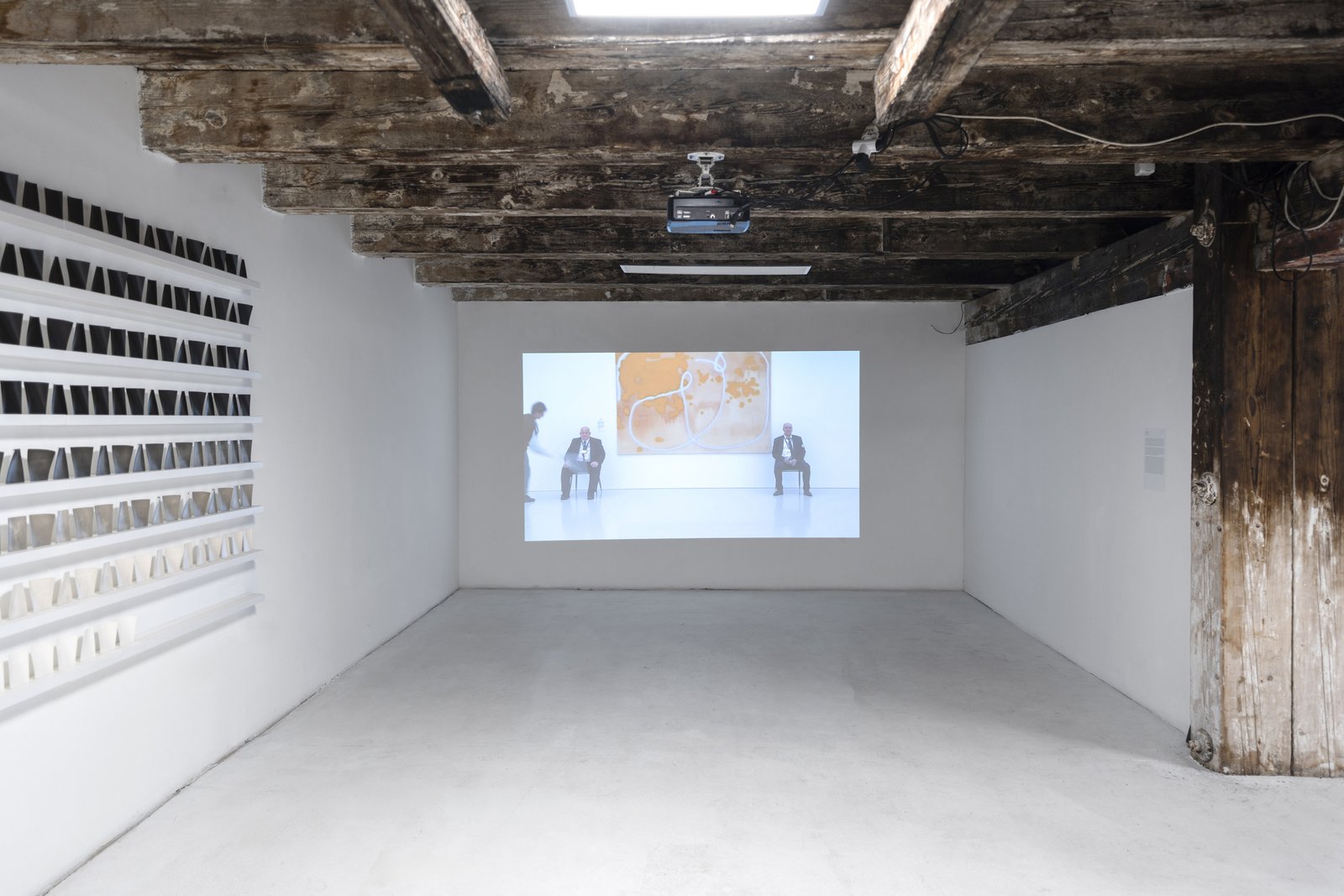
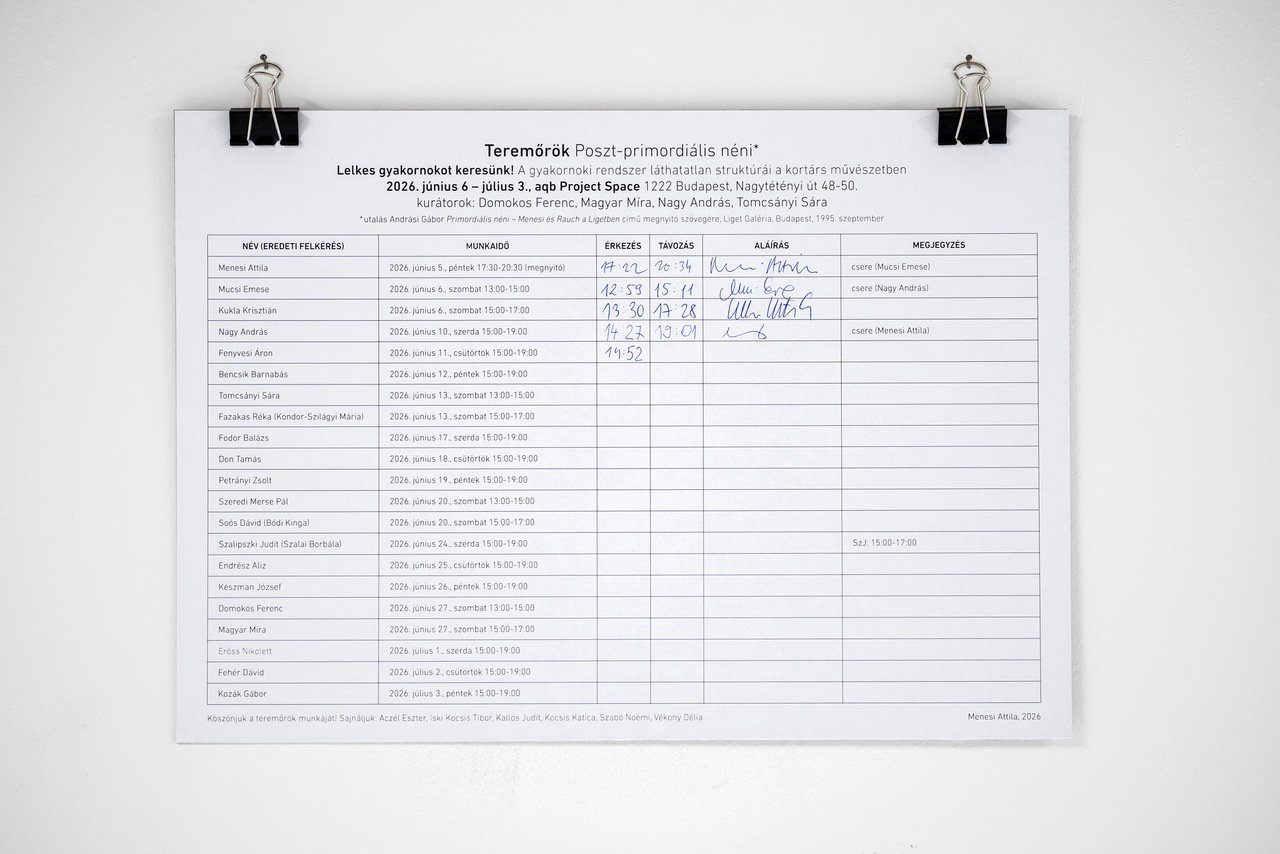
Image courtesy of Míra Mónika Magyar.
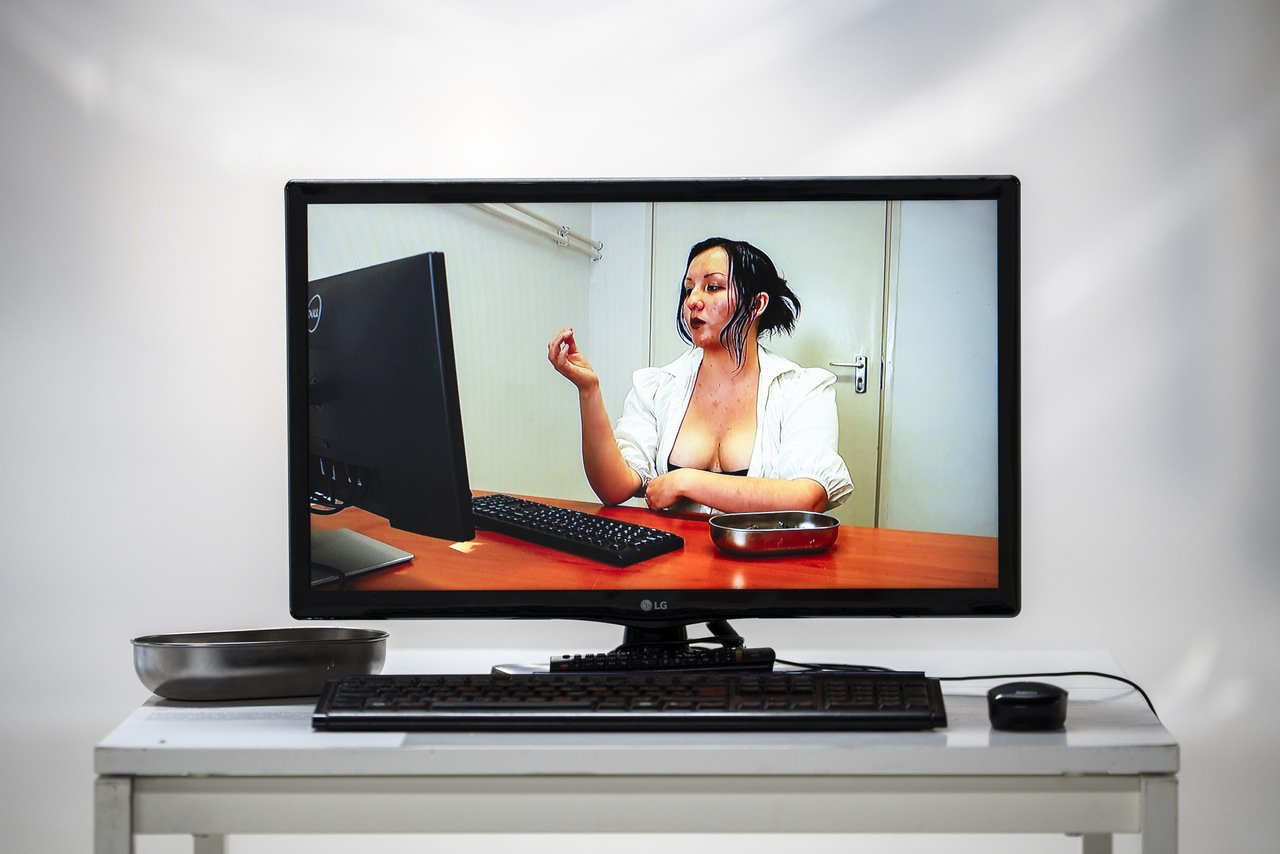
Image courtesy of Míra Mónika Magyar.
Hierarchy and Exploitation: The Intern and the Employer
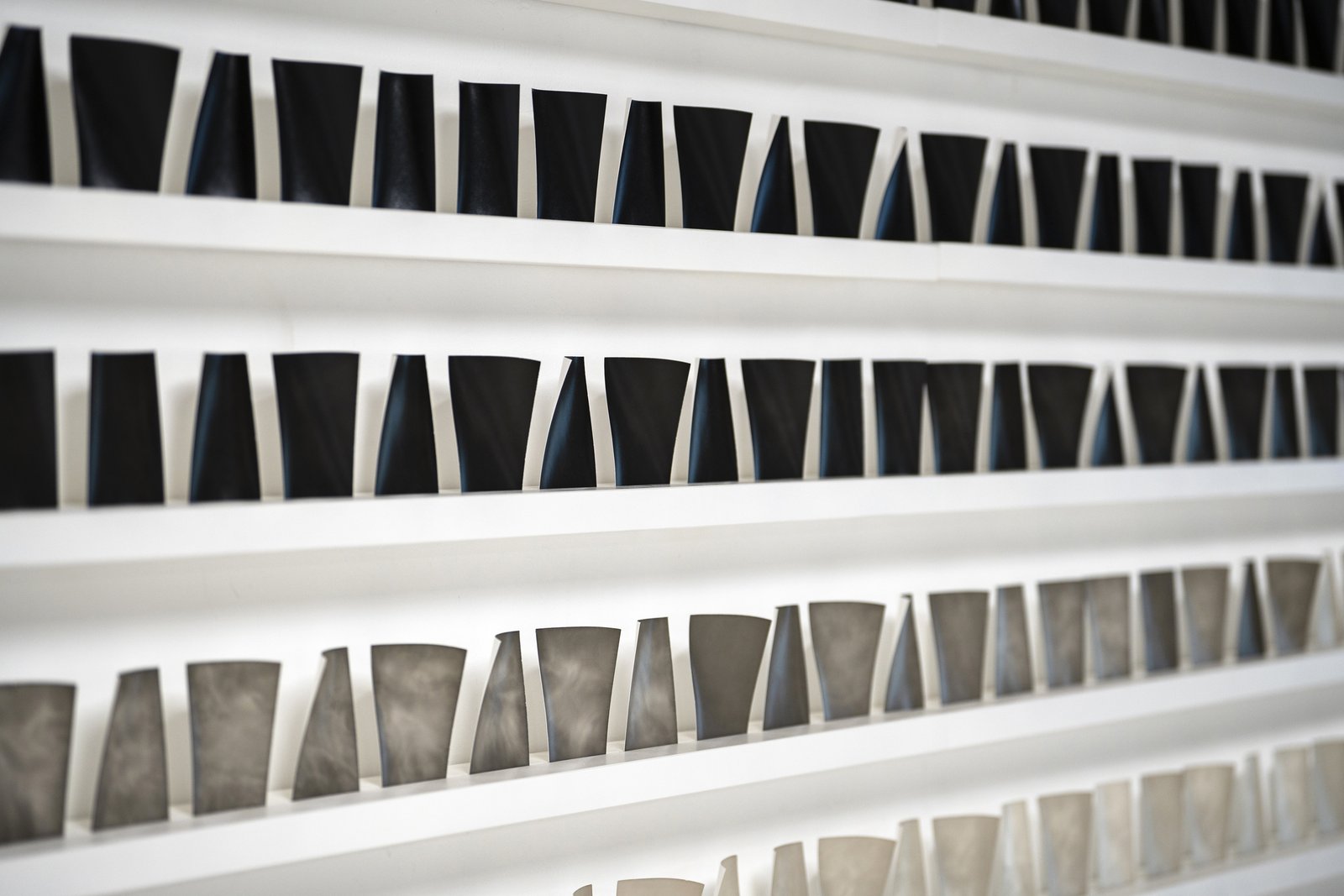
The intern is often literally invisible: their name does not appear in the credits of the project they worked on. As a result, they receive neither financial compensation nor adequate symbolic recognition for their labor. Fruzsina Siklódy’s monochrome graphic series Objects of Hidden Work (2026) emerged from this personal experience, offering a glimpse “behind the scenes.” The intern and their working environment typically remain hidden behind the glossy, champagne-filled façade of cultural institutions. Siklódy’s dark still lifes bring into the exhibition space the material environments of cultural institutions that audiences rarely get to see, which raises the question: why do young people at the beginning of their careers repeatedly accept exploitative work? Alongside the formal expectations imposed by universities — most notably compulsory professional placements — internships also function as an informal requirement for entering the art field, sustained by the often false promises of professional advancement and networking. Since these positions are generally unpaid or poorly paid, “access to them is class-based”[11] and so by extension, is access to the art field itself.
The difficulty of crossing this threshold is evoked by Ádám Széll’s large-scale frottage Belépési küszöb (Threshold of Entry, 2026), a delicate impression of the door leading from the exhibition space of Erika Deák Gallery into its storage area. A narrow gap beside the door offers a glimpse of the room beyond: the door both conceals and reveals, inviting entry while simultaneously keeping the viewer out. The employer looking for an enthusiastic intern promises to help them cross this threshold, but that promise often goes unfulfilled. And even if someone manages to climb the rungs of the hierarchy and finally gain entry, they may still be confronted with the bleak scene evoked by Siklódy’s still lifes — or, as in Name, Age, Occupation (2026), become like the insect: once inside, immediately consumed by the system.
Menesi Attila’s project, by contrast, reverses the hierarchy through a simple gesture: instead of an unpaid intern, it places leading figures from Hungary’s institutional art system in the gallery guard’s chair. Some of the most visible figures in Hungarian art thus performed one of its most invisible forms of labor — “in honor of unpaid work.”
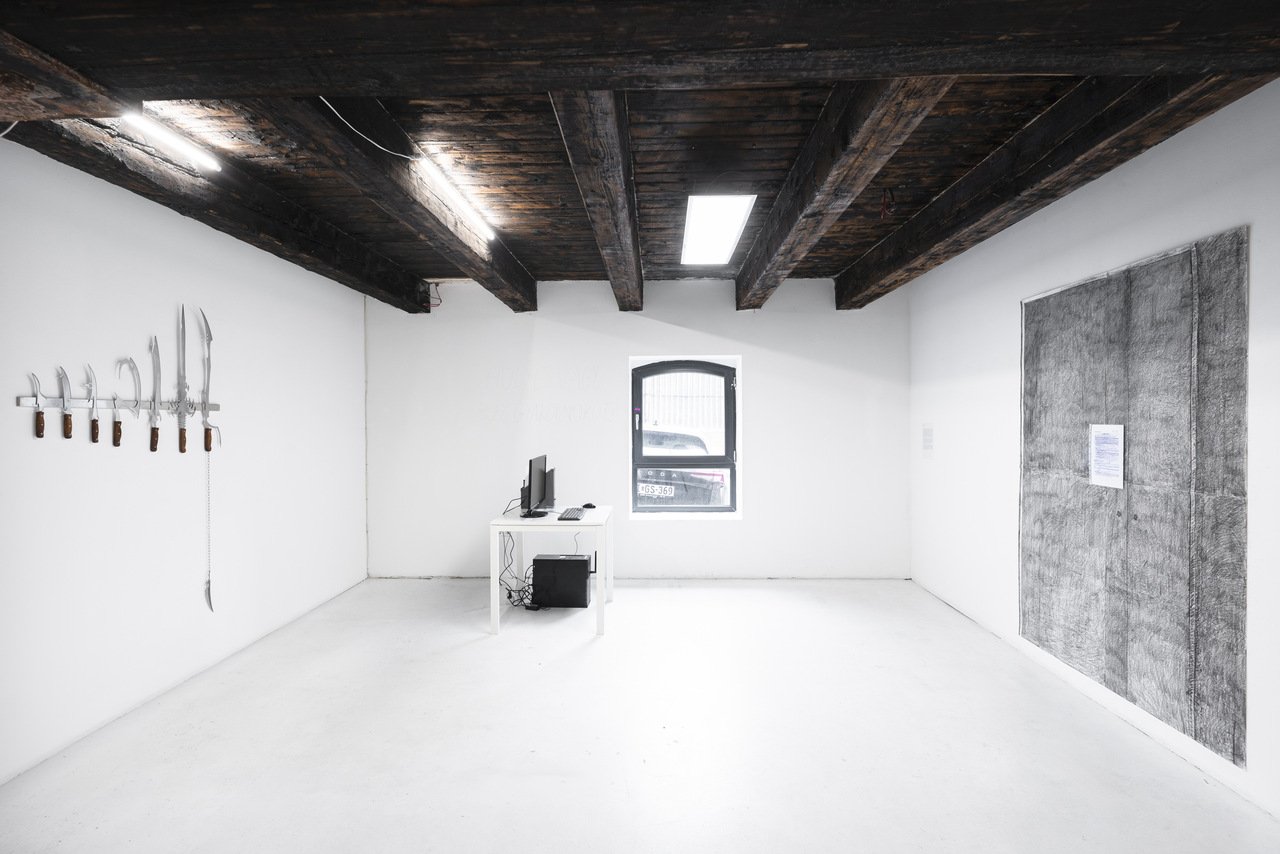
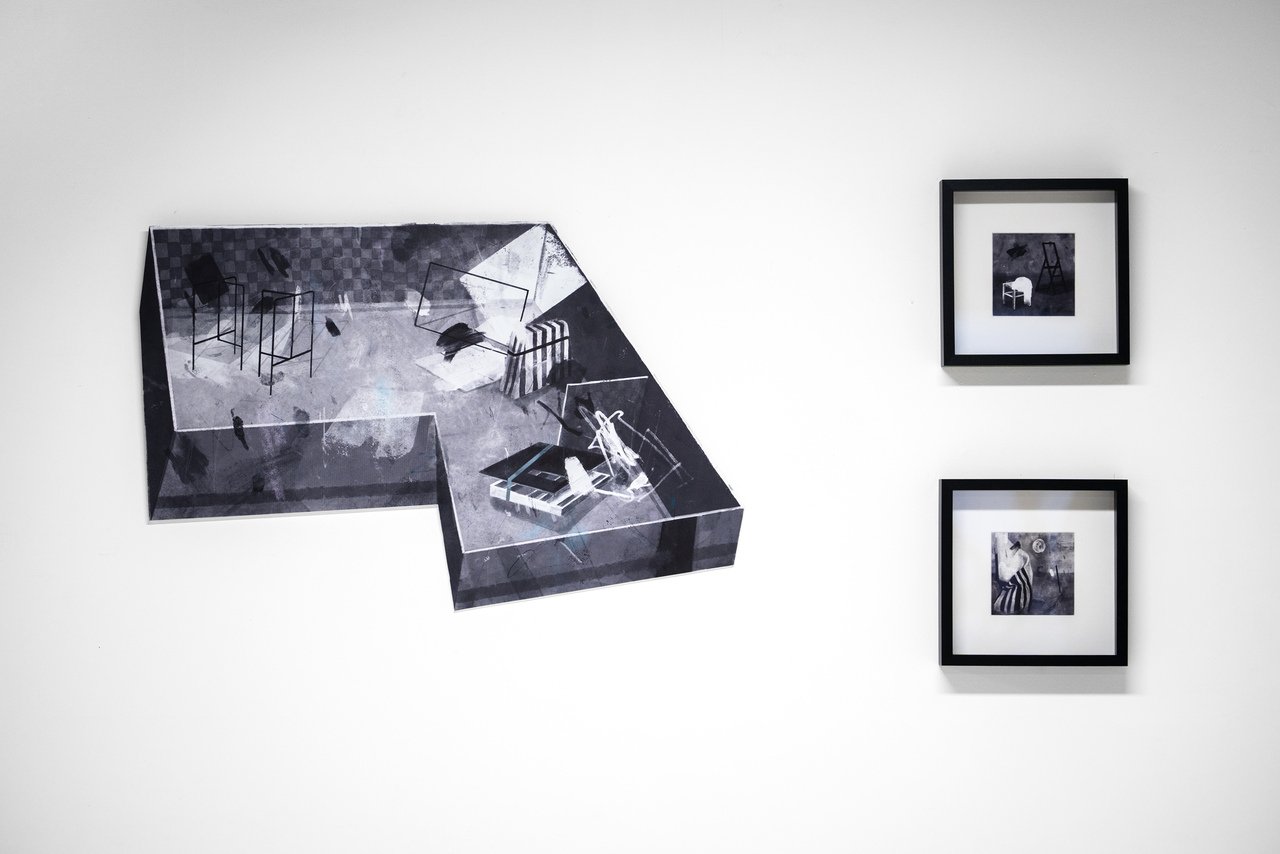
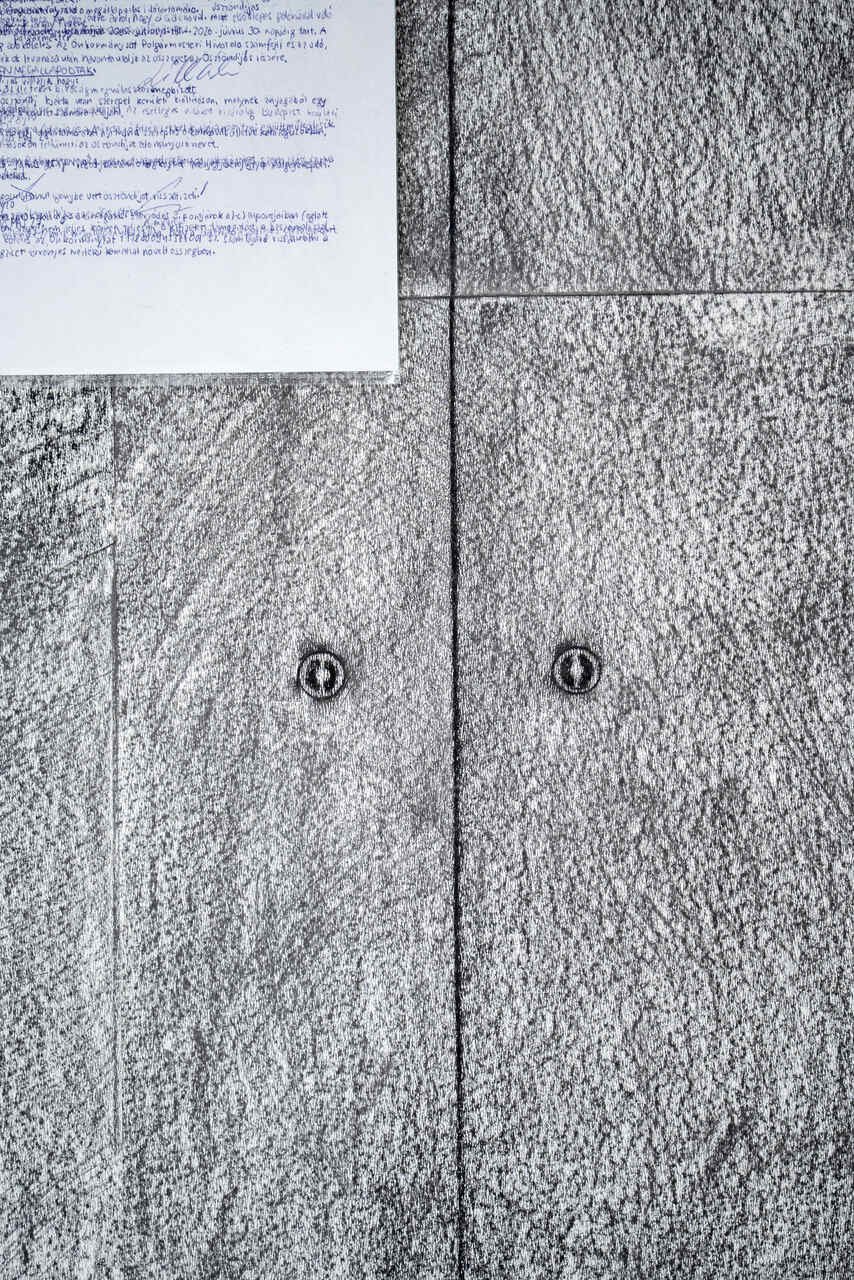
Image courtesy of Míra Mónika Magyar.
Knowledge Transfer: Educational Institutions and Interns
The project emphasizes that (self-)exploitation is closely tied to another persistent problem: the transfer of knowledge, which could itself function as a form of “payment,” often fails to take place. Without meaningful knowledge transfer, professional advancement becomes genuinely difficult. This aspect is less prominent in the exhibition itself, but several interviewees and contributors address it in the accompanying publication.[12]
Universities and other educational institutions are particularly important in this respect, since many internship positions are filled by students completing compulsory professional placements. In this way, universities provide partner institutions with a source of free labour and, in many cases, help legitimize exploitative situations. Given that the project itself is the diploma work of graduating curatorial students at the Hungarian University of Fine Arts, it is striking that the responsibility of universities receives comparatively little attention. Anna Eszter Setényi’s Ismereteim (My Knowledge) series (2026) presents the technical knowledge the artist acquired informally, partly through internships. In the three-part series of reliefs, graphite drawings of tools are embraced by archaic figures, symbolizing knowledge as a form of value that becomes part of the person who acquires it. The works also evoke the old guild system, in which knowledge and professional practice were passed from master to apprentice. Today, it is far less clear how such transmission is supposed to work. In this context, the tools can also be read as symbols of the means through which exploitative structures might be repaired.
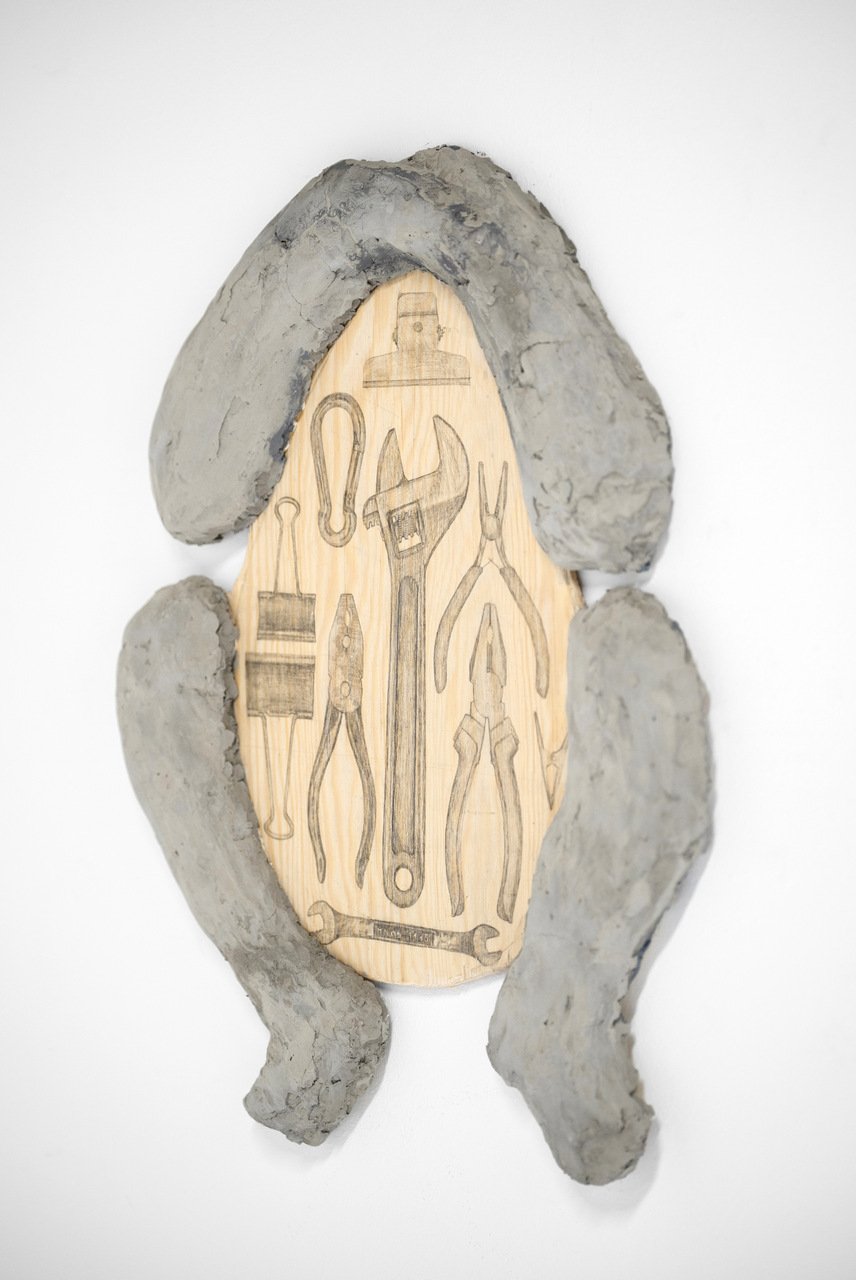
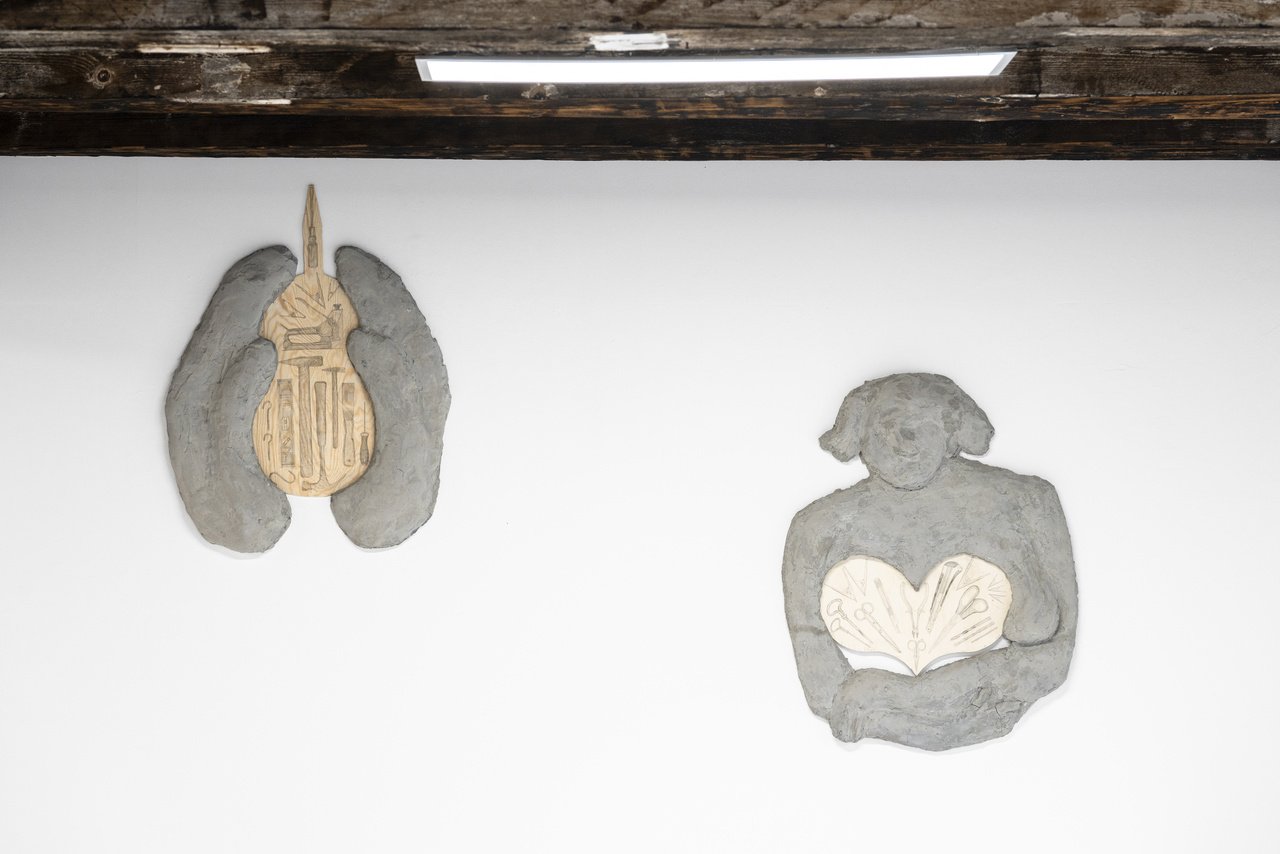
Image courtesy of Míra Mónika Magyar.
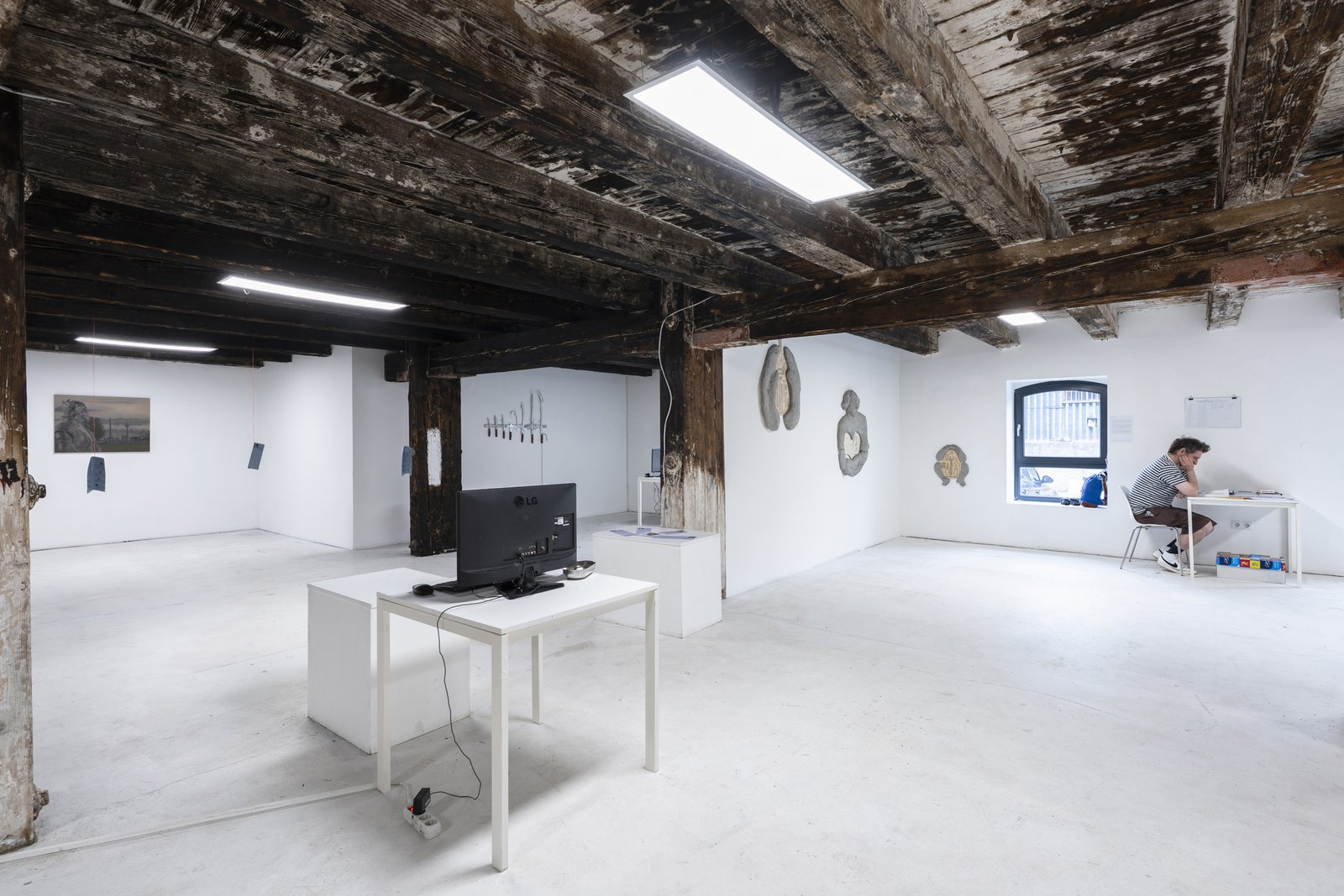
Image courtesy of Míra Mónika Magyar.
Community as a Mode of Practice
One of the exhibition’s central claims is that the internship cannot be understood in isolation. The intern is an indispensable component of the institutional art system, part of the “dark matter”[13] that holds it together. The condition of the intern therefore reflects the condition of the system as a whole. Dóra Kolocz brings the publication to an optimistic close,[14] using the example of the Miksa Róth Memorial House and Collection to demonstrate that the complex problems of the internship system can only be addressed if we tackle them at their roots and understand community-based practice as a foundation of institutional life. In our crisis-ridden present, the shared task of art workers should be to prevent the system from collapsing entirely and, in doing so, to create sustainable, progressive institutional structures and communities. We Are Looking for an Enthusiastic Intern! marks an important point at the beginning of this journey. It calls for greater attentiveness to one another and for solidarity — something that Hungary’s increasingly polarized society may need now more than ever.
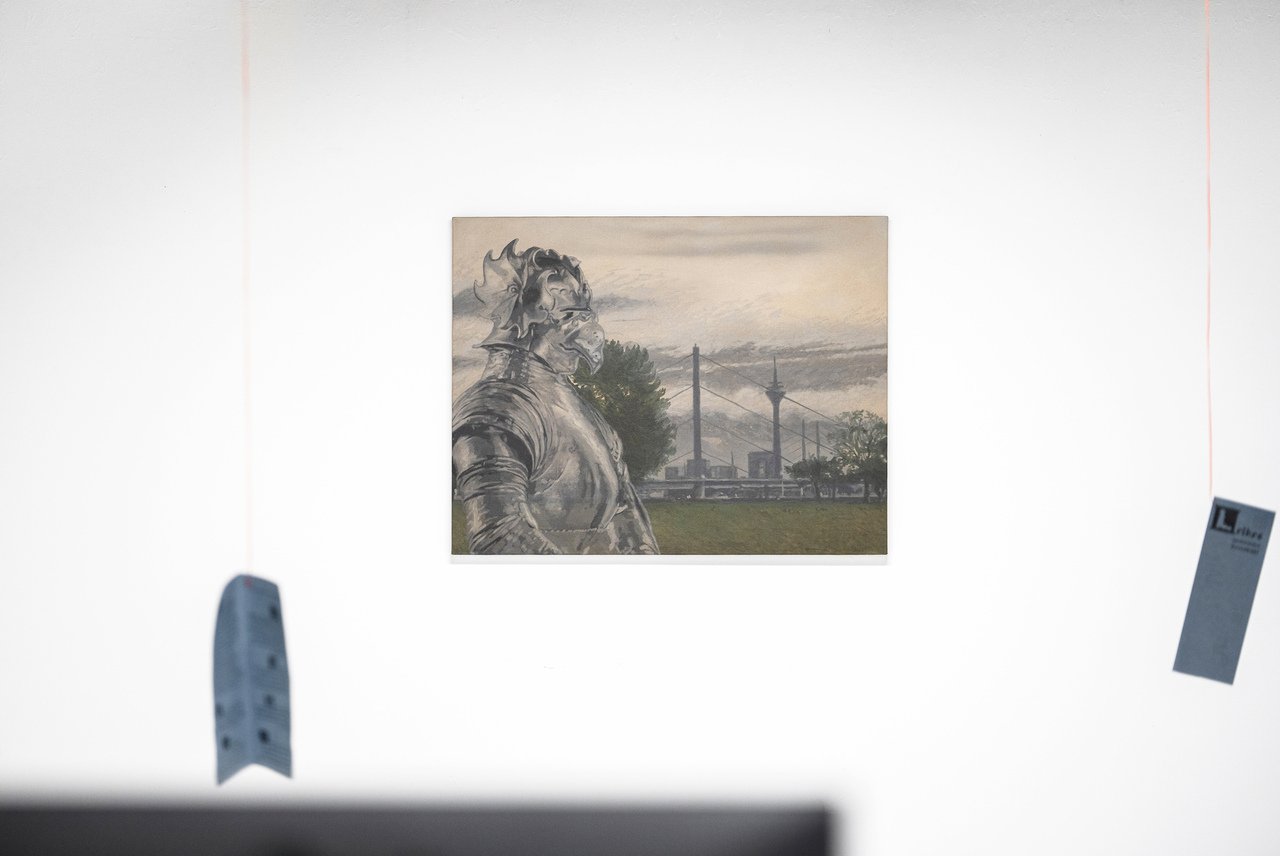
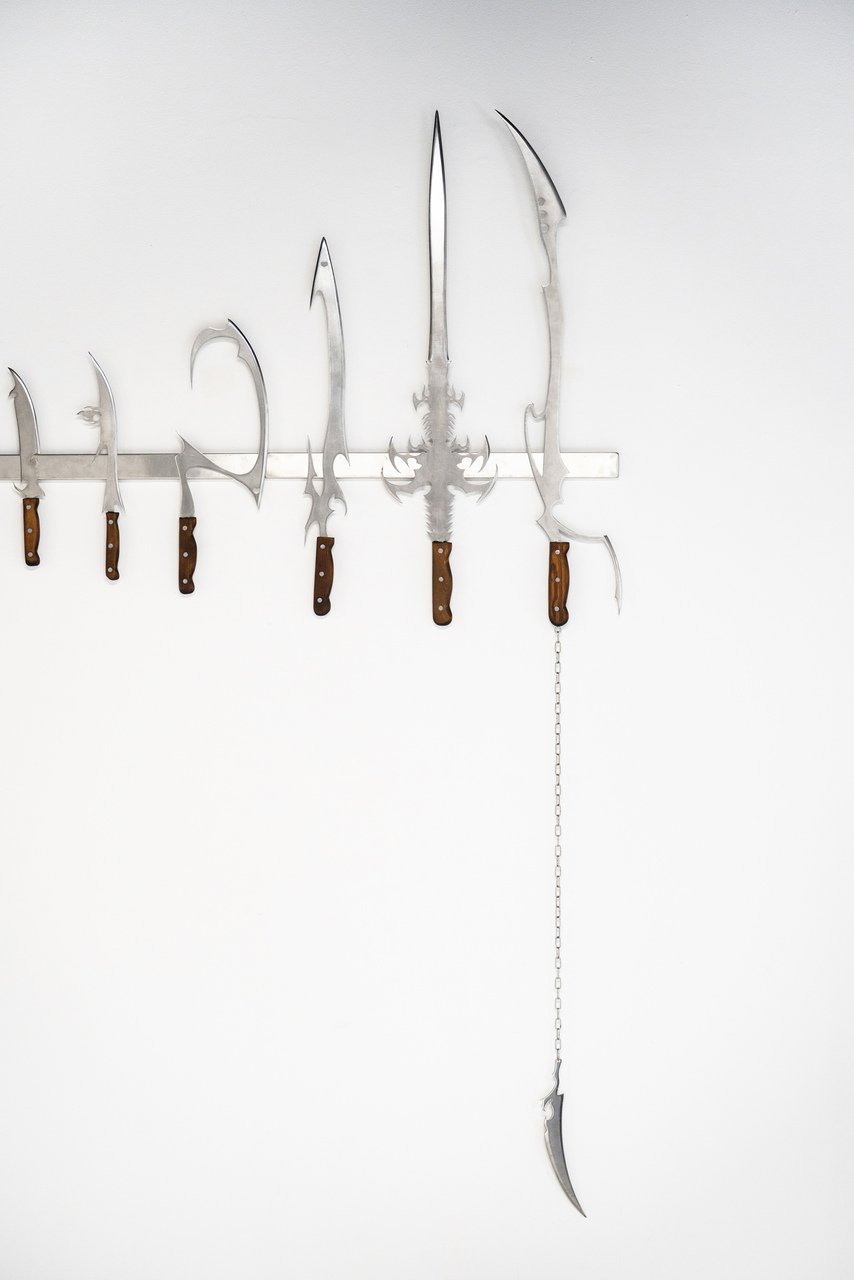
Image courtesy of Míra Mónika Magyar.
Hungary
Authors: Sára Vera Bodor, Kata Martincsák, Dóra Vázsonyi
Mentors: Jan Elantkowski, Réka Majsai, Hedvig Turai
Translator: Kata Balázs
Coordination: Kata Balázs
Co-coordination: Tamás Don
Poland
Authors: Ida Dziublewska, Wojciech Grum, Łucja Staszkiewicz
Mentors: Ewa Borysiewicz Vera Zalutskaya, Kathryn Zazenski
Translator: Ewa Borysiewicz
Coordination: Arkadiusz Półtorak
Slovakia
Authors: Ema Brestovanská, Sofia Suzziová, Gregor Zimmermann
Mentors: Daniel Grúň, Adrián Kobetič, Lucia Miklošková
Translator: Kamila Talarovič
Coordination: Peter Megyeši
[1] Gregory Sholette, Dark Matter: Art and Politics in the Age of Enterprise Culture (Pluto Books, 2010).
[2] Ferenc Domokos, Míra Mónika Magyar, András Nagy and Sára Tomcsányi, “The Seasoned Stranger”, in We are Looking for an Enthusiastic Intern! The Invisible Structures of the Internship System in Contemporary Art, eds. Ferenc Domokos, Míra Mónika Magyar, András Nagy and Sára Tomcsányi (2026) 7-12.
[3] R. Miranda Rojas-Nagy: Név, életkor, munkakör (Name, Age, Occupation) 2026
[4] Anna Eszter Setényi: Ismereteim: Szúró- és vágófélék és Ismereteim: Függesztőfélék (My Knowledge: Piercing and Cutting Toolsand My Knowledge: Hanging/Suspension Devices), 2026
[5] Luca Florian: Self-portrait as Don Quixote in Düsseldorf, 2025.
[6] Ádám Széll: Belépési küszöb (Threshold of Entry), 2026.
[7] Gleb Burnashev: Pp_dstr, 2025-
[8] Gregory Sholette, Dark Matter: Art and Politics in the Age of Enterprise Culture (Pluto Books, 2010).
[9] Lelkes gyakornokot keresünk! A gyakornoki rendszer láthatatlan struktúrái a kortárs művészetben (We are Looking for an Enthusiastic Intern! The Invisible Structures of the Internship System in Contemporary Art). Curators: Ferenc Domokos, Míra Mónika Magyar, András Nagy, Sára Tomcsányi. Exhibiting artists: Apparatus 22 (RO/BE/Suprainfinit utopian realm), Máté Dobokay, Gleb Burnashev (BY/PL), Klaudia Januskó, Nóra Juhász, Luca Florian (RO), Attila Menesi, Réka Miranda Rojas-Nagy, Fruzsina Siklódy, Anna Eszter Setényi, Ádám Széll. art quarter budapest, June 5 2026 – July 3
[10] This opportunity is inseparable from the broader political context. Following the spring elections and the end of the NER era, new possibilities for action have opened up within Hungary’s cultural sphere. With grassroots initiatives playing an increasingly important role, there is now a genuine prospect of transforming Hungary’s art institutional system in a more positive direction.
[11] In the research conducted by the curators, 86% of survey respondents agreed that access to internships is class-based. Source: Ferenc Domokos, Míra Mónika Magyar, András Nagy and Sára Tomcsányi, “The Seasoned Stranger”, in We are Looking for an Enthusiastic Intern! The Invisible Structures of the Internship System in Contemporary Art, eds. Ferenc Domokos, Míra Mónika Magyar, András Nagy and Sára Tomcsányi (2026) 10.
[12] E.g. János Szoboszlai, “Win-Win Paradise (Or Not): Notes on University Internships” in We are Looking for an Enthusiastic Intern! The Invisible Structures of the Internship System in Contemporary Art, eds. Ferenc Domokos, Míra Mónika Magyar, András Nagy and Sára Tomcsányi (2026) 33-37.
[13] Gregory Sholette, Dark Matter: Art and Politics in the Age of Enterprise Culture (Pluto Books, 2010).
[14] Dóra Kolocz, “Internship Programme at the Miksa Róth Memorial House and Collection” in We are Looking for an Enthusiastic Intern! The Invisible Structures of the Internship System in Contemporary Art, eds. Ferenc Domokos, Míra Mónika Magyar, András Nagy and Sára Tomcsányi (2026) 45-50.
Artists: Apparatus 22 (Suprainfinit utopian realm), Máté Dobokay, Gleb Burnashev, Klaudia Januskó, Nóra Juhász, Luca Florian, Attila Menesi, Réka Miranda Rojas-Nagy, Fruzsina Siklódy, Anna Eszter Setényi, Ádám Széll
Exhibition Title: We are Looking for an Enthusiastic Intern! The Invisible Structures of the Internship System in Contemporary Art
Curated by: Ferenc Domokos, Míra Mónika Magyar, András Nagy, Sára Tomcsányi
Venue: aqb (art quarter budapest)
Place (Country/Location): Budapest, Hungary
Dates: 05.06.2026 – 03.07.2026
Photos: Zsuzsi Simon