
Dóra Vázsonyi
How can a contemporary art exhibition make the critique of capitalism its subject without coming across as talking to the wind? The question may seem strange at first, but it is not every day that one finds oneself at an exhibition capable of exploring its chosen theme through a variety of means while remaining relevant throughout. Andi Schmied’s Asset Town has succeeded in doing just that.
“Welcome to Asset Town,” reads the doormat that greets visitors as they enter the exhibition space, part of the installation itself. This opening, evoking the aesthetics of both AI-generated visual content and kitschy home decor, sets a satirical tone for an exhibition that explores the phenomenon of luxury real estate purchased by the economic elite for speculative purposes. The entire exhibition is housed in a single room. This often leads to a convoluted central narrative; here, however, it directly contributes to its interpretation. In reality, these “ghost properties,” purchased for investment purposes, are scattered across various parts of the world. But in the exhibition, this system, which spans the capitalist world, is condensed into a single fictional city: Asset Town.
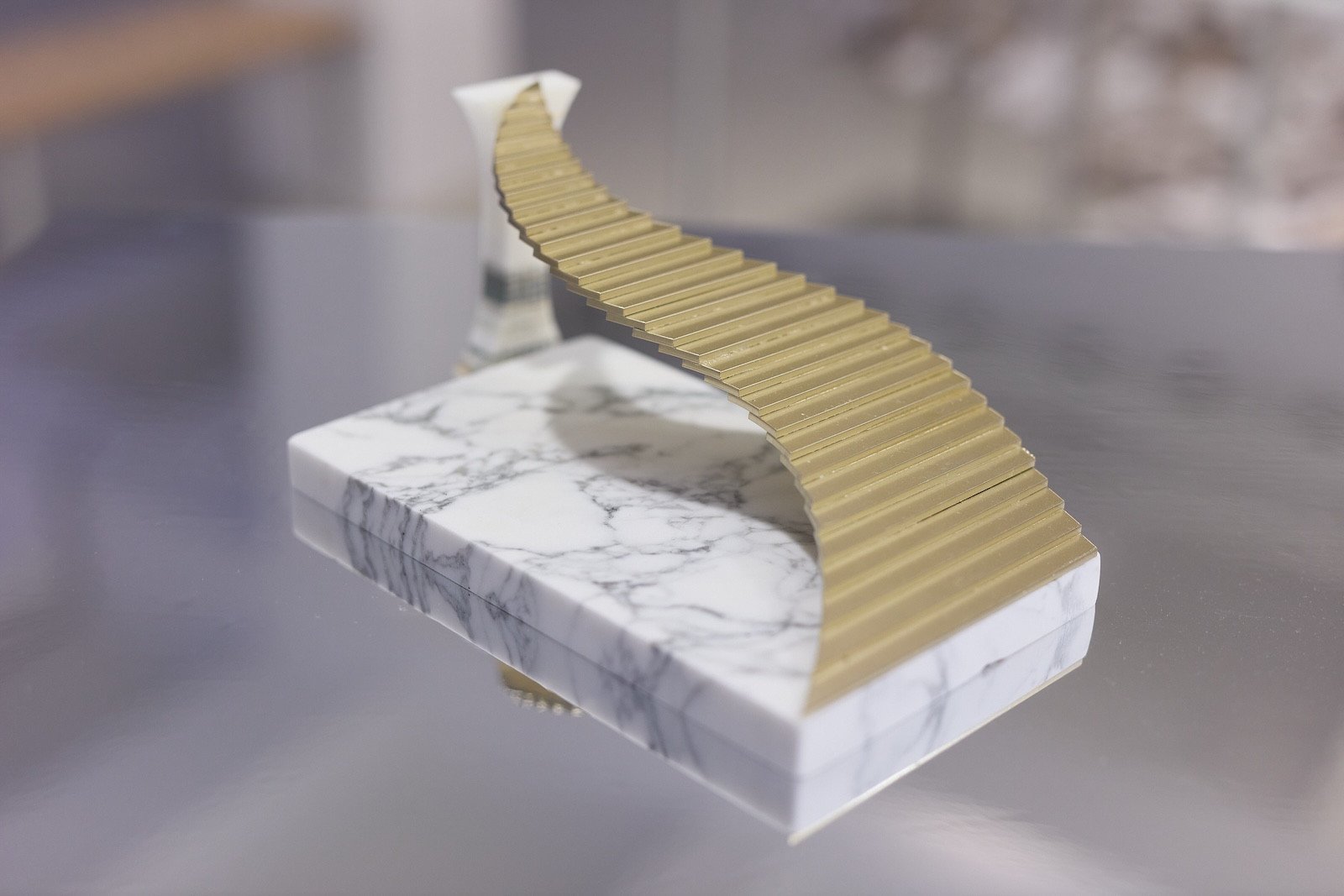
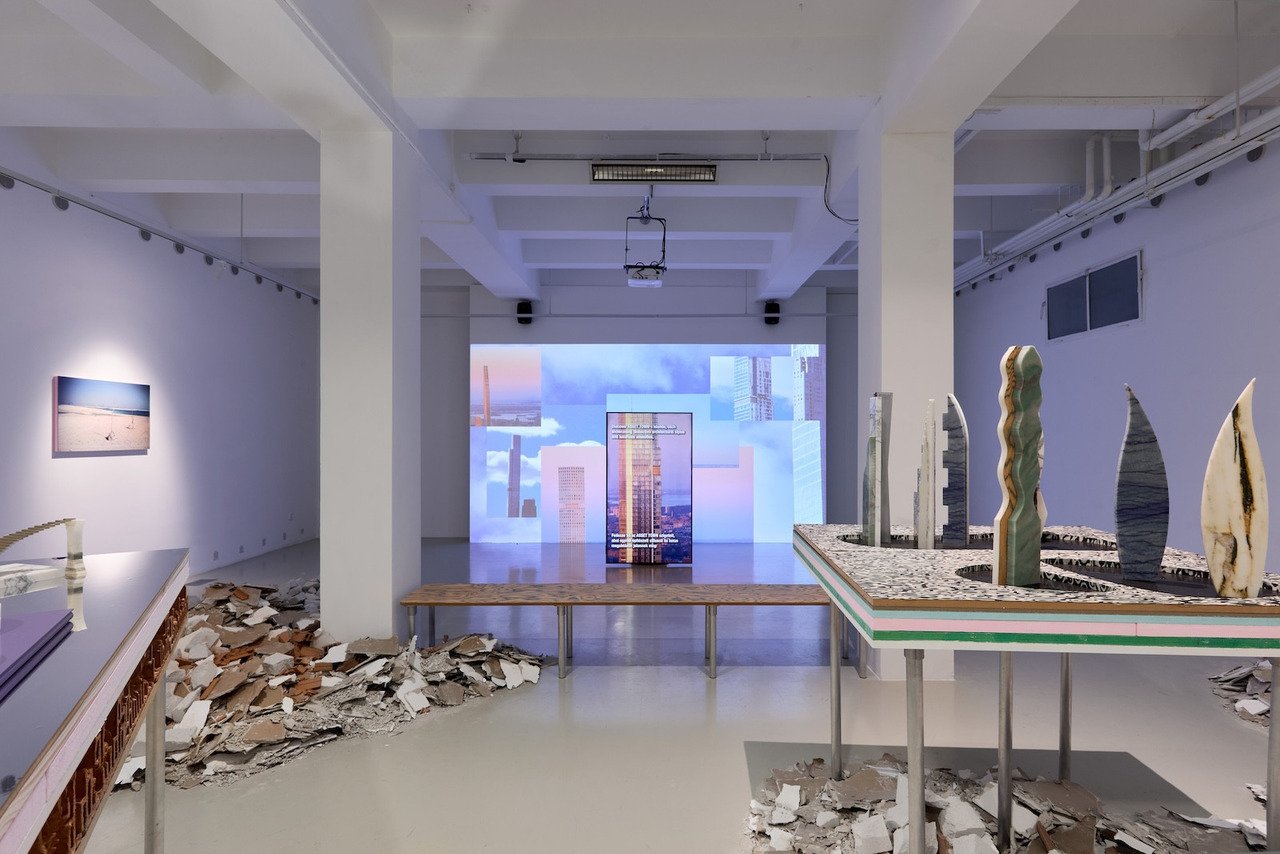
Despite the apparent grandeur of the spatial installation presented in the exhibition, it reflects the artist’s observations of this phenomenon through highly subtle artistic means. As we walk through the space covered in construction rubble, we witness constant shifts in scale. The pedestals, assembled from layers of building materials, not only allude to the process of construction through their materiality but also make the artistic gesture of allowing us a glimpse behind the scenes, otherwise concealed by a marble veneer. On the pedestals rising above the rubble, we find models of building carcasses and luxury interior design objects along with a standard floor plan, and even a fictional archipelago. These are none other than the symbolic building blocks of Asset Town. Some of these intricately shaped building fragments are scaled-down versions of actual structures, while others model fictional buildings. It is also interesting to take a look at the use of materials: while some building models are made of marble, others are simply made of painted plywood. This well represents the form-and-image centered mindset inherent in this architectural typology. Alongside the installations, we cannot overlook the leaflets and catalogs that Schmied received from the real estate agents of the buildings she visited during her research.
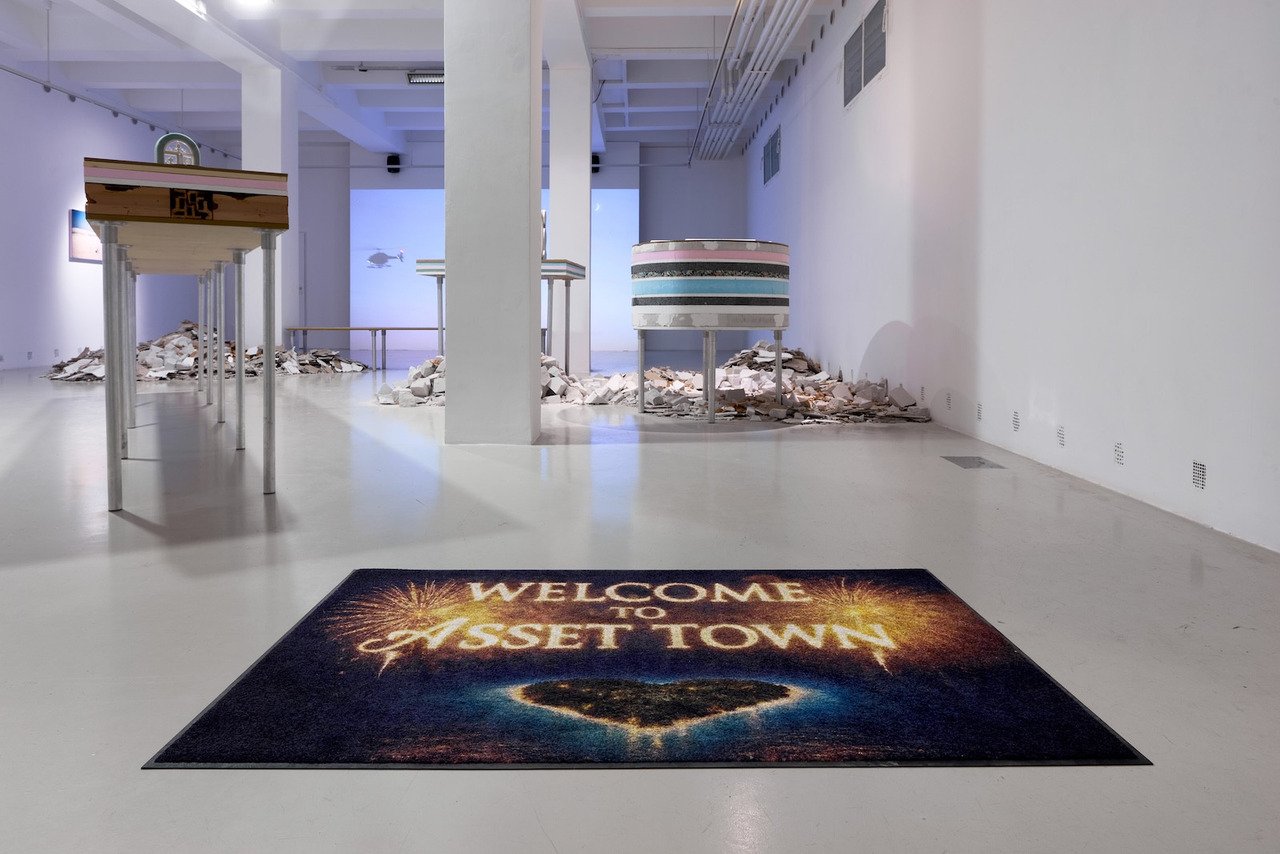
Image courtesy of Trafó Gallery.
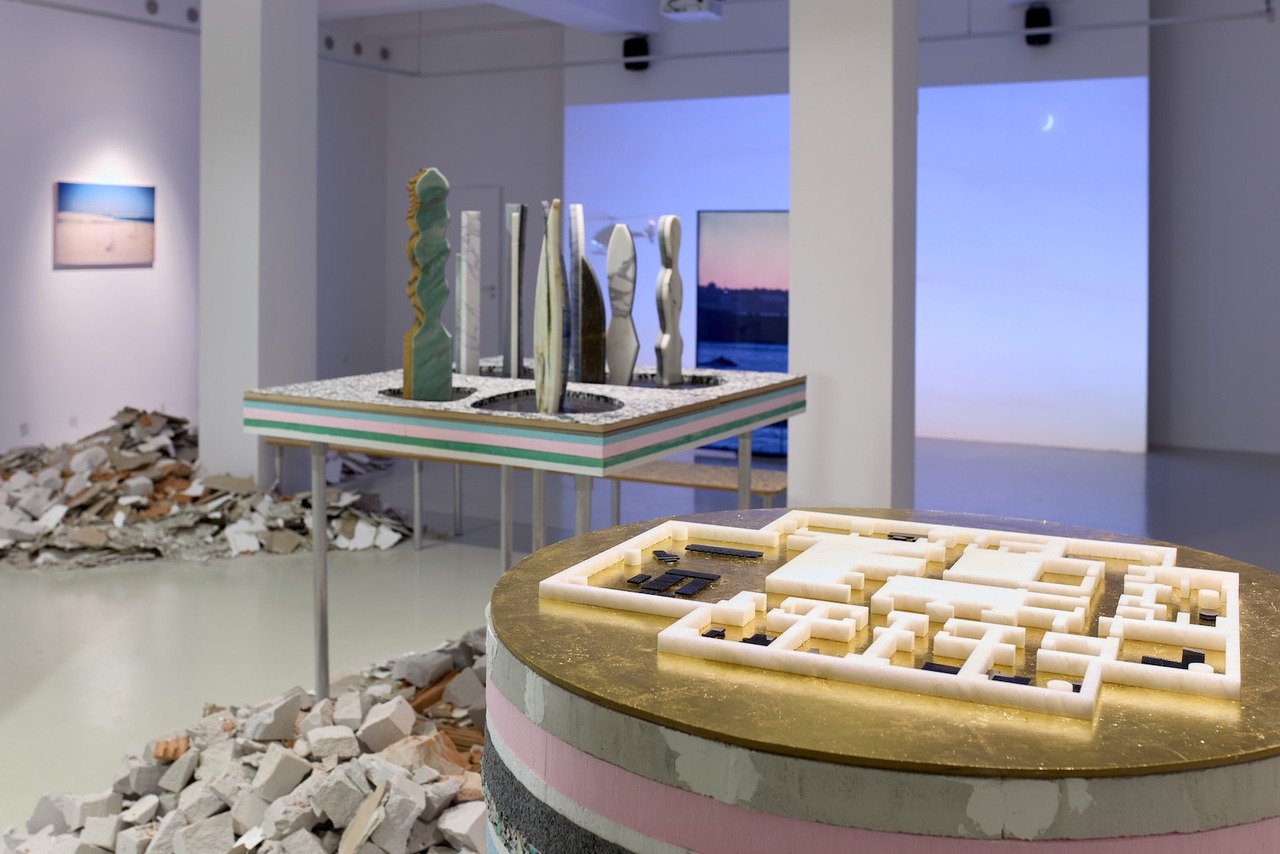
Image courtesy of Trafó Gallery.
Here, fiction becomes reality, serving as a kind of memento that reminds us: what we see is not some absurd dystopia, but a harsh reality. The built structures presented in the exhibition are the imprints of the neoliberal order manifested in our urban spaces: the urbanistic projections of individual prosperity and extreme individualism. Schmied’s work examines the phenomenon of how the economic elite views our urban spaces as a landscape that they can arbitrarily reshape. Even in our immediate surroundings we see day after day how buildings and neighborhoods are destroyed, sink into oblivion, or fall victim to radical transformations – processes to which broader economic and political systems contribute significantly, alongside architecture and urban planning.
A striking example of this is the way in which, among other things, Hungary’s late-modern architectural heritage is being treated. To mention just one example, consider how Hotel Budapest was recently demolished.1 But we could also point to the much-discussed phenomenon of gentrification, a striking example of which is the Corvin Quarter as it stands today.2 These examples demonstrate that the value of urban and public space is expressed in floor plans, dimensions, and prices per square meter, while its accessibility remains a privilege reserved for a very narrow segment of society. At the exhibition, we encounter an extreme manifestation of this and gain a glimpse into the secluded luxury that is accessible only to a select few.
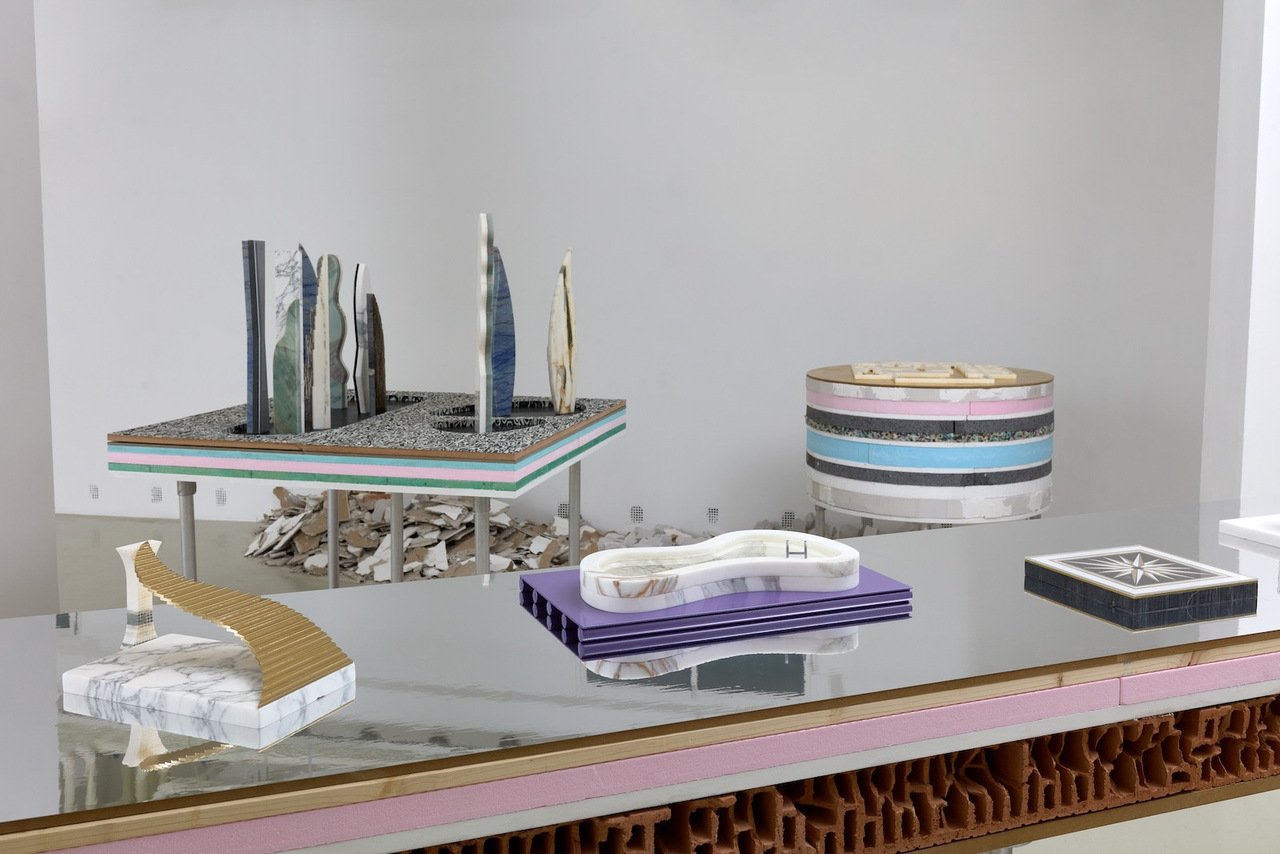
Through the gesture of revelation, it subverts the system and visually exposes the deeply hidden world of the economic elite – a world that dictates our urban spaces and quality of life. However, this revelation is not intended to elicit sensation or admiration. The exhibition evokes moral distance and aesthetic revulsion in the viewer. This rejection, however, does not stem merely from the extreme degree of luxury, but rather from the sight of the uniform spaces presented in the exhibition and the impersonal and ultimately alienating nature of the standardized floor plans. Schmied herself refers to the phenomenon as “vulgar exclusivity”3: buildings bearing the names of star architects and characterized by distinctive exterior forms become crude manifestations of iconicity. This straightforward decodability and regular emphasis on exclusivity are evidence of the homogenizing operational logic of global capitalism, which in reality does not produce innovation and diversity, but rather their exact opposite – and our urban spaces are no exception to this.
Asset Town, where built structures functioning as financial storage vehicles are concentrated into a single city, highlights the absurdity of real estate investments taken to extremes. It exposes this distinctive architectural typology and, at the same time, highlights that these buildings share a much closer kinship with one another than with their immediate surroundings, no matter where in the world they may be.
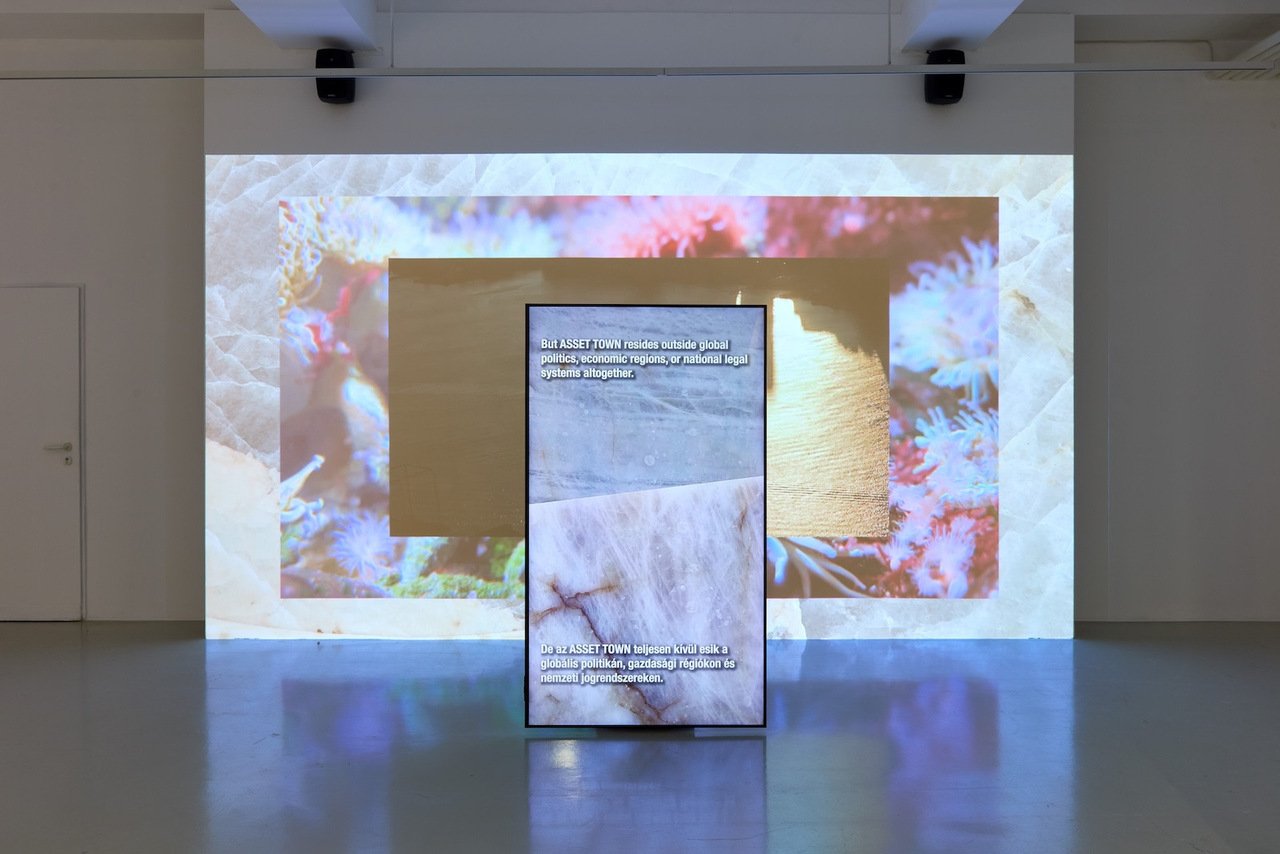
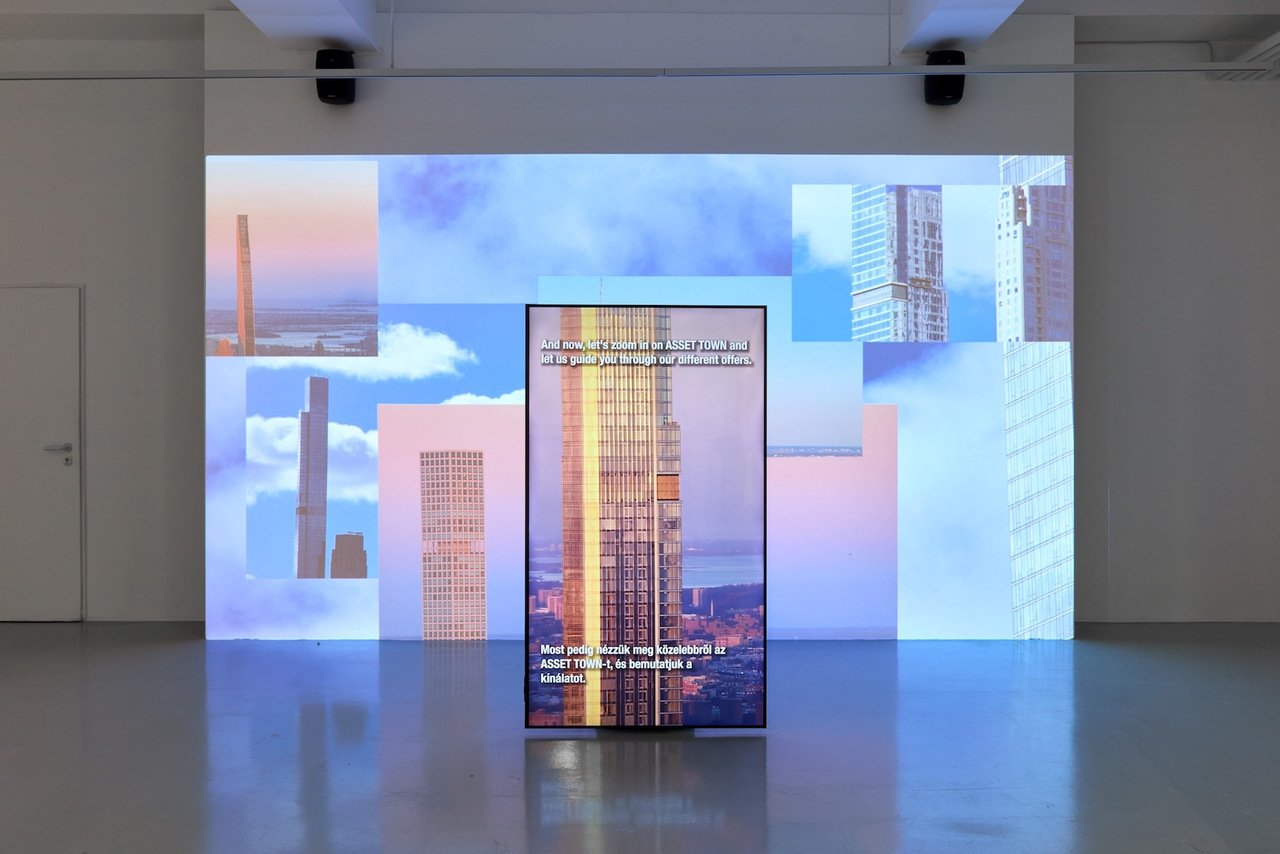
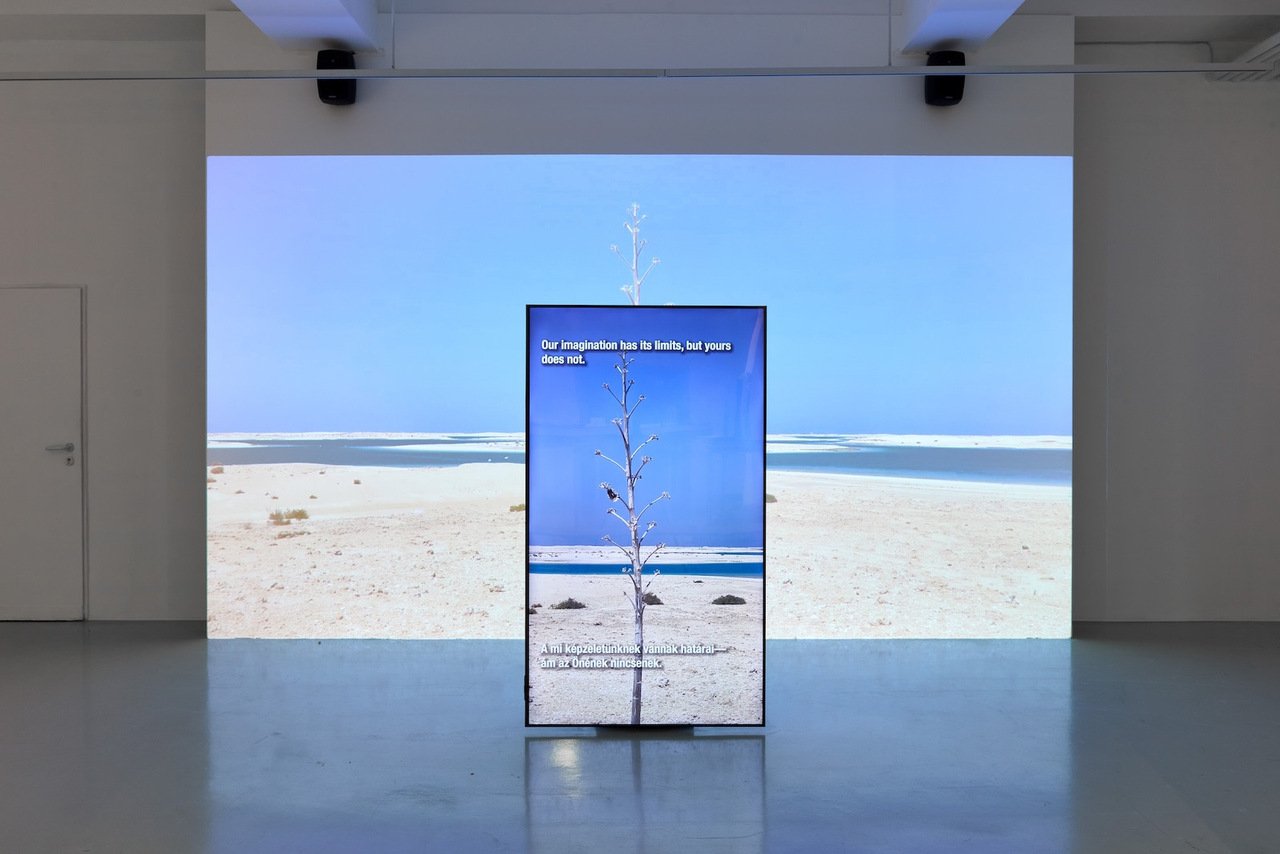
A central video installation featured in the exhibition advertises real estate for sale in this fictional city for investment purposes. A city where there is no room for communities, culture, or anything else that makes a city a city. This phenomenon bears many similarities to Marc Augé’s theory, on the emergence of what he calls non-places, and their proliferation in today’s world. In this work, Augé argues that a defining feature of the contemporary system of relations, which he calls ‘supermodernity’, is the creation of spaces “that imply neither identity, nor relationships, nor historicity” (Augé 2012, 47). The advertisement for Asset Town reads as follows:
Asset Town is a blank canvas for fresh thinking to realize your wildest dreams, while keeping your hard-earned wealth securely in place, exactly where it belongs. Asset Town is more than a city: it’s a sanctuary for your wealth, a free economic zone where property taxes fade into obscurity, and privacy reigns supreme. … Entry and exit occur with ease: while you retain something solid, something architectural, something that remains when other instruments do not. And should conditions beyond Asset Town become less predictable, your asset remains exactly as you left it. Sealed. Preserved. Unaffected. (Trafó Gallery 2026)
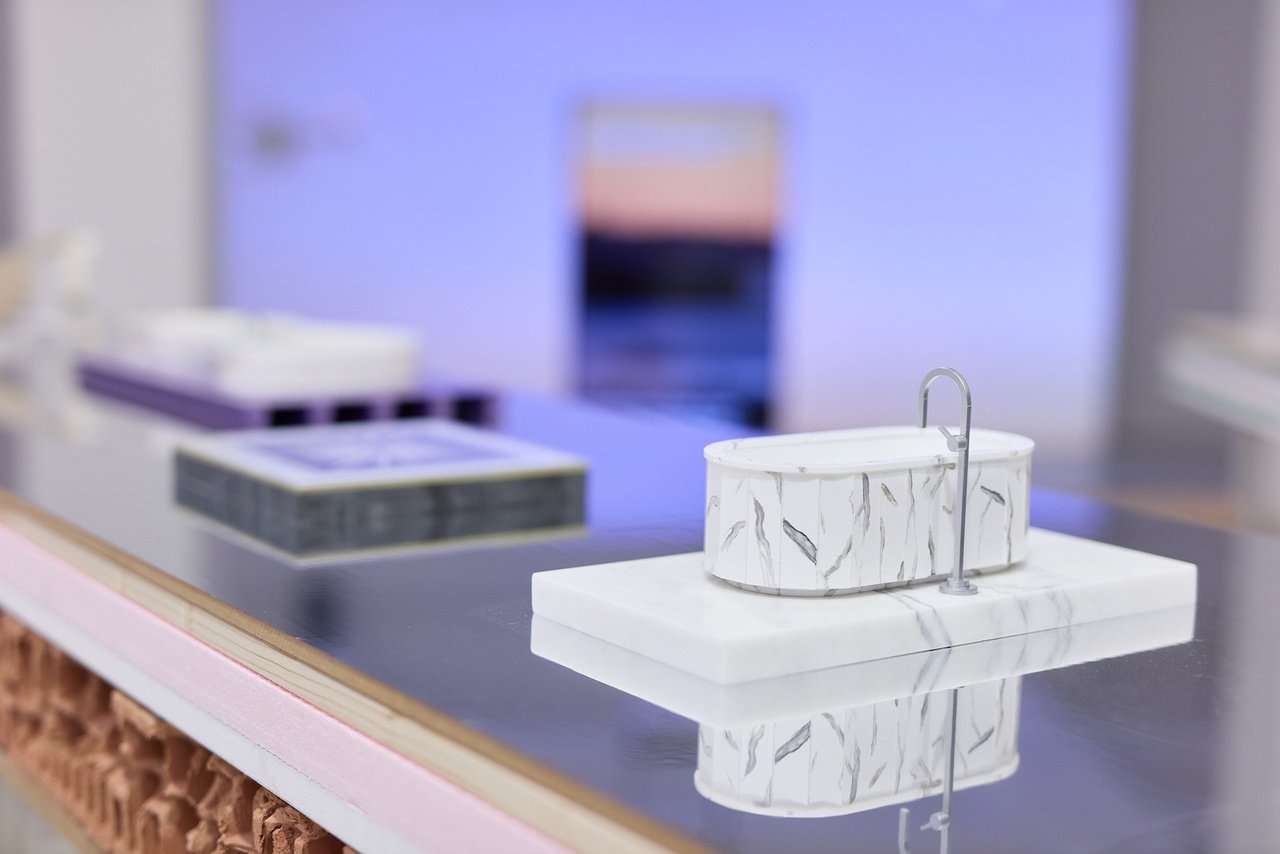
Image courtesy of Trafó Gallery.
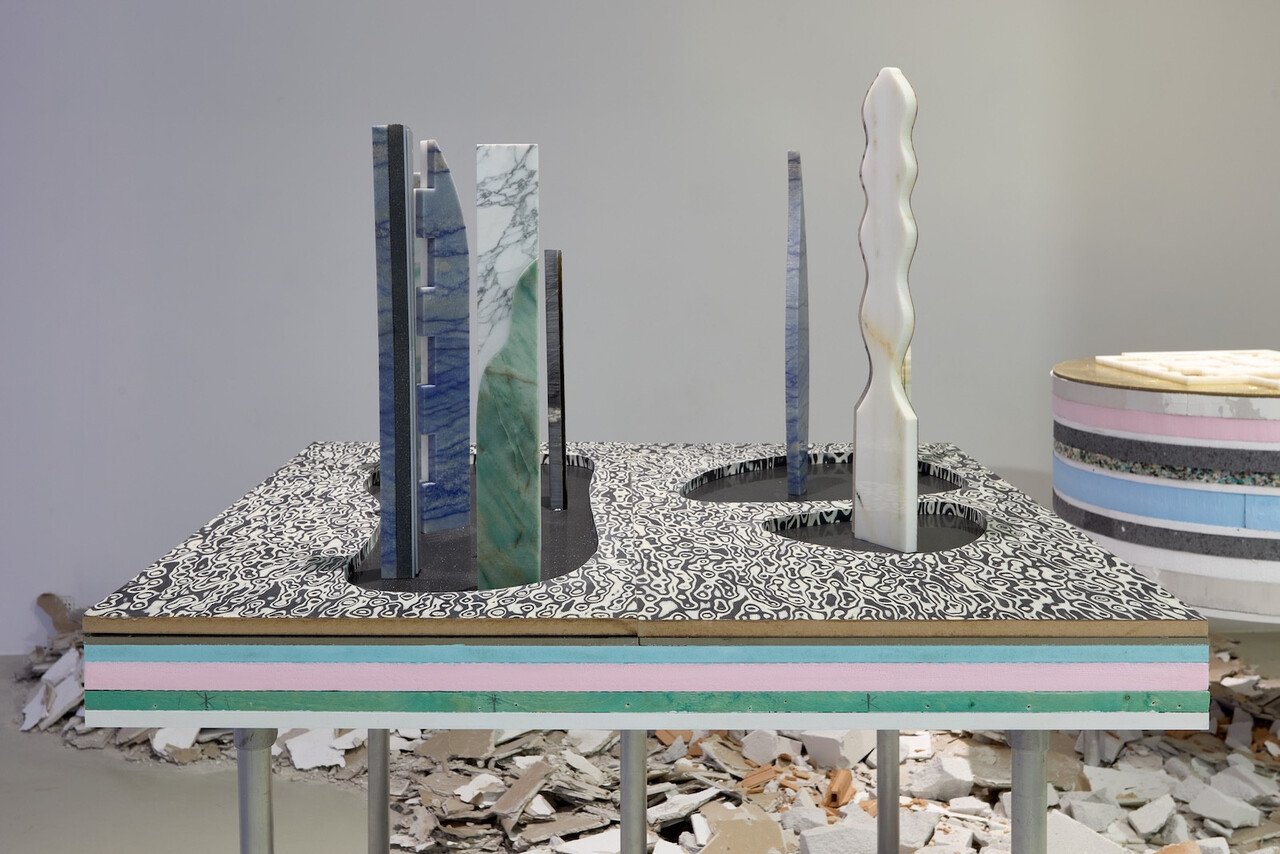
Image courtesy of Trafó Gallery.
Augé discusses the everyday experience that our ability to navigate the world is now linked to those solitary, transactional places – such as airports or restaurant chains – that are in some way connected to the worlds of commerce, transportation, and financial transactions. Although the buildings featured in the exhibition were never intended to be accessible or open to the general public, Asset Town highlights how the management of urban space with the goal of maximizing financial profit empties our spaces and strips them of their value beyond speculation. “The space of non-place creates neither singular identity nor relations, only solitude, and similitude” (Augé 2012, 60, tr. John Howe). There are no communities, no stories, and no added cultural dimension. Their sole purpose is the storage of wealth. Asset Town is a startling thought experiment exploring what it would be like to concentrate these properties within a city, and it is here that Augé’s theory becomes truly relevant. Just as the goal for non-places is to create easy, quick navigability and streamlined passage, the goal for Asset Town is to ensure secure storage conditions for accumulated surplus wealth. And while the problem of storing wealth on such an extreme scale is a headache for relatively few people – and let’s face it, for most people, the problem is precisely that they have nothing to store – the problem of the economic elite becomes a problem for all of us as soon as they put our urban spaces and opportunities at risk.
All in all, the exhibition serves as an excellent illustration of Schmied’s creative practice, which straddles the boundaries between investigative journalism, sociography, and the visual arts, bringing together both a documentary and an artistic approach. The exhibition consists of two video installations, brochures, pamphlets, and a central spatial installation, with the construction rubble covering the floor of the exhibition space forming an integral part of the display.
Deconstruction serves multiple purposes here: on the one hand, it questions the professional integrity and moral responsibility of architecture; on the other, it symbolizes the drastic decline in the accessibility of our urban spaces and the standard of living of “ordinary people.” The exhibition is characterized by a constant alternation between reality and fiction, the symbolic and the concrete, thus becoming both a symbolic repository of the documents collected during the research and a discursive space for the presentation and critical reexamination of the issue at hand.
This text was written as part of the mentoring program for emerging art critics developed jointly by the Hungarian, Polish, and Slovakian sections of AICA. The program, now in its second year, seeks to support art critics at the beginning of their professional paths, while strengthening the networks of solidarity and exchange that connect the contemporary art scenes of Central and Eastern Europe. Committed to creating sustainable conditions for art criticism at a time when independent platforms for critical writing are under increasing pressure across the region, this program maintains a collaborative approach to mentorship. For this edition, the editors of MOST Magazine mentored the participants from Poland and are responsible for publishing the resulting texts from all three sections.
Hungary
Authors: Sára Vera Bodor, Kata Martincsák, Dóra Vázsonyi
Mentors: Jan Elantkowski, Réka Majsai, Hedvig Turai
Translator: Kata Balázs
Coordination: Kata Balázs
Co-coordination: Tamás Don
Poland
Authors: Ida Dziublewska, Wojciech Grum, Łucja Staszkiewicz
Mentors: Ewa Borysiewicz Vera Zalutskaya, Kathryn Zazenski
Translator: Ewa Borysiewicz
Coordination: Arkadiusz Półtorak
Slovakia
Authors: Ema Brestovanská, Sofia Suzziová, Gregor Zimmermann
Mentors: Daniel Grúň, Adrián Kobetič, Lucia Miklošková
Translator: Kamila Talarovič
Coordination: Peter Megyeši
Artist: Andi Schmied
Exhibition Title: Asset Town
Venue: Trafó Gallery
Place (Country/Location): Budapest, Hungary
Dates: 10.04.2026 – 14.06.2026
Photos: Dávid Biró
- Építészfórum. 2024. “The Hotel Budapest (Körszálló) to Be Demolished and Rebuilt.” Építészfórum, October 30. Accessed September 2, 2026. https://epiteszforum.hu/lebontjak-majd-ujjaepitik-a-budapesti-korszallot ↩︎
- Szabó, Milán, and Anna Ürmössy. 2023. “How Can Public Space Become Exclusionary? The Story of the Corvin Quarter.” Mérce, August 28. Accessed September 2, 2026. https://merce.hu/2023/08/28/hogyan-valhat-kirekesztove-a-kozter-a-corvin-negyed-tortenete/ ↩︎
- Partizán. “Vagyonfalva: What Is the City of Billionaires Like? An Interview with Andi Schmied.” Live broadcast, May 28, 2026. Accessed September 2, 2026. https://www.youtube.com/watch?v=T4kz1RDA9U8 ↩︎