Liene Rumpe
In Agate Tūna’s work, a photograph rarely remains as a single fixed image. It may begin as a frame on a roll of film, become a scan, be divided into thousands of fragments, printed, cut apart, scanned again, enlarged, bent, or transferred onto plexiglass or aluminium composite plates. It is remembered, staged, transmitted, misread and transformed. With every transfer, Tūna tests what can be shed while something of the first exposure continues to travel in a different carrier.
Her exhibitions develop by the same principle. Each begins inside a question left open by the previous one. A family archive draws her towards spirit photography, anomalies caused by the camera acquire lives of their own, from there, the ghost enters electronics and returns as data. The sequence proceeds through recurrence, as an earlier work creates the conditions for a later one.
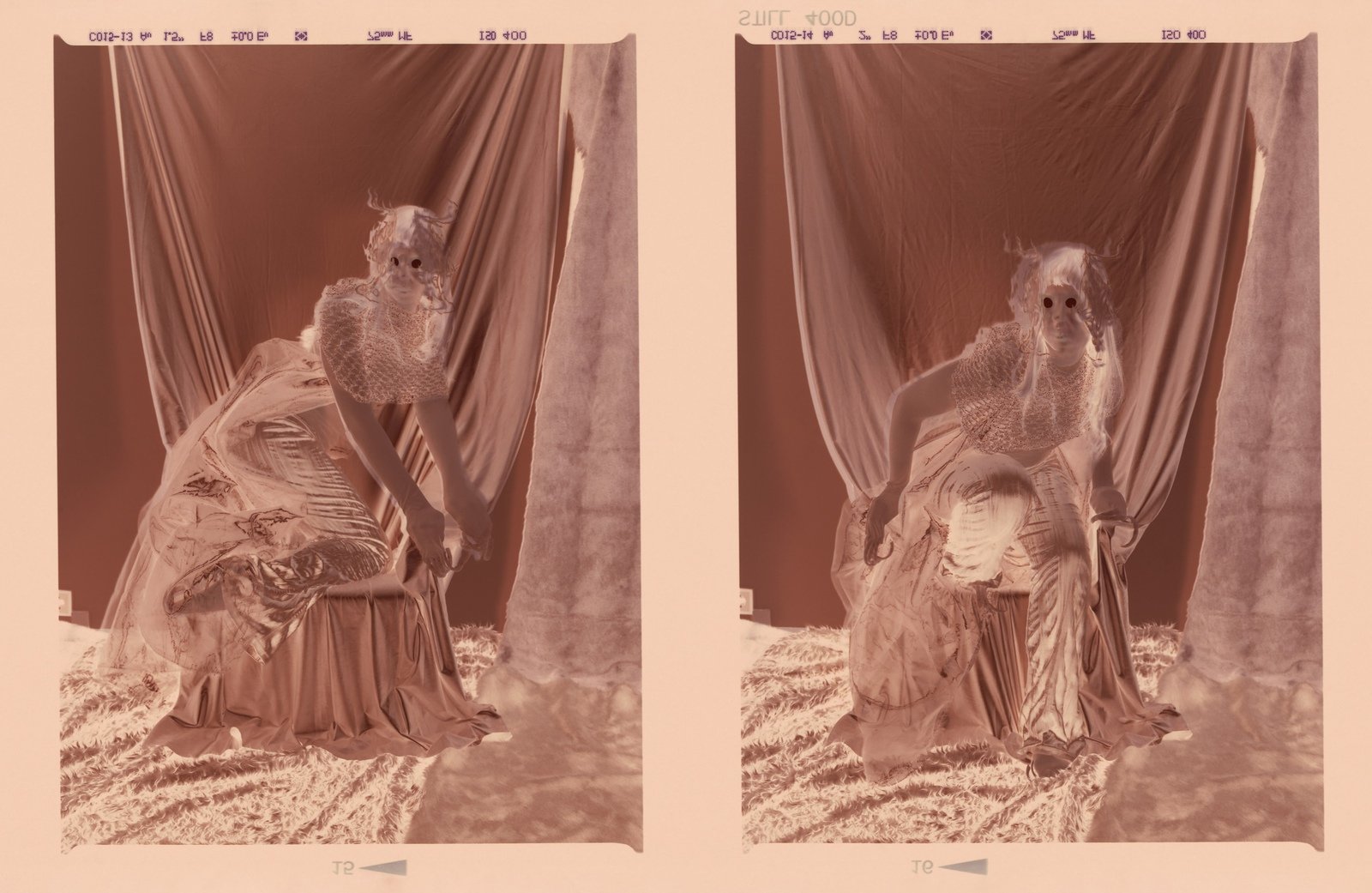
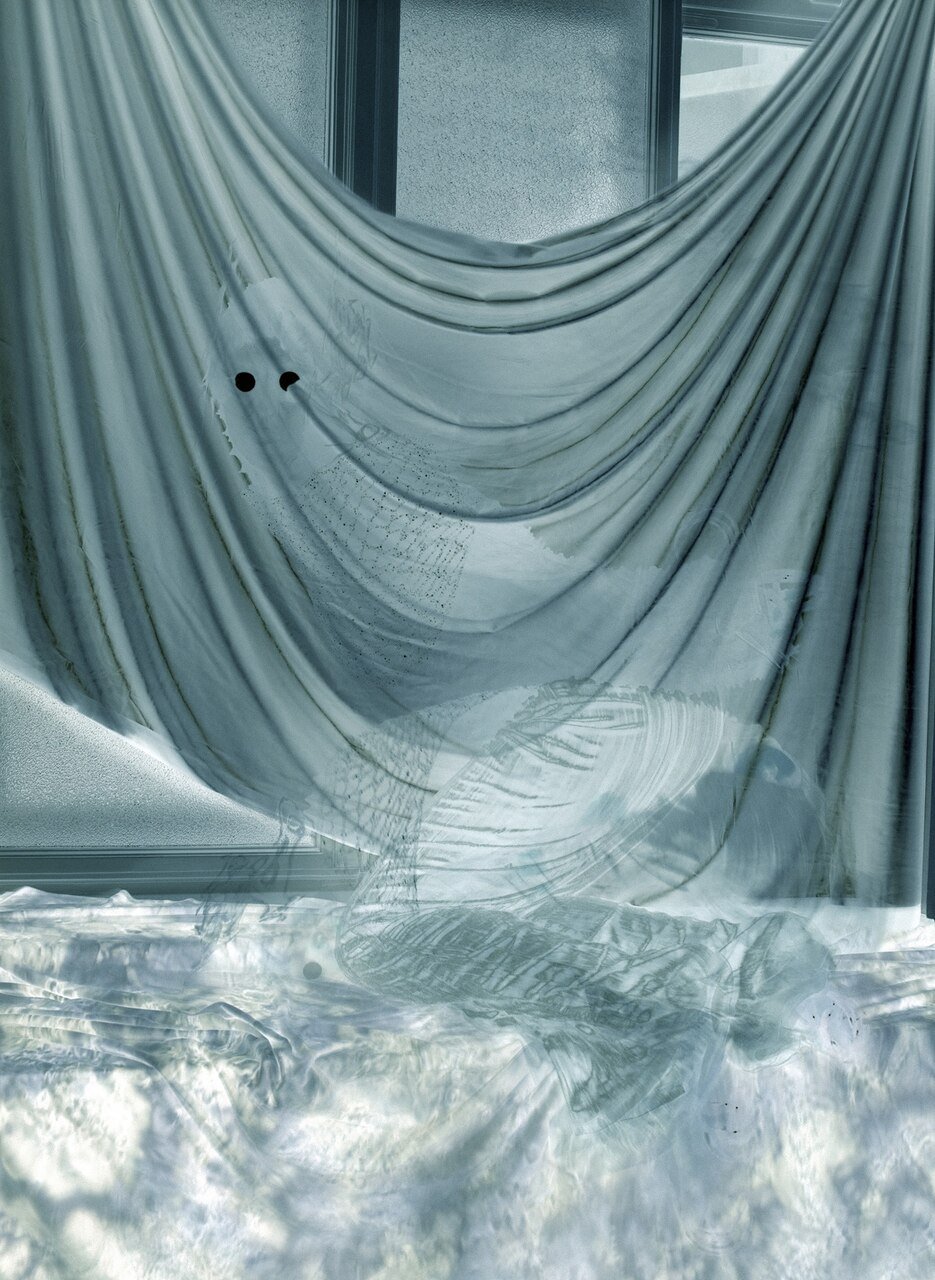
Tūna started her artistic journey training as a painter, and the habits of painting remain visible in how she builds a photograph. Fabric sets the color and spatial weight of a scene. A veil can disrupt a figure and a mirror opens an unstable second plane. During an Erasmus semester in Lisbon in 2019, she discovered camera-less and chemically altered photography through chemigrams, photograms, and experiments with film. Developer and fixer became paints whose reactions were not always predictable or obedient. This negotiated authorship also governs her self-portraits. Tūna constructs the set and places herself within it. A brief exposure may require days of preparation. She works with different rolls, including expired film and emulsions altered through film “soups,” aiming to achieve as much as possible within the exposure and the material of the film itself. After development comes a rigorous selection — she may expose many rolls before one or two frames are chosen for an exhibition. Once scanned, the images receive minimal digital correction, usually limited to dust removal and slight adjustments to contrast. The result cannot be corrected during the performance — expired film or a leak of light may reorganise the scene. Vilém Flusser (1920–1991) understood the photographer as a player searching the camera’s program for unrealised possibilities. Tūna arranges the game, then the apparatus introduces a move of its own.
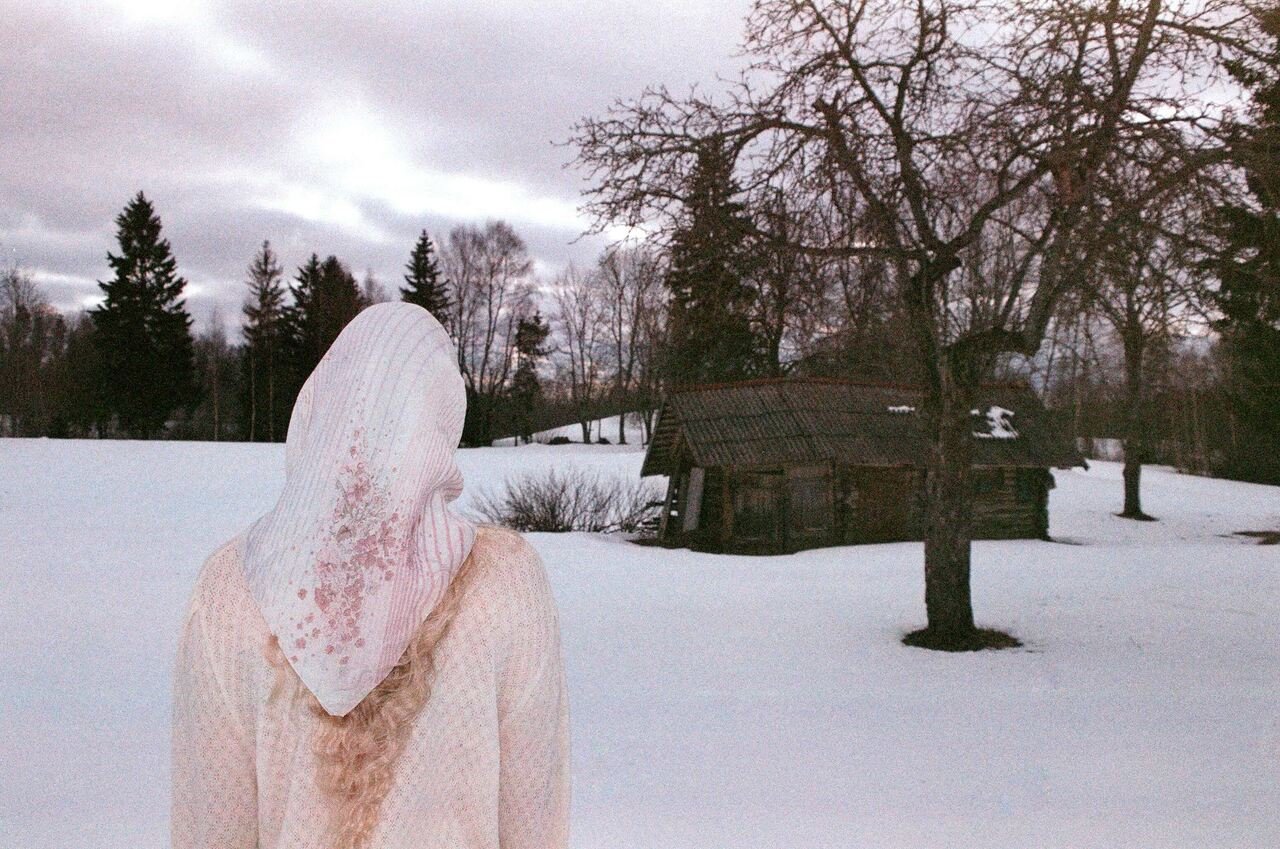
analogue photography. Image courtesy of the Artist.
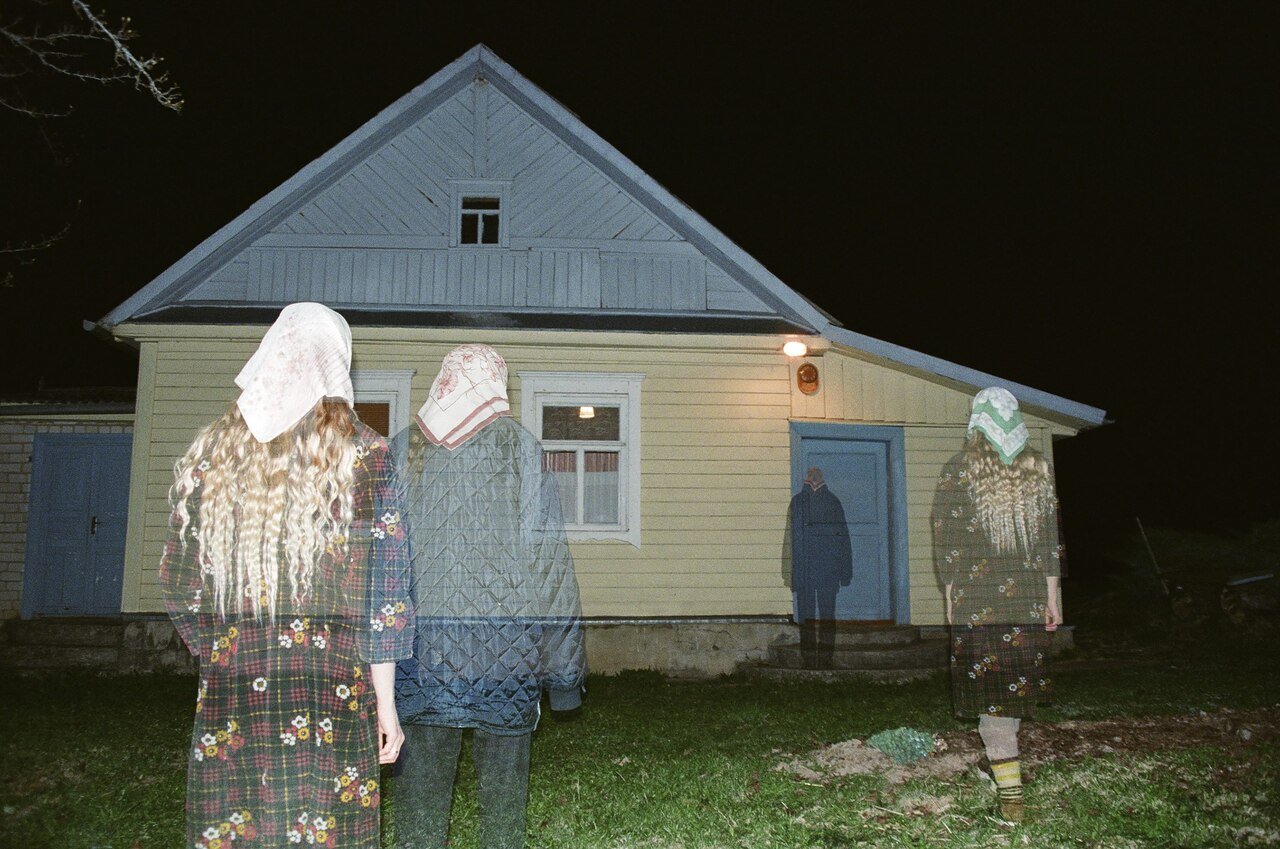
analogue photography. Image courtesy of the Artist.
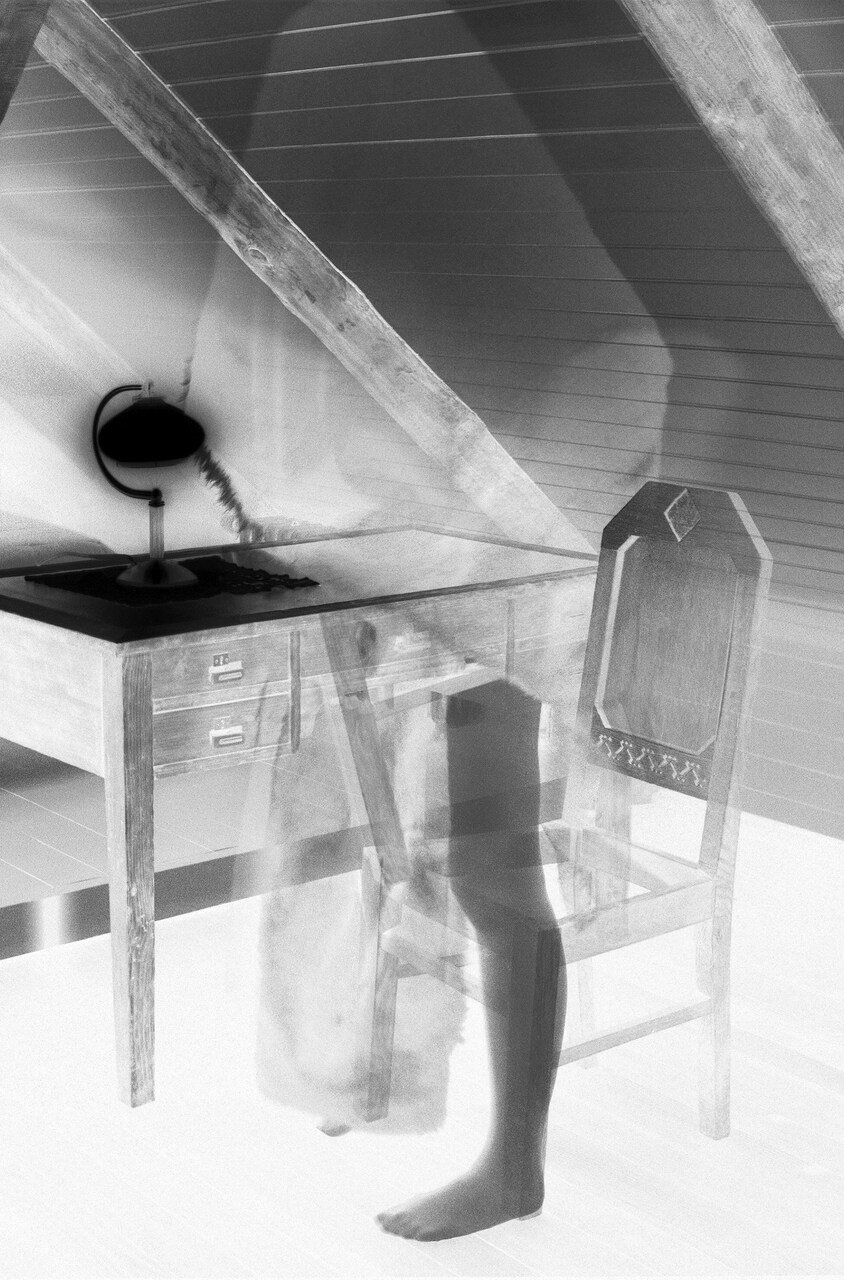
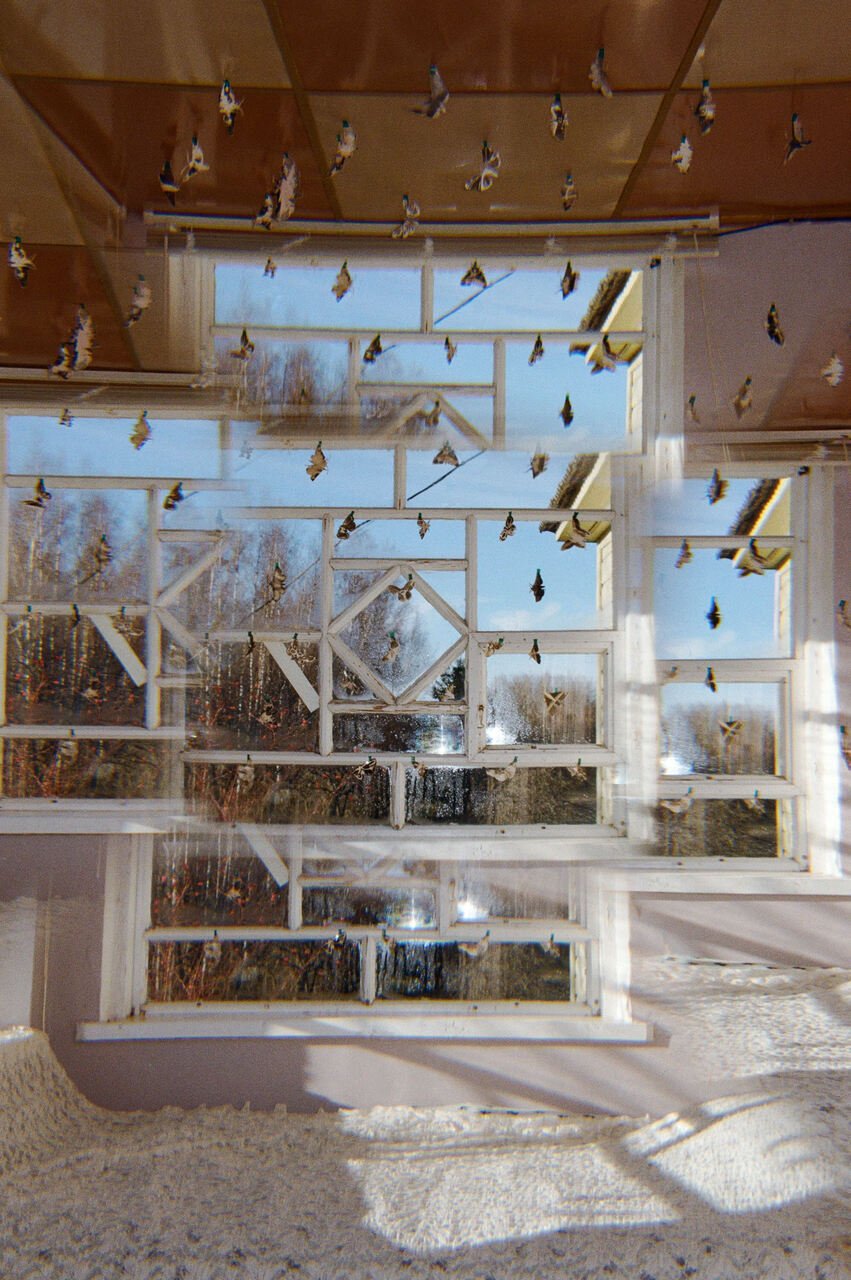
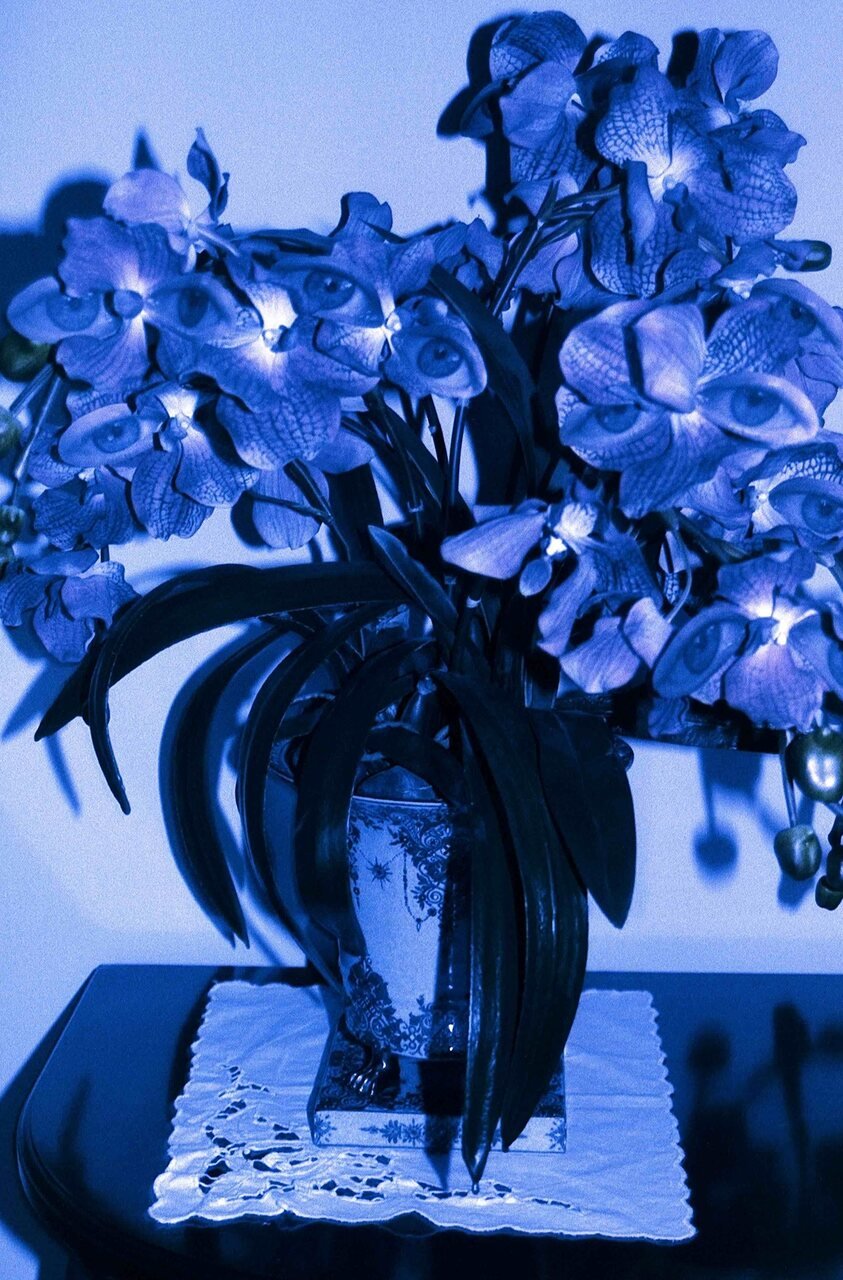
This tension has belonged to photography from the start. Its public invention in 1839 preceded the rise of modern Spiritualism by less than a decade; by the early 1860s, William H. Mumler (1832–1884) was producing portraits in which pale figures appeared beside the living. Spirit photography tested the camera’s authority almost as soon as it was established. Multiple exposure, composite printing, and prepared props supplied many such effects. Knowledge of the trick did not always cancel its emotional use. After the American Civil War, even a dubious photograph could offer a comforting meeting with the dead.
Tūna’s route into this history passed through her own family. When her grandmother developed dementia, she began recording stories about the Pond House in the rural region of Latgale, Latvia, inhabited by seven generations of her ancestors. Among them were healers and women who knew incantations. Everyday life had scarcely been photographed — a camera arrived when a neighbor or visitor brought one. A small inherited book of spells had also disappeared, perhaps burned, perhaps hidden between the floorboards. The house with its contents (furniture, textiles) had to carry what the photographic archive could not. The resulting series, The Pond House, appeared in the ISSP School graduation exhibition Under the Skin in Riga in 2022; in Language of Flowers at the Artists’ Union of Latvia Gallery in 2023; and most recently, in the group exhibition Gen Z: Shaping a New Gaze at Photo Elysée in Lausanne in 2025. In her solo show The Order of Invisible Things at DOM Gallery, Riga, in 2022, the analog camera became an investigative instrument and a ritual of courage for approaching ancestral practices concealed during the Soviet period.
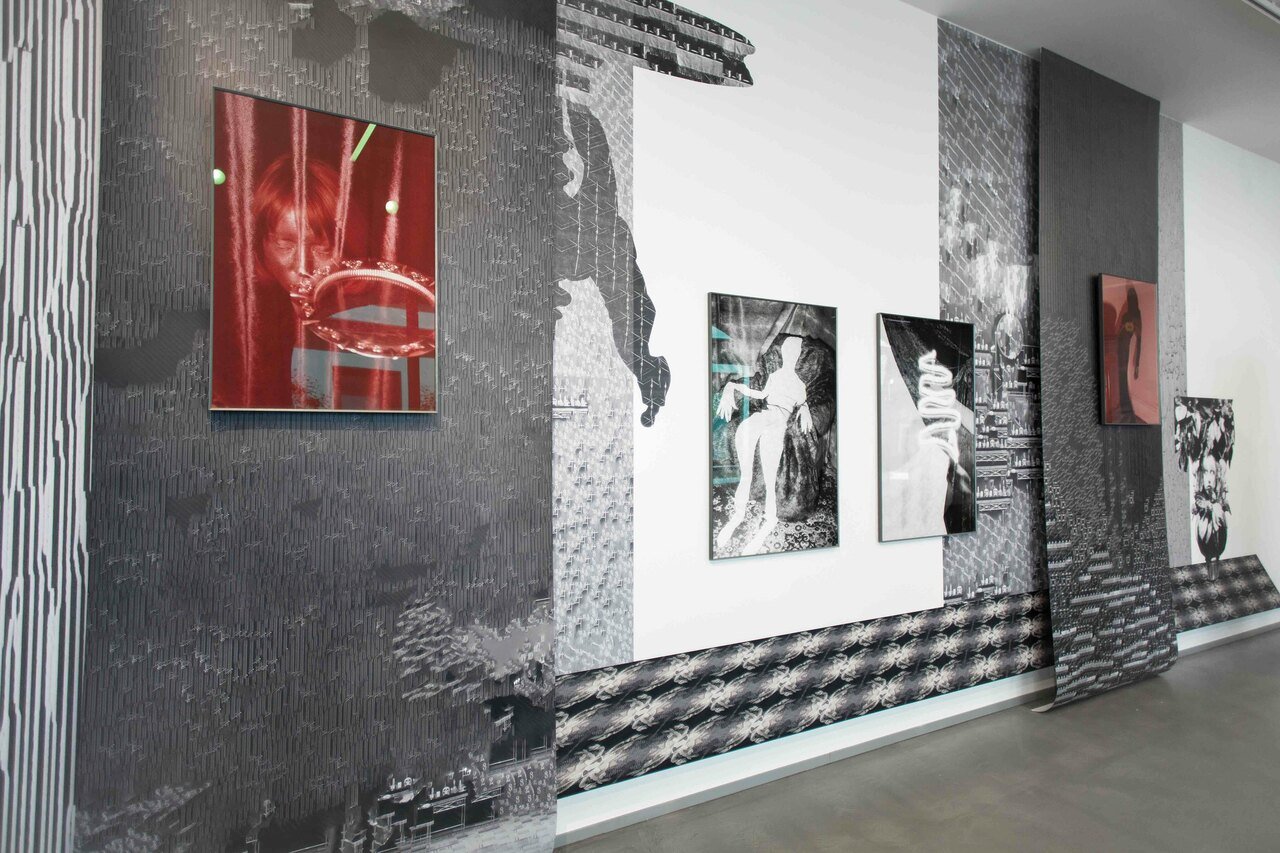
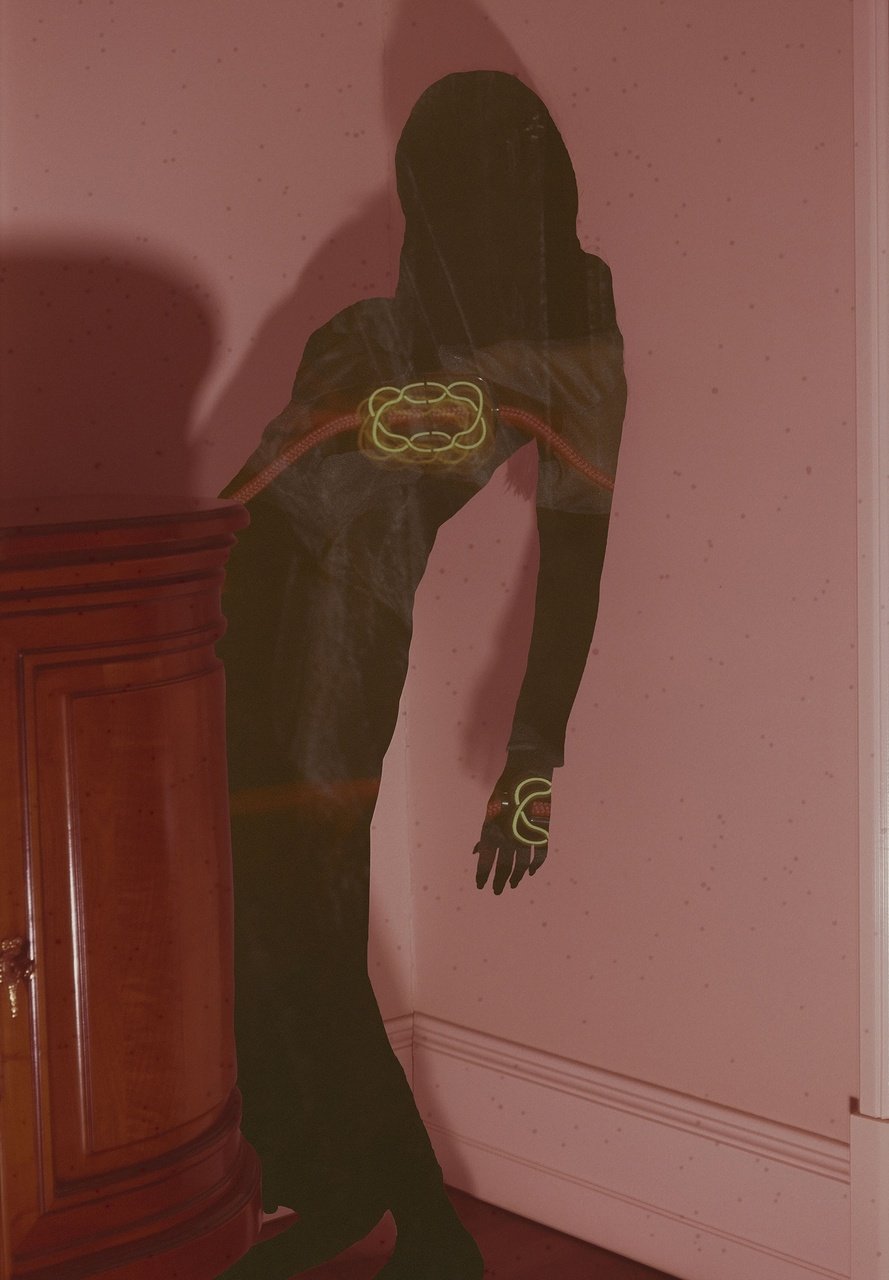
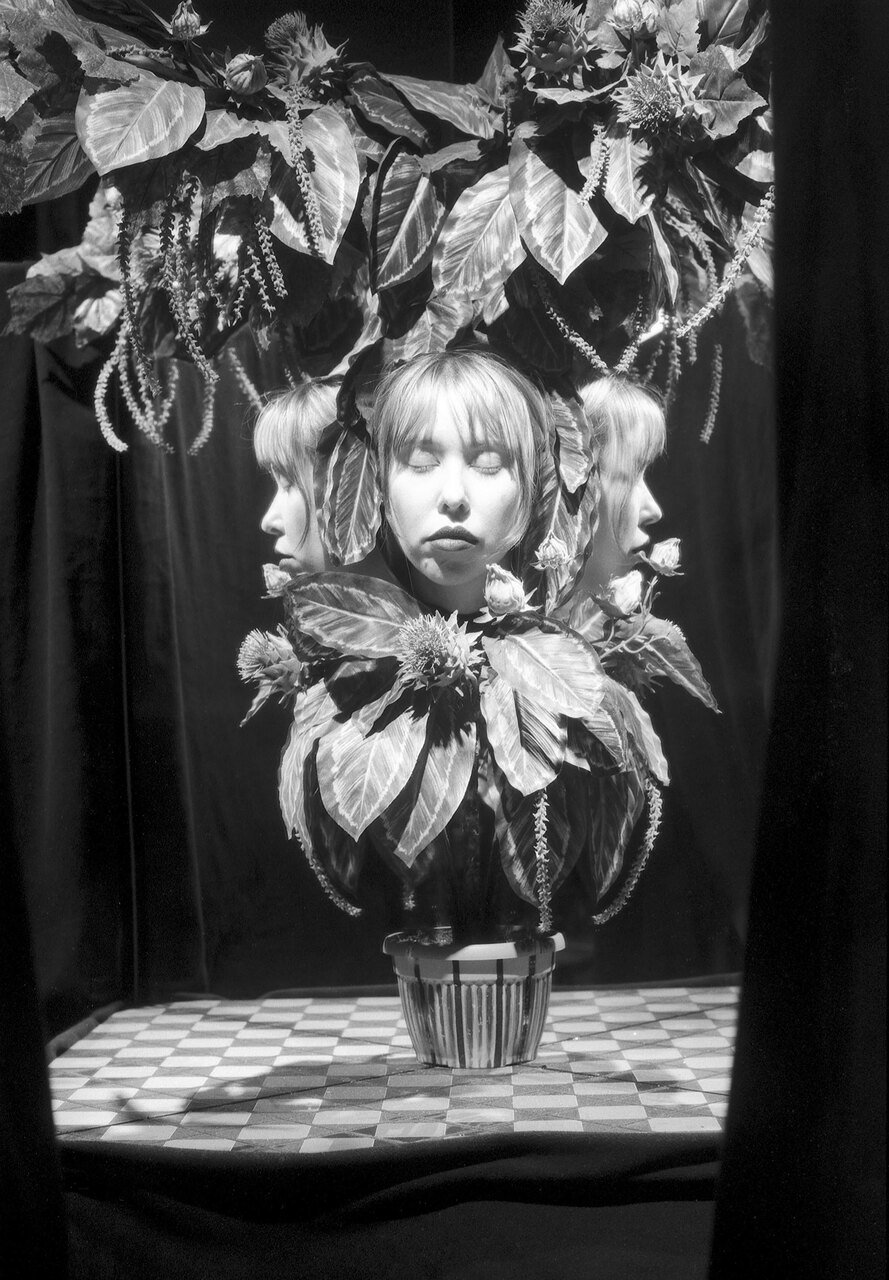
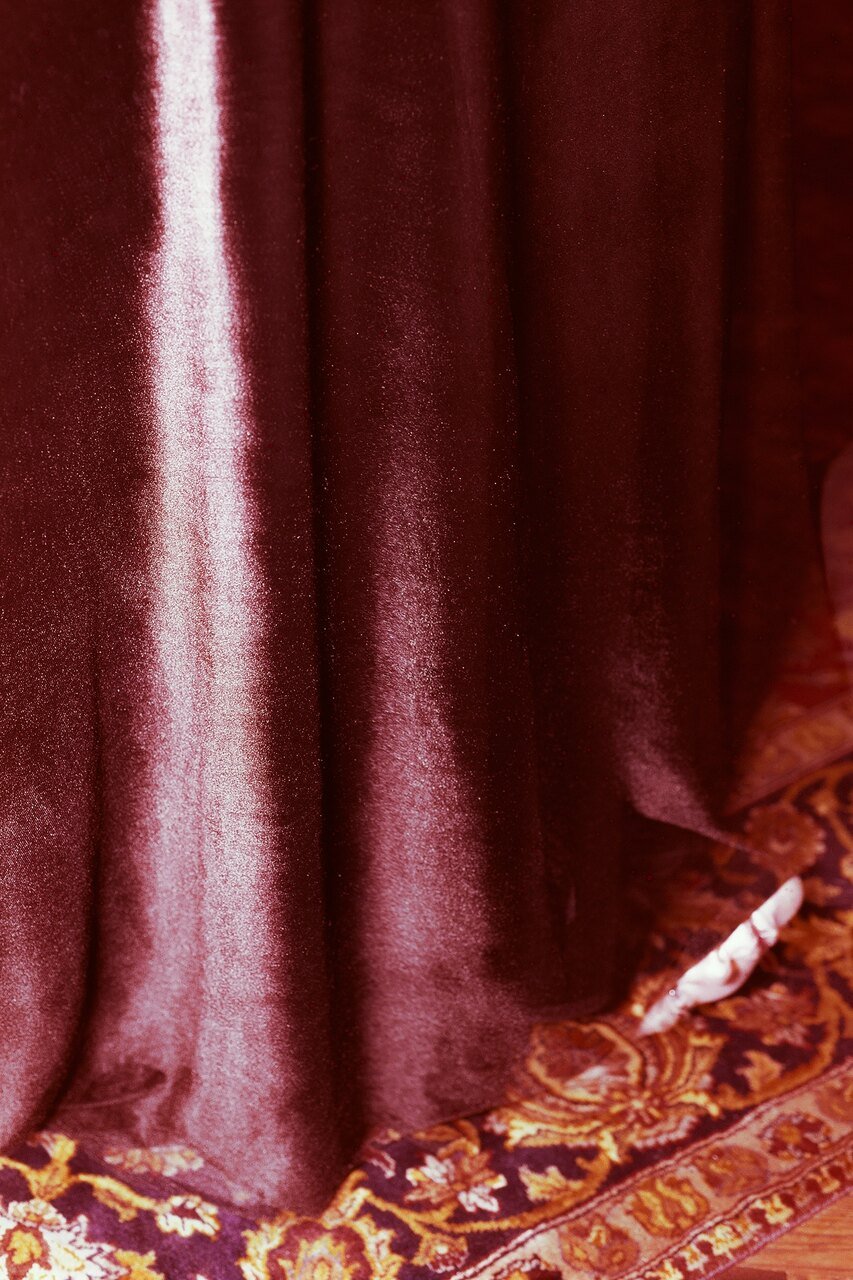
The aspect of missing photographs becomes active in Who Has Come Here?, presented in Contemporary Histories of Photography I at the ISSP Gallery during the 2024 Riga Photography Biennial. The exhibition text records a rumor that Voldemārs Priede and Mārtiņš Buclers documented séances with the clairvoyant and photographer Eižens Finks, yet no evidence has surfaced. Tūna answers the gap by staging possible versions of an absent archive. Her body serves as photographer, model, and medium. Séance and stage illusion meet in props, pose, and exposure. The project also widens photographic history. Occult, scientific, and journalistic images often remain misclassified or overlooked in local collections. A 1961 Soviet newspaper excerpt condemning mediums as fraud exposes a political edge of the problem — official disbelief shaped what could be stored and studied, while credulity shaped what a photograph was asked to prove.
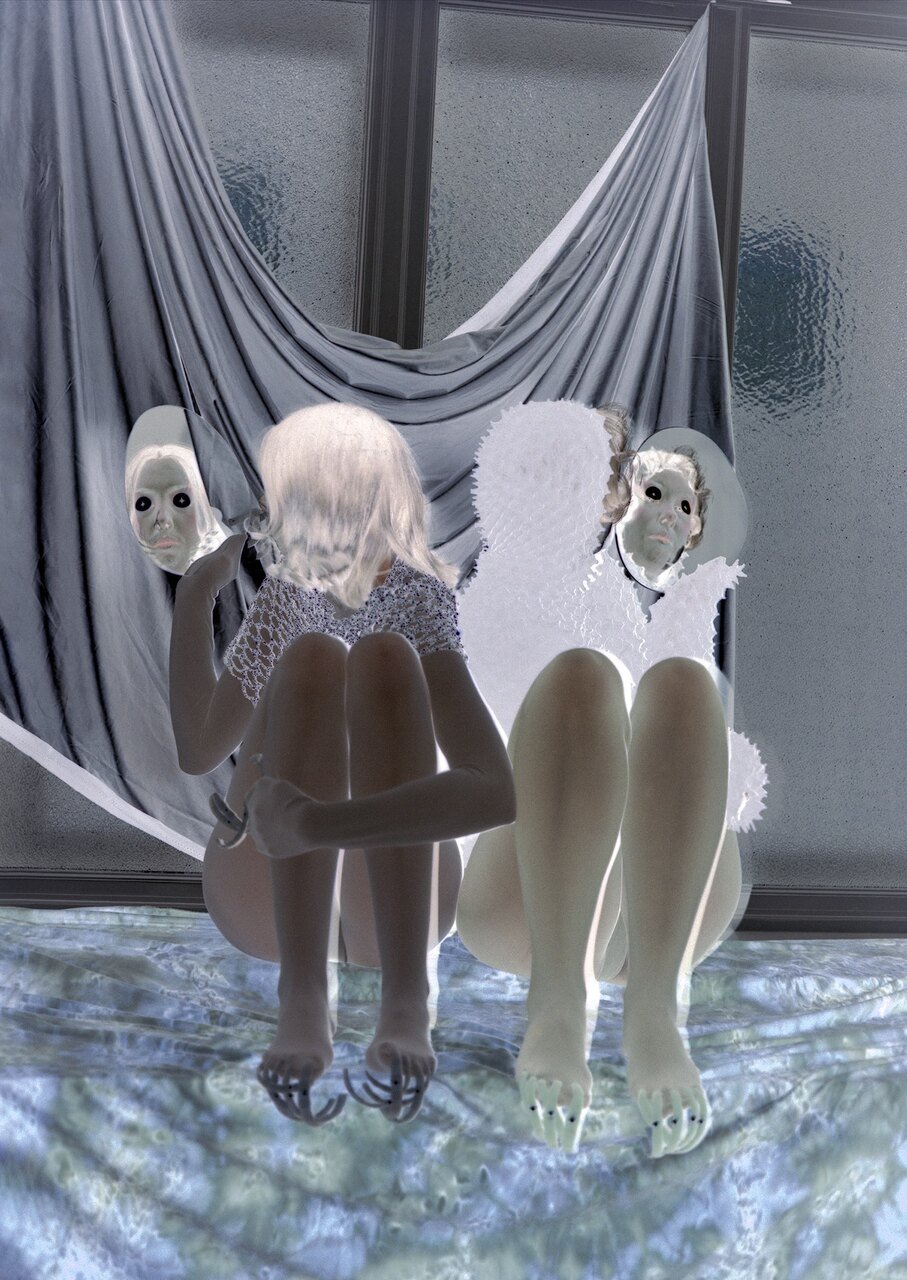
The word medium becomes useful in both of its meanings. Photography is a technical medium; in Spiritualism, it names the body through which another presence supposedly acts. That body was often female and monitored by male investigators, with some exceptions. During séances held in Turin in 1908–09, the spirit guide of Italian medium Linda Gazzera reportedly instructed when photographs should be taken. Tūna occupies this complicated position knowingly. Chosen set design materiality recalls historical methods used to capture the spirits. Veils and wrappings recall the muslin and paper ghost cut-outs similarly as a family blanket carries a history of women’s work. The handmade absurdity is even enhanced, reminiscent of low-budget science fiction with artificial long nails or a furry shape. Fear is given a costume and made to hold still. As Tūna says, the task is to “make friends with ghosts.” Friendship proves more useful than belief, because it involves play and a special kind of tolerance for unreliable behavior.
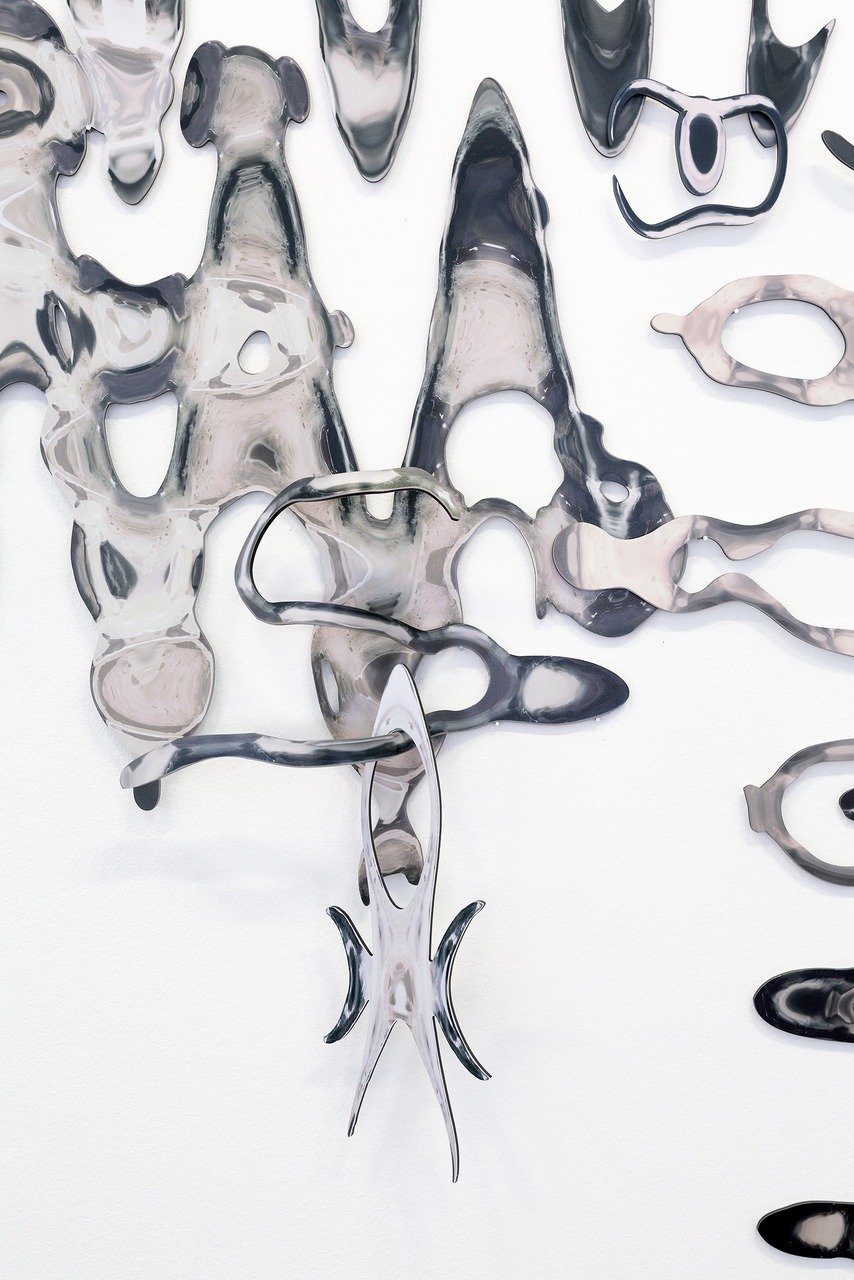
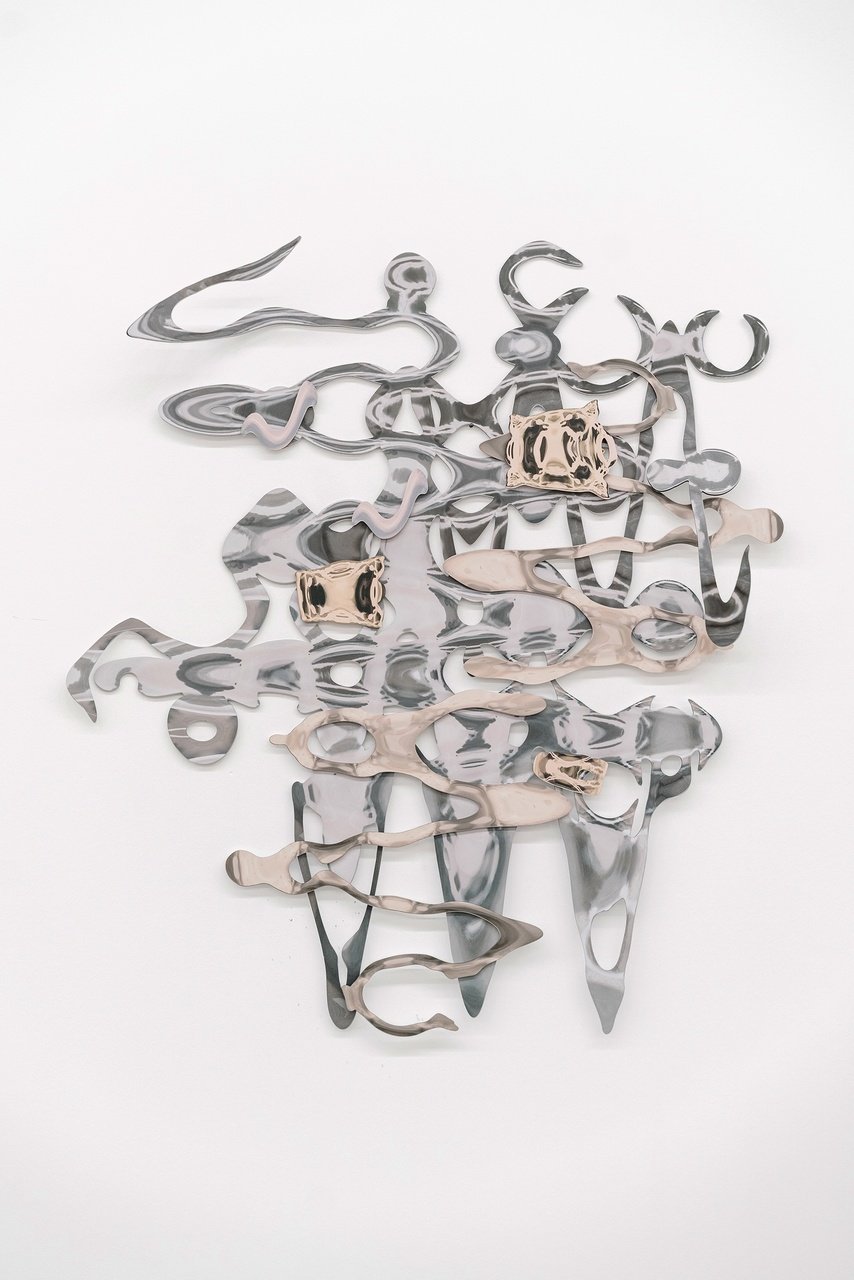
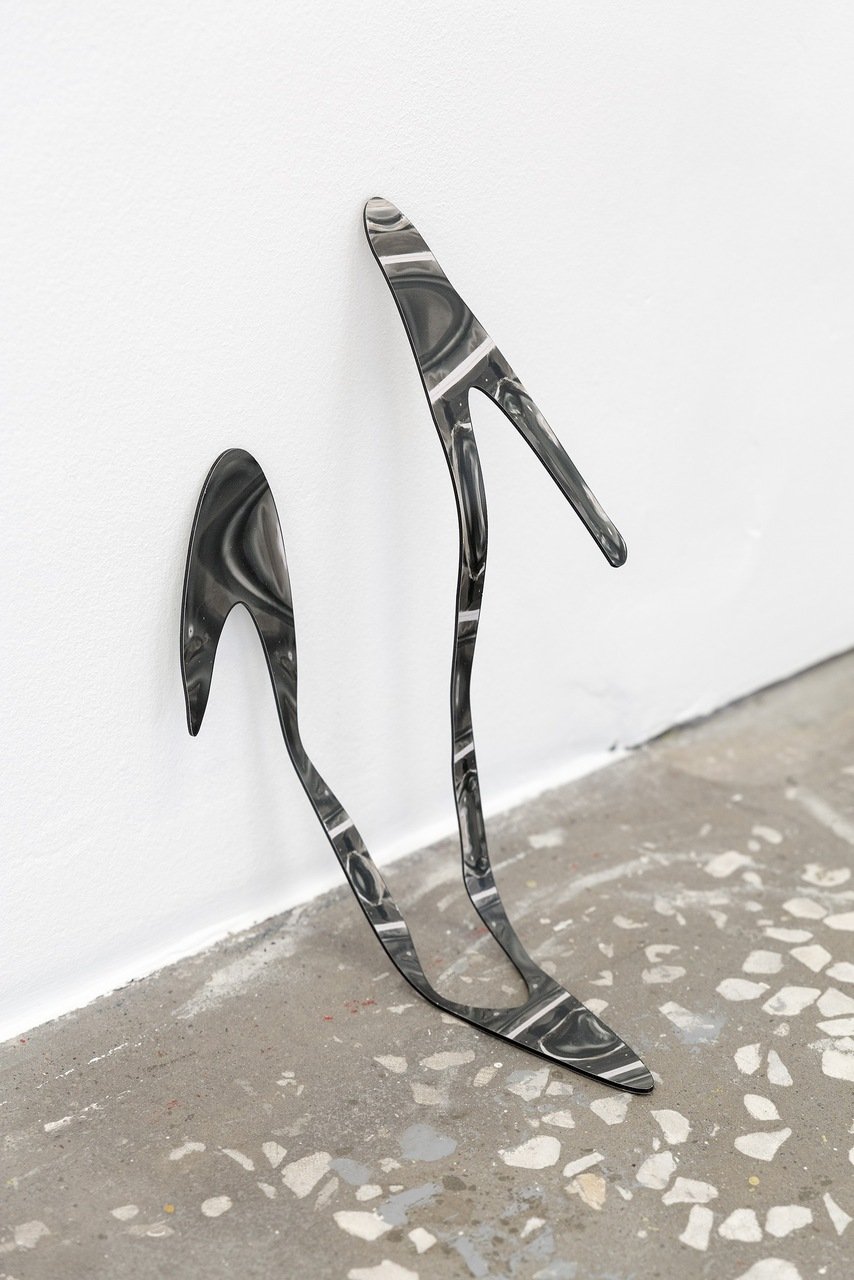
Her chemigrams bring the same problem to the photographic surface. Gilbert Simondon (1924–1989) called such development transduction: each operation alters the field from which the next one emerges. Film, scanner, software, and exhibition support function as phases in this process, so the work itself takes form through the passage. Understood as such, the photograph crosses from analog to digital without a clean historical break. By Techno-Spectre (POST graduation exhibition, Slokas iela 18, Riga, 2023), the ghost had moved into ordinary data life — like a selfie or message that persists on a forgotten hard drive. Tūna gives physical form to this survival as photographs bend away from the wall or settle into shaped plexiglass. The mineral basis of those media emerges in Grains of Sand and Screens, shown at PILOT Gallery, Riga, in 2024–25. Sand, glass, silicon, and screens place geological time inside technologies usually experienced as immediate. Jussi Parikka’s (b. 1976) “geology of media” locates electronic culture in the minerals on which it depends. Quartz and silicon connect the darkroom to the computer.
In the solo exhibition Voltentity (ASNI Gallery, Riga, 2025) the problem shifts towards calibration. Quartz stabilises frequencies in cameras and military radios, and it has also accumulated esoteric claims about stored energy and communication. The exhibition begins from a 1990 Rīgas Balss story about Atlanteans using crystals as a power source, placing fantasy beside the mineral’s piezoelectric work. Copper wire, mirrors, wallpaper, and furniture turn the domestic interior into an electromagnetic field. The body appears as receiver, conductor, and possible source of interference. The title joins voltage to entity.
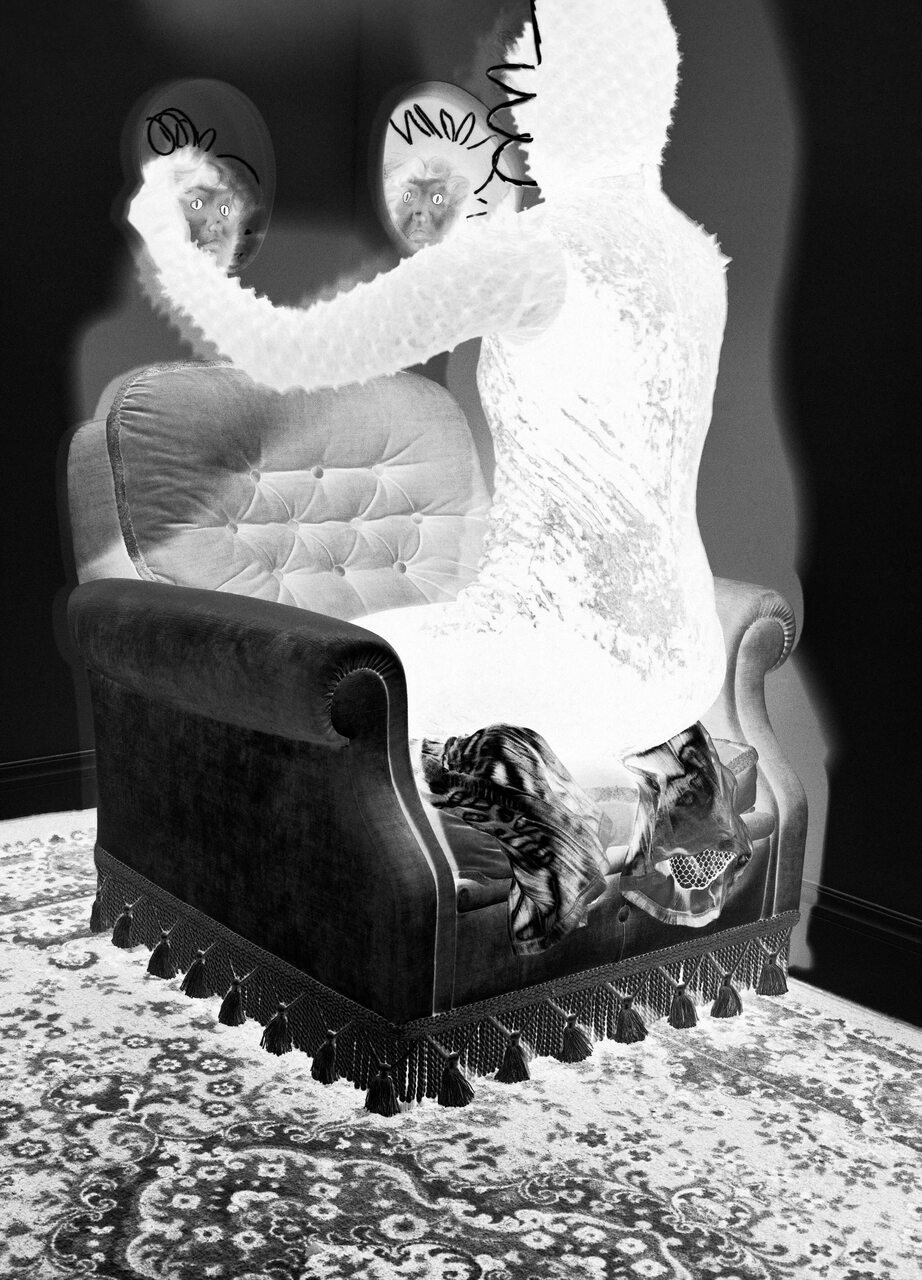
analogue photography. Image courtesy of the Artist.
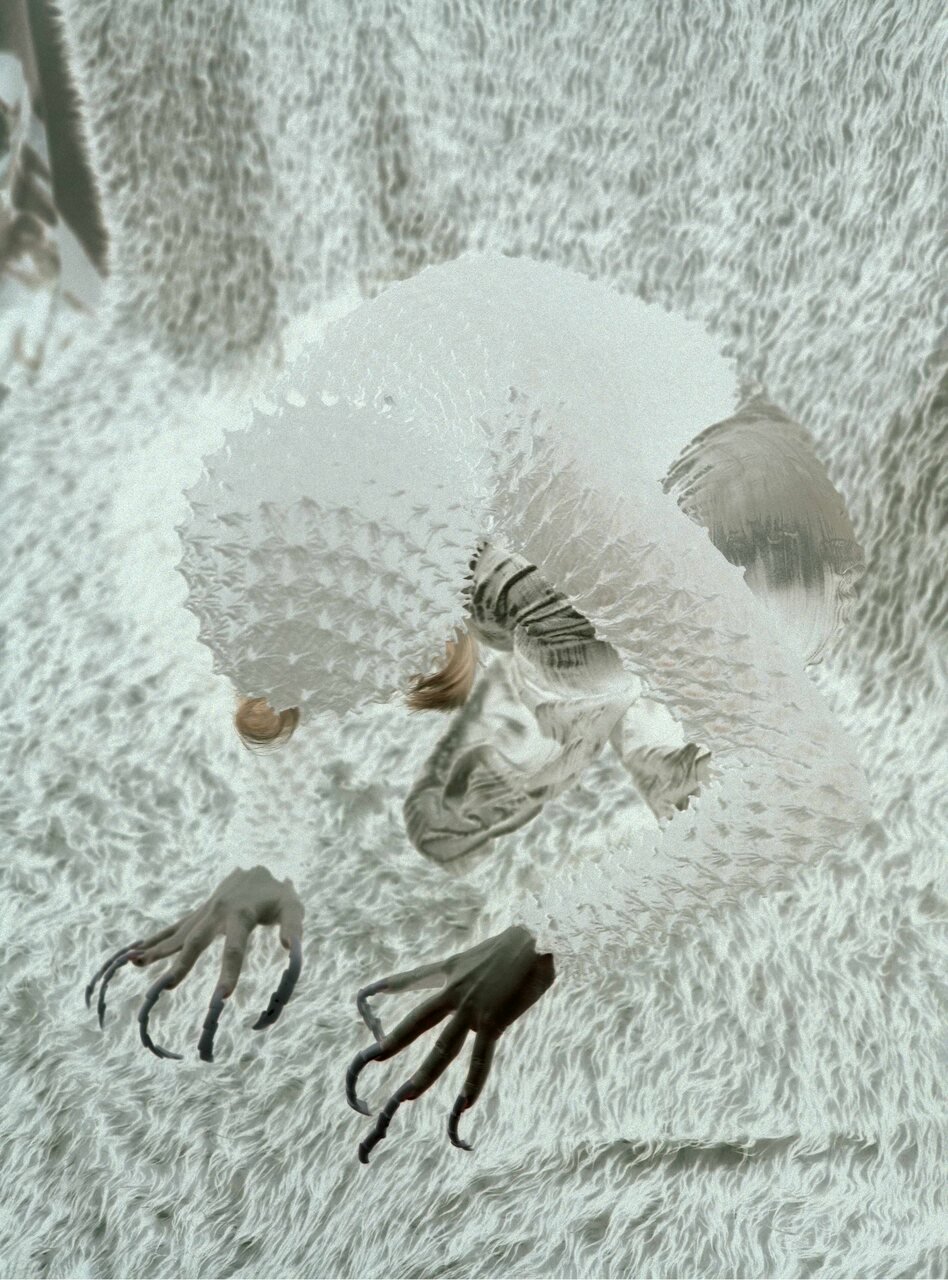
analogue photography. Image courtesy of the Artist.
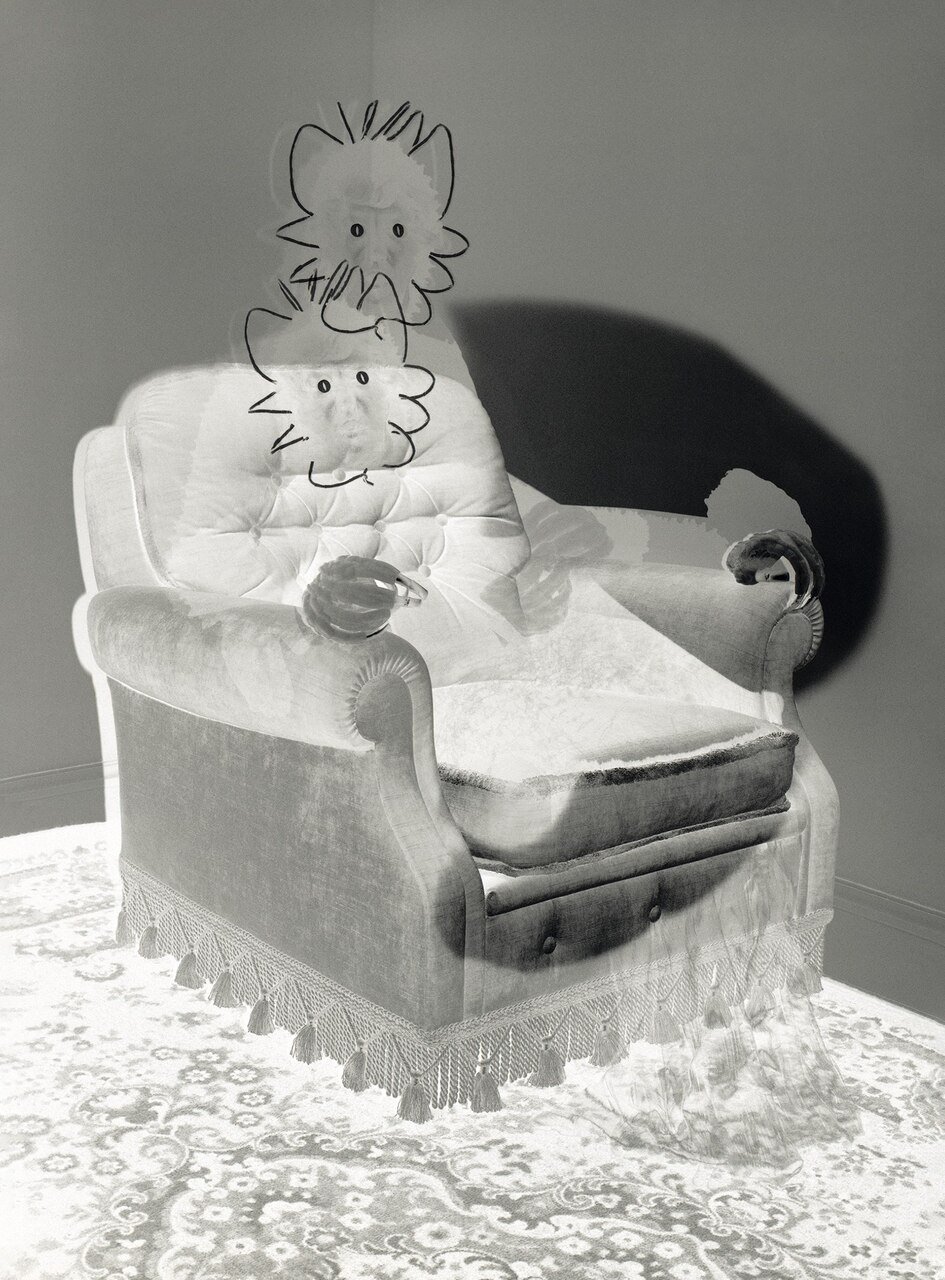
analogue photography. Image courtesy of the Artist.
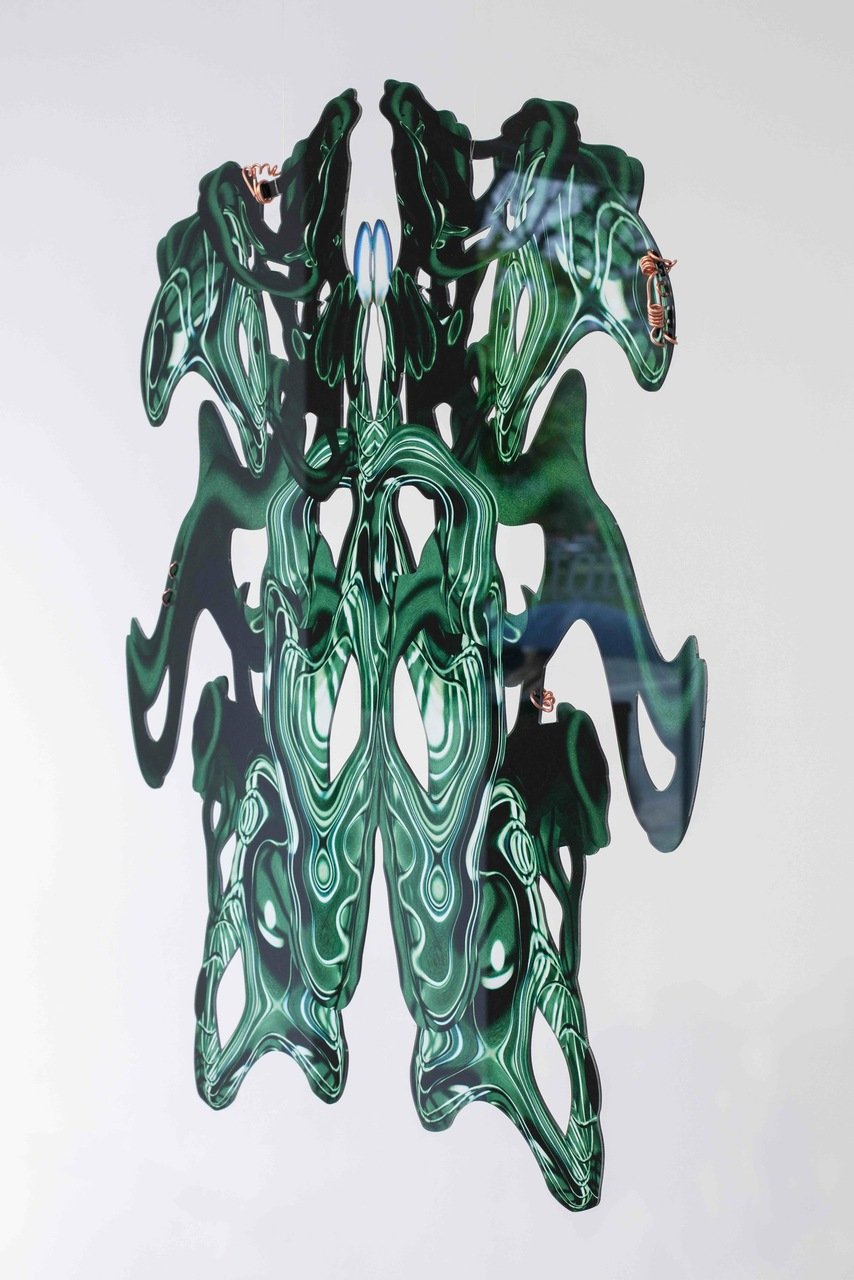
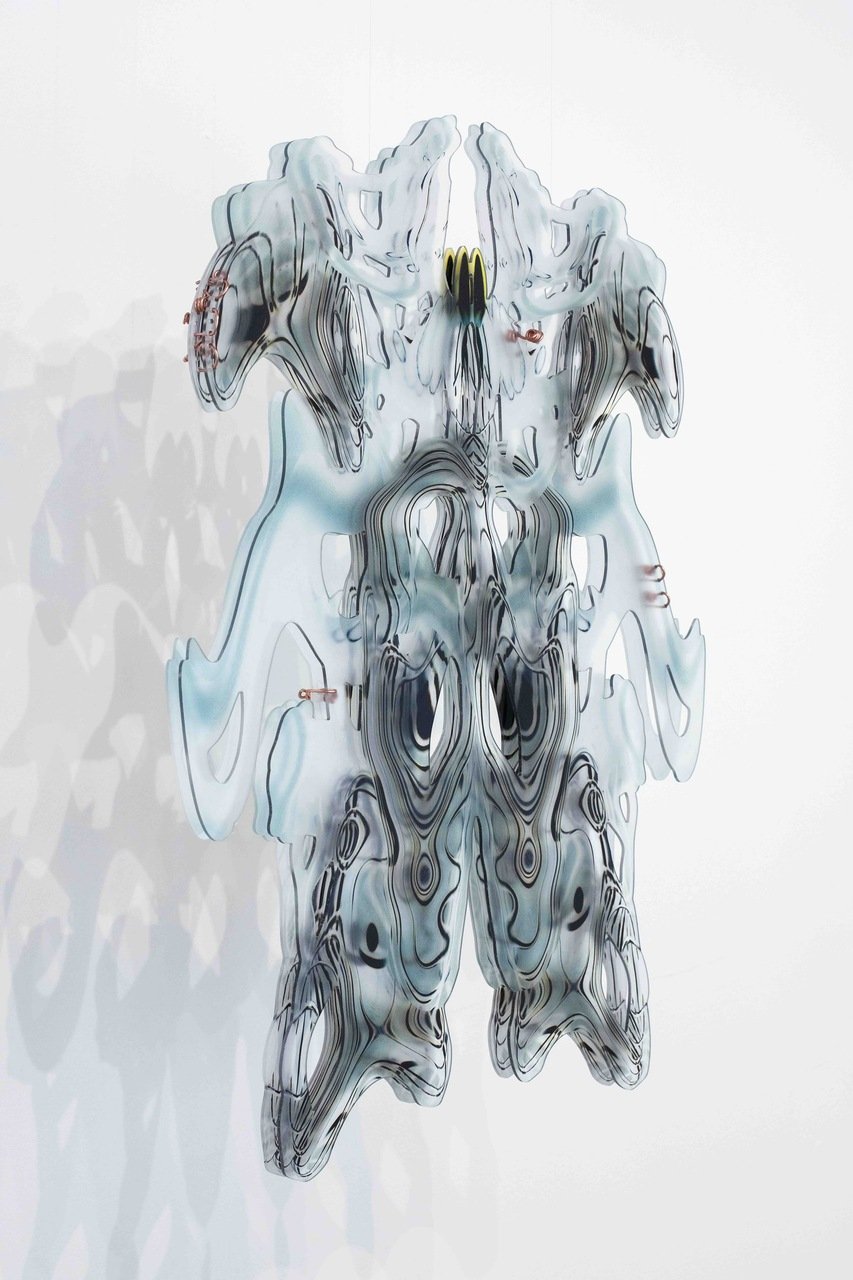
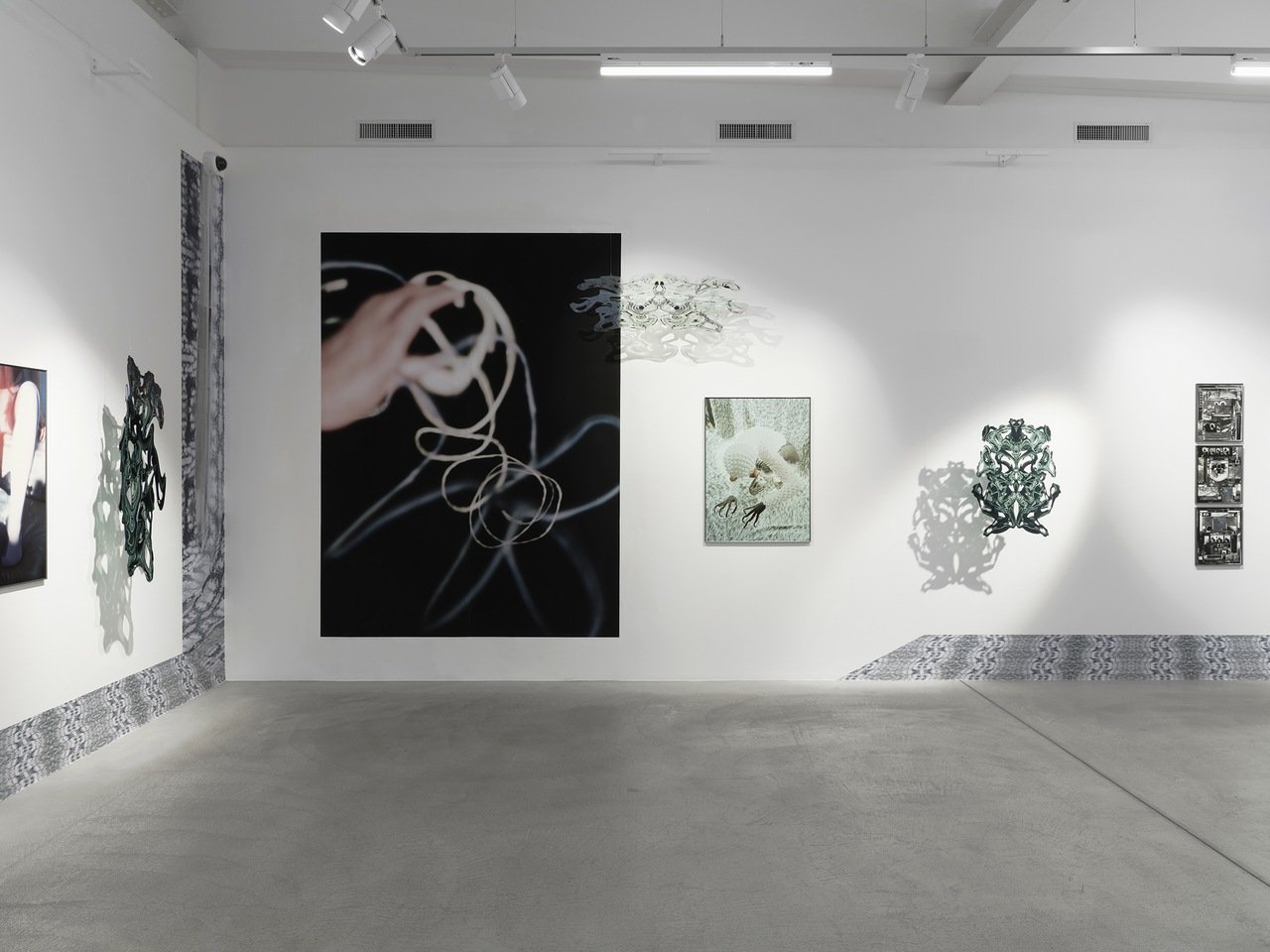
Tūna was also struck by the 1943 industrial film Crystals Go to War, in which women with styled hair and painted nails grind quartz for wartime communications. Femininity, precision, and war production occupy the same gesture. These aspects lend themselves readily to curatorial framing through the lens of spiritual feminism, drawing attention to suppressed knowledge and gendered labor. But Tūna herself does not adopt this term as a definition. In her work, technology and intuition are already too entangled. A spiritual feminist reading might arrange these elements into a familiar opposition — rational technology on one side, embodied feminine intuition and suppressed occult knowledge on the other, with the latter reclaimed as an emancipatory truth. Tūna’s work does not sustain that division. The image of women grinding quartz for wartime radios places femininity within technical labour, while intuition operates through calibrated cameras, chemical processes, and precise preparation. Quartz belongs simultaneously to radio engineering, military production, and esoteric speculation. Scientific, technological and Spiritualist systems emerge as parallel attempts to register, transmit, or store forces that remain unseen, each producing its own forms of evidence and uncertainty. Spiritual feminism therefore illuminates the work’s gendered histories of labor and expertise, yet cannot fully account for a practice that keeps these modes of knowledge entangled and grants none of them final authority.
Deleuze’s crystal-image offers another route through this entanglement. In a mirror, the actual figure and its virtual image form a circuit; the copy can become as present as its source. For the group exhibition Under the Sun (TUR Art Space, Riga, 2025, organised in collaboration with 1646 in The Hague), Tūna divided one negative from Voltentity into roughly 2,500 fragments, cut them out and scanned them again. Four large works emerged. She calls the pieces “creative parasites.” They suggest bugs, glitches, or unidentified aircraft, while the first photograph survives as a host that no longer controls its descendants.
Her solo exhibition Familiar (Gallery 427, Riga, 2026) brought these concerns together. Its title referred to the familiar spirit — a non-human companion traditionally attached to a witch or magical practitioner — but also to familiarity as an unstable condition of recognition. In the exhibition, photographs of Tūna and her sister appeared on paper, aluminium, and monumental sheets of glass. The figures seemed to move between self-portrait, apparition, and alter ego. Their collaboration invoked the history of sisters within spiritualist culture – from the Fox sisters (Margaretta “Maggie” Fox, 1833–1893 & Catherine “Kate” Fox, 1837–1892), whose séances helped popularize Spiritualism in the nineteenth century, to the Cottingley cousins (Elsie Wright, 1901–1988 & Frances Griffiths, 1907–1986) and their disputed photographs of fairies that persuaded even Arthur Conan Doyle (1859–1930). Yet Familiar depended less on deception than on a shared secret: the sisters know how the images were made while the viewer is left to negotiate between technical explanation and imaginative response.
Across Tūna’s practice, visibility never guarantees knowledge. She controls the room, costume, body, and moment of exposure, then waits for the camera to answer. The few frames that survive her edits hold sophisticated precision and interference in the same image. They have become familiar through labor and can still look back as strangers. Their maker always remains close, though she no longer occupies the center.
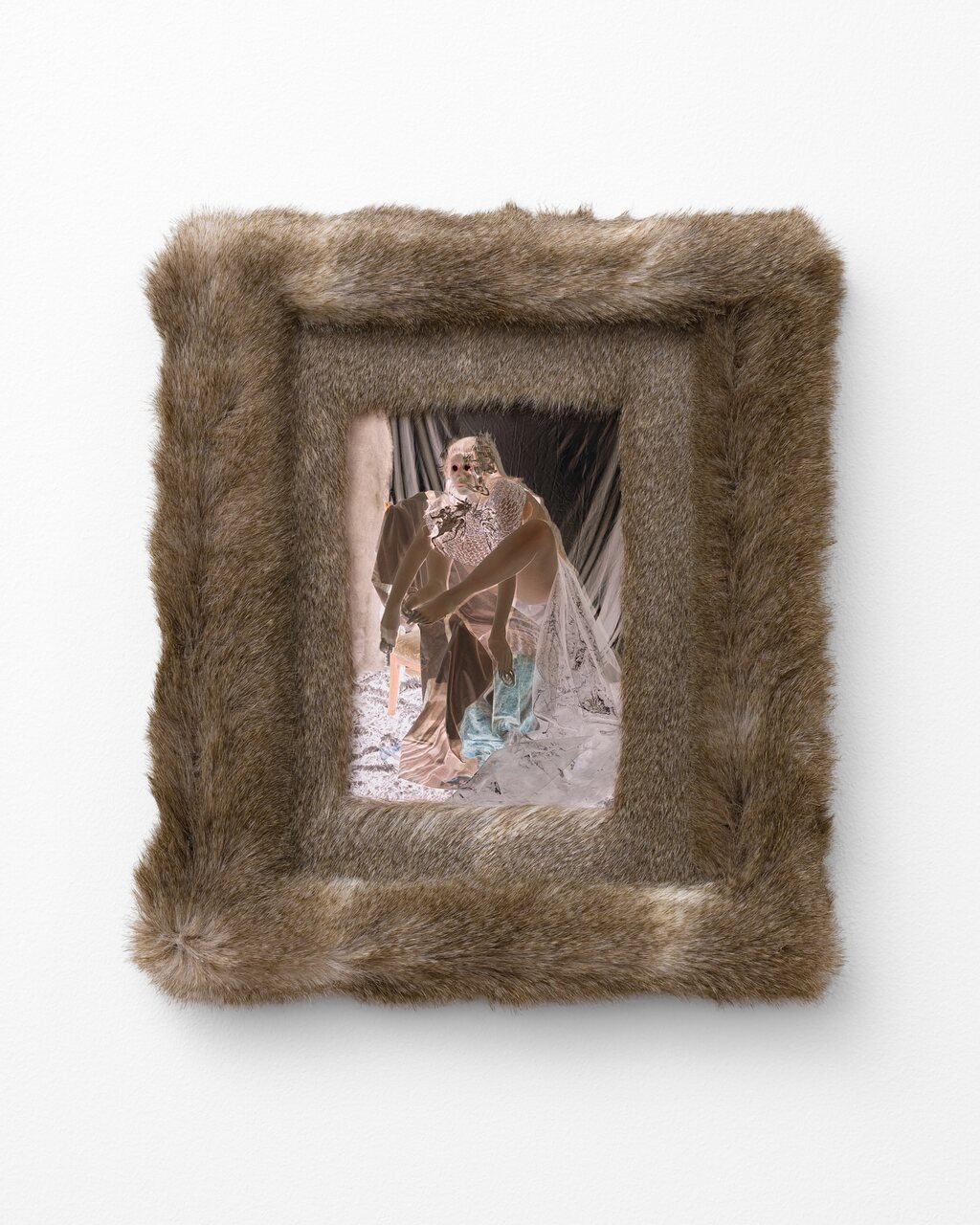
24 × 17 cm (print), 38 × 31 cm (frame).
Image courtesy of the Artist.