Ewa Borysiewicz
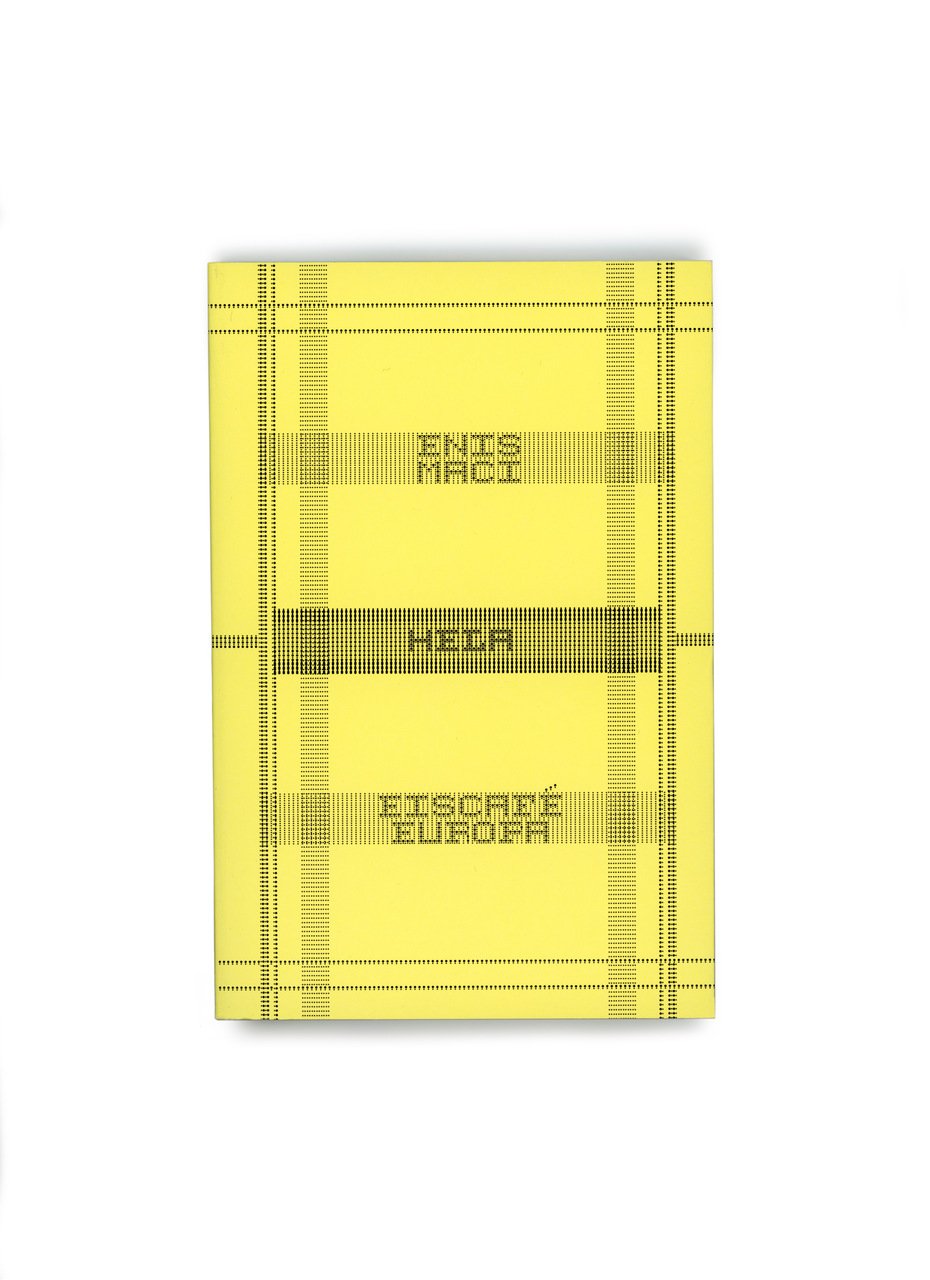
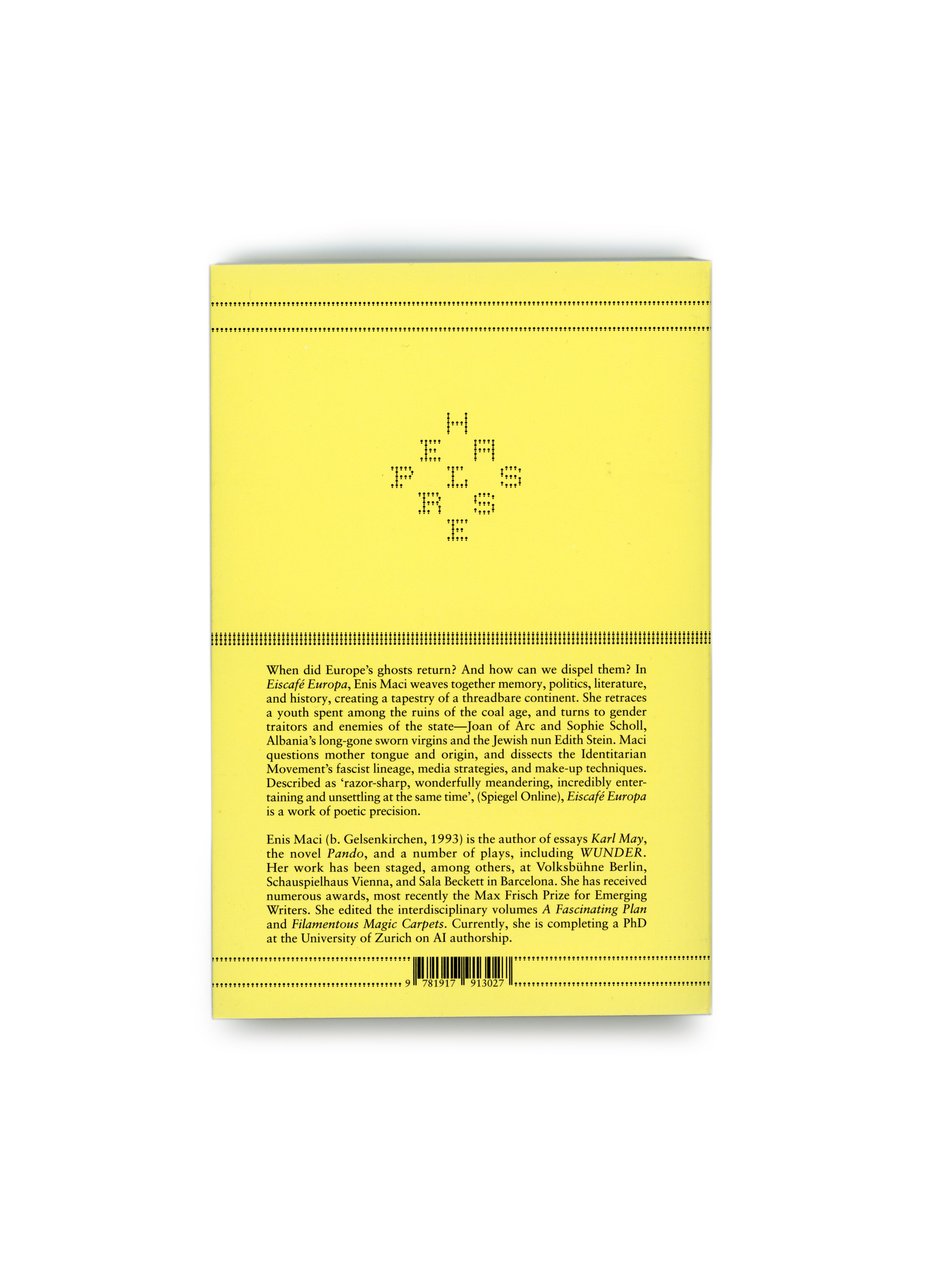
Ewa Borysiewicz: I just need to say I’m a bit nervous, since I really liked Eiscafé Europa.
Enis Maci: I’m glad it resonates with you.
EB: Ok, since I got this off my chest, I wanted to ask you about the very beginnings of your writing process: how and under which circumstances do you start working on a text? How do you settle for an idea? And how do you go from there?
EM: To me, writing has a lot to do with mapping out an uneasiness, somehow trying to trace what’s … wrong. And so for Eiscafé, it began with lots of notes, lots of time spent taking notes. The other day I found the first note about my most recent novel Pando. It was from 2017, predating Eiscafé’s publication. And the book came out in 2024. So yes, I do have to sit with it for quite a while.
EB: I’m also curious whether you could describe the situation you were in when you started working on Eiscafé Europa. I don’t necessarily mean this in one specific way – it could be emotional, professional, biographical, geographical. Please interpret the question however you like.
EM: The first essay I wrote was “On Secrets.”
EB: That’s my favourite one.
EM: Oh, that’s so nice. “On Secrets” is not how the book starts now, but it is where the writing began. In a way, it was my first attempt at locating that uneasiness, or maybe at locating myself first. Trying out a language that might become the book’s.
Back then, I was grappling with these questions: How is reality produced? What are the components that make it up? Is there anything new about them? How much reality must seep into my text? At the very end of Eiscafé, I take a close look at the way Wikipedia works. Back then it used to be “don’t quote Wikipedia because it’s not a reliable resource;” nowadays it’s “please don’t quote ChatGPT,” right? Which is a bleak turn: A transparent medium is replaced for a decidedly opaque one, a non-commercial one for one based on theft on an enormous scale.
Revisiting Eiscafé today, it’s striking how fast conversations around the digital have moved on. Back in 2018, I had this notion of being slightly too late: The far-right social media profiles I discuss in To Blend in/onto Sth (Obituary) had all been deleted just as the book was published. Anti-hate speech regulation was gaining traction. And when we started working on the English translation for Hela Press last year, the opposite was happening: Instagram and Twitter/X had begun cancelling hate speech regulations. In 2018, notions of representational politics which were so new to the German-speaking context, it had this slight ring of being too good to be true. And of course soon one did feel they were nothing more than a slight widening within the ever-same market logics. But now, with a stronger far-right and its fantasies of cultural purity, we are reminded that even this tame stuff was something fought about.
It’s such a slippery terrain, because in many ways, the book’s world is still today’s. In many ways, seven years are not that long a time. In other, an eternity.
EB: How does it feel for you to revisit a text? I know that when I go back to something I wrote, say, seven years ago, I feel an enormous amount of anxiety – and maybe also cringe – as well as frustration that I can no longer edit it, that it is already out there. So I’d like to know whether you experienced a similar reaction. Maybe my question has more to do with the emotional, or affective, response to one’s own past work.
EM: From my experience, cringe peaks at around six months. This is the most dangerous timeframe to investigate a text. But when you keep touring with a work, when you keep reading and discussing it, it becomes a part of your physical body.
EB: Your essays are filled with a lot of both literary and historical references, as well as allusions to your personal experience. So just an example: the one titled Twilight of the Gods mentions Andrea Dworkin, Joan of Arc, Sido, and Wagner among many others. I’m just wondering, how do you set boundaries for your research? Because it can be a never-ending process (this is how it works for me at least). When do you say “that’s enough?” Is there a certain discipline that you cultivate?
EM: Yes. Though discipline is not always about exhaustion. Research can be exhaustive, yes. But discipline is not only something you inflict on yourself, it’s also something the text inflicts on you. Including the knowledge of when to stop.
EB: To follow this thread further – and this is a question that popped up in your conversation with Nikolai Brandes and Anna Sophia Nübling, but perhaps your view on this has changed – how do you differentiate between artistic and academic research? Is it the intention behind it, the methodology, or the degree of objectivity involved?
EM: There is some slippage between disciplines and ways of writing. Sometimes, it’s the vantage point that marks a text as academic or literary. Neither self-reflection nor source material guarantee objectivity. The difference appears poetic: a literary text does not keep the reader in mind. A journalistic or academic text must do so. An essay can be both of these things. Writing an essay is not a commitment to genre, but to a specific method. To write an essay is to write a text that makes the very act of its production visible.
EB: Would that connect to what you once said in the context of your essayistic works, that you are more interested in the crime scene than in the perpetrator?
EM: This goes back to the idea of mapping out an uneasiness. I have this fantasy of arriving at a crime scene and not only having to look for the perpetrator, but also for the victim. What kind of crime took place here? You know that something has happened, but what is it?
EB: How do you see the role of fiction and storytelling at the moment? From what I know of your work, this seems to be one of its recurring themes.
EM: The thing is: how do you tell a story? Does it deal with the real world? What’s real, what’s realistic, and what’s realism? To me, a conventionally realist story that has no space for synchronicity, for disorientation, for the group chat, the news, the video ads penetrating my perception in the most intimate moments – a story where all of this does not exist, is a work of fantasy. There is nothing realist about it. Realism as it’s sold to us is a toxic tranquilliser. To Lacan, the Real is the sticky dirt between the Symbolic and the Imaginary. It has nothing to do with realism.
Of course, there is a beauty in simple stories. How shocking then that they are the ones most most easily replicated by the machine, the ones most easily bastardised into cliché.
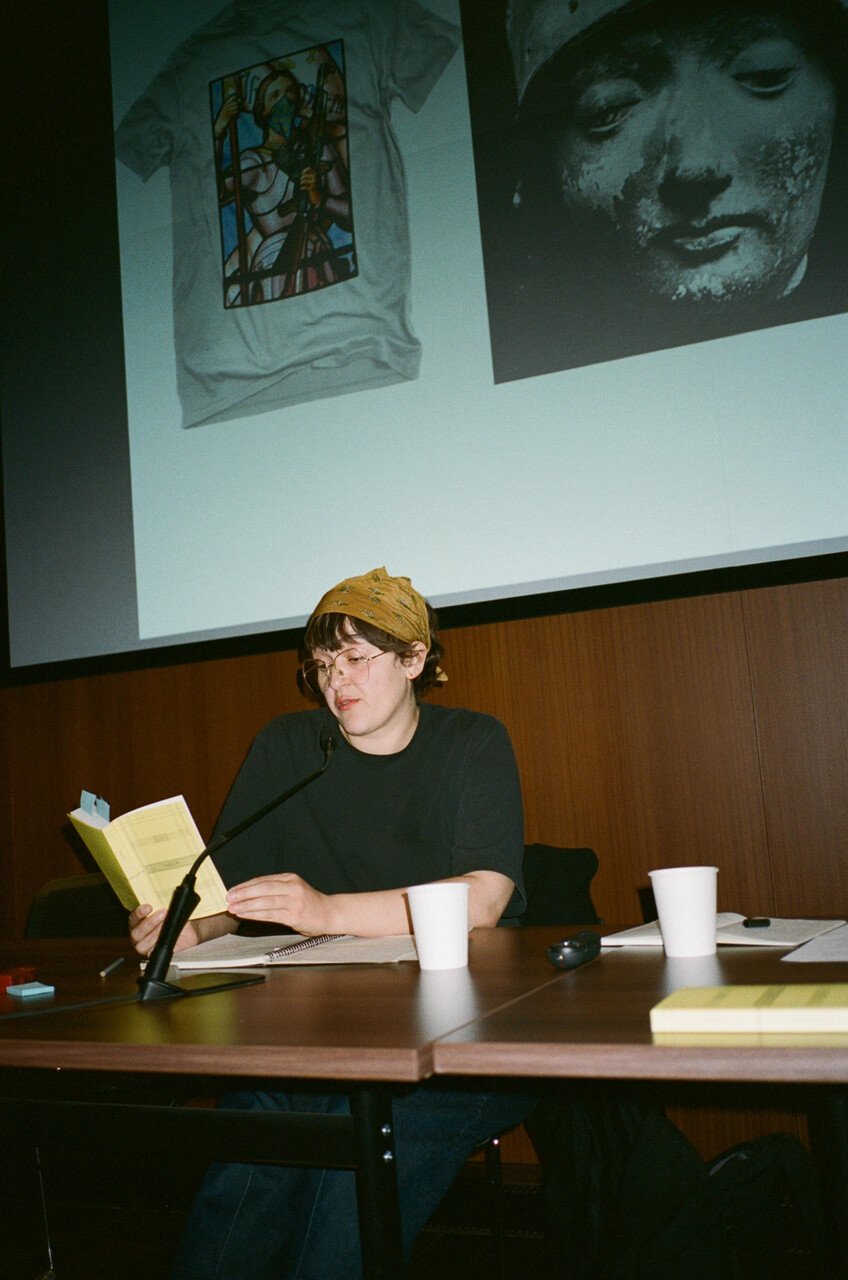
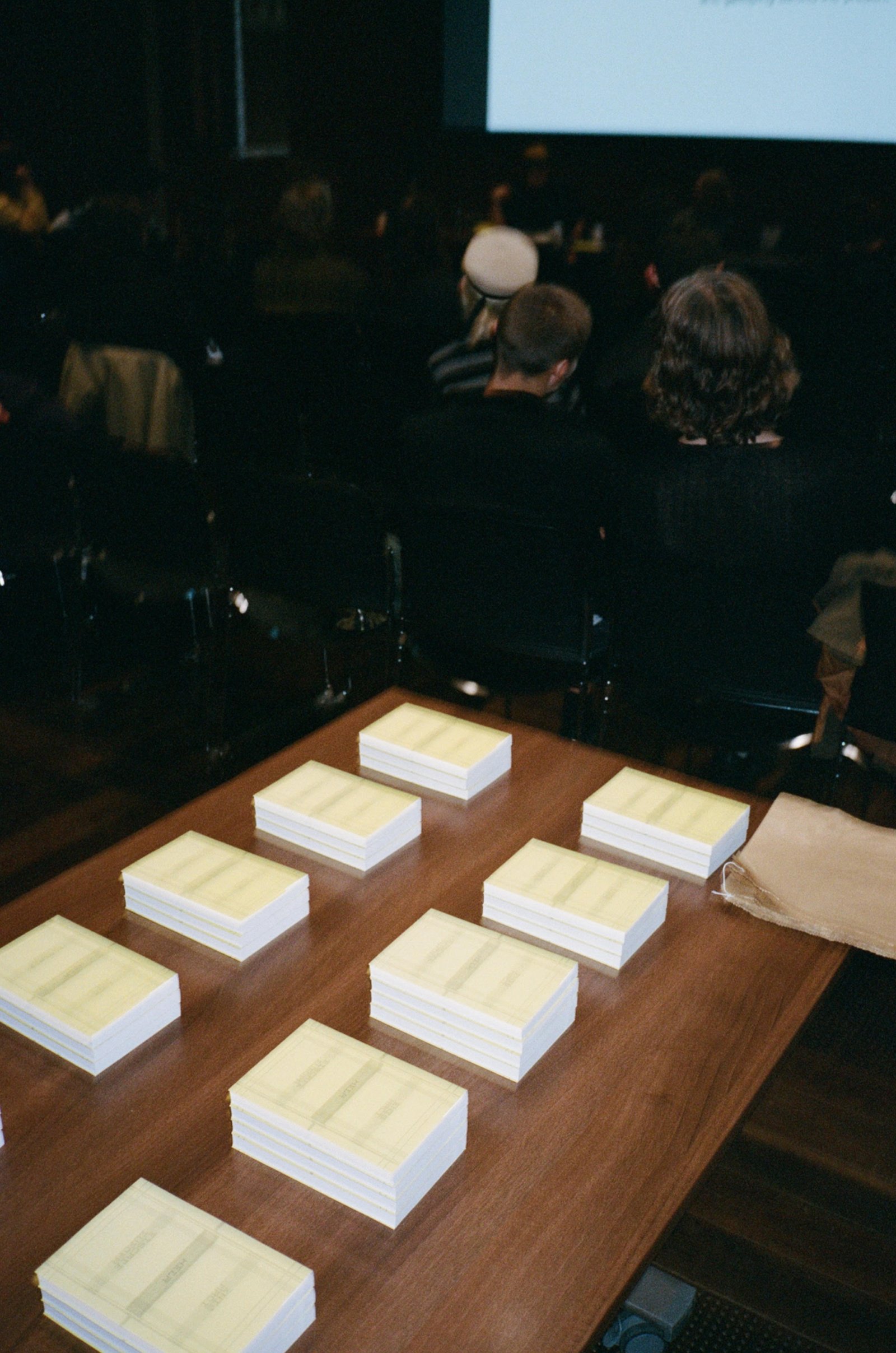
Photo: Igor Czernecki. Image courtesy of Hela Press.
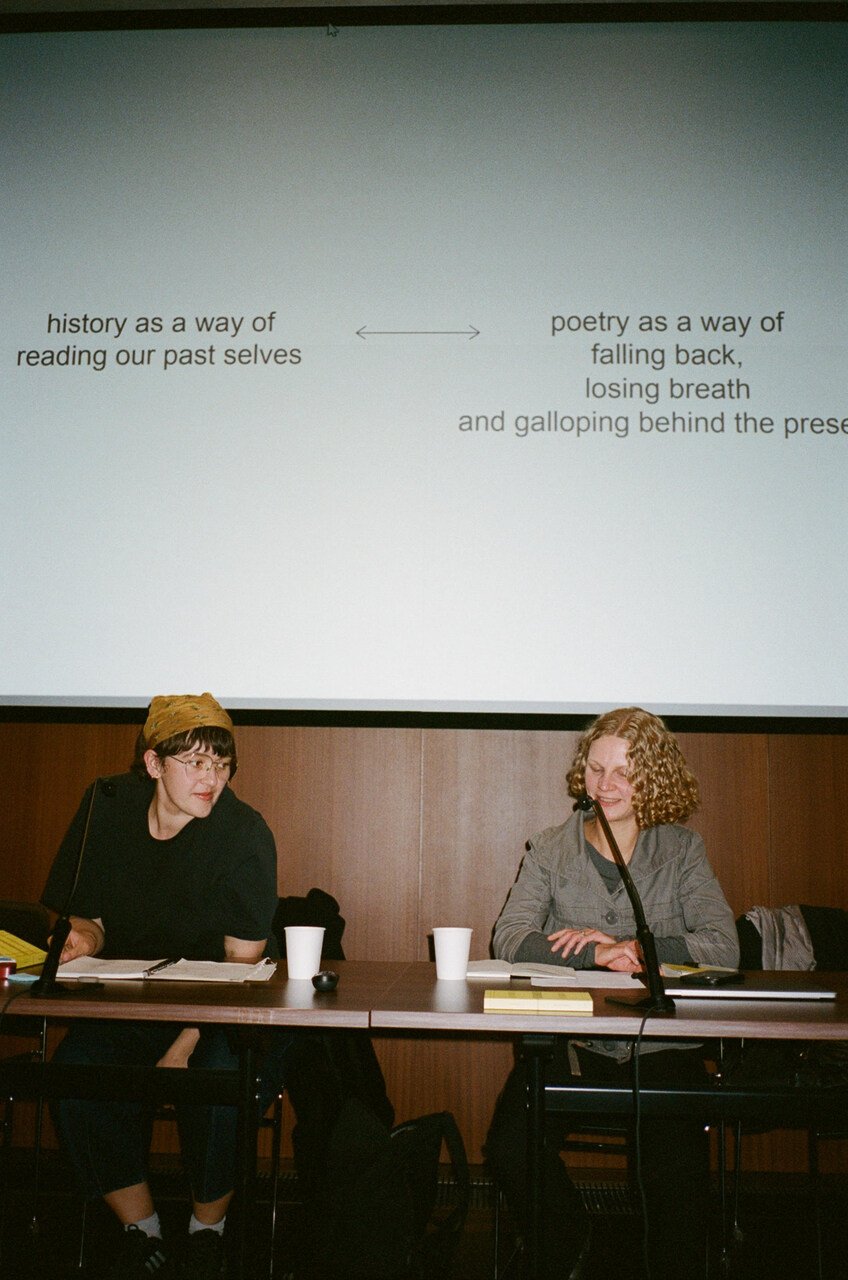
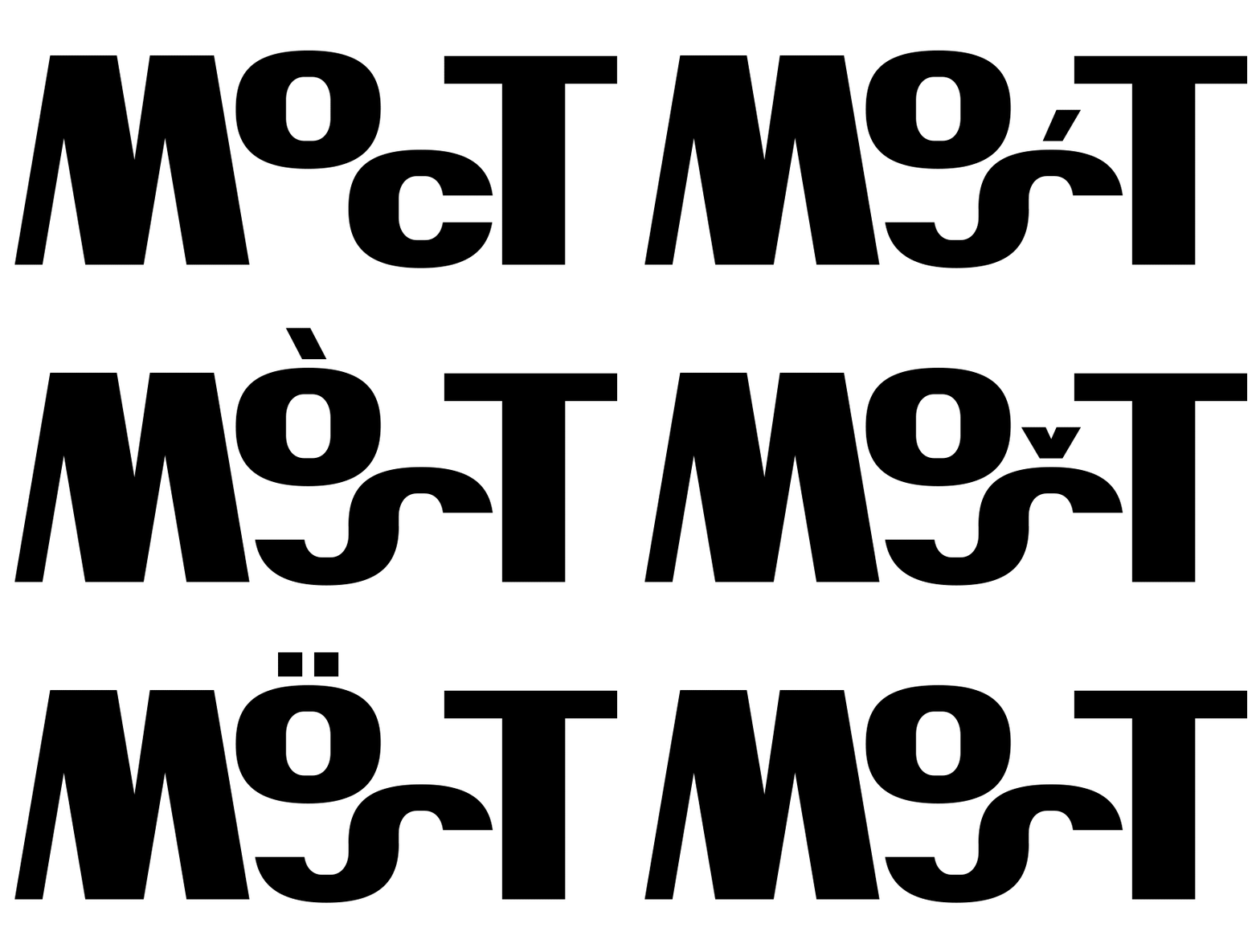
Photo: Igor Czernecki. Image courtesy of Hela Press.
EB: What you say about stories being replicated by machines makes me think of your PhD research on AI and authorship, which I’m very curious about. Would you be willing to share more about it?
EM: The notion of what an author is or isn’t or may become is being heavily questioned right now. Now, that is: under circumstances shaped by AI. Where you can outsource the menial work next to writing: transcribing, recording, translating, cataloguing, organising. Where you can prompt the machine to write for you. Activate it with a word, a sentence imbued with magic. This seems so contemporary. And yet it also goes back to what Ginzburg writes about. I guess this is what it’s about for me: looking back to understand where I am at. And this notion of “back”, of the “past” is creeping up closer and closer to our “now.” Maybe you know about these browser plugins that show the internet as it was before 2022?
EB: No, I don’t.
EM: 2022 was the moment when powerful generative AI started becoming publicly available. And so AI-generated content began to be swept back into the internet, infiltrating, corrupting the very data AI was being trained with. The desire to return to a time before that, before 2022, reminds me of this Y2K, point-and-shoot, iPod nostalgia. My generation in turn was nostalgic for the internet of the 1990s, where there appears to have been this sense of an unmapped space, of unbound liberty, communality, and so on. There is of course also a weird desire for purity in there, pining for an easier world and so on.
EB: I’m a bit hesitant about this next question, and please don’t take it the wrong way. I’m asking because I struggle with this myself. Do you ever feel that, with the proliferation of AI and AI-generated content, the role of the writer might become obsolete?
EM: The job of the writer has always been obsolete. There’s not need to struggle with the idea of being useful, of having a place in society and so on. However – the texts writers produce for money, the texts they write so that they can do the other thing, the jobs sustaining your artistic work – they have dried up. Actual humans used to write the clothing descriptions on Zalando – a vintage boho linen summer dress, and so on. Never again will that kind of writing be produced by a human being. The alternatives are simple: algorithmic platform economies, state subsidy programs, or a kind of job that has nothing at all to do with writing.
EB: What does it mean for you personally?
EM: There’s two desires here, really. I don’t want my work to be contaminated by this kind of bullshit. But I am also aware that the idea my work might remain uncontaminated by anything is ridiculous in itself. Perhaps contamination is the wrong word. Maybe this is more about armor, about protecting, bracing myself; ourselves, really.
EB: I’m also curious about what you’re reading right now. Maybe you have books that you like to revisit or that have made an impact on you as a writer?
EM: There are three things right now. One of them is Transcription by Ben Lerner. It deals with the problem of realism in a very strange way. I’m almost done, and read it very quickly, on my phone, which is funny, because a broken phone is how everything starts.
The other thing is Carlo Ginzburg’s Ecstasies: Deciphering the Witches’ Sabbath, which is this 1980 historical study where Ginzburg wonders: “How come that all the people interviewed at the witches’ trials had this coherent story of what they did at the sabbaths.” You know, brewing potions, flying, convening with the devil. And he investigates whether there was some kind of pre-Christian popular ritual behind this, one that has no real language, not yet or not anymore. And when people were forced to testify, they might have drawn from that. Ginzburg is known for pioneering this idea of microhistory, and in Ecstasies, microhistory has gotten completely out of control. I recommend it.
And then, because I just started writing a column for Swiss weekly WOZ Die Wochenzeitung, I revisited Clarice Lispector’s newspaper columns. They have this great, mundane ease.
EB: Lispector had a very precise editing process that she devised herself, no?
EM: I have this on my table right now because I was teaching a class on editing. And I was showing the students this page where we see her manuscript and her instructions she has to follow when working on her novel: cut out all the shiny adjectives, let the things speak for themselves, erase traces of your biases and so on.
EB: Writing is often considered a solitary practice. You, however, have co-written novels, such as Pando with Pascal Richmann, so I’m curious what that experience was like for you.
EM: There’s this line by Diane Cluck: You’re so easy to be around / We were two but we melted down. Writing together is doing the difficult thing until it becomes easy. Melting language or forging it or maybe foraging within it. My writing originates in the theater, where there is no practice without togetherness. A dramatic text is always slightly undone. It makes room for actors and actresses, for something that goes beyond. It is a mode of thinking, a way of reacting to the world, that is maybe also a way of rejecting what we were talking about earlier: certain modes of fossilization. And this culminated in two very different pieces with others, one written together with Mazlum Nergiz and one with Pascal Richmann.
Of course, this is not something you can do with anyone. Sweating blood together is very different from doing it alone.
EB: I wonder: does writing ever get easier?
EM: Oh. No, absolutely not.