
Weronika Morawiec
The collateral show, Rhizomatic Portals: Ways of Knowing, of the 18th International Triennial of Textile in Łódź, curated by Bukola Oyebode-Westerhuis, unfolds across the third floor of the Textile Museum in Łódź, Poland, where it is the beating heart framing the extensive programming of this edition.
When I say the program was extensive, I mean that the scale and coherence of the exhibition made it clear how complex the curatorial and staging process must have been, especially within the three-story building of the museum. The concept behind Deconstruction / Reconstruction (the title of this year’s central exhibition) was shaped by co-curators Marta Kowalewska and Oyebode-Westerhuis. Their focus was on dismantling and then putting back together various kinds of structures – whether material, social, political, or symbolic – through contemporary textile practices. Marta Kowalewska, who has worked internationally for over 25 years as an art historian and critic, and is also the chief curator of the museum, contributed her extensive knowledge of textile as a form of communication and experience in organizing global exhibitions. Bukola Oyebode-Westerhuis, an independent curator, writer, and editor based in Amsterdam, added a dimension concerned with multisensory and cross-cultural viewpoints. She also emphasized voices that question mainstream narratives in contemporary art. I felt lucky to be there in person as the triennial, celebrating its 50th anniversary, presented such a luscious and ambitious curatorial vision. As we can read in the curatorial description:
“(…) textiles – both intimate and communal – proves to be an ideal language for discussing global issues. As the works submitted to this year’s Triennial demonstrate, deconstruction and reconstruction are not only artistic processes but also metaphors for the contemporary world: from redefining the notion of home through migratory experiences to women’s emancipation and building inclusive communities.”
Coming from the perspective of a caregiver, I was already embodying one of the curatorial takes, that of the rhizome philosophy: “(…)in the rhizome ecosystem there is no hierarchy; the structure of relating is non-linear and everything operates on the principle of multiplicity.”1 Anyone who has ever found themselves in the role of one who gives care – to kids, animals, systems, archives… – would know that this is the sole state we know: to be multitasking, to be shifting attention, to be constantly moving from Self to Other, to be always facing multitudes of universes that are equally important and often equally in need of attention. But, I arrived in a rush, coming from an early morning train to Łódź to attend Ibrahim Mahama’s seminar at another location, and then to the museum with my mind already filled with multiple reflections, urges, tasks, and longings. I was excited but also felt guilty that I might be unable to stay in the exhibition long enough to engage fully with it.
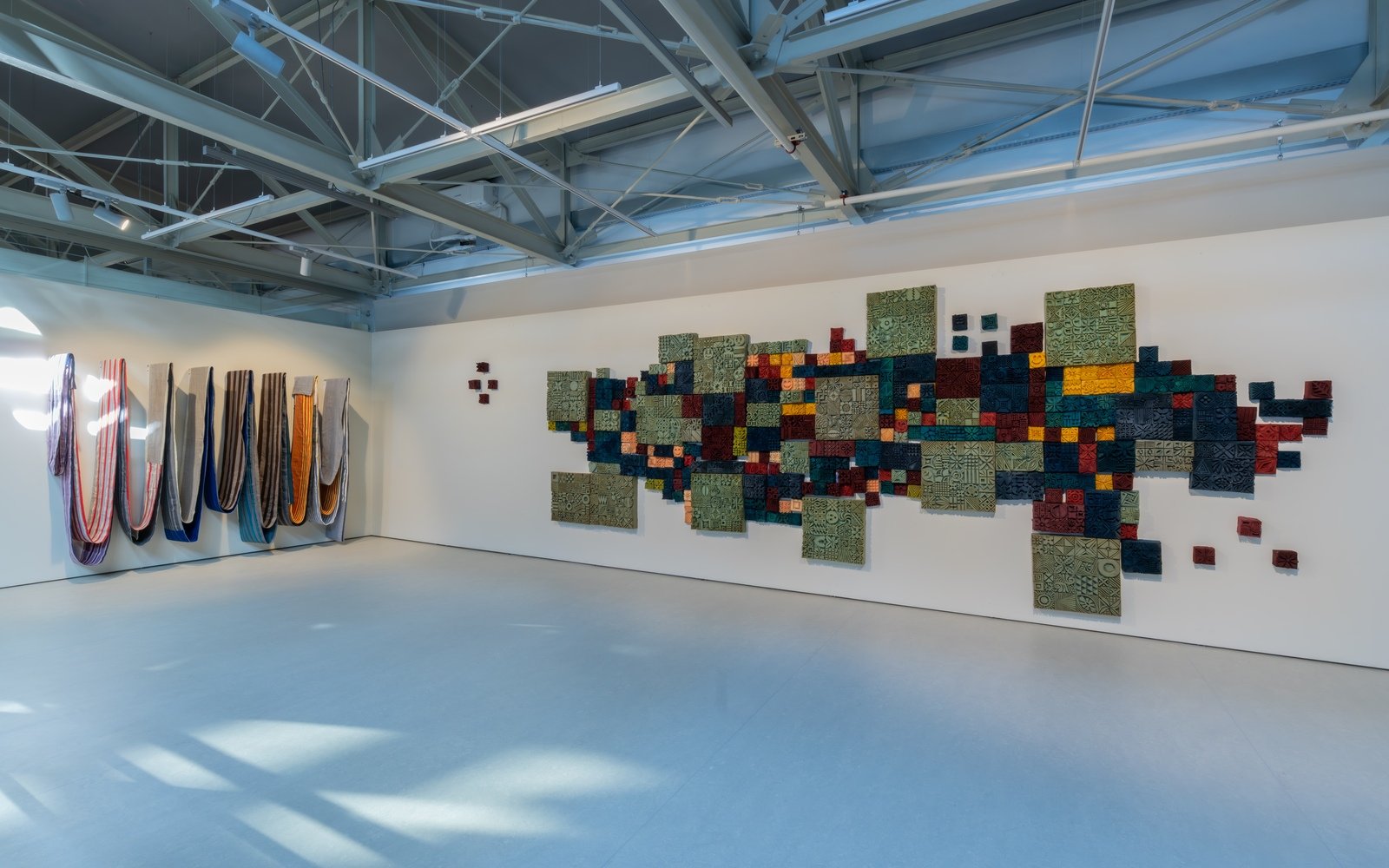
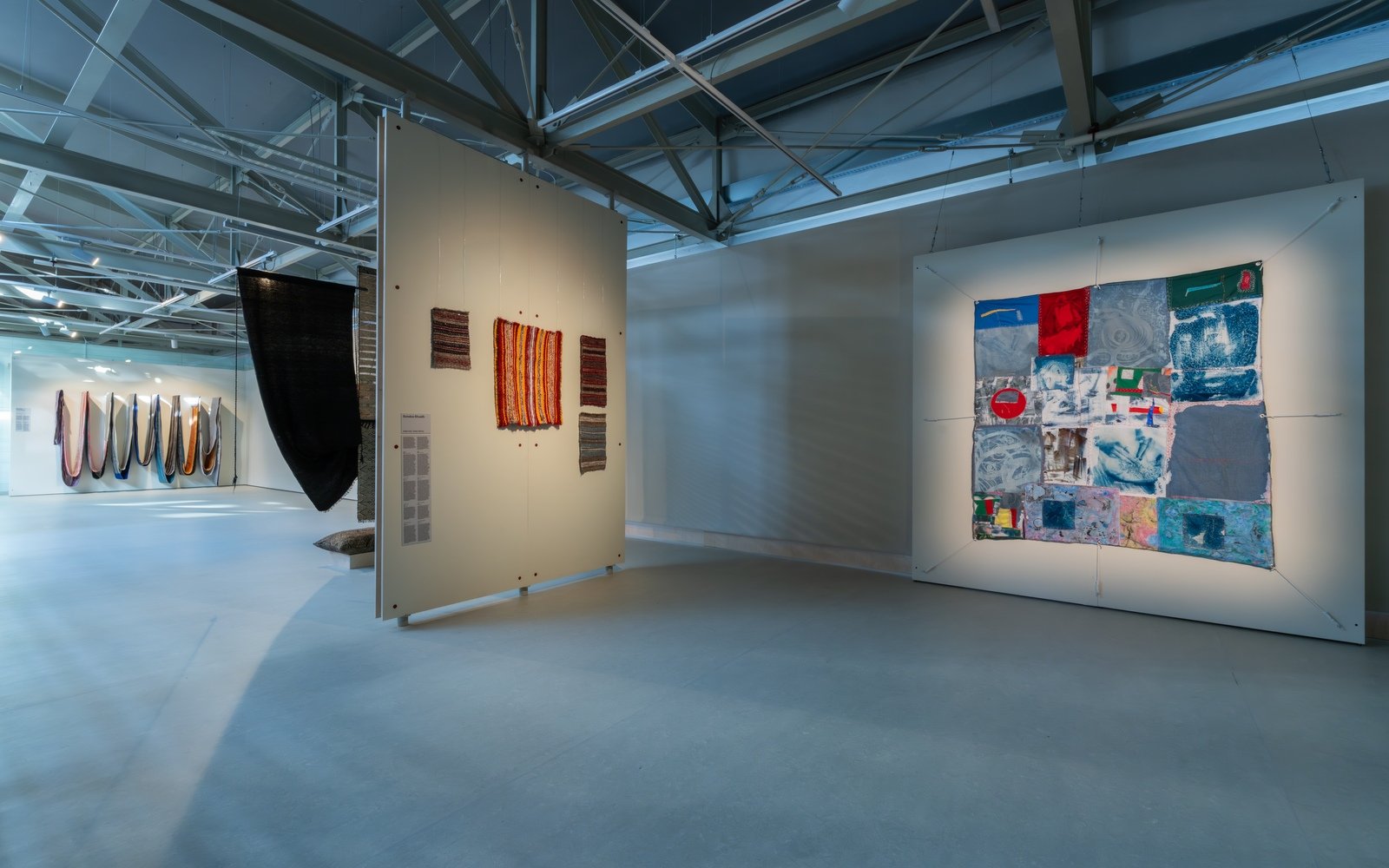
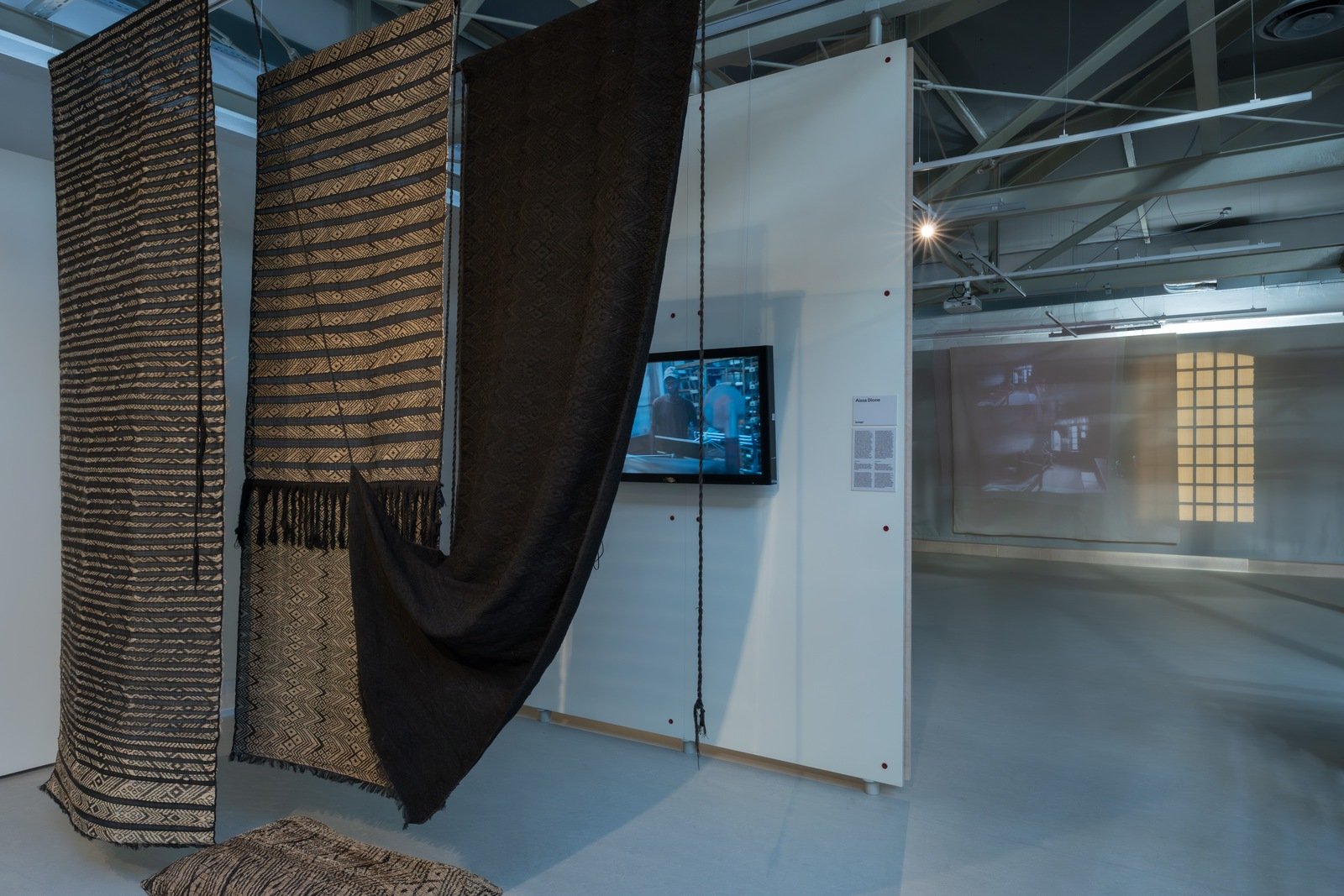
Rhizomatic Portals: Ways of Knowing is presented in a challenging space on the third floor with prominent structural angles, cold glass and steel architecture, and clear visibility to the lower floors where the main exhibition, Deconstruction/Reconstruction, is presented. There was not much guidance for how to move within the exhibition; instead, it unfolded as a quiet choir of various artistic voices. Oyebode-Westerhuis explains that the exhibition draws on Gilles Deleuze and Félix Guattari’s notion of the rhizome, as well as African feminist ideas by Ifi Amadiume, Patricia McFadden, and Minna Salami. The works span across generations and geographies, tracing personal histories, dreams, myths, cultural practices, transnational identities, and the labor of women. The works – by Amina Agueznay (Morocco), Peju Layiwola (Nigeria/USA), Aissa Dione (Senegal), Marie-Claire Messouma Manlanbien (France/Ivory Coast), Ngozi Ajah Schommers (Nigeria/Germany), Adeola Olagunju (Nigeria/USA), Sondos Shuaib (Sudan/Italy), weavers from Ghana’s Upper West region, and the archive materials and catalogue of Madame Zo (Zoarinivo Razakaratrimo, Madagascar) – do not submit to easy reading, nor to the external gaze. They occupy their own space. They resonate quietly, self-sufficiently, like a pantheon of goddesses, each bearing distinct gifts, histories, and rhythms. Together, they create new landscapes and realms: intellectual, emotional, and aesthetic, shaped as much by themselves as by those who enter.
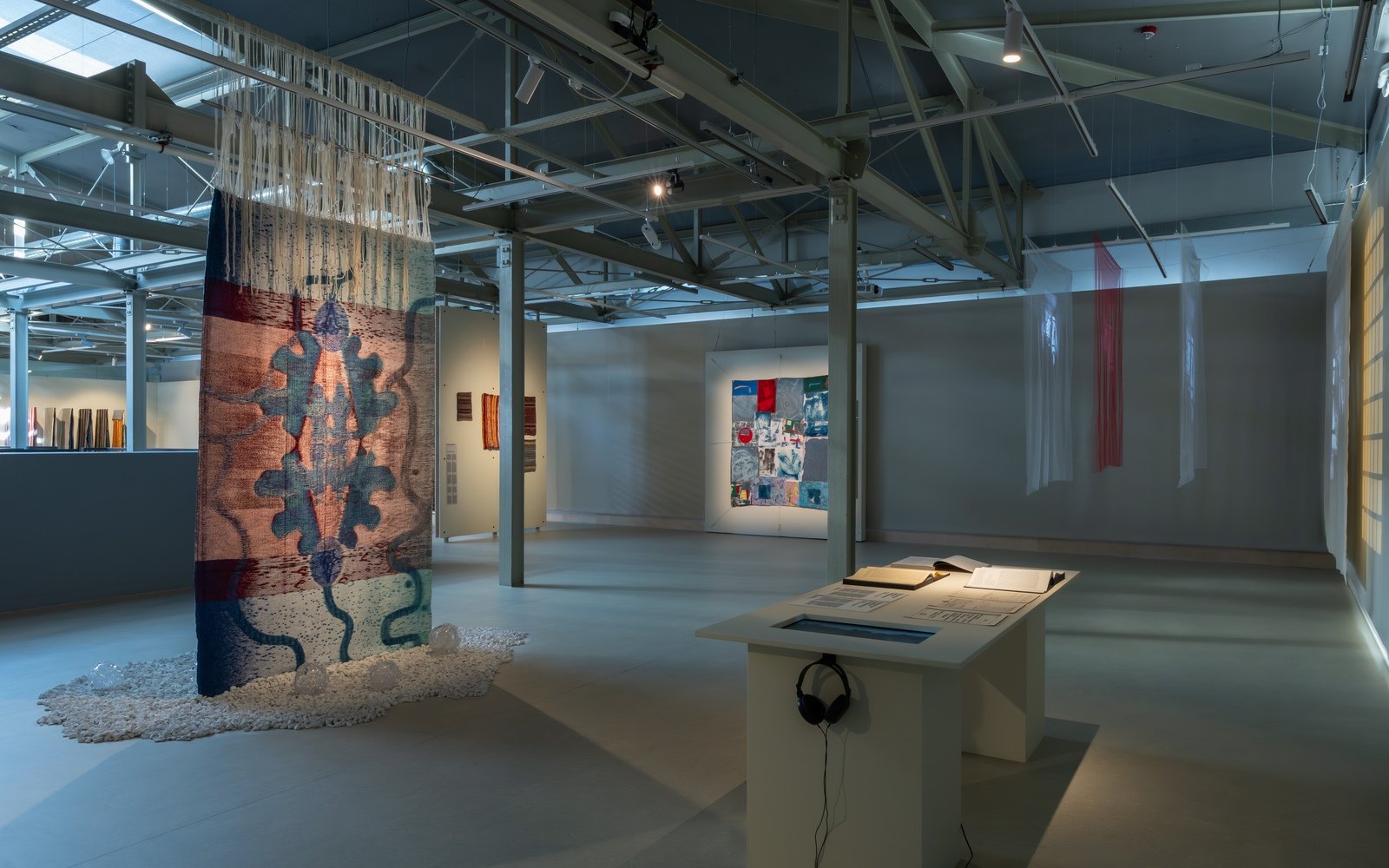
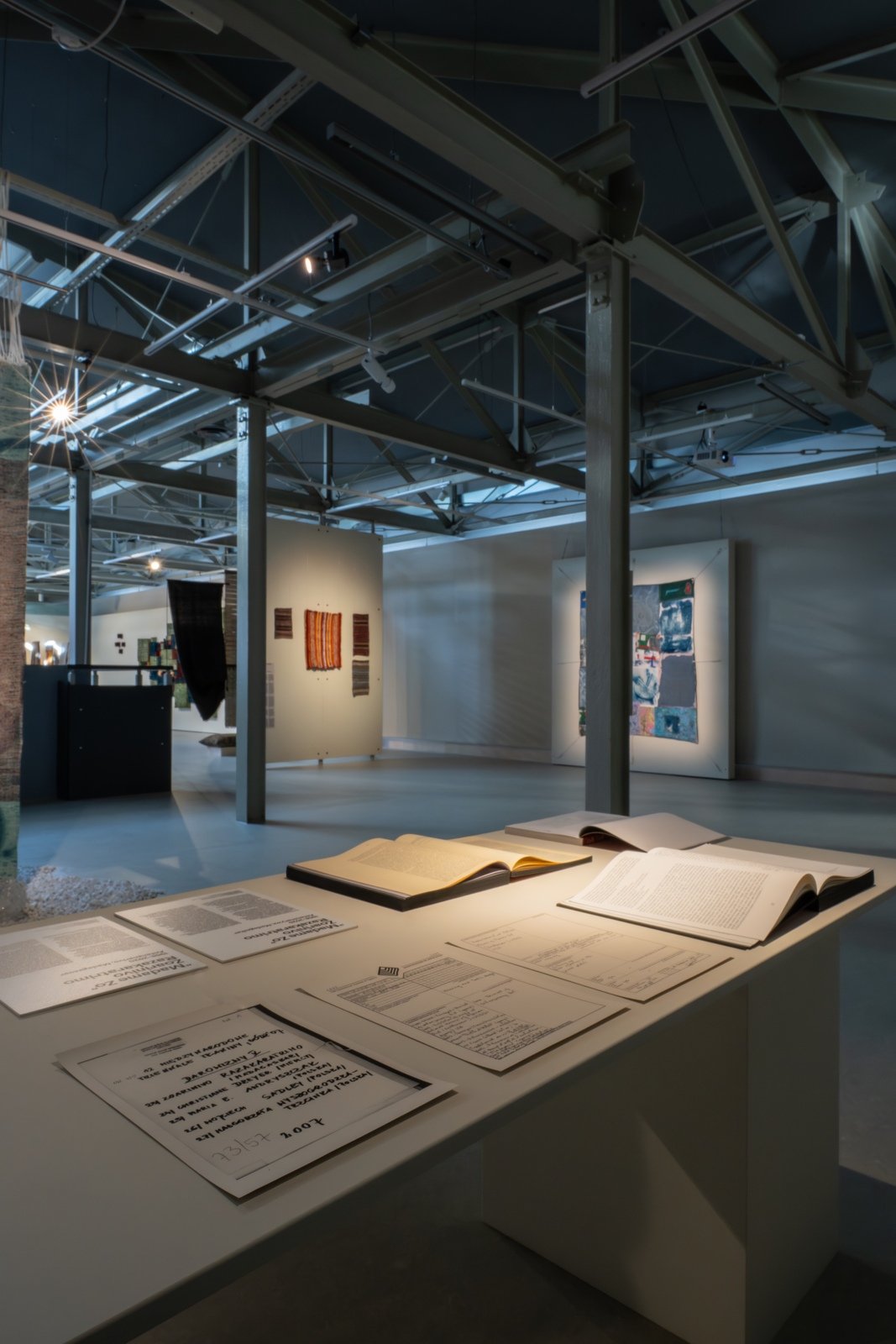
The first work I engaged with is not an obvious one: it was a small presentation of documents, books, and photographs. Homage to “Madame Zo” Zoarinivo Razakaratrimo put together with the help of Hobisoa Raininoro, Tony Agbapuonwu, and the CMWL (Central Textile Museum in Łódź) Library and Archive seemed to be a primary source for this exhibition. The survey of works and the memory preserved through Madame Zo’s catalogue becomes a presence that quietly radiates through every corner. In that presentation one can see her monumental weavings born of ancestral Malagasy forms, her self-made looms, and her original experimentation with materials. They beckoned to me; I could feel them beaming. It was a very lively archive: her work emanates outward, seeping onto the pieces of other artists, recalling the paths she had paved for them many years earlier, as a pioneer in her field. Working primarily in textiles and three-dimensional hanging forms, often combining organic and inorganic materials, Madame Zo (1956-2020) situated her practice at the intersection of traditional Malagasy weaving, experimental materiality, and socio-political reflection. In the space of Rhizomatic Portals(…), this artist from Madagascar is not only history or reference, she seems like a force or a guiding presence whose voice hums beneath everything.
In the context of Madame Zo’s work, I reminded myself of the questions by Bonaventure Soh Bejeng Ndikung in an interview for ART X Lagos: Who has access to archives? And who do we find in their stories?2Ndikung points out that archives can be an ideal tool for navigating time and space, and claims (and I repeated that to myself while walking through the exhibition) that archives are the pillars for situating ourselves. The homage to Razakatrimo acts as such. Rooted in tradition but allowing a futuristic perspective, an invisible pillar of labour, dedication, shared experiences, giving a voice to the unheard.3Hence, the act of emanation is key for me in how to engage with this exhibition and its objects, and how to track its permeation.
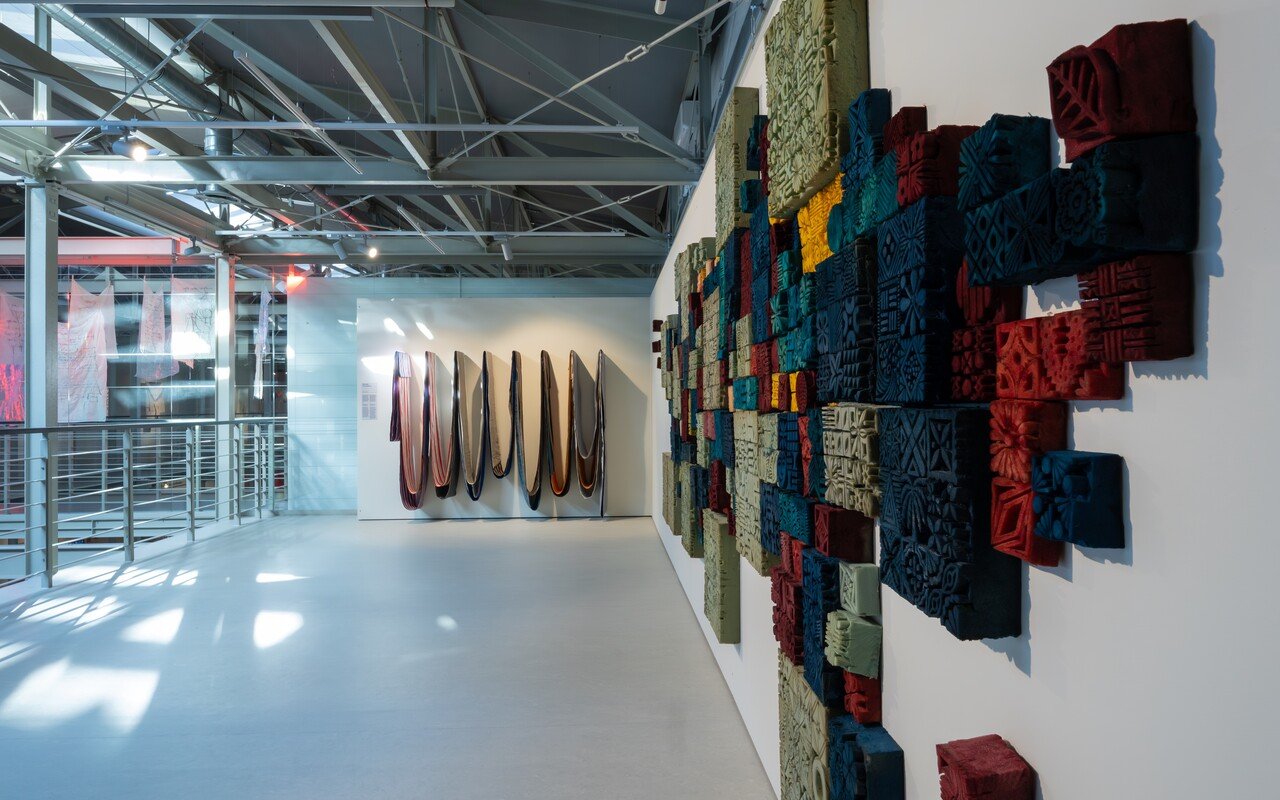
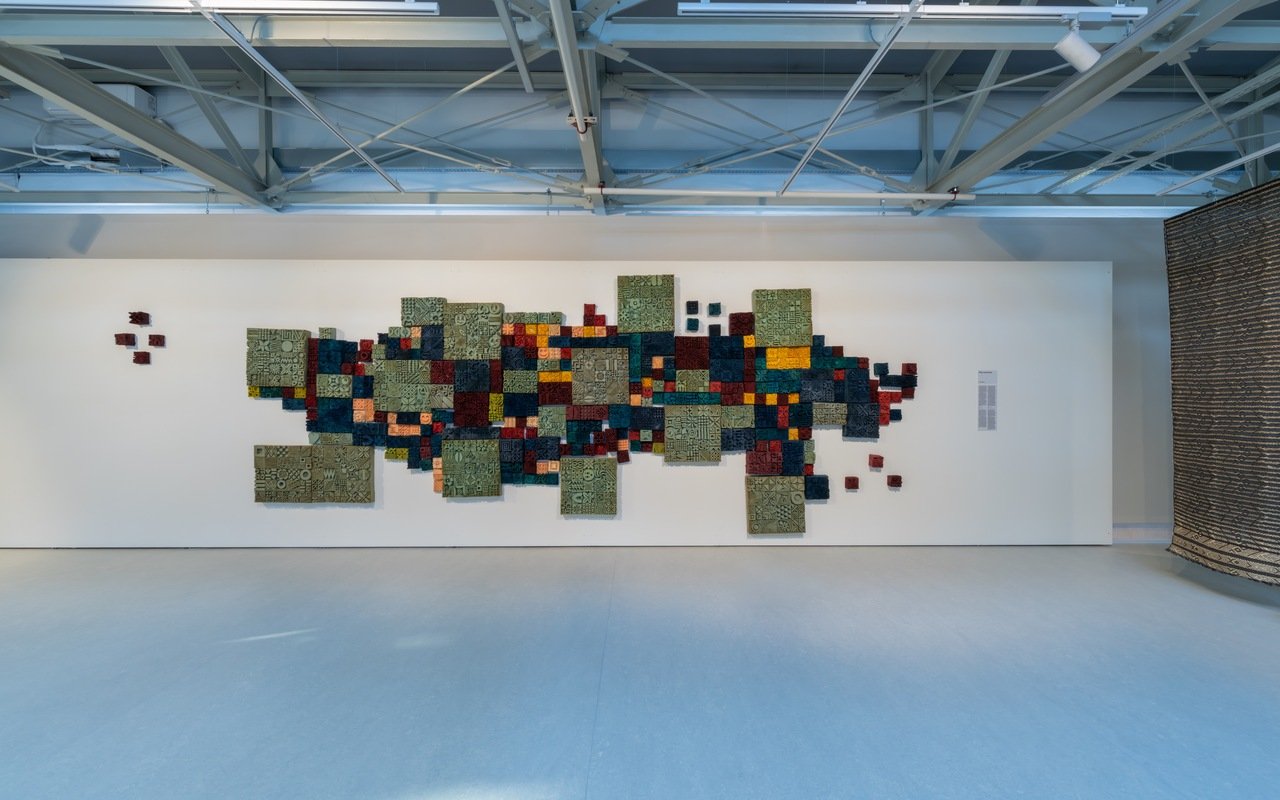
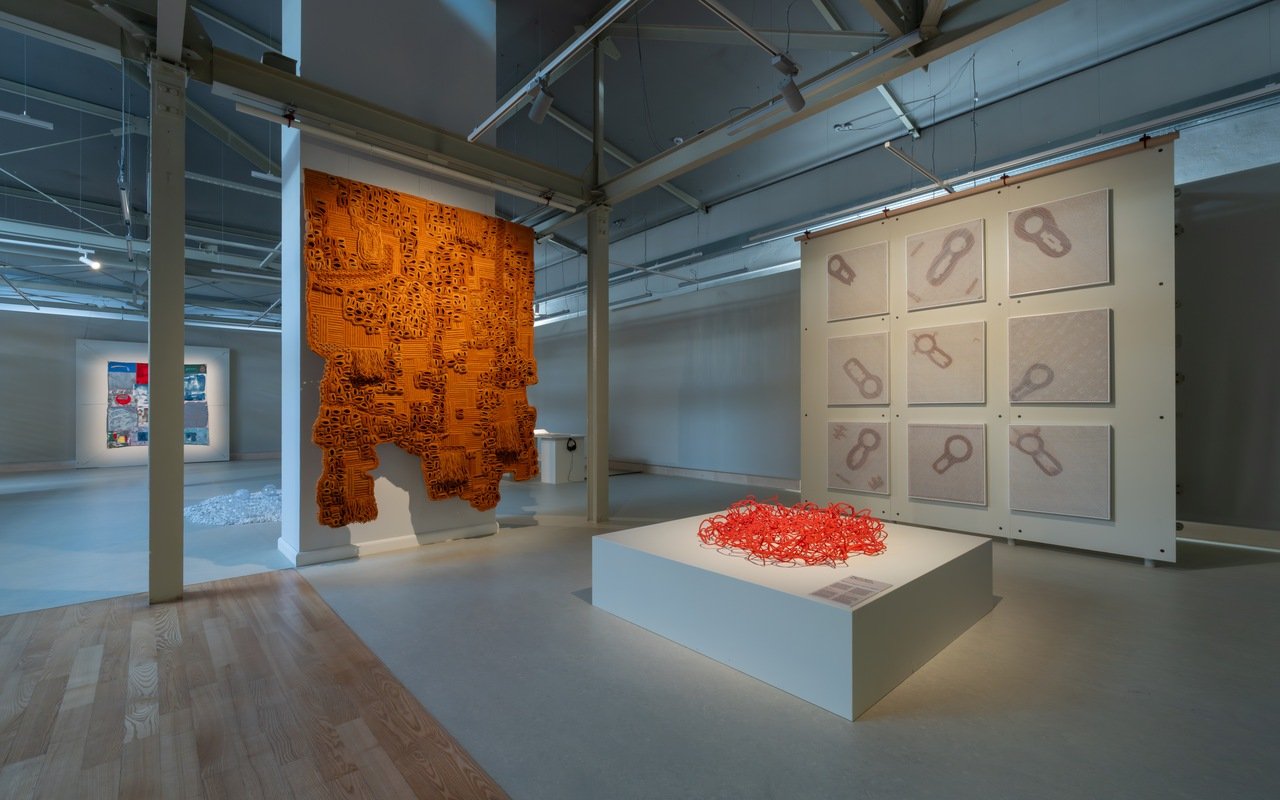
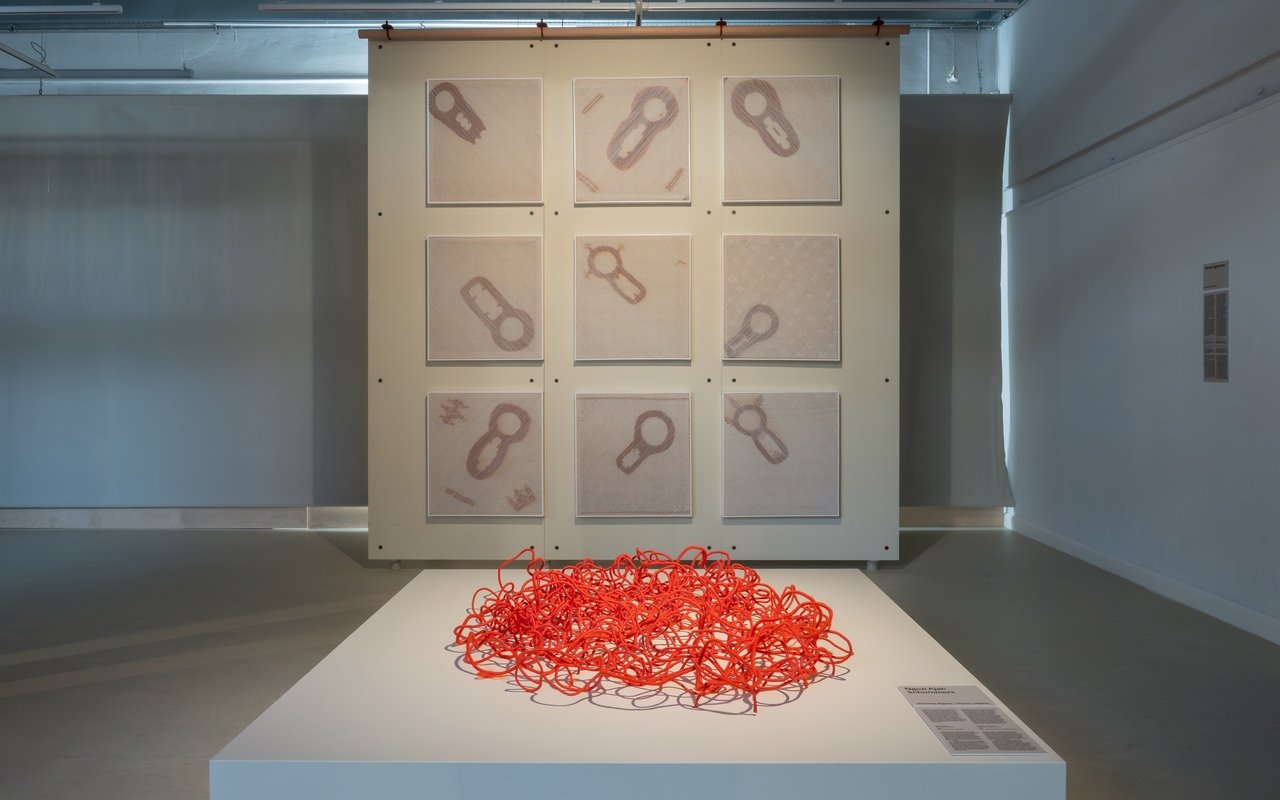
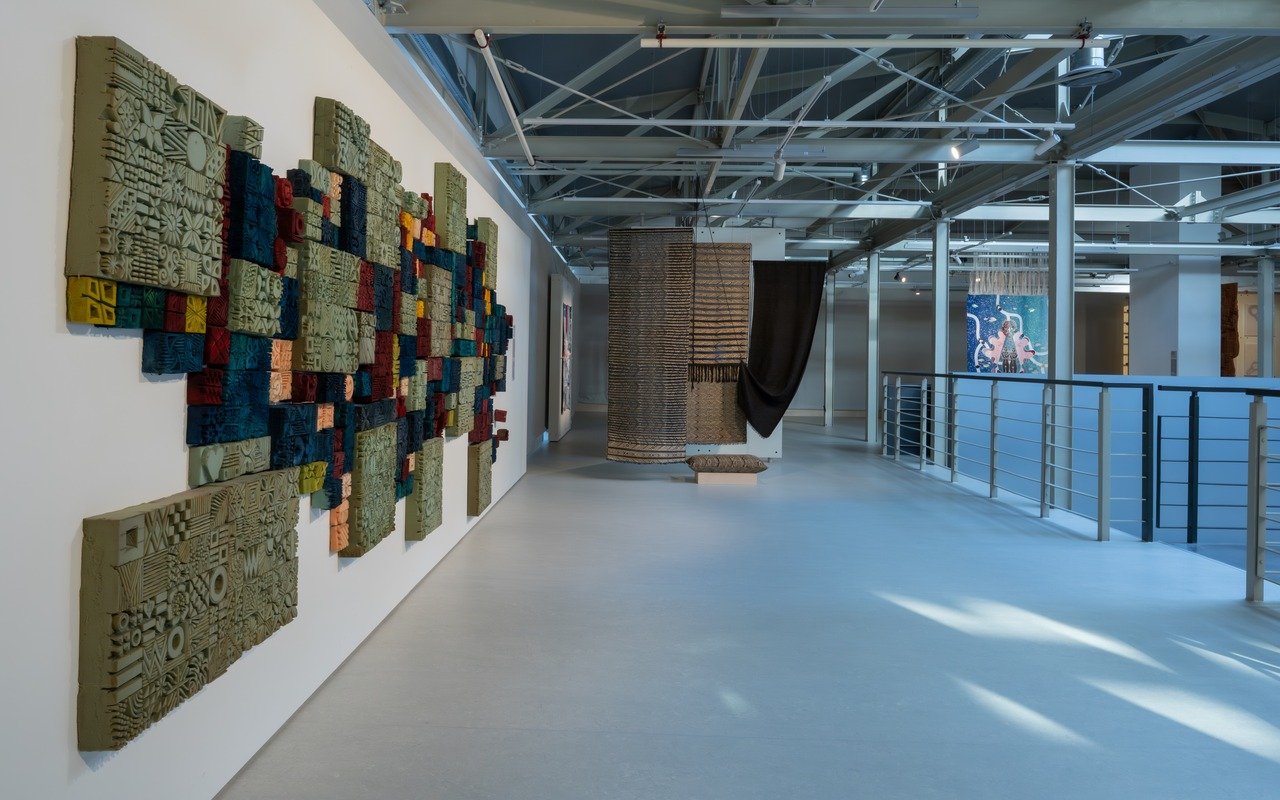
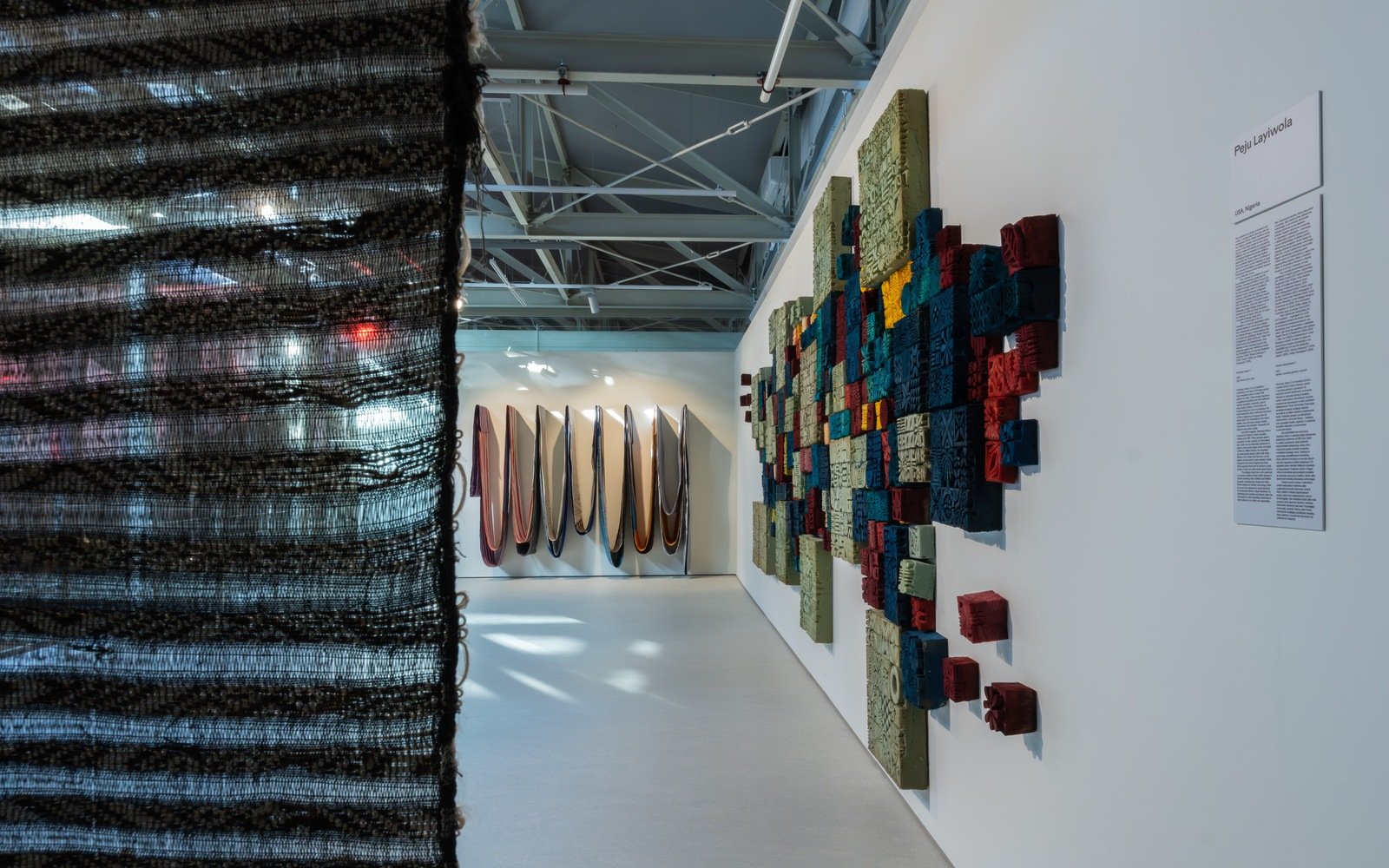
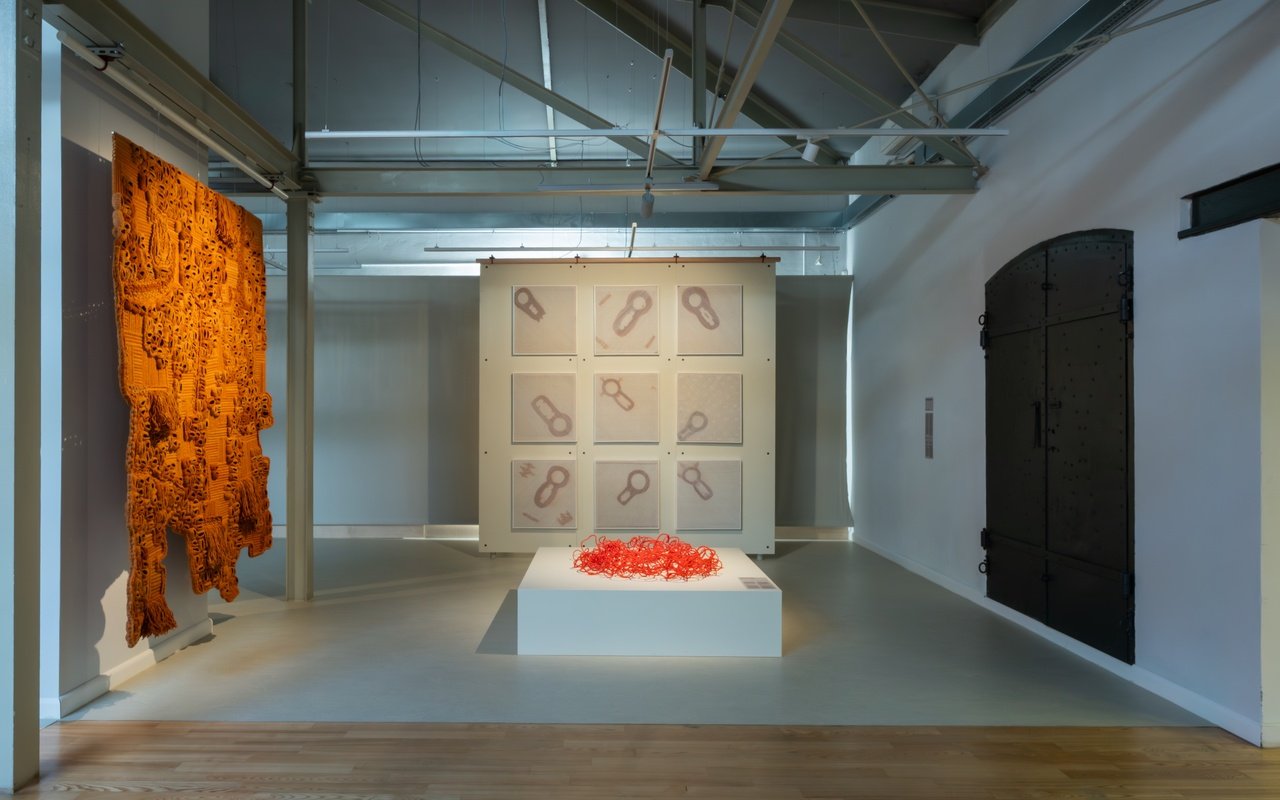
I was stopped by the dialogue between Stamping History II by Peju Layiwola and Tales in Shrubs, Weeds and Gathering by Ngozi Ajah Schommers. The first one is a monumental installation of high-density foam templates used to create batik patterns on cloth, which uncovers the hidden background of fabric design in West Africa. Maintaining that the stamp carries as much meaning as the celebrated textiles, the precise pattern lingers within the template that often stays behind in the artist’s studio. The second installation is a sculptural form built with metal and threads of deep red wool mixed with synthetic hair, used in wigs that are widely used in parts of the Black community.4 Both works told me a lot about how we can treat our community, how easily we can overlook the precious things and gestures hidden not in big historical narratives but in the personal ones. How superficial or even tokenistic we might be to praise only the final oeuvre without acknowledging the minds and hands of those working the backrooms.
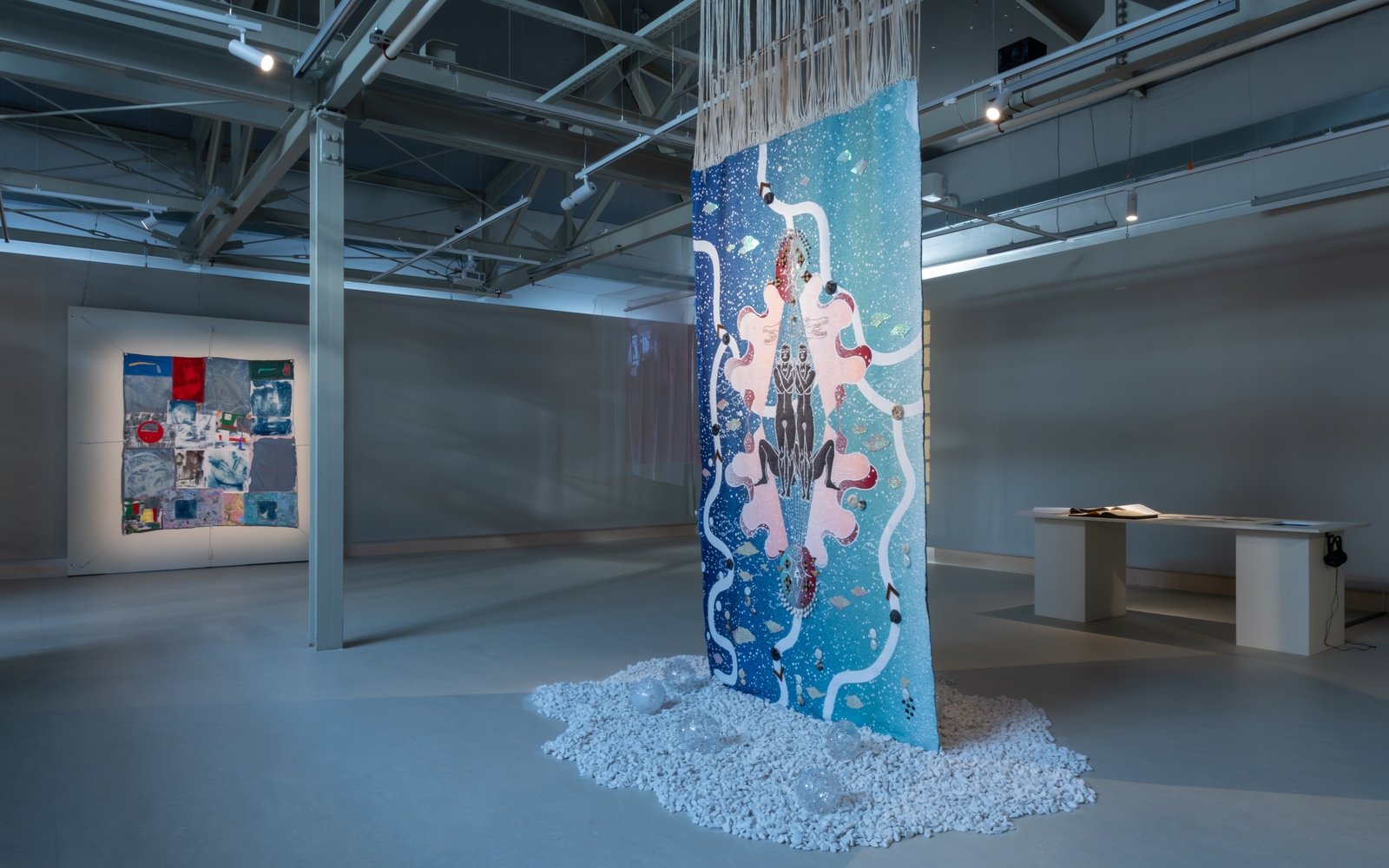
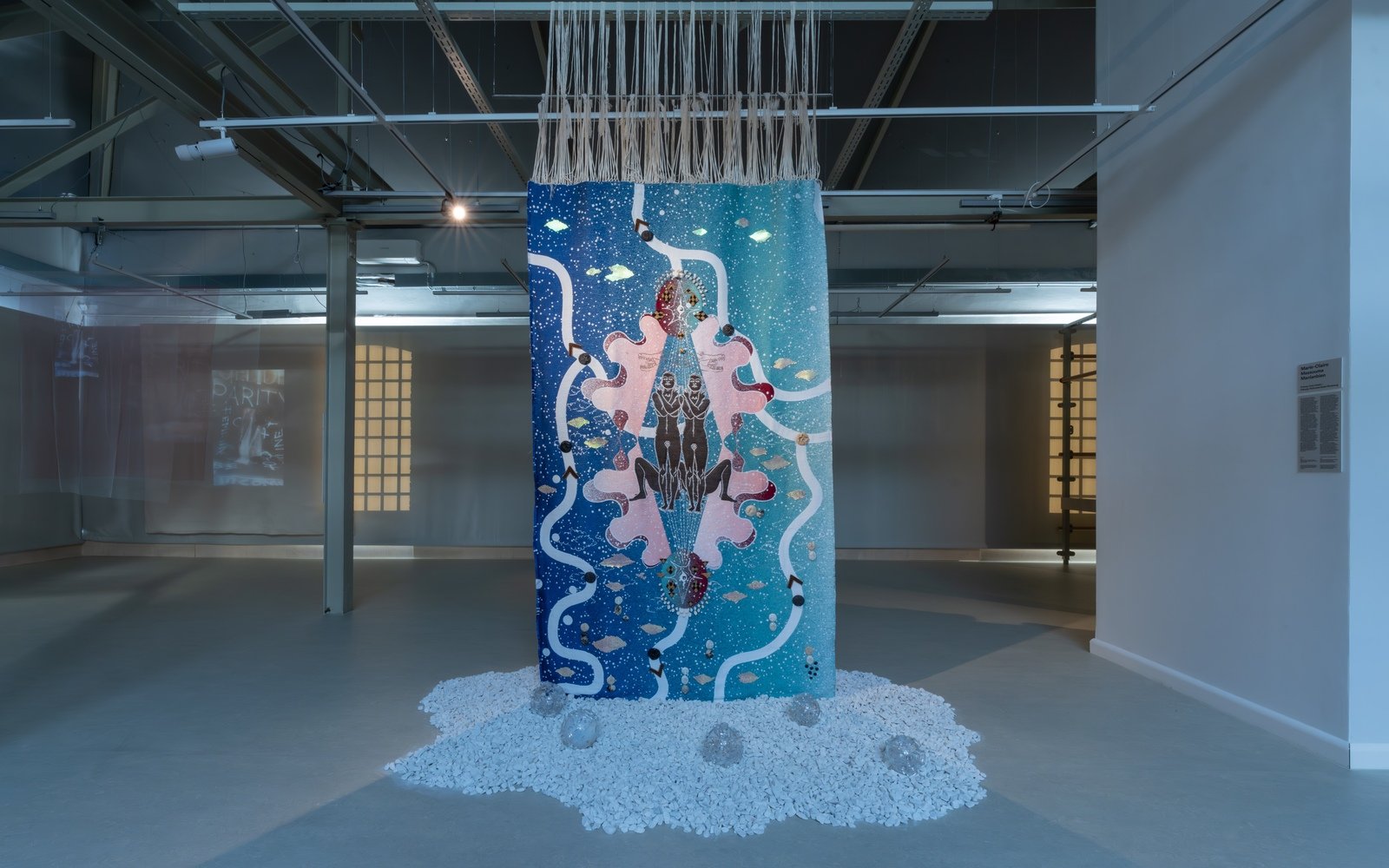
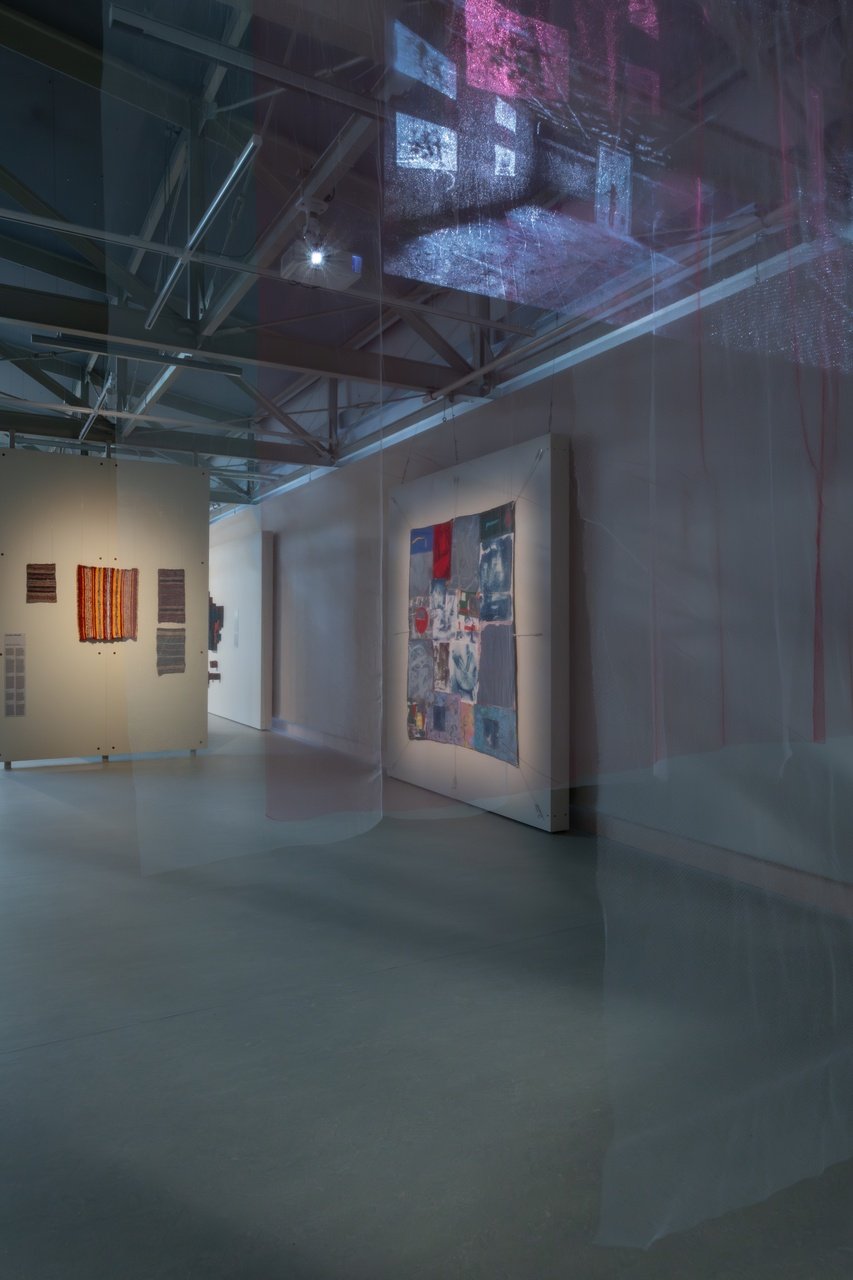
Some works felt like they were clashing, especially the work of Marie-Claire Messouma Manlabien, working between the Ivory Coast and France, and Georgian artist Gvantsa Jishkariani, whose work hung suspended between the floors. Jishkariani’s work – a series of embroidered tapestries called Brutal Honesty – is somehow brutal: ripped vintage materials, threads hanging loose, colors similar to blood, mud, and cold steel. It was also far away from the viewer in space; you could read phrases like “generational trauma” or “history of shame” but you could not touch them. Manlabien’s Take Care, on the other hand, sits at your fingertips. A large-scale object combining fabric with pebbles, glass, and subtle sound, glowed in soft lilac, pink, and pale blue tones. Its presence was calm, luminous, and meditative, a perfect example of the artist’s approach: modular, responsive, and attentive to the rhythms of space. In contrast to Jishkariani’s taut, politically charged tapestries, Take Care offered a spatial and emotional counterpoint: poetic, gentle, and luminous, yet still a part of the same constellation of feminine experience, encompassing the soft and the brutal, the light and the dark, the beautiful and the painful. It is mesmerising with all its stories, possibilities, and complexity, of what the feminine (or spiritual human) experience embodies in our physical world, with all its glitter and blood and unexpected affairs. We are involved in stories and collective relationships that we may not yet be aware of – and telling a story through objects enables us to rework history, trauma, and to reconstruct the world as we want it.5
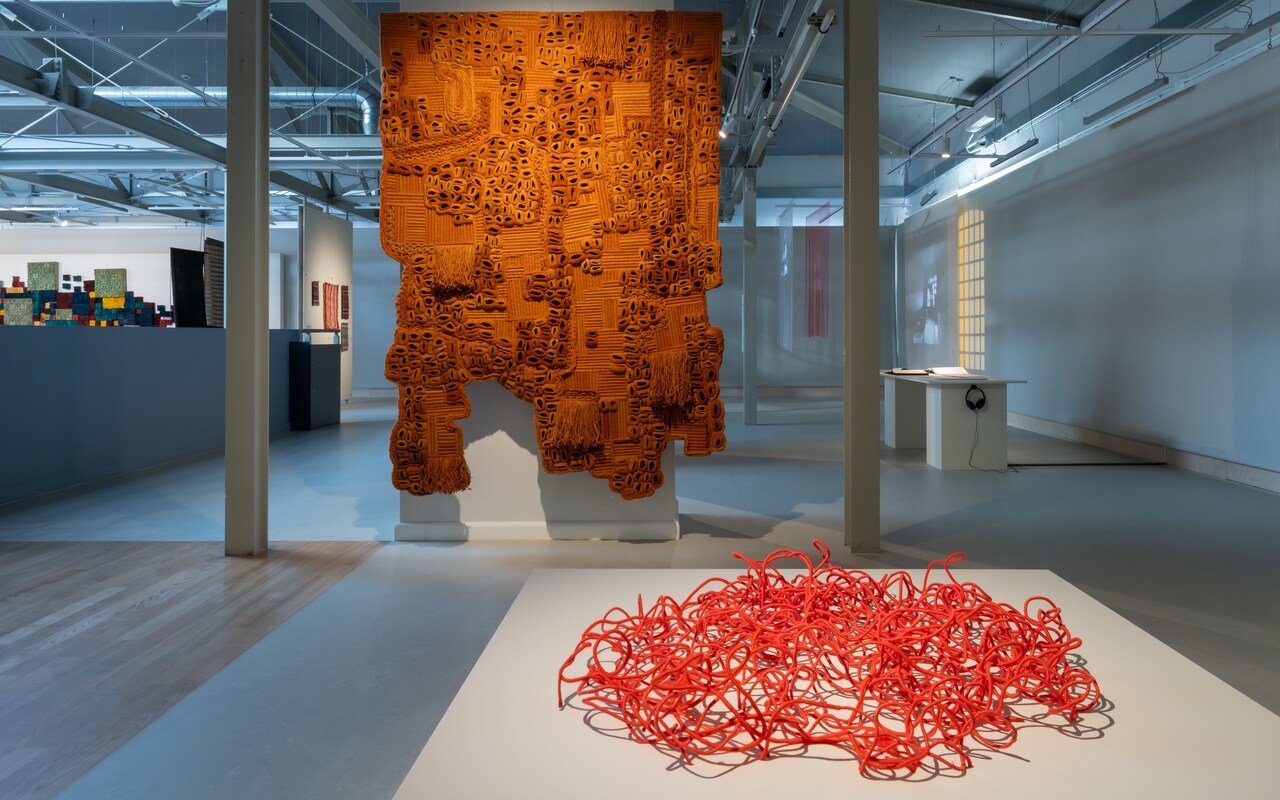
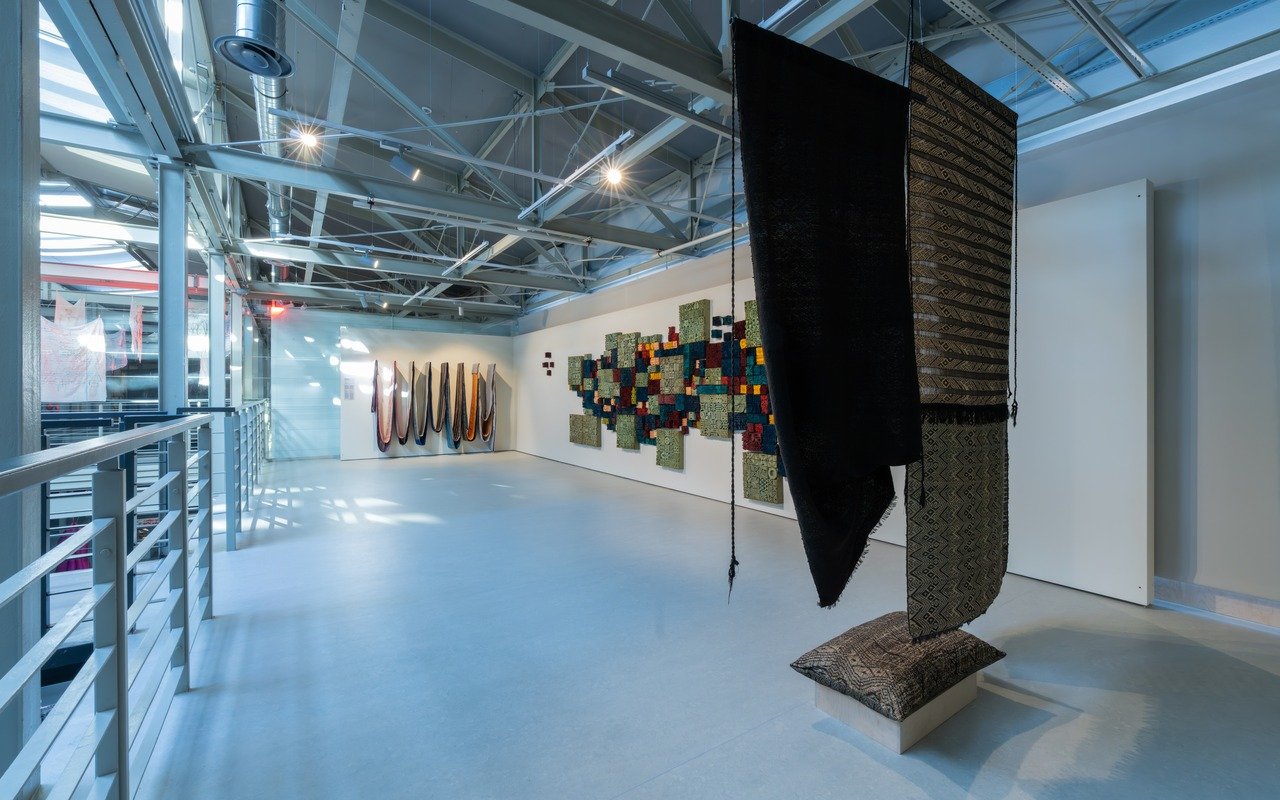
The last work I want to mention is Talisman of Henna by Amina Agueznay. Deliberately placed close to the curator’s introduction, as it seems to directly refer to the “way of knowing” part of the exhibition’s title. “Challenging industrial erasure and patriarchal historiography, Amina Agueznay asserts textile as both medium and method: a living negotiation of heritage, agency, and collective imagination.”6 What I read in the practice of Agueznay is that it’s rooted in an ongoing exchange with artisans; she is truly loyal to traditional craft practices. In this work, virgin wool is soaked in henna, giving the fiber a warm, earthy hue while physically binding it with the plant’s natural properties. Across this textured surface, Agueznay embeds talismanic symbols, creating a layered, tactile landscape that enfolds the body and transforms the textile into a both protective and resilient object. By weaving together architectural echoes, archaeological traces, and the intimate labour of the hand, Agueznay created a piece that honours the fragile yet enduring lineage of craft. Her artwork becomes a vessel for knowledge passed from maker to maker, kept alive through textile, gesture, and material memory. It is very raw, and in my view, close to a folk healer’s – i.e. the szeptucha7 – practical ritual: powerful, simple, yet heavy in meaning. Almost impossible not to touch its coarse surface (I couldn’t help myself!), hiding some talismanic vocabulary within it.
Leaving the space of Rhizomatic Portals: Ways of Knowing, I felt both hungry and full. Hungry to learn more of the stories hidden behind each artwork, full of the encounters and surprises that unfolded before me, as the best gifts always do, unexpectedly.
1 Rhizomatic Portals: Ways of Knowing by Bukola Oyebode-Westerhuis. (2025, Łódź ). Retrieved March 27, 2026, from https://cmwl.pl/public/informacje/portale-rizomatyczne-drogi-poznania,450
2 The Power Of The Archive And Its Limits: Kelani Abass and Bonaventure Soh Bejeng Ndikung Moderated by Emmanuel Iduma. (2021, November 21). [Video]. ARTXLAGOS. Retrieved March 25, 2026, from https://www.artxlagos.com/art-x-talks/the-power-of-the-archive-and-its-limits
3 This brings into this text the good spirit of Ursula K. Le Guin, who mentioned females (and other non-male genders) as those who have the most unheard voices in the white imperial European setting. For reference, see the conversation of Le Guin with Zoë Carpenter, fragments are available at The Nation YouTube channel [access November 2025].
4 I add this for the white readers who, like me, might be unaware of that. When I first encountered Ajah Schommers works in 2019, it took me quite a while to fully understand what I was looking at and why she used synthetic hair. The history and cultural meaning of Black hair and hair styling are broad and sensitive topics that, again, need to be treated with care and attention. In this context, the presence of synthetic hair becomes a way of speaking about heritage, resilience, and the politics of how Black bodies are seen.
5 I had this written on a note which I later found in my pocket after Ibrahim Mahama’s seminar.
6 From the wall text about the artwork
7 szeptucha can be translated as “whisperer” or “one who whispers,” and is a term used to describe traditional Polish healers. Due to the peculiar healing rituals the whisperers perform, they are sometimes compared to shamen or witches. Definition from: Meet The Whisperers: The Christian Folk Healers of Eastern Poland by Marek Kępa, culture.pl [access: November 2025]
Artists: Amina Agueznay, Peju Layiwola, Aissa Dione, Marie-Claire Messouma Manlanbien, Ngozi Ajah Schommers, Adeola Olagunju, Sondos Shuaib, weavers from Ghana’s Upper West region, Madame Zo (Zoarinivo Razakaratrimo)
Exhibition Title: Rhizomatic Portals: Ways of Knowing (a collateral exhibition of the 18th International Triennial of Textile)
Curated by: Bukola Oyebode-Westerhuis
Venue: Central Museum of Textiles in Łódź
Place (Country/Location): Łódź, Poland
Dates: 11.10.2025 – 12.04.2026
Photos: HaWa